Schedule a call!
The honesty test candidate experience is one of the most consequential and least managed touchpoints in the pre-employment process. When candidates feel blindsided by an integrity assessment — uncertain about its purpose, unclear about their rights, or concerned about fairness — the result is disengagement, application abandonment, and negative employer brand impact that extends well beyond the individual hiring cycle.
When the honesty test candidate experience is handled with transparency and structure, the outcome is the opposite: higher completion rates, more authentic responses, stronger predictive validity, and a candidate population that views the organization as a fair and trustworthy employer. This guide covers exactly how to design that experience — from communicating the assessment purpose to addressing concerns and navigating real workplace scenarios that integrity testing is designed to screen for.
What Is a Pre-Employment Honesty Test?
A pre-employment honesty test is a structured assessment that evaluates a candidate’s trustworthiness, reliability, and likelihood of counterproductive work behavior. The US Office of Personnel Management (OPM) formally recognizes these tools as valid instruments that predict theft, absenteeism, and overall job performance.
Honesty tests are not polygraphs, gotcha tools, or entrapment mechanisms. They are validated, legally defensible screening instruments designed to identify the behavioral risk factors — attitudes toward accountability, ethical decision-making, rule-following — that predict whether a candidate will be a reliable, trustworthy member of a team.
A meta-analysis of 104 integrity test studies confirms corrected validity coefficients of .32 for counterproductive work behavior and .18 for job performance. When candidates understand that the assessment is a research-validated tool rather than a subjective judgment exercise, anxiety decreases and response quality improves.
Honesty tests work best when layered with structured interviews and reference checks. Read about why reference checks alone are insufficient for identifying high-risk candidates.
Why the Honesty Test Candidate Experience Matters
The honesty test candidate experience has a direct impact on both screening quality and organizational reputation. Research on integrity test validity and candidate reactions confirms that candidate perceptions of fairness and transparency significantly affect response authenticity — and therefore the predictive accuracy of the results.
Candidates who feel the process is opaque or unfair are more likely to disengage mid-assessment, respond defensively rather than authentically, or withdraw from the process entirely. Each of these outcomes reduces screening quality and increases the likelihood of a mis-hire.
Beyond individual hiring decisions, a poorly designed honesty test candidate experience affects employer brand. Candidates who have a negative assessment experience share it — in reviews on employer rating sites, in conversations with peers in the same industry, and in direct feedback to the organization.
Conversely, organizations that deploy integrity assessments as part of a transparent, professionally communicated hiring process report stronger candidate buy-in and lower application abandonment rates. Research also links employee disengagement to increased workers’ compensation costs — making candidate experience a business outcome, not just an HR metric.

What Candidates Experience During a Honesty Test
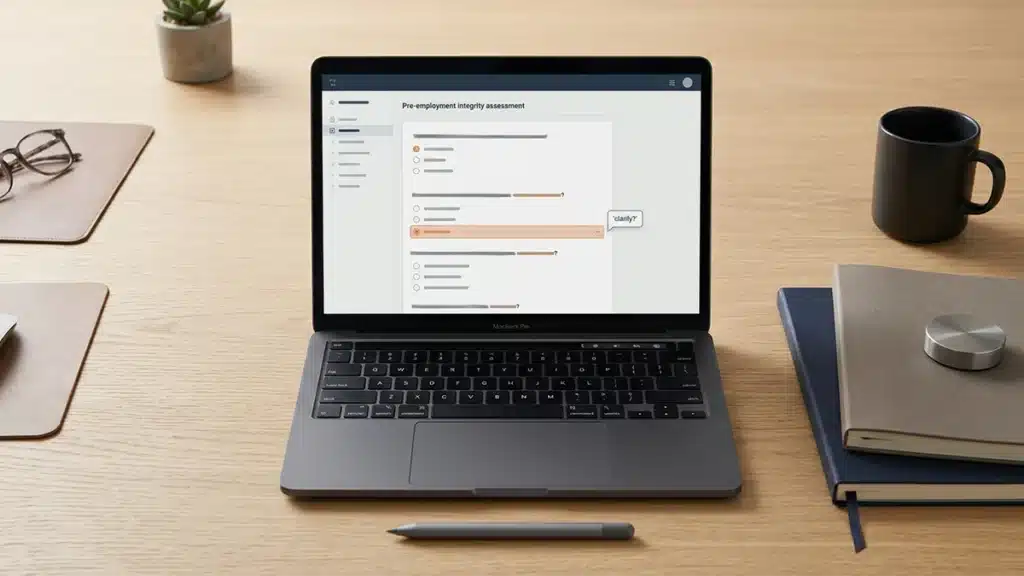
The honesty test candidate experience varies significantly depending on the format. Understanding what each format looks and feels like from the candidate’s perspective is essential for designing effective communication and a process that produces authentic, usable results.
Overt Integrity Tests
Candidates completing an overt integrity test encounter direct questions about past behavior and attitudes toward workplace misconduct. Questions are explicit: whether they have ever taken company property without permission, whether they believe misusing sick days is ever acceptable, or how they would respond to witnessing a colleague falsifying records.
From the candidate’s perspective, this transparency is both clarifying and potentially anxiety-inducing. Candidates who have no dishonest behavior to conceal typically respond well to direct questions. Those who are aware of the scoring intent may attempt to present a more favorable profile than their actual behavior warrants — a known faking susceptibility that is higher in overt formats.
Personality-Based Integrity Tests
Candidates completing a personality-based integrity test encounter behavioral preference statements and indirect questions that assess conscientiousness, dependability, and ethical risk orientation. The intent is less transparent — candidates are not always aware that their responses are being evaluated for integrity-related patterns.
From the candidate’s perspective, personality-based tests often feel less confrontational than overt formats. The trade-off is transparency: some candidates feel uncertain about what is being measured and why, which can create a different kind of anxiety if the process is not clearly explained beforehand.
Situational Judgment Tests
Candidates completing a situational judgment test encounter realistic workplace scenarios and are asked to describe or select their most likely response. Questions mirror actual situations they might face on the job: discovering a billing error, observing a colleague breaking a rule, or navigating a conflict of interest.
This format tends to produce the strongest candidate acceptance because it feels job-relevant and fair. Candidates recognize that the questions reflect real workplace complexity rather than attempting to catch them in a violation. SJTs typically result in lower application drop-off and higher completion rates than overt formats.

Common Candidate Concerns and How to Address Them
Candidates approaching a pre-employment honesty test carry assumptions that HR teams can address proactively. Doing so improves completion rates, response quality, and the overall honesty test candidate experience.
Concern: Is this a polygraph?
This is the most common and most easily resolved concern. The Employee Polygraph Protection Act prohibits physiological monitoring in pre-employment screening. Written and digital honesty tests are fully compliant. Stating this explicitly in the pre-assessment communication — ‘This is a written questionnaire, not a polygraph or physiological monitoring instrument’ — eliminates the concern before it affects the candidate’s approach to the assessment.
Concern: Can I be flagged unfairly based on my background or history?
A legitimate concern that deserves a direct answer. Under EEOC employment testing guidance, assessment results are one input in a multi-dimensional evaluation. Explain that the assessment measures attitudes and behavioral patterns, not a candidate’s demographic background or personal history. Document the conversation in the compliance record.
Concern: Can I be coached to give the ‘right’ answers?
Overt honesty tests are more susceptible to coached responses than personality-based formats. Acknowledging this directly — and explaining that the assessment uses multiple measures and inconsistency detection — reduces candidate anxiety about being ‘trapped’ while also reducing the motivation to game the scoring. Authenticity produces more useful results for both the candidate and the organization.
Concern: What happens if I make a mistake or misread a question?
Reassure candidates that individual responses are evaluated in pattern, not in isolation. A single response that appears inconsistent does not automatically flag the overall assessment. If a candidate raises a concern about a specific question after completing the assessment, document the conversation and factor it into the result interpretation.
Real-World Scenarios: How Candidates Navigate Integrity Dilemmas
Honesty tests are designed to predict how candidates will behave in real workplace situations involving ethical decisions, conflicting incentives, and social pressure. These scenarios arise in every industry and role type. Helping candidates understand that the assessment reflects genuine workplace situations — not theoretical traps — improves engagement and response authenticity.
Scenario: Discovering a billing or inventory discrepancy
A candidate who encounters a discrepancy in their work — an overstated invoice, a missing inventory item, an accounting error — faces a genuine integrity decision: escalate immediately, investigate quietly, or ignore it. Pre-employment honesty tests that ask about reporting behavior in these situations are measuring exactly the behavior that drives workplace trust. Candidates who understand this context approach the question with clarity rather than defensiveness.
- Recommended policy: Document and report immediately through the official incident reporting process
- Sample script for HR: ‘Our assessment includes questions about reporting behavior because these decisions happen in every role. There are no trick questions — we’re looking for how you approach the situation, not a single correct answer.’
Scenario: Being accused of misconduct or theft
False accusations are a legitimate workplace reality. Candidates who have experienced this may approach honesty test questions about past misconduct with heightened anxiety. Explaining that the assessment measures attitudes and patterns rather than past accusations — and that a borderline result triggers a conversation, not an automatic disqualification — significantly reduces this anxiety.
- Recommended policy: Collect facts, document statements, and review all evidence before reaching any conclusion
- Sample script for HR: ‘If your results prompt a follow-up conversation, it means we want to understand your perspective better — not that a decision has been made.’
Scenario: Observing peer misconduct or low-level rule-breaking
Social pressure to overlook minor violations is one of the most consistent predictors of future counterproductive work behavior. Candidates who can describe how they have navigated these situations — reporting through appropriate channels, documenting what they observed, or consulting a supervisor — consistently score higher on integrity assessments and perform better in roles requiring independent ethical judgment.
- Recommended policy: Reinforce that reporting peer misconduct through official channels is supported and protected
- Sample script for HR: ‘We ask about these situations because they happen in every organization. We’re looking for how you’d use the resources available to you, not for a heroic response.’
How to Communicate Honesty Tests to Candidates Effectively
Effective candidate communication about honesty testing is both a legal requirement under EEOC guidance and a practical tool for improving response quality. Candidates who understand the process before they begin provide more authentic responses and are significantly less likely to abandon the assessment.
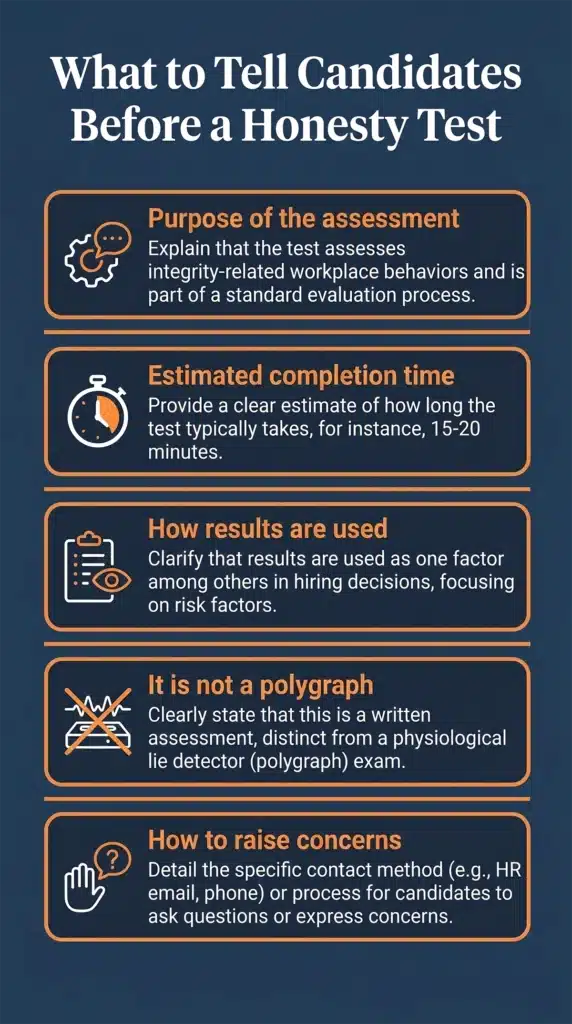
Every candidate should receive the following information in writing before the assessment begins:
- The purpose of the assessment and what it measures
- The estimated completion time and format (written questionnaire, not polygraph)
- How results will factor into the hiring decision alongside other evaluation inputs
- How to raise concerns or request accommodation
- How assessment data will be stored, who will have access, and for how long
Sample disclosure language: “As part of our hiring process, we use a validated written integrity assessment. This is not a polygraph test and is fully compliant with US employment law. Results are one factor in our evaluation and are held confidentially. If you have any questions before you begin, please ask your recruiter.”
Implementation Steps That Protect Candidate Experience
- Select a validated tool with documented validity and a clear technical manual. Candidates who sense that an assessment is poorly designed or arbitrary disengage faster than those using a professionally administered, research-backed instrument.
- Define role-specific criteria and communicate role-relevance to candidates before the assessment begins. Candidates are more accepting of assessments they perceive as directly relevant to the job.
- Integrate with your ATS and set consistent administration timing. Consistent administration reduces candidate confusion about when and why the assessment appears in the hiring process.
- Provide written pre-assessment disclosure to every candidate. Include the five elements listed above. Obtain written acknowledgment where required by state law.
- Train all recruiters and hiring managers on how to answer candidate questions about the assessment. Inconsistent or uncertain answers from HR erode candidate confidence in the process.
- Document all hiring decisions and candidate communications. A complete audit trail protects the organization during any candidate-initiated challenge.
- Collect candidate feedback on the assessment experience and review it annually. Feedback loops are one of the most reliable ways to identify and correct candidate experience problems before they affect employer brand at scale.
Frequently Asked Questions
What is the honesty test candidate experience like?
The honesty test candidate experience varies by format. Overt tests involve direct questions about past behavior and attitudes toward workplace misconduct — they feel transparent but can produce anxiety in candidates who are aware of the scoring intent. Personality-based tests feel less confrontational but can create uncertainty about what is being measured. Situational judgment tests feel most job-relevant and typically produce the highest completion rates and most authentic responses.
Can candidates refuse to take a pre-employment honesty test?
Yes. Candidates can decline any pre-employment assessment. However, most organizations treat completion of required screening tools as a condition of continuing in the hiring process. Being transparent about this from the outset — and explaining the purpose and legal compliance of the assessment — significantly reduces refusal rates and the negative employer brand impact that follows.
How do candidates feel about honesty tests?
Research indicates that candidates who receive clear, advance communication about the assessment’s purpose and process rate the experience more favorably than those who encounter it without context. Acceptance is highest for situational judgment tests, which candidates perceive as job-relevant and fair. Overt tests generate more resistance when candidates feel the questions are invasive without adequate explanation.
What should candidates do if they feel a question was unfair or invasive?
Candidates should raise the concern with the recruiter before or after completing the assessment. HR teams should document the concern, review the question for potential bias, and factor the candidate’s explanation into the result interpretation. Under EEOC guidance, candidates have the right to understand how their results were used in the hiring decision and to raise concerns about the process.
Does a good honesty test candidate experience affect hiring quality?
Yes, directly. Candidates who feel the process is transparent and fair provide more authentic responses, which increases predictive validity. Application drop-off rates decrease when candidates understand the purpose of the assessment before they begin. And a well-managed honesty test candidate experience contributes to employer brand — candidates share their hiring experiences, both positive and negative.
Design a Better Honesty Test Candidate Experience with IntegrityFirst Tests
IntegrityFirst Tests provides validated, US-compliant honesty assessments designed to deliver strong predictive results while maintaining the candidate experience that protects your employer brand and your legal standing. Schedule a free demo with IntegrityFirst Tests and build a screening process candidates trust.