Schedule a call!
Trust is the quiet asset an operation runs on, and it is the first thing to crack when a few hires cut corners, falsify a log, or pocket what is not theirs. That is the real reason honesty tests for hiring and workplace trust come up in staffing conversations: not to “catch liars,” but to hire people whose everyday choices match the accountability your culture depends on.
Used that way, an integrity test reinforces a culture people believe in. Used as a moral court or a last-minute veto, it does the opposite, and candidates and managers feel it. This guide is about staying on the right side of that line: what these tests actually measure, the traps that quietly erode trust, and a rollout that strengthens accountability instead of suspicion.
How Honesty Tests for Hiring and Workplace Trust Shape Culture
An honesty test does not build trust by catching dishonest people. It builds trust by helping you hire for the behaviors a healthy culture needs: consistent rule-following and ownership when something goes wrong.
Picture a 24/7 warehouse where no one can watch every pick lane. A well-chosen integrity measure tilts your hires toward people who scan correctly and report damage on their own, which is what keeps a safety routine like lockout-tagout from becoming optional.
The erosion happens when the tool is positioned badly. Treat a score as a verdict on someone’s character, or spring it as a surprise rejection after a manager has already chosen a candidate, and you signal distrust by default. Real trust also depends on psychological safety, people feeling free to flag a hazard without punishment, so the test should set expectations and support accountability, not stand in for judgment.
Where They Add Signal, and Where They Don’t
The evidence is more specific than most vendor decks admit, and you should hold it to that standard. A 2023 meta-analysis of integrity testing and workplace deviance across 150 studies found that every type of integrity test significantly predicted deviance, with a corrected mean validity of about .43, and value-oriented measures landing even higher. The signal is real and it generalizes across settings.
It is also strongest in combination. The QIC-WD research summary on integrity tests notes that pairing an integrity test with a cognitive-ability measure produces the most powerful prediction of performance, and that integrity tests moderately predict involuntary turnover while only modestly predicting voluntary quits. In other words, lean on them for misconduct and reliability, not as your one fix for no-call/no-show.
A balanced view matters too. As Workable’s overview of the problems with employee integrity tests notes, candidates can attempt to fake answers, and a test used as the sole filter produces false positives. Treat the score as one signal that guides follow-up, not a stand-alone gate, and pair it with the rest of your process, as our breakdown of the honesty tests for employment facts and research explains.
So before you deploy, answer three questions:
- Which trust failures actually hurt this job family, inventory shrink, documentation integrity, safety violations, patient-privacy lapses?
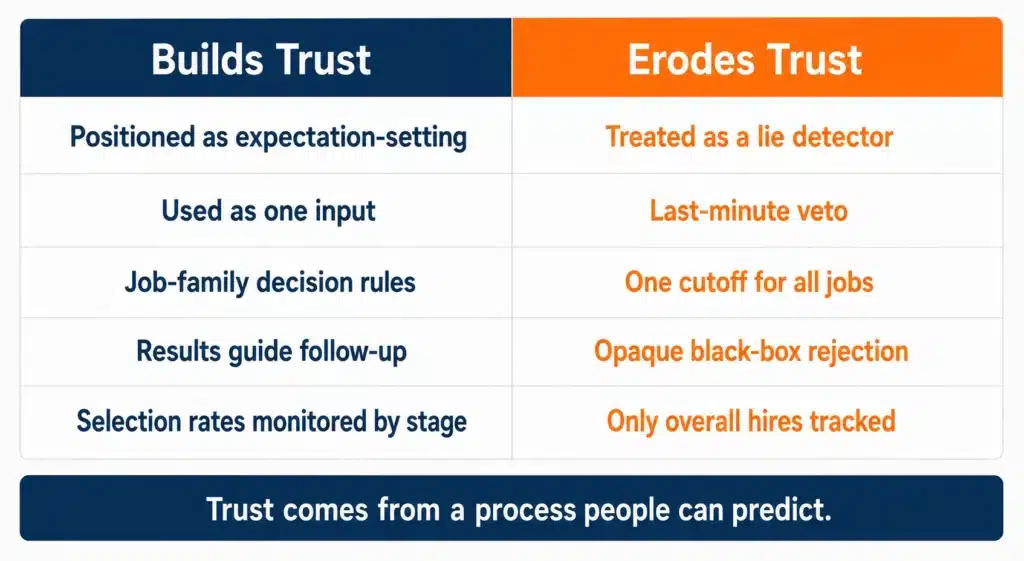
- Will managers use results as interview probes and onboarding emphasis, or as an opaque veto?
- Are you tracking selection rates at each stage by group, so you catch process-level adverse impact early?
Choosing the Right Type to Protect Trust
The format you pick shapes how the step feels to candidates, which is part of protecting trust. Match it to the kind of failure you are trying to prevent.
| Test type | What it surfaces | Best fit | How to use the result |
| Overt integrity test | Direct attitudes toward theft, rule-breaking, and accountability | Straightforward risk and an explicit expectations conversation (for example, retail cash handling) | To reinforce expectations and guide a structured follow-up, not as a moral court or a last-minute veto |
| Personality-based test | Trait-linked risk patterns such as conscientiousness, dependability, and impulse control | Risk that shows up over time in SOP-heavy settings (for example, food production) | As a complementary signal that targets interview probes and onboarding, not a standalone pass/fail |
When you compare vendors, look past the culture language and ask for the evidence. Can they map specific scales to your failure modes in plain terms? Can you use results as structured probes rather than a black-box veto?
And will they hand over technical documentation, reliability, validity, and subgroup reporting, that you can review internally? Overt and personality-based tests also produce different candidate reactions, which our comparison of overt vs. personality-based honesty tests walks through.
Four Honesty-Test Traps That Erode Trust

Most trust damage traces to a handful of avoidable patterns. Catch them before you scale:
- The late-stage veto. You run the assessment after a strong interview, then rescind on a low score with no structured review. Managers feel overruled and good candidates walk. Fix it by moving the step earlier, or by converting a low score into a required, documented follow-up with predefined criteria.
- The coached perfect profile. Candidates trade answer tips and your pool starts looking implausibly virtuous, which also flags thoughtful people as “less pure.” Require the vendor’s documentation on response-distortion controls, and treat a suspicious profile as a prompt to probe, not an automatic fail.
- The one-score rule across different jobs. Applying the same cutoff to forklift operators, cashiers, and medication techs feels fair but is not defensible, because the trust failures differ by role. Set job-family-specific decision rules tied to real exposures, agreed with operations before launch.
- The hidden adverse-impact stage. Tracking only overall hires hides that the assessment stage filters one group at a higher rate. Track selection rates by job and by stage, and treat any imbalance as an immediate problem to investigate.
Rolling It Out So It Builds Trust
A tool people can predict is a tool people trust. If managers know how results will be handled and candidates can see a consistent, job-related logic, the assessment reinforces accountability instead of feeling like surveillance. A construction crew is a good example: our network’s construction recruitment guide shows how safety-sensitive hiring leans on exactly this kind of consistency.
Keep the rollout legible and consistent across roles:
- Align on the risk first. With Operations and Safety, name two or three real failure modes (falsified pre-trip checklists, lockout-tagout shortcuts, incident non-reporting) and map the test scales and interview probes to them.
- Message it as an expectation-setter. Tell candidates at a high level what you measure (reliability, rule-following, accountability) and how results are used, so the step never lands as a surprise.
- Set decision rules that trigger review, not mystery. Define job-family thresholds and what a low score requires next, such as a documented structured follow-up rather than an unappealable veto.
- Assign oversight and limit overrides. Name who interprets reports, who approves exceptions, and what documentation is required.
- Monitor the process, not just hires. Track selection rates by stage and investigate four-fifths flags early.
For how the step lands with candidates, see our guide to the honesty test candidate experience, and for the retention payoff of a trusted process, how honesty tests reduce employee turnover.
Keeping It Defensible
To keep honesty tests for hiring and workplace trust defensible, run the assessment like any other selection procedure. In the US, the Employee Polygraph Protection Act restricts lie-detector devices, but federal definitions exclude written and online honesty tests, so integrity assessments fall under a different regime, one that still demands a job-related rationale and a consistent process.
As the law firm Fisher Phillips lays out in its guidance on integrity tests, the burden sits with the employer to show a selection tool is job-related, consistent with business necessity, and the least discriminatory alternative available. A few states add their own limits: the QIC-WD summary notes, for example, that Massachusetts and Rhode Island restrict certain overt integrity tests, so confirm local rules before you roll out.
The practical guardrails are simple: document why the test maps to the job’s trust failures, keep the vendor’s validity evidence on file, and monitor adverse impact by stage using the four-fifths rule. Our guide to honesty test legal compliance in hiring covers the full framework, and our deeper look at honesty and integrity in hiring and assessing trust connects it back to culture.
Start With One High-Trust Role
You do not have to overhaul hiring to make this work. Pick the single role where a lapse costs you most, name the two or three failures you are screening for, and run the test as one documented input with a clear, structured follow-up for low scores.
Then watch the numbers for a quarter: selection rates by group, alongside the incidents, write-ups, or shrink you set out to reduce. If the signal holds and the process feels fair to managers and candidates alike, expand to the next role and repeat.
When you are ready to build that kind of measured rollout on a validated assessment with decision rules that hold up, talk to IntegrityFirst Tests about where to start.