Schedule a call!
A bad hire almost never shows up in the interview. It shows up weeks later, as a till that comes up short, a safety step skipped, or a no-show that leaves a shift scrambling. By then the cost is already yours, and you are managing a problem you could have seen coming. Pre employment integrity testing is how employers catch that risk earlier, measuring a candidate’s honesty, reliability, and attitude toward rules before the offer goes out.
IntegrityFirst was built to do exactly that, quickly and without disrupting how you already hire. The sections below walk through what it measures, how it scores, what employers get out of it, and how to try it.
Key Benefits: Reduce Turnover, Prevent Theft, and Hire With Confidence
Integrity testing works because it predicts the behaviors that quietly drain a workforce, the ones a resume never mentions. The US Office of Personnel Management recognizes integrity tests as valid predictors of theft, absenteeism, and job performance, and the SHRM Foundation’s Selection Assessment Methods reports that pairing one with a cognitive measure reaches a composite validity near .65, about as strong as hiring signals get.
For an employer, that shows up in three places you already feel:
- Turnover drops. Screening toward dependable, accountable people cuts the early-tenure churn that keeps you rehiring for the same seat. In IntegrityFirst’s benchmarking, field construction operations saw voluntary turnover fall by 26 percent.
- Theft and loss shrink. A validated screen filters out the small share of applicants most likely to steal or cut corners. One national retailer using IntegrityFirst recorded a 57 percent drop in employee theft in a single year.
- Decisions get consistent. Every candidate meets the same job-related standard, so a strong hire looks the same in one store or site as in another, and managers stop leaning on a gut read that changes from one interviewer to the next.
How Pre Employment Integrity Testing Works: Delivery, Scoring, and ATS Integration
IntegrityFirst is an overt, or clear-purpose, assessment developed by industrial-organizational psychologists at Portland State University. “Overt” means it asks candidates directly rather than inferring traits sideways, and there is a good reason that works: people who routinely bend the rules tend to assume everyone else does too, so they answer honestly to blunt questions. That is why direct items like “Sometimes lying is necessary to get ahead” or “I don’t see the harm in taking small things from work” surface risk that a polished interview hides.
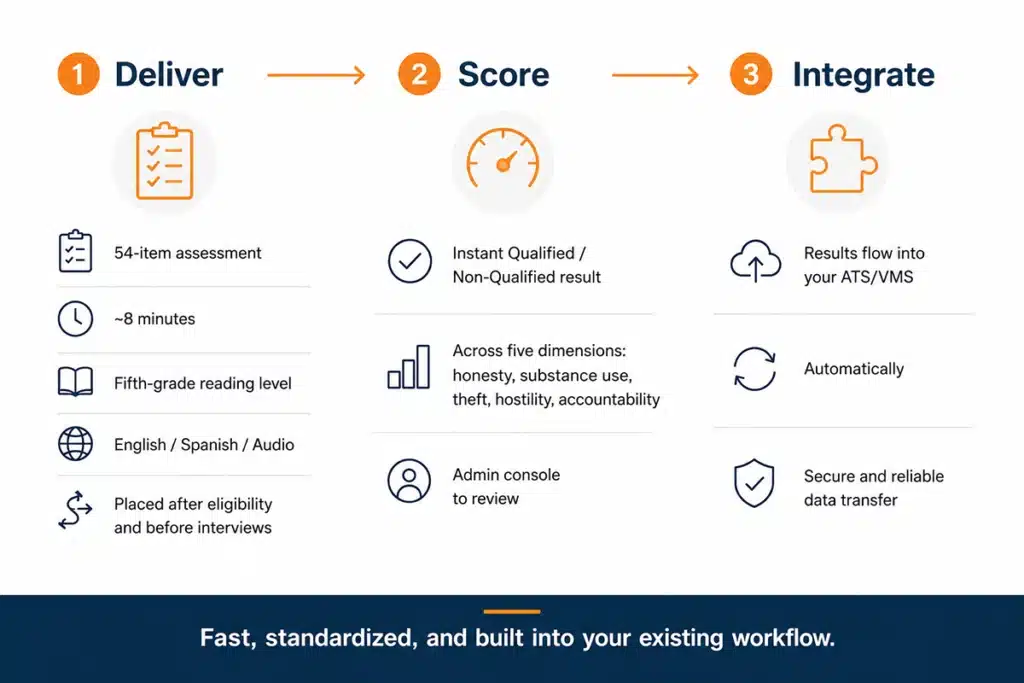
Delivery. The assessment is 54 short behavioral questions, finished in about eight minutes on any device. It reads at a fifth-grade level and comes in English and Spanish, with audio versions for candidates who have reading or vision barriers, so comprehension never gets in the way of the result. You place it early, right after basic eligibility checks and before anyone spends time on interviews. Across those items it reads five dimensions that drive real workplace cost: honesty, substance use, theft, hostility, and accountability, and validity scales flag candidates who try to game their answers.
Scoring. Results come back instantly as a clear Qualified or Non-Qualified recommendation, so a branch manager does not need a psychology degree to act on them. A candidate is flagged Non-Qualified for defined, job-relevant reasons, such as admitting current illegal drug use at work, admitting theft in the last two years, markedly hostile responses, or statistical evidence of faking. Authorized administrators can open a central console to review the breakdown behind any result and apply judgment, so the score informs the decision rather than replacing it.
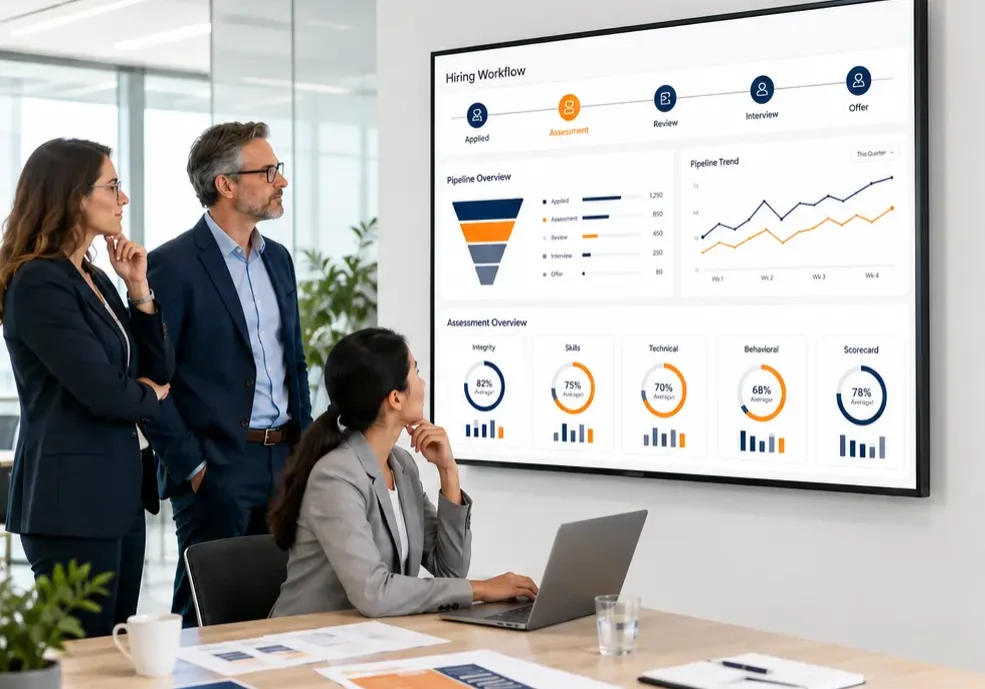
ATS integration. IntegrityFirst connects with common applicant-tracking, VMS, and staffing platforms. Invitations trigger automatically and results land in the candidate record your recruiters already use, with no separate login and no manual data entry. That is what lets pre employment integrity testing add signal to your funnel without adding work.
Results and Proof: What Employers See After Implementing IntegrityFirst
The case for pre employment integrity testing is not theoretical. IntegrityFirst’s results have been measured across more than 20 independent benchmarking studies covering a combined 552,237 employees in operational roles, and the pattern holds across very different work.
In janitorial and facilities operations, employers saw the total cost of workers’ compensation claims fall by 81.6 percent. In field construction, voluntary turnover dropped 26 percent. In healthcare, direct workers’ compensation claim costs came down 15 percent. In high-volume settings, the screen typically flags 20 to 25 percent of applicants as Non-Qualified before a manager ever spends time on them, most for behaviors they openly admit.
Those numbers land in budgets employers already watch, insurance premiums, staffing costs, shrink. The teams that get the most from the tool capture a baseline first, turnover, claims, shrink, then track the same measures by result afterward, which turns a good story into evidence a CFO will sign off on.

Objections and FAQ: Validity, Compliance, and Time-to-Hire
Is it actually valid, or is it guesswork?
It is well validated. IntegrityFirst is built on the science behind overt integrity testing, including the foundational meta-analysis by Ones, Viswesvaran, and Schmidt (1993) that pooled 665 validity coefficients, and OPM recognizes integrity tests as predictors of counterproductive behavior and performance. Validity rises further when the screen is paired with a cognitive measure.
Is pre employment integrity testing legal? Isn’t it a lie detector?
No. The Employee Polygraph Protection Act restricts polygraphs, but it explicitly excludes written and online integrity tests, which fall under normal selection-procedure rules. Used correctly, per the EEOC’s guidance on employment tests, the screen must be job-related and monitored for adverse impact, and well-validated integrity tests generally show small subgroup differences, which supports fair, defensible hiring.
Will it slow down our time-to-hire?
It tends to speed it up. At about eight minutes and placed early in the funnel, it clears weaker-fit candidates before anyone books an interview, so recruiters and managers spend their time on a stronger shortlist.
Do we have to build a new process around it?
No. It plugs into the ATS you already run, and results arrive instantly in the candidate record, so the step adds signal without adding admin work.
How fast can we launch, and how do we prove it worked?
Most teams go live quickly because it connects to their existing ATS. To prove impact, record your baseline metrics for the target roles first, then compare results over the next two to three quarters.
Book Your Free Demo and See the Assessment in Action
The fastest way to judge pre employment integrity testing is to watch it run on one of your own roles. IntegrityFirst will show you the candidate experience, the recruiter view, the Qualified/Non-Qualified result and admin console, and the ATS integration, and help you map the metrics you would track to prove it out. Book a free demo to see IntegrityFirst’s pre employment integrity testing platform in action.