Schedule a call!
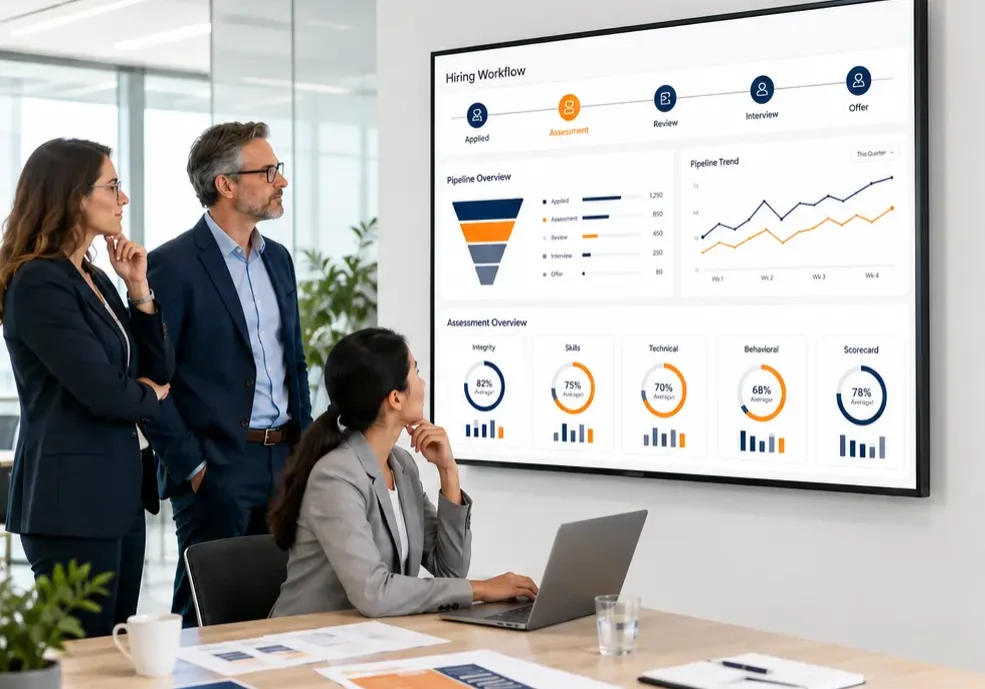
An integrity self assessment is one of the most misunderstood tools in an HR team’s screening kit, because the same phrase describes two very different things. For some vendors it means a self-report questionnaire used to predict whether a candidate is likely to steal, cut safety corners, or break rules. For others it means an internal governance checklist that leaders use to audit their own ethics program. Buying or deploying the wrong one is how teams end up with a compliance worksheet they expected to behave like a hiring test, or a selection instrument they never validated.
This guide is a complete reference for HR professionals evaluating integrity self assessments. It defines the categories you will see in the market, explains what the validity evidence does and does not support, shows where these instruments fit across hiring, performance reviews, and culture audits, and outlines how to use them in a way that holds up to legal scrutiny. Each section links to a more detailed guide so you can move from the overview into the specifics you need.
For the full picture, see our complete guide to integrity self assessment, which explains what it is, the main formats, and how to use it across hiring, performance reviews, and culture audits.
What Is an Integrity Self Assessment?
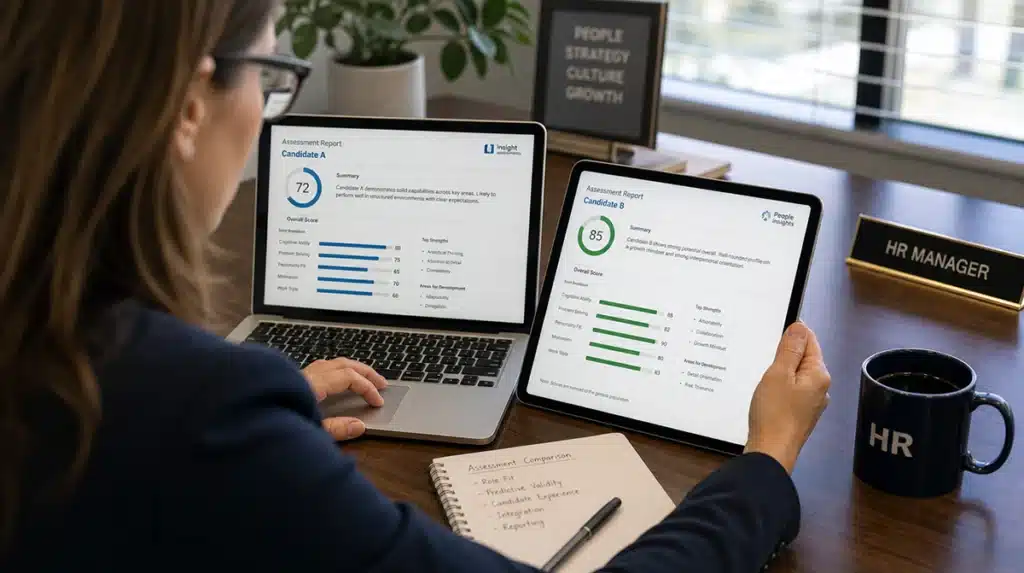
An integrity self assessment is a structured instrument in which a person reports on their own honesty, accountability, and ethical conduct, scored against defined criteria rather than read as free-form opinion. In a hiring context it sits alongside background checks and reference checks but measures something different. A background check confirms factual history. A reference check captures third-party impressions. An integrity self assessment estimates how a person is likely to behave under pressure, temptation, or competing priorities. For a practical, HR-focused starting point on the concept and its uses, read our integrity self assessment for HR overview.
The behaviors these instruments target are not marginal. Federal survey data indicate that 9.5 percent of full-time US workers aged 18 to 64 were dependent on or abused alcohol or illicit drugs in a single year, a base rate of workplace risk that resumes and interviews do not surface. An integrity measure is one of the few screening signals designed to estimate that risk before a hire.
The Two Meanings You Need to Separate First
Before evaluating any product, decide which of two tools you are actually looking at. The distinction determines how you validate it, how you defend it, and what outcomes you can reasonably expect.
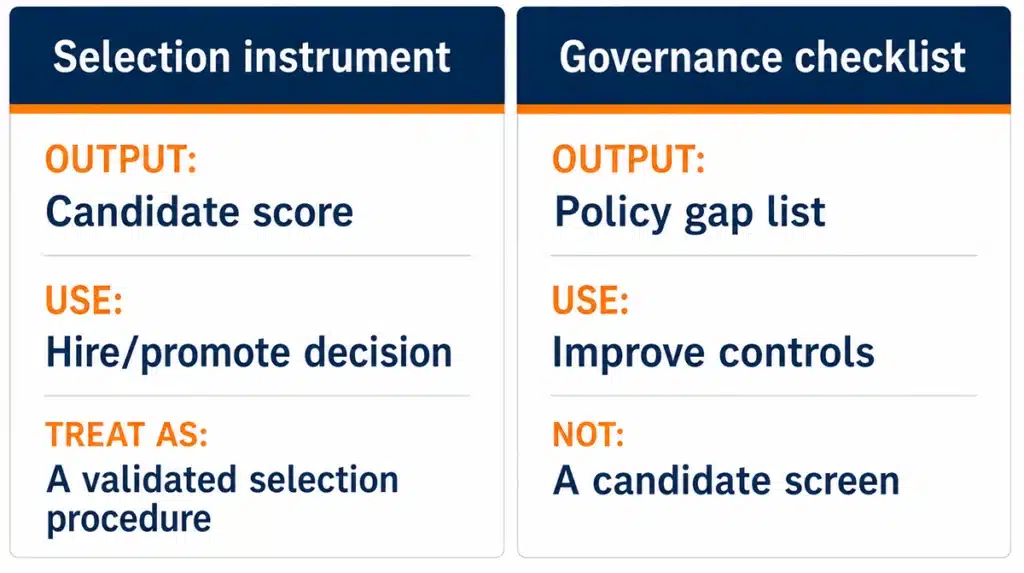
The first meaning is a hiring instrument: a self-report integrity test given to applicants or employees and designed to predict counterproductive behavior. Its output is a candidate score that informs a hiring or promotion decision, which means it must be treated as a selection procedure with documentation and adverse-impact monitoring.
The second meaning is an organizational integrity checklist used for compliance, governance, or culture work. Here leaders rate the maturity of reporting channels, training, and enforcement. Its output is a gap list used to improve policies and controls, not to rank-order applicants. A fast way to classify what you are holding: if the result is a score used to screen people in or out, you are in selection-procedure territory; if it is a list of policy gaps, you are doing governance. This guide focuses on the first meaning, the hiring and HR-screening use, while keeping the governance use clearly labeled so the two never get confused in procurement.
The Main Types of Integrity Self Assessment
Most evaluation mistakes happen because teams treat “integrity self assessment” as a single category and compare price and user experience instead of the measurement model. Three formats dominate, and our integrity self assessment examples show the question styles each one uses.
Overt, admissions-style tests ask applicants directly about attitudes toward rule-breaking and past conduct such as theft or on-the-job substance use. They are intuitive for high-volume employers because the items map cleanly to outcomes like time theft. The tradeoff is transparency. As the U.S. Office of Personnel Management notes, the purpose of an overt test is obvious to the applicant, applicant faking is always a concern, and scores should be interpreted with caution.
Personality-based tests infer risk from broader traits such as conscientiousness and dependability rather than asking about misconduct directly. Because the intent is less obvious, these formats tend to be more stable when candidates are coached, and they travel better across job families where misconduct looks different. A useful evaluation question is how the vendor maps the underlying trait to the behaviors you actually track.
Values and situational-judgment formats present scenarios where productivity, peer pressure, and policy collide, and they measure the judgment a person applies. This category often aligns well with culture and coaching signals. Whichever format you choose, the principle is the same: the moment a score is used to screen someone out, the instrument is a selection procedure and should be evaluated like one.
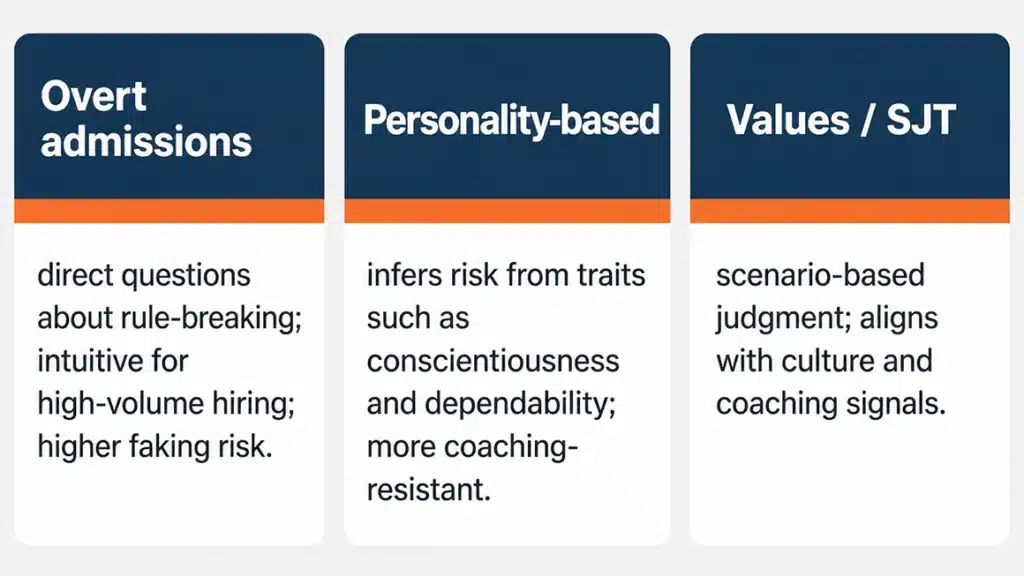
[INFOGRAPHIC 2 — file: integrity-self-assessment-types.jpg | alt: “Infographic of the three integrity self assessment types used in HR screening” | three stacked cards: Overt / Personality-based / Values-SJT]
What the Validity Evidence Actually Supports
Integrity self assessments are not opinion surveys. When used for selection they function as a counterproductive-work-behavior screen, and the research behind them is substantial. According to the U.S. Office of Personnel Management, integrity tests are valid predictors of overall job performance and of counterproductive behaviors such as absenteeism, illicit drug use, and theft, and they add meaningful predictive power when combined with a cognitive ability test. The same federal guidance notes that integrity tests show few, if any, average score differences between men and women or across racial and ethnic groups, which makes them useful alongside measures that carry higher adverse-impact risk.
What that evidence supports is a specific, modest claim: a well-chosen integrity self assessment improves your odds of avoiding counterproductive behavior. It does not support the marketing story that a questionnaire will eliminate theft or certify a person as ethical. Results also depend on test type and on how you define the outcome, so expectations have to match the job family. A distribution center that defines deviance as shrink and safety shortcuts will see a different payoff than a healthcare setting where the costly behaviors are documentation lapses. For HR leaders who need to translate this into cost-of-turnover and bad-hire math, our integrity self assessment ROI guide for HR works through the metrics.
Where Integrity Self Assessments Fit Across the Employee Lifecycle
A single framework serves HR at three distinct points, and knowing which stage you are in determines how the score should be used.
In hiring and screening. Used before a hire, an integrity self assessment helps identify candidates whose self-reported conduct aligns with role requirements and company values. It rarely stands alone; it works as one stage in a pipeline alongside structured interviews, references, and background checks. For how the instrument sits inside that end-to-end pipeline, read our guide to integrity assessment for employee screening.
In performance reviews. Used during employment, the same approach gives current employees a structured way to reflect on accountability, confidentiality, and decisions made under pressure over a review cycle. The value comes from specific, scorable examples rather than vague self-praise, which is why our integrity self assessment examples for performance reviews adapt the format to the review cycle for both managers and employees.
In culture and trust building. Used at the team level, aggregated self-assessment data benchmarks ethical maturity across departments and surfaces risk areas before they become compliance problems. It also gives HR managers a structured, repeatable way to build trust through honest reflection rather than top-down policing, an approach our guide to the employee self assessment for HR covers in detail.
[CONTENT IMAGE 3 — file: integrity-self-assessment-lifecycle-dashboard.jpg | alt: “Dashboard showing integrity self assessment across the HR employee lifecycle”]
Compliance and Fair Use in US Hiring
Because an integrity self assessment used for selection is a test under federal law, it carries compliance obligations. Any selection instrument must be job-related and consistent with business necessity, the standard the EEOC applies to employment tests, and it must be validated for the specific role and applied consistently across every applicant. If a test produces disparate impact on a protected group, the employer must be able to show that validation and consider less discriminatory alternatives.
These written instruments are also distinct from lie detector tests. The Employee Polygraph Protection Act bars most private employers from using polygraph examinations for pre-employment screening, which is one reason written, validated integrity assessments became the standard alternative. Keeping the two clearly separate protects you legally and sets accurate expectations with hiring managers.
How to Choose and Implement an Integrity Self Assessment
Treat the instrument as one layer in a system rather than a standalone gate. The strongest programs pair a validated integrity measure with structured interviewing and verified reference data, because each method offsets the weaknesses of the others. Federal guidance reinforces this layered approach, noting that integrity tests add the most predictive power when combined with a cognitive ability measure. Before you buy, define the counterproductive behaviors that matter in your environment, confirm the vendor can map the construct to those behaviors, and look at the hiring-decision and benefits angle in our guide to the integrity self assessment for hiring.
Once a tool is in place, measure it against your own outcomes rather than the vendor’s marketing. Run a pilot on a defined role, hold the instrument constant, and track the behaviors you actually care about (shrink, safety incidents, attendance, early turnover) for the cohorts that were screened against those that were not. Monitor selection rates as you go, because under the federal Uniform Guidelines, a selection rate for any group below four-fifths (80 percent) of the highest group’s rate is treated as evidence of adverse impact. That ratio is the threshold enforcement agencies watch and the number your documentation should track.
Set decision rules before you collect a single score. Decide in advance whether a result is informational, an interview guide, or a pass/fail cutoff, because cutoff use raises your defensibility burden. Interpret scores as risk indicators, not moral labels: a lower score signals a candidate who is statistically less suitable for a high-trust role, not a verdict on their character. Finally, build in inconsistency checks and document why one candidate advanced over another, so the program remains fair, explainable, and auditable.
Common Pitfalls When Deploying an Integrity Self Assessment
Most failed programs fail for predictable reasons, and each one is avoidable once HR knows to look for it.
The first is treating the instrument as a verdict rather than a signal. A single self-report score is one data point about likelihood, not proof of character, and using it as an automatic disqualifier invites both bad decisions and legal exposure. Pair it with other evidence and keep a human in the loop.
The second is ignoring faking and coaching, particularly with overt formats whose intent is obvious to applicants. Without inconsistency checks, response-time flags, or a corroborating measure, a polished applicant can produce a clean score that the rest of their record does not support. The same federal guidance that recognizes these tests also cautions that overt scores should be interpreted carefully for exactly this reason.
The third is skipping role-specific validation. A tool validated for one job family does not automatically transfer to another, and a vendor’s general brochure claim is not the same as evidence for your roles. If the score screens anyone out, the burden to show job-relatedness sits with the employer, not the vendor.
The fourth is misreading the cost case. Buyers often expect an integrity self assessment to “pay for itself” by eliminating theft, then judge it a failure when incidents still occur. The realistic return is a measurable reduction in counterproductive behavior and bad-hire cost over time, concentrated in high-trust and high-volume roles. Setting that expectation with hiring managers and finance up front keeps a working program from being abandoned over an unrealistic promise.
The fifth is inconsistent administration. Giving the assessment to some candidates and not others, or applying different cutoffs across groups, undermines both fairness and defensibility. Apply the same instrument, the same way, to everyone in a given role.
Where to Go Next
The guides linked throughout this page each cover one part of the picture in more depth, so follow the link that matches your immediate decision: the overview for the concept, the screening and hiring guides for selection, the examples for question formats and reviews, the employee self assessment guide for culture, and the ROI guide for the business case.
For the bigger picture of how integrity measurement works beyond self-reporting, see our complete guide to integrity assessments for HR.
Frequently Asked Questions
What is an integrity self assessment?
It is a structured instrument in which a candidate or employee reports on their own honesty, accountability, and ethical conduct, scored against defined criteria. HR teams use it to produce comparable, defensible evidence of trustworthiness that resumes and interviews do not reliably provide.
Is an integrity self assessment the same as a compliance checklist?
No. The phrase describes two tools. One is a self-report selection instrument that scores candidates; the other is an internal governance checklist that audits an organization’s ethics controls. Confirm which one you are evaluating before you compare products.
Do integrity self assessments actually predict behavior?
Federal guidance recognizes integrity tests as valid predictors of job performance and of counterproductive behaviors such as absenteeism, drug use, and theft, with stronger prediction when combined with a cognitive ability test. They improve the odds of a sound hire; they do not guarantee one or certify a person as ethical.
Are integrity self assessments legal to use in US hiring?
Yes, when used correctly. Written integrity assessments are not restricted the way polygraph tests are, but as employment tests they must be job-related and consistent with business necessity, validated for the role, and applied consistently across applicants.
Should an integrity self assessment be the only screen?
No. It works best as one layer alongside a validated structured integrity test, behavioral interviews, and reference and background checks, with clear decision rules set in advance.
Build a More Trustworthy Workforce
An integrity self assessment gives HR teams a standardized, evidence-based way to measure the trait conventional screening misses, across hiring, performance reviews, and culture work. IntegrityFirst Tests provides validated integrity assessment tools built for United States HR teams that want to reduce turnover, lower workers’ compensation exposure, and hire for values fit with confidence. Request a tailored demo to see how integrity measurement fits your hiring process.