Schedule a call!
An integrity self assessment for HR hiring addresses a problem conventional screening leaves open: judging candidate trustworthiness through resumes and interviews alone is not enough. Resumes confirm credentials. Interviews reveal communication skills. Neither reliably measures ethical alignment, accountability under pressure, or the likelihood of counterproductive behavior on the job. A structured integrity self assessment gives HR teams comparable evidence of how a candidate or employee reasons about honesty, responsibility, and the rules that govern their role.
This article is the foundational overview for the topic. It defines what an integrity self assessment is, explains the three points in the employee lifecycle where HR teams use it, and shows how it fits into a broader hiring and talent strategy.
For the full picture, see our complete guide to integrity self assessment, which explains what it is, the main formats, and how to use it across hiring, performance reviews, and culture audits.
What Is an Integrity Self Assessment for HR?
An integrity self assessment is a structured evaluation in which an individual reports on their own ethical conduct, accountability, and alignment with stated organizational values, using standardized prompts that produce comparable results across people and roles. In an HR setting it functions as a screening and development instrument rather than a personality quiz, because responses are interpreted against defined behavioral criteria instead of read as free-form opinion.
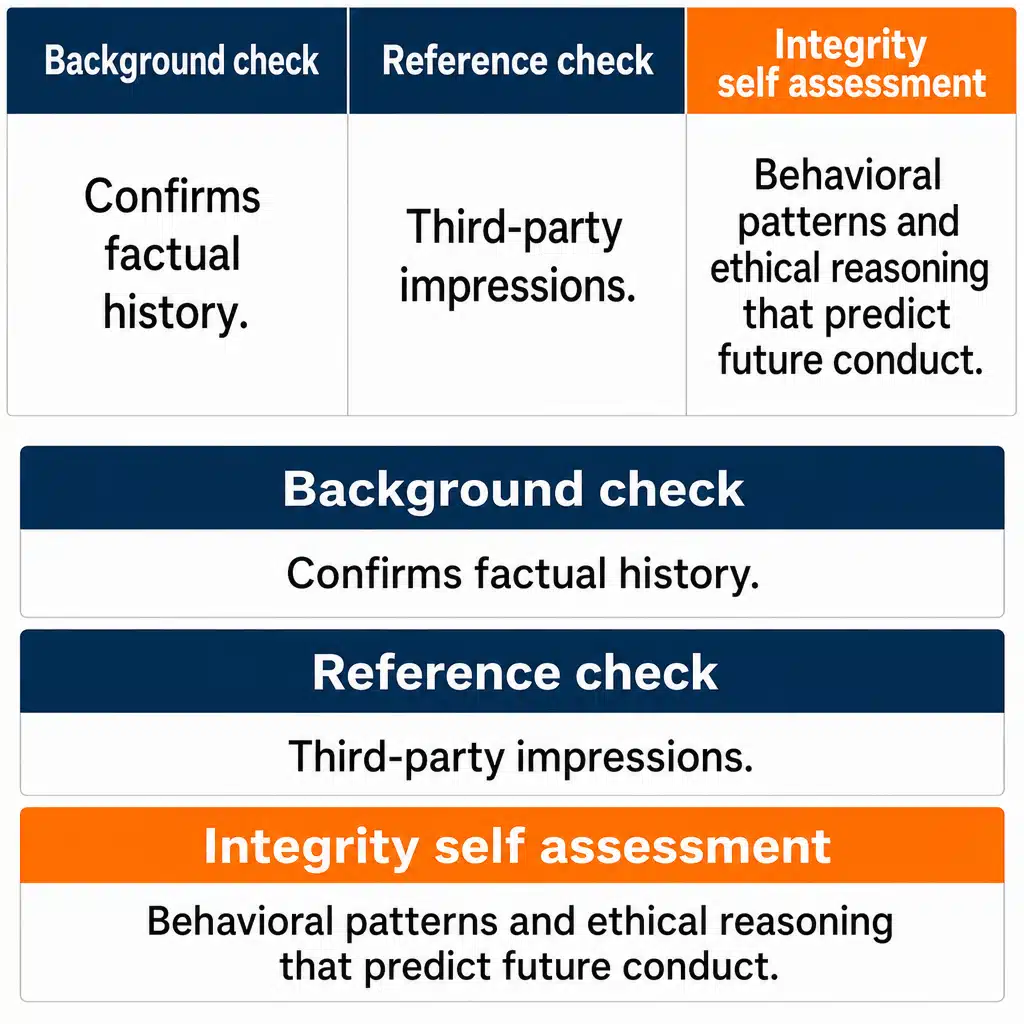
It differs from two tools HR teams already use. A background check confirms factual history (employment dates, criminal records, credentials). A reference check captures third-party impressions. An integrity self assessment instead surfaces behavioral patterns and ethical reasoning: how a person responds to pressure, temptation, or competing priorities. The point is not to catch dishonest people after the fact; it is to identify trustworthy ones before a hiring or promotion decision is made.
These are written, self-report instruments, which matters legally. They are distinct from polygraph examinations, which the Employee Polygraph Protection Act bars most private employers from using for pre-employment screening. Written integrity assessments remain a lawful, widely used alternative.
Two broad formats exist. Overt (clear-purpose) tests ask directly about attitudes toward dishonest behavior and a person’s own past conduct. Personality-based (disguised-purpose) measures infer integrity indirectly from traits such as conscientiousness and reliability. The two formats differ in transparency, candidate reaction, and coaching risk. Neither is a lie detector. Both estimate relative risk of counterproductive behavior, which HR then validates through other methods.
Why HR Teams Use Integrity Self Assessments in Hiring
HR teams adopt an integrity self assessment because it standardizes a judgment that interviews make inconsistently. On what these tools can predict, a federally cited research summary on integrity tests concludes that they are strong predictors of training performance, job performance, and counterproductive work behaviors, and that combining an integrity self assessment with a cognitive ability test provides one of the most powerful means of predicting future performance. The same summary reports they are only moderately predictive of involuntary turnover and modestly predictive of voluntary turnover — so HR should not position them as a retention fix.
A second reason is scale. High-volume and safety-sensitive environments (retail, logistics, healthcare, manufacturing, hospitality) cannot run a deep, individualized integrity interview for every applicant, yet these are exactly the settings where a single dishonest or unreliable hire carries the most cost. A standardized self assessment lets a small HR team apply the same ethical criteria across hundreds of candidates without sacrificing consistency. It also creates an audit trail — because each response is recorded and scored against fixed criteria, HR can document why one candidate advanced over another, which matters when a hiring decision is later questioned internally or by a regulator.
HR therefore uses an integrity self assessment primarily to reduce workforce risk by flagging a higher likelihood of counterproductive work behavior. The most defensible application treats the score as one input that prompts verification, not a standalone decision.
Where Integrity Self Assessments Fit in the HR Workflow
A single instrument serves HR at three distinct points in the employee lifecycle. Knowing which stage you are in determines how the results should be used.
Pre-employment screening
Used before a hire, an integrity self assessment helps identify candidates whose self-reported conduct and reasoning align with role requirements and company values. This is the highest-stakes application because the output feeds a selection decision that must be applied consistently across every applicant. It rarely stands alone; for how a self assessment fits inside the full pipeline alongside other tools, see the guide to integrity assessment for employee screening, and for the question sets and formats used at this stage, see integrity self assessment examples.
Performance reviews
Used during employment, the same framework gives current employees a structured way to reflect on ethical conduct over a review period, including accountability for errors, handling of confidential information, and decisions made under pressure. The STAR method (Situation, Task, Action, Result) is the most common format for turning these reflections into specific, scorable evidence rather than vague self-praise. See integrity self assessment examples using the STAR method for ready-to-adapt templates.
Organizational culture audits
Used at the team or organization level, aggregated integrity data benchmarks ethical maturity across departments and flags risk areas before they become compliance problems. The output is a map for HR: it shows which functions warrant closer oversight, additional training, or tighter process controls, and it gives leadership an evidence base for those decisions rather than anecdote.
The Limits of Self-Report
Because the instrument is self-report, it measures responses given under the incentive to be hired. Faking and coaching are realistic concerns, particularly for overt formats whose intent is transparent. A strong score reflects how someone chose to respond, not a guarantee of future conduct.
The standard safeguard is to use any result as a trigger for verification and to monitor outcomes by job family and location. Unusually uniform response profiles, or score patterns that differ across demographic groups, are signals to review the process rather than trust the number.
Three questions help align HR, Legal, and Operations before rollout:
- Risk signal — which specific behaviors the role needs to reduce (theft, falsification, safety shortcuts) rather than ‘integrity’ in the abstract
- Point in process — where a flag should trigger follow-up rather than automatic rejection
- Decision threshold — what other evidence must agree before a candidate is declined
If those questions cannot be answered in a single planning meeting, the tool does not yet fit the selection system.
How an Integrity Self Assessment Fits Your Broader HR Strategy
An integrity self assessment is most effective as one component of a layered strategy rather than a standalone gate. Self-reported data is strongest when paired with a validated structured integrity test and corroborated by behavioral interviewing and reference data. Each layer offsets a limitation of the others. For the broader selection framework this fits into, see the guide to integrity assessments for smarter hiring decisions.
Two considerations should shape implementation. The first is compliance: any selection instrument used in United States hiring must be job-related and consistent with business necessity — the standard the EEOC applies to employment tests — and it must be validated for the specific role and applied consistently across applicants. The second is alignment: an assessment adds value only when its criteria reflect the conduct the organization genuinely expects and rewards.

Compliance and Defensibility
Once an integrity self assessment informs employment decisions, it is a selection procedure under the federal Uniform Guidelines on Employee Selection Procedures, and the employer owns how it operates regardless of vendor validation claims. If a selection step produces adverse impact, the employer must be able to show that the procedure is job-related and valid for its intended use.
Adverse impact has a practical screen. Under the four-fifths rule in 29 CFR 1607.4, a selection rate for any race, sex, or ethnic group that is less than four-fifths (80%) of the rate for the group with the highest selection rate is generally regarded as evidence of adverse impact. The move that reduces risk is ongoing monitoring of selection rates by job family and location at the step where the assessment sits, not a one-time validation claim.
State law can add further limits. Some states place specific restrictions on pre-employment integrity or honesty testing, so HR should confirm requirements in each jurisdiction where it hires.

Building the Business Case
Quantifying the financial return of an integrity self assessment program (turnover reduction, lower shrinkage, fewer workers’ compensation claims) deserves its own treatment. The integrity self assessment ROI guide for HR walks through those metrics in full, including how to model cost-per-hire and bad-hire avoidance. For HR leaders building a foundational case, the logic is straightforward: a standardized, defensible screening signal that predicts counterproductive behavior reduces the cost of a bad hire at the point where it is cheapest to prevent.
Frequently Asked Questions
What is an integrity self assessment for HR?
A structured evaluation in which a candidate or employee reports on their own ethical conduct, accountability, and alignment with company values, scored against defined behavioral criteria. HR teams use it to produce comparable, defensible evidence of trustworthiness that resumes and interviews do not reliably provide.
How is an integrity self assessment different from a background check?
A background check verifies factual history (employment dates, criminal records). An integrity self assessment measures behavioral patterns and ethical reasoning, predicting future conduct rather than confirming the past.
When do HR teams use it in the hiring and employment process?
At three points: pre-employment screening to inform selection decisions, performance reviews to structure employee reflection on ethical conduct, and organizational culture audits to benchmark integrity across teams and surface risk areas.
Is an integrity self assessment legal to use in US hiring?
Yes, when applied correctly. Written integrity assessments are not restricted the way polygraph tests are. They must be job-related and consistent with business necessity, validated for the role, and applied consistently across all applicants.
Should an integrity self assessment be used as a standalone decision?
No. It works best as one layer alongside a validated structured integrity test, behavioral interviews, and reference and background checks. Each layer offsets the limitations of the others.
Put Integrity Measurement at the Center of Your Hiring IntegrityFirst Tests provides validated integrity assessment tools built for US HR teams that want to reduce turnover, lower workers’ compensation exposure, and hire for values fit with confidence. Request a tailored demo.