Schedule a call!
Every recruiter knows the sinking feeling: a candidate who looked perfect on paper joins the team, and within weeks you’re dealing with friction, compliance complaints, and an unexpected vacancy. That cycle costs organizations not just money, but momentum.
Adding a structured integrity assessment for employee screening to your hiring process is one of the most effective ways to break that cycle. When designed and implemented correctly, these assessments give HR teams data-driven insight into a candidate’s honesty, ethical reasoning, and behavioral tendencies — before they ever step through the door.
This guide walks you through what integrity assessments are, how they work, how to implement them step by step, and how to measure their impact. Whether you’re building a screening program from scratch or improving an existing one, you’ll find a practical framework here that holds up under real-world conditions.
What Is an Integrity Assessment — and Why Does It Matter in Hiring?

An integrity assessment is a structured diagnostic tool used in hiring and performance management to measure a person’s honesty, ethical reasoning, and behavioral tendencies in workplace situations. Unlike a basic background check — which tells you what happened in the past — an integrity assessment is designed to predict how someone is likely to behave in the future.
The format was originally developed by institutions like NATO for defense and public-sector accountability, and has since been adapted for commercial HR use across industries. Modern integrity questionnaires are more sophisticated than older “honesty tests” and typically include three core components:
- Overt items — direct questions about rule-following, promise-keeping, and attitudes toward theft or dishonesty.
- Covert personality items — indirect probes into underlying values, risk tolerance, and ethical decision-making style.
- Situational dilemmas — scenario-based questions that reveal how a candidate responds to real-world ethical pressure.
Organizations that embed these tools early in their screening workflows — not as a final gate, but as one signal among many — consistently report stronger cultural fit, lower early turnover, and fewer compliance incidents. Research cited by HR practitioners suggests turnover reductions of 20–25% in the first year for companies that use validated integrity screening on frontline roles.
For a deeper look at the pre-hire context, see our overview of the 6 key facts about pre-employment integrity assessment.
How Integrity Assessment Tools Work: Overt Items, Dilemmas, and Behavioral Interviews
Understanding the mechanics behind these tools helps HR professionals ask better questions when evaluating vendors and interpreting results.
Overt and Covert Questionnaire Items
A standard integrity questionnaire mixes two question types. Overt items are transparent: they ask directly about attitudes toward honesty, loyalty, and rule-following. “Would you return a found wallet if no one was watching?” is a classic example. Covert items are subtler, probing personality traits — conscientiousness, impulse control, risk-taking — that correlate with workplace integrity without ever mentioning the word.
Responses are scored for internal consistency. When a candidate’s answers contradict each other across similar questions, that pattern is often more informative than any single answer.
Situational Dilemmas
More advanced assessments present mini case studies: realistic workplace scenarios where there is no obviously “correct” answer. A candidate might be asked how they’d handle discovering a colleague misrepresenting results on a report, or what they’d do if a supervisor asked them to cut a corner on a safety checklist. Scoring focuses less on the answer chosen and more on the reasoning and consistency behind it.
Behavioral Interview Integration
The strongest screening programs layer behavioral interview questions on top of assessment data. Past behavior is the best predictor of future behavior, so structured questions like “Describe a time you had to push back on a decision you thought was ethically questionable” give hiring teams richer signal than questionnaire scores alone. The combination of self-reported data and interview response creates a more defensible, complete picture.
Step-by-Step: Implementing Integrity Screening in Your Hiring Process
Step 1 — Choose a Scientifically Validated Tool
Not all integrity assessment tools are equal. The most important criteria are scientific validation (look for peer-reviewed psychometric research), compliance readiness (the tool should be regularly audited for EEOC alignment — see the EEOC’s guidance on pre-employment testing), and integration capability with your existing applicant tracking system.
Use the EEOC guidance on pre-employment testing as a baseline compliance reference when evaluating tools. A non-discriminatory, transparent process is not just a legal requirement — it also signals fairness to candidates, which matters for employer brand.
A simple decision matrix can help clarify your options:
| Evaluation Criterion | What to Look For |
| Scientific Validation | Published psychometric studies; predictive validity data for your industry |
| Compliance / EEOC Coverage | Regularly updated; adverse impact monitoring included |
| ATS Integration | API or native integration with your current system |
| Report Clarity | Benchmarked scores; actionable candidate summaries |
| Candidate Experience | Mobile-friendly; clear instructions; reasonable completion time |
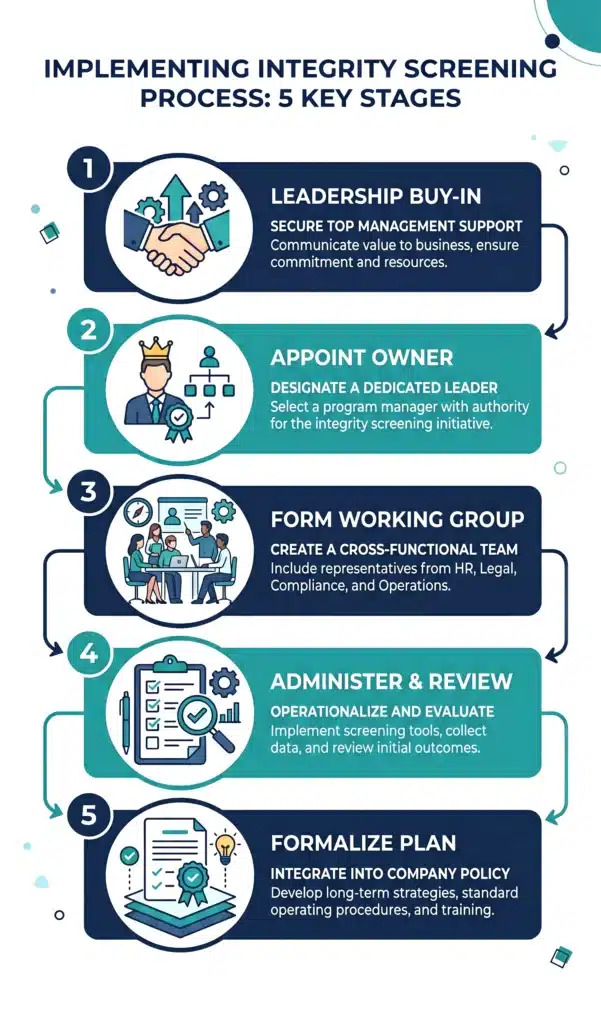
Step 2 — Secure Buy-In and Assign Ownership
Rolling out a new screening layer requires leadership alignment. Have your CHRO or VP of People formally introduce the integrity assessment initiative to hiring managers before the first candidate completes one. Assign a single point of accountability — typically a senior recruiter or HR operations lead — to own the rollout, manage compliance documentation, and coordinate with your legal team. For structured implementation guidance, SHRM publishes practical frameworks for introducing assessment tools into existing HR workflows.
Step 3 — Administer, Score, and Debrief as a Team
Run the assessment at the same stage for all candidates in a given role to ensure consistent comparison. Once results are in, bring the hiring team together to review them alongside resume data and interview notes. Avoid letting a single score drive a decision in isolation. The assessment is a lens, not a verdict.
For performance review contexts, integrity self-assessment language should be framed constructively:
- “I am actively working to improve X by doing Y.”
- “In the last quarter, I resolved [specific situation] by [specific action].”
- “I take ownership of [outcome] and my next step is [plan].”
This framing turns self-evaluation into a forward-looking accountability tool rather than a backward-looking judgment exercise.
Step 4 — Formalize the Process and Iterate
Document your integrity screening protocol: which roles require it, at what stage it’s administered, how results are weighted, and who has access to scores. Schedule a quarterly review for the first year to recalibrate scoring thresholds and catch any emerging bias patterns.
Organizations that run annual reassessments of their screening programs consistently report stronger controls and lower fraud incidents over time. For data on how this affects claims outcomes, see how integrity screening reduces workers’ comp claims.
How to Interpret Results, Spot Red Flags, and Measure ROI
Reading Green Lights
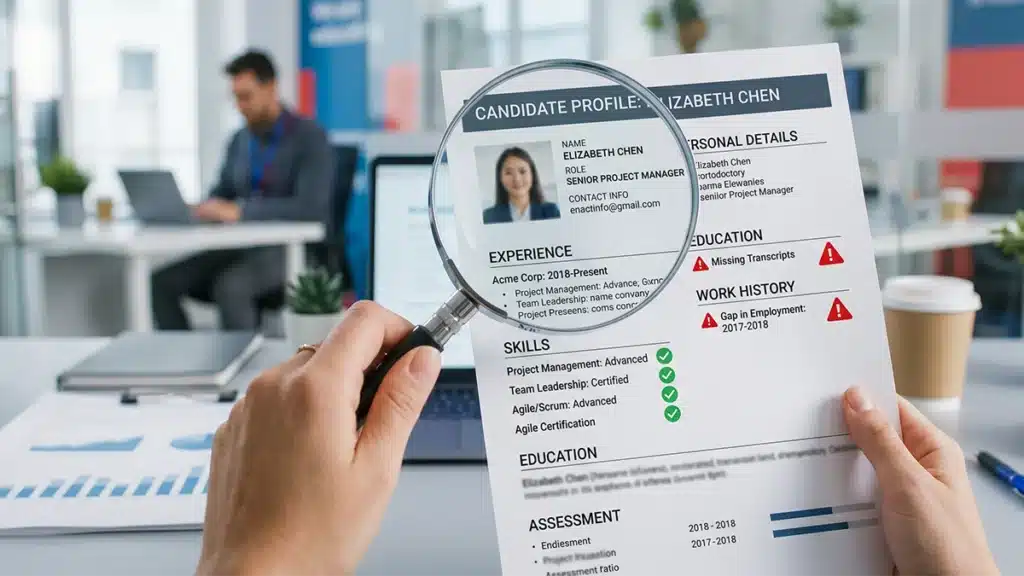
A strong result is not simply a high score — it’s a pattern of consistent responses across both overt and covert items, with behavioral interview answers that align. Candidates who acknowledge past mistakes and clearly describe how they’ve grown from them often perform better on long-term culture fit than those who claim a spotless record. Look for coherence, not perfection.
Interpreting Red Flags
Red flags emerge when contradictions appear across similar questions, when answers are consistently evasive or vague, or when self-reported behavior conflicts sharply with reference data. That said, context matters. A brief, cautious answer can reflect interview anxiety as easily as it reflects dishonesty. When a red flag appears, the right response is a follow-up conversation, not a disqualification.
Combine automated scoring with direct conversation. No algorithm, however sophisticated, replaces the judgment call a skilled recruiter makes after a genuine exchange with a candidate.
Measuring ROI
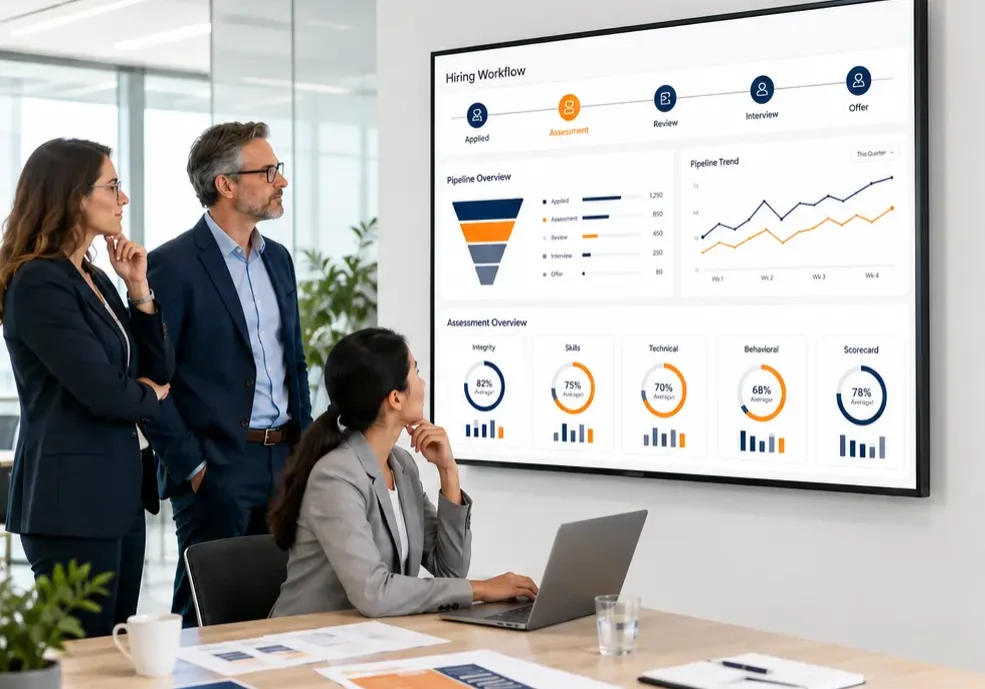
The clearest way to demonstrate value is to benchmark before and after. Track these four metrics:
| Screening Metric | Before Integrity Assessment | With Integrity Assessment |
| Employee Turnover Rate | ~23% | ~17% |
| Workers’ Comp Claim Count | ~48 per year | ~29 per year |
| Cost-Per-Hire | ~$6,500 | ~$4,900 |
| Trust Index Rating | Moderate | High |
Note: Figures above are illustrative benchmarks. Actual results will vary by organization, role type, and screening configuration. For verified ROI case data, see our analysis of the ROI of integrity testing.
For a detailed breakdown of financial impact, see ROI of integrity testing. For the full picture, see our complete Integrity Self Assessment: The Complete Guide for HR , which explains what it is, the main formats, and how to use it across hiring, performance reviews, and culture audits.
Ready to see this in action? Book a free demo with IntegrityFirst Tests and get a live walkthrough of how our validated tools integrate with your current ATS.
FAQs: Integrity Assessment for Employee Screening
What is the difference between an integrity assessment and a background check?
A background check reviews factual history — criminal records, employment verification, credentials. An integrity assessment for employee screening measures behavioral tendencies and ethical reasoning. They answer different questions: one looks backward, the other looks forward. The most robust screening programs use both.
Are integrity assessments legally defensible?
Yes, when tools are scientifically validated, applied consistently across all candidates for a given role, and regularly audited for adverse impact. Documenting your process thoroughly is essential. Consult EEOC guidelines on pre-employment testing and, where appropriate, your legal counsel.
What if a strong candidate fails the integrity assessment?
A failing score is a signal, not a final answer. Review the specific pattern of responses, consider the context, and use a follow-up behavioral interview to probe further. Some “fails” reflect test anxiety or cultural unfamiliarity with the format rather than genuine ethical risk.
How honest should employees be in performance review self-assessments?
Employees should be constructively transparent — candid about challenges, but always framed in terms of learning and forward action. Phrases like “I am actively working to improve X by doing Y” are more useful than either defensiveness or over-confession.
How do I measure whether integrity assessments are working?
Track turnover rate, cost-per-hire, workers’ compensation claims, and internal fraud or compliance incidents before and after implementing the program. Run a formal review after 12 months to assess whether screening thresholds need recalibration.
Can integrity assessments integrate with our current ATS?
Most modern, validated integrity assessment platforms offer API integration with major ATS systems. Confirm integration compatibility as part of your vendor evaluation — it is one of the most important practical criteria for a smooth rollout.
Conclusion: Build Hiring Decisions on Evidence, Not Instinct

Integrity assessment for employee screening is not about catching people out. It’s about giving your hiring team a richer, more reliable basis for decisions that carry real consequences — for your organization, your existing team, and the candidate themselves.
The organizations that do this well share a few common traits: they use scientifically validated tools, they apply them consistently, they treat results as one input among several, and they measure outcomes over time. That combination turns screening from a compliance checkbox into a genuine competitive advantage.
If you’re ready to build a more defensible, ethical, and effective hiring process, IntegrityFirst Tests can help. Our assessments are validated, ATS-compatible, and backed by real-world ROI data. Book a free demo today to see how they fit your specific hiring context.