Schedule a call!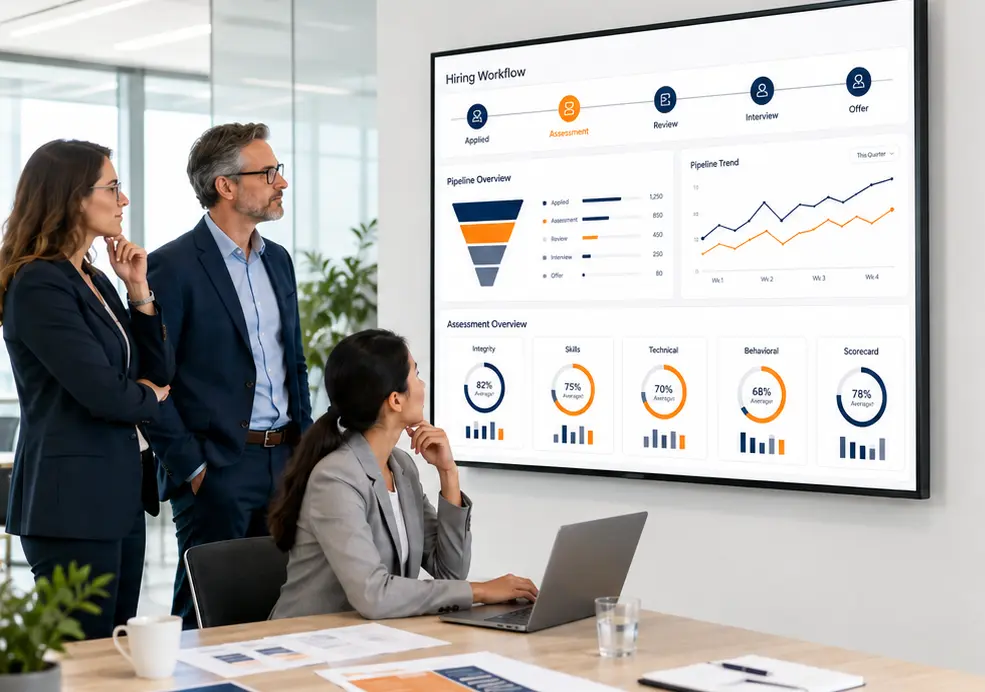
Most hiring teams do not add assessments because they want another step in the process. They add them because something in the current process is not giving them enough confidence.
Recruiters may be spending too much time on candidates who are not a strong fit. Hiring managers may be relying heavily on interviews and first impressions. Frontline teams may be dealing with turnover, absenteeism, conduct issues, or reliability concerns after the hire has already been made. Technical teams may be using valuable interview time to confirm skills that could have been screened earlier.
That is where talent assessment tools for HR hiring become useful.
The right assessment gives HR a more consistent signal before too much time is invested. It can help clarify whether a candidate has the required skills, fits the role, understands the work, shows reliability, or presents risk factors the company needs to evaluate carefully.
The wrong assessment creates the opposite effect. It slows recruiters down, frustrates candidates, adds another system to manage, and produces data that no one trusts enough to use.
This guide is designed as the main hub for the C1 talent assessment tools cluster. It brings together the key points from the related articles on ATS integration, pre-hiring assessments, easy-to-integrate tools, implementation workflows, and integrity screening.
For a direct vendor comparison, read 7 Best Talent Assessment Tools That Integrate With ATS. For the implementation side, use How to Implement Talent Assessment Tools in ATS Workflows.
What Are Talent Assessment Tools?
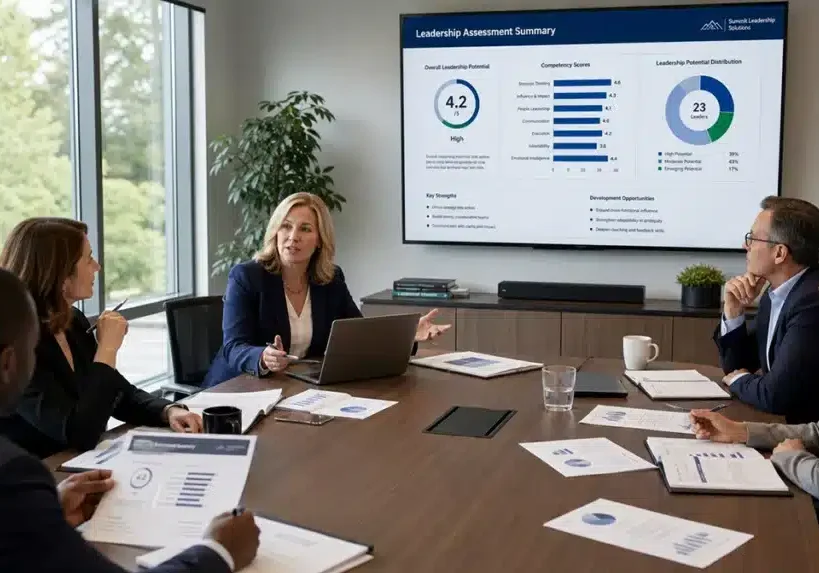
Talent assessment tools are structured methods or software platforms used to evaluate candidates before making a hiring decision. They may measure job skills, integrity, reliability, cognitive ability, work style, communication, technical knowledge, leadership potential, or role-specific judgment.
They are valuable because they add a more consistent data point to a process that can otherwise become subjective.
Interviews still matter. Recruiter judgment still matters. Hiring manager context still matters. But assessments can help those decisions become more structured and easier to compare across candidates, teams, and locations.
The EEOC recognizes that employers use several types of employment tests and selection procedures, including cognitive tests, personality tests, work samples, and integrity tests. It also notes that these tools must be used carefully and consistently to avoid discriminatory impact or improper use. See the EEOC’s guidance on employment tests and selection procedures.
In practical terms, HR should never choose an assessment simply because it is popular or because a vendor offers a large test library. The assessment should answer a specific hiring question.
Start With the Hiring Problem

The best way to choose an assessment is to begin with the issue the business is trying to solve.
A company hiring warehouse associates at scale may need a very different tool from a software company hiring senior engineers. A healthcare support employer may be concerned with reliability and conduct. A sales team may need to understand communication style, motivation, and judgment. A growing company may need stronger ATS workflows before adding more specialized assessments.
A simple starting point is to match the hiring problem to the assessment category.
| Hiring problem | Better assessment fit |
| Too many unqualified candidates reach recruiters | Pre-screening questions or basic skills assessment |
| Early turnover in frontline roles | Integrity, reliability, or dependability assessment |
| Hiring decisions vary by location | Standardized assessment workflow and decision rules |
| Managers rely too much on interviews | Structured scorecards or role-specific assessments |
| Technical interviews take too much time | Coding, technical, or work sample assessment |
| Recruiters manage results outside the ATS | ATS-integrated assessment tools |
| HR needs better documentation | Tools with audit trails, score history, and consistent workflows |
The U.S. Office of Personnel Management recommends beginning assessment strategy with job analysis and the critical competencies required for the role. That approach helps HR select tools that are tied to actual job requirements rather than broad assumptions. See OPM’s assessment strategy guidance.
The question is not “Which assessment tool has the most features?” The better question is “Which signal do we need before this candidate moves forward?”
Main Types of Talent Assessment Tools for HR Hiring
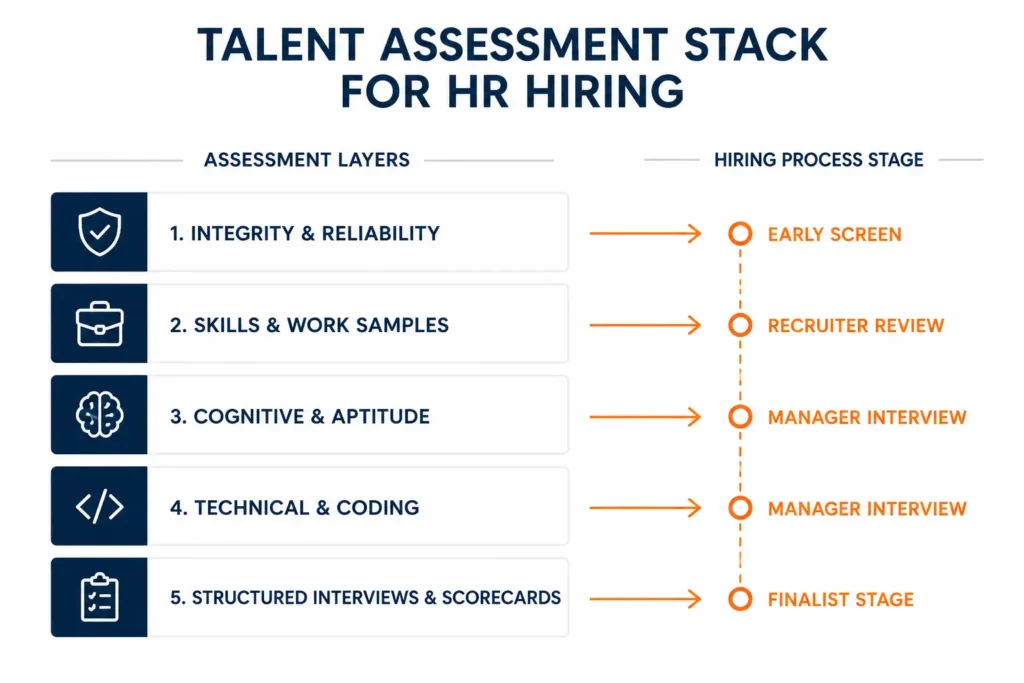
Most companies do not need every assessment type. They need the right combination for their roles, hiring volume, risk profile, and candidate experience.
Integrity and Reliability Assessments
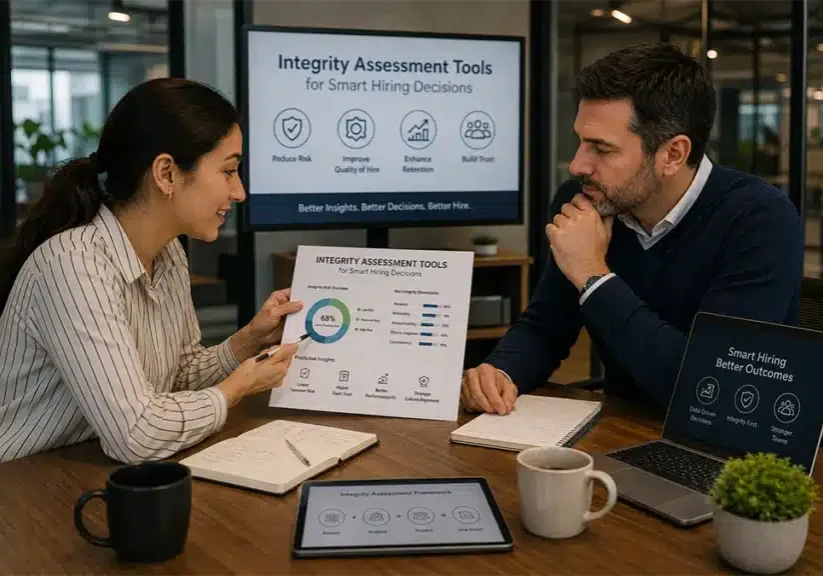
Integrity and reliability assessments help employers evaluate risk factors related to honesty, dependability, attendance, workplace conduct, safety, policy adherence, theft risk, and consistency.
These assessments are especially relevant in high-volume or risk-sensitive hiring, including staffing, logistics, construction, manufacturing, healthcare support, retail, hospitality, transportation, and frontline operations.
This is where IntegrityFirst Tests fits most naturally. It is designed for employers that need a focused pre-interview screen for integrity, reliability, and workforce risk.
For more context on this category, read Integrity Assessment for Employee Screening and Honesty Test for Employee Screening.
Skills and Work Sample Assessments
Skills assessments help determine whether a candidate can perform specific job-related tasks. These may include data entry, writing samples, customer service simulations, sales exercises, accounting tests, administrative tasks, or role-specific scenarios.
These tools are strongest when the task clearly reflects the job. A good skills assessment should feel relevant to the candidate and useful to the hiring team.
For example, a customer service assessment may evaluate how a candidate responds to a frustrated customer. A sales assessment may test how they handle objections. A warehouse assessment may evaluate accuracy, attention to detail, or safety-related judgment.
Cognitive and Aptitude Assessments
Cognitive assessments evaluate areas such as problem-solving, reasoning, learning ability, numerical ability, verbal ability, or attention to detail.
They can be helpful for roles where learning speed and judgment matter. However, they should be used with care. HR should understand why the assessment is relevant to the job, how scores will be interpreted, and whether outcomes should be monitored for adverse impact.
Cognitive assessments are rarely a good “default” screen for every role. They work best when they are clearly connected to the demands of the position.
Behavioral and Personality Assessments
Behavioral and personality assessments help hiring teams understand how candidates may approach communication, collaboration, motivation, decision-making, stress, and leadership.
These assessments can support hiring for management, sales, client-facing, or team-based roles. They are often more useful later in the process, especially when interpretation matters.
For many roles, behavioral assessments should inform the interview rather than operate as a simple pass/fail filter.
Technical and Coding Assessments
Technical assessments are common in software engineering, data, QA, cybersecurity, analytics, IT, and other technical roles. Platforms such as HackerRank and Codility help teams evaluate job-specific technical skills before engineers or technical leaders spend time in interviews.
These tools are valuable when the hiring question is straightforward: can this candidate demonstrate the required technical skill?
They are not a substitute for technical interviews, but they can help teams use interview time more effectively.
Structured Interviews and Scorecards
Not every assessment is a test. Structured interviews, scorecards, and interview guides are also assessment tools.
They help hiring managers evaluate candidates against consistent criteria instead of relying on memory, personal preference, or informal impressions.
For companies trying to create a more disciplined hiring process, scorecards can be just as important as pre-employment tests. They also work well inside a broader hiring platform where recruiter notes, assessment results, interview feedback, and final decisions are connected.
Where Assessments Belong in the Hiring Process
Assessment placement matters. The same tool can improve the process or create friction depending on when it appears.
Earlier in the funnel, assessments should be short, clear, and easy to complete. Later in the process, assessments can be more detailed because the candidate pool is smaller and the company has already established mutual interest.
| Hiring stage | Best assessment use |
| Application received | Minimum qualifications or knockout questions |
| After minimum qualifications | Integrity, reliability, or short pre-hiring assessment |
| Before recruiter screen | High-volume screening to prioritize candidates |
| Before hiring manager interview | Skills test, work sample, or technical screen |
| Finalist stage | Leadership, personality, or deeper behavioral assessment |
| After interviews | Structured scorecards, references, and final evaluation steps |
For high-volume hiring, an integrity or reliability assessment often works best after basic qualifications and before recruiter screening. That keeps recruiters from spending time on candidates who may not be a strong fit for the role or work environment.
For professional and technical roles, a skills assessment may fit better after an initial recruiter screen but before a hiring manager or technical interview.
For leadership roles, deeper behavioral or psychometric assessments often belong closer to the finalist stage.
For a full workflow breakdown, read How to Implement Talent Assessment Tools in ATS Workflows.
Why ATS Integration Matters
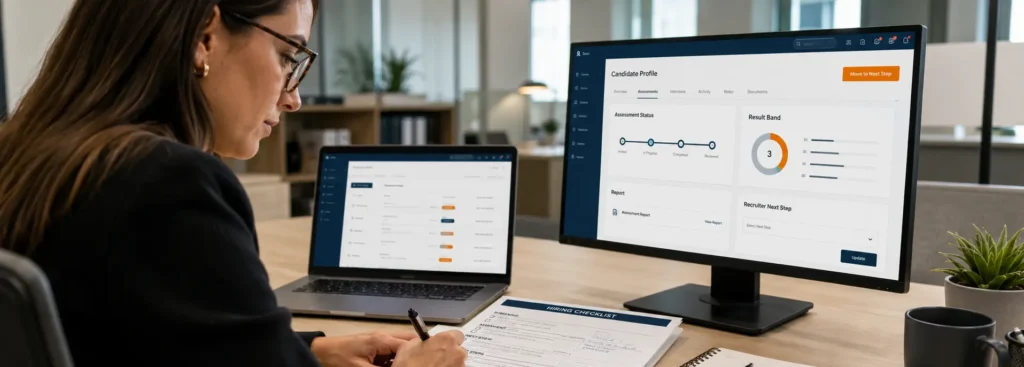
A good assessment tool can still fail if it does not fit the recruiter’s daily workflow.
If recruiters have to copy candidate information into another platform, manually send assessment links, wait for separate reports, and then update candidate stages by hand, the process becomes fragile. Some recruiters may use it correctly. Others may skip it when volume increases.
The ATS should remain the center of the hiring process.
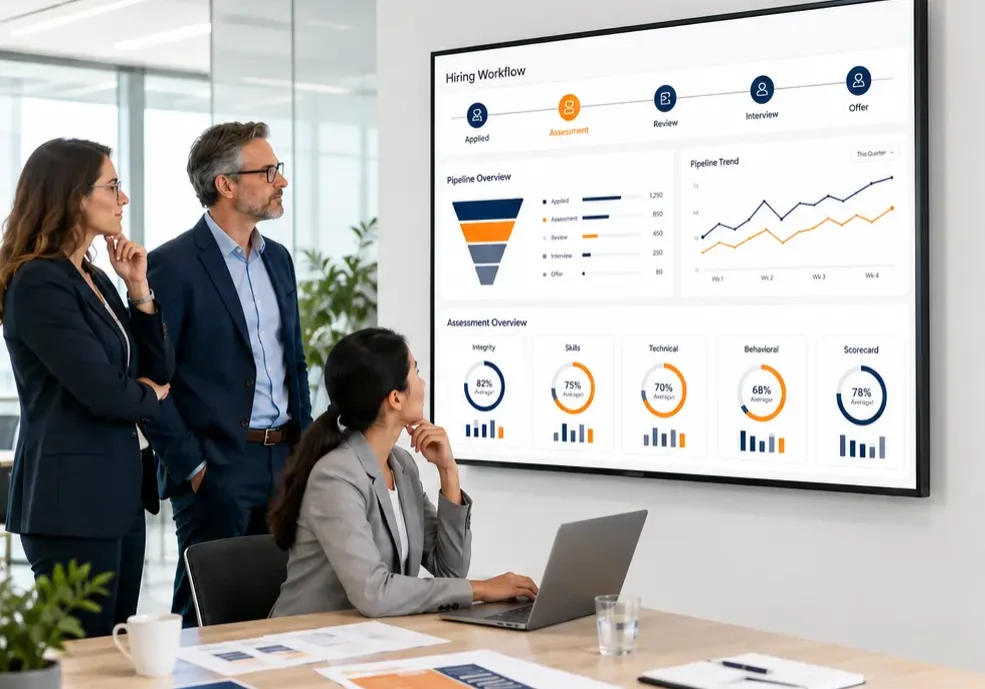
A practical assessment workflow usually looks like this:
Candidate applies.
Minimum qualifications are reviewed.
The correct assessment is triggered.
The candidate completes the assessment.
Results return to the ATS or hiring platform.
The recruiter sees the next step.
The hiring manager receives a stronger shortlist.
HR can review the process later.
Discovered’s guide to what an ATS is provides helpful context on how applicant tracking systems organize candidate data, workflow stages, communication, and hiring activity.
If integration ease is a priority, read Easy-to-Integrate Pre-Hiring Assessment Tools and 7 Easy-to-Integrate Pre-Hiring Assessment Tools for HR.
What “Easy to Integrate” Should Mean for HR
“Integration” can mean very different things depending on the vendor. Some tools offer a secure link. Others offer native ATS connections, API options, or a full hiring platform.
For HR, the definition should be more practical: can the recruiting team use the assessment without adding unnecessary manual work?
An assessment is easy to integrate when it supports:
- Simple candidate invitations
- Mobile-friendly completion
- Clear assessment status
- Score or recommendation visibility
- Role-based assessment rules
- Recruiter-friendly outputs
- Reporting and audit history
- A pilot that does not require a long IT project
A secure link may be enough for a smaller team or a fast pilot. A native ATS integration may be better for higher volume. A full hiring platform may be the right choice when the company wants ATS, assessments, communication, interviews, scorecards, and automation in one place.
For a deeper comparison, use Best Pre-Hiring Assessment Tools for HR Compared.
How HR Should Evaluate Talent Assessment Vendors
A vendor demo should not only show polished dashboards. It should show how the tool works inside a real hiring scenario.
HR should ask vendors to walk through one role from start to finish.
For example:
“We are hiring 75 warehouse associates per month across multiple locations. Show us when the assessment is sent, what the candidate receives, what the recruiter sees, how the result is stored, and what the hiring manager reviews.”
That type of walkthrough reveals more than a feature list.
| Evaluation area | Questions to ask |
| Role relevance | What hiring outcome does the assessment help clarify? |
| Candidate experience | How long does it take, and does it work well on mobile? |
| Recruiter usability | What does the recruiter see after completion? |
| ATS fit | Does status, score, or recommendation return to the workflow? |
| Compliance support | What validation and job-relatedness documentation is available? |
| Implementation effort | Can we pilot one role without a long technical project? |
| Reporting | Can HR track completion, pass-through, and outcomes? |
| Scalability | Can the tool support more roles, locations, or workflows later? |
For a more detailed selection framework, read How to Choose Top Talent Assessment Tools for HR.
Compliance and Fairness Considerations
Talent assessment tools should make the hiring process more consistent and better documented. They should not create an informal shortcut around good selection practices.
Before launch, HR should confirm that:
- The assessment is job-related.
- The same process applies to similarly situated candidates.
- Decision rules are documented.
- Recruiters understand how to use the results.
- Candidates receive clear instructions.
- Results are stored securely.
- Overrides are documented.
- Outcomes are reviewed over time.
- Adverse impact is monitored where appropriate.
- The workflow is updated when job requirements change.
The EEOC advises employers to validate employment tests for the positions and purposes where they are used. It also notes that relying on vendor documentation alone does not remove the employer’s responsibility for proper use. See the EEOC guidance on employment tests and selection procedures.
OPM also recommends using current job analysis, standardizing assessment procedures, treating candidates consistently, and documenting the assessment process. See OPM’s assessment strategy guidance.
For broader candidate evaluation practices, SHRM’s guide to screening and evaluating job candidates is also useful.
What to Measure After Launch
A talent assessment program should not be judged by how many assessments are sent. It should be judged by whether the workflow improves hiring outcomes.
The most useful metrics include:
| Metric | Why it matters |
| Assessment invitation rate | Confirms the workflow is triggering correctly |
| Completion rate | Shows whether candidates can complete the step easily |
| Time to completion | Reveals friction in the candidate experience |
| Score writeback reliability | Confirms integration quality |
| Recruiter adoption | Shows whether teams trust and use the tool |
| Pass-through rate | Shows how candidates move after assessment |
| Time-to-interview | Measures recruiter efficiency |
| Time-to-hire | Measures process speed |
| Early turnover | Helps evaluate quality impact |
| Incident or claim trends | Relevant for risk-sensitive roles |
| Override frequency | Shows whether decision rules need adjustment |
| Adverse impact review | Supports fairness and defensibility |
A pilot does not need a perfect analytics dashboard. It does need enough visibility to answer a practical question: is the assessment helping the team make better decisions with less wasted effort?
Where IntegrityFirst Fits in the Talent Assessment Stack
IntegrityFirst is not a broad test library. Its value is more focused.
It is designed to help employers screen for integrity, reliability, and workforce risk before a candidate moves too far into the process.
That makes it especially relevant when poor hiring decisions can create operational costs through turnover, absenteeism, policy violations, safety concerns, theft risk, client trust issues, or unreliable attendance.
IntegrityFirst is a strong fit for:
- High-volume hiring
- Frontline roles
- Staffing and temporary placement
- Construction and field roles
- Logistics and transportation
- Retail and hospitality
- Manufacturing
- Healthcare support
- Roles where reliability matters before day one
For HR teams that already have an ATS, IntegrityFirst can serve as a focused assessment layer. For teams building a more connected hiring process, it can also fit inside the broader Discovered ecosystem.
Where Discovered Fits in the Hiring Ecosystem
Discovered is broader than a single assessment tool.
It brings together applicant tracking, workflow management, candidate assessments, custom skills tests, scorecards, interviews, communication, automation, and hiring decision support.
That matters for companies that do not want to keep stitching together multiple point solutions. A team may start with one need, such as integrity screening or candidate assessments, but eventually need the surrounding workflow: ATS, scorecards, communication, interviews, and reporting.
Discovered’s employee assessment software page positions the platform around pre-employment assessments for skills, traits, job fit, cognitive ability, integrity, leadership potential, and custom skill assessments.
For HR teams, the distinction is straightforward:
Use IntegrityFirst when the immediate need is a focused integrity and reliability screen.
Use Discovered when the broader need is a connected hiring platform that brings assessments, ATS workflows, scorecards, communication, interviews, and automation together.
How This C1 Cluster Fits Together
This pillar should act as the main hub for the C1 talent assessment tools content. Each supporting article should answer a more specific question and link back to this guide.
| Reader need | Recommended guide |
| Compare ATS-integrated platforms | 7 Best Talent Assessment Tools That Integrate With ATS |
| Build the implementation workflow | How to Implement Talent Assessment Tools in ATS Workflows |
| Evaluate vendors by criteria | How to Choose Top Talent Assessment Tools for HR |
| Prioritize simple setup | Easy-to-Integrate Pre-Hiring Assessment Tools |
| Compare pre-hiring options | Best Pre-Hiring Assessment Tools for HR Compared |
| Use a buyer checklist | 7 Easy-to-Integrate Pre-Hiring Assessment Tools for HR |
| Understand the pre-hiring category | Pre-Hiring Assessment Tools Guide for HR |
This structure helps the pillar capture the broader topic while the cluster articles handle more specific search intent.
Common Mistakes to Avoid
The first mistake is choosing an assessment before defining the hiring problem.
The second is applying the same assessment to every role.
The third is placing long or complex assessments too early in the funnel.
The fourth is allowing results to sit outside the ATS where recruiters do not consistently use them.
The fifth is giving recruiters a score without a clear next step.
The sixth is ignoring candidate experience.
The seventh is treating compliance as a vendor promise instead of an HR responsibility.
A good assessment program should make hiring easier to manage, easier to explain, and easier to measure. If the tool makes the process harder to run, the workflow needs to be adjusted before it scales.
FAQ
What are talent assessment tools for HR hiring?
Talent assessment tools for HR hiring are structured tests, scorecards, interviews, simulations, or software platforms used to evaluate candidates before a hiring decision. They may assess skills, integrity, reliability, cognitive ability, personality, technical capability, or role-specific judgment.
Which talent assessment tool should HR use first?
Start with the hiring problem. If the issue is technical skill, use a technical or work sample assessment. If the issue is reliability, conduct, absenteeism, theft, safety, or turnover risk, use an integrity and reliability assessment such as IntegrityFirst.
Should talent assessments integrate with the ATS?
Yes, whenever possible. ATS integration helps recruiters see assessment status, results, and next steps inside the candidate workflow instead of managing reports in a separate platform.
Are talent assessment tools compliant?
They can be, but compliance depends on how they are selected and used. HR should confirm job-relatedness, apply assessments consistently, document decision rules, review adverse impact, and train recruiters on appropriate use.
Is IntegrityFirst a talent assessment tool?
Yes. IntegrityFirst is a talent assessment tool focused on integrity, reliability, and workplace risk screening. It is best suited for pre-interview screening in high-volume or risk-sensitive roles.
Is Discovered an ATS or an assessment platform?
Discovered is broader than a single assessment platform. It includes applicant tracking, assessments, scorecards, workflows, communication, interviews, and automation in one hiring ecosystem.
Final Takeaway
Talent assessments are most valuable when they help HR make earlier, clearer, and more consistent hiring decisions.
For some roles, the most important signal is technical skill. For others, it is communication, judgment, leadership potential, or job-specific knowledge. In high-volume and risk-sensitive environments, reliability and integrity may be the signal that matters most before the first interview.
That is where IntegrityFirst Tests adds value. It gives employers a focused way to evaluate integrity, reliability, and workforce risk before recruiters and hiring managers invest more time in the process.
For companies that want those assessments connected to the larger hiring workflow, Discovered provides the broader platform: applicant tracking, assessments, custom skills tests, scorecards, communication, interviews, workflow automation, and hiring decision support.
IntegrityFirst provides the focused integrity signal.
Discovered provides the hiring system around it.
To reduce hiring risk with a focused integrity assessment, schedule an IntegrityFirst demo.
To connect assessments with ATS workflows, scorecards, interviews, communication, and automation, book a Discovered demo.