Schedule a call!
Using a honesty test for employee screening is one of the most validated and cost-effective ways to reduce hiring risk in the United States. When deployed correctly within a multi-step screening pipeline, integrity assessments identify the behavioral risk factors that interviews, background checks, and reference calls consistently miss: attitudes toward accountability, rule-following, and workplace conduct.
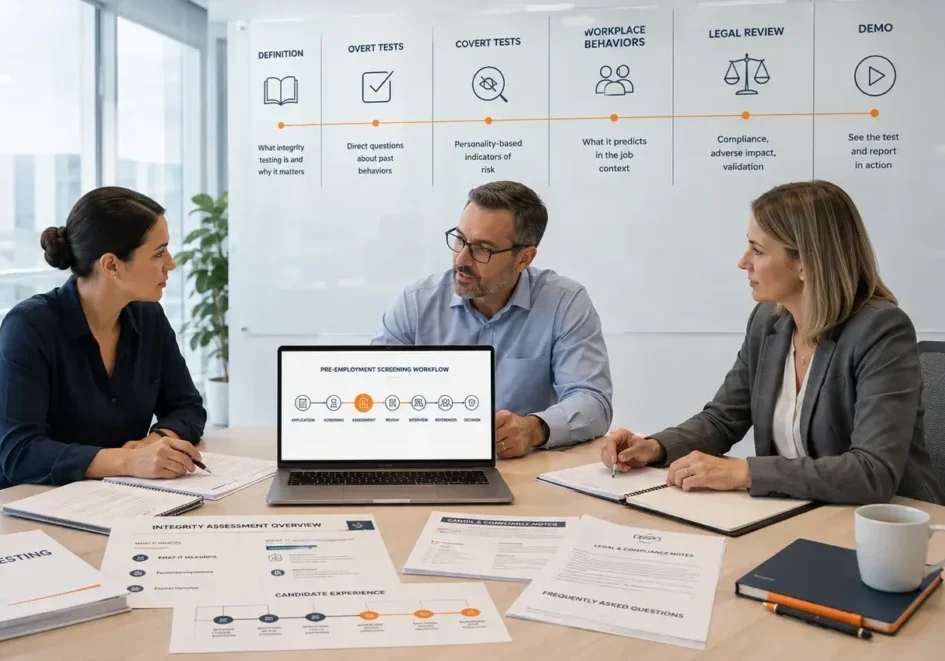
This guide covers how a honesty test for employee screening works, which formats suit which roles and industries, how to integrate testing into your existing pipeline, and the implementation and legal requirements your HR team needs to get it right the first time. For HR teams managing high-volume hiring, high-risk roles, or both, structured integrity screening is one of the highest-return changes available to your pre-employment process.
What Is a Honesty Test for Employee Screening?
A honesty test for employee screening is a structured pre-employment assessment that evaluates a candidate’s trustworthiness, reliability, and likelihood of engaging in counterproductive work behavior. The US Office of Personnel Management (OPM) formally recognizes these tools as valid instruments that predict theft, absenteeism, and overall job performance.
The research foundation is substantial. A comprehensive meta-analysis of 665 validity coefficients across 576,460 data points, published in the Journal of Applied Psychology, found a mean operational predictive validity of .41 for supervisory ratings of job performance — establishing integrity tests as among the most predictive instruments available in pre-employment screening.
Unlike general aptitude tests or unstructured interviews, honesty tests are purpose-built to identify specific behavioral risk patterns. They target the attitudes and orientations — toward accountability, ethical decision-making, and workplace conduct — that predict whether a candidate will behave reliably and honestly in the role.
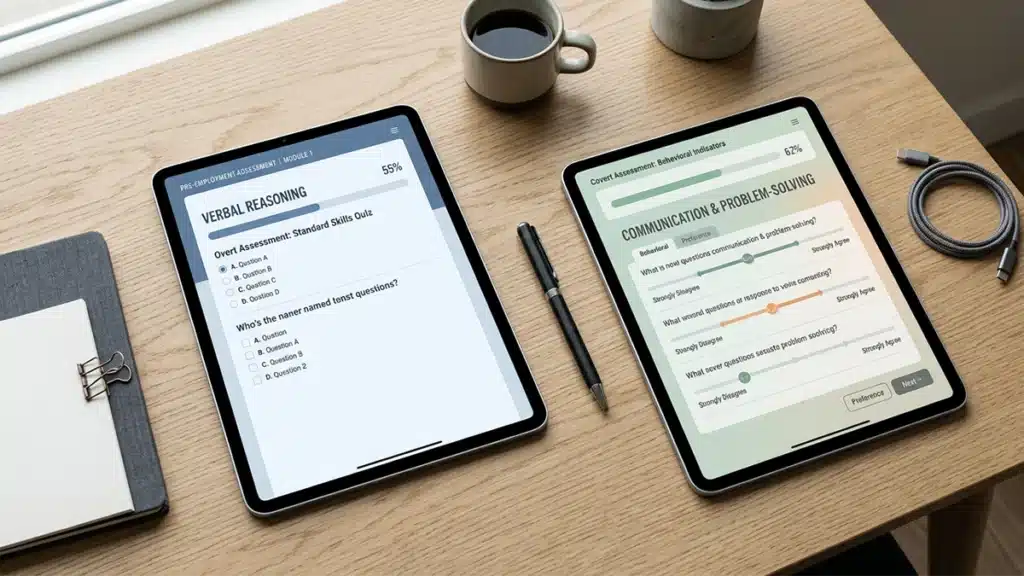
Two primary formats are used in US employee screening: overt integrity tests, which ask direct questions about past behavior and attitudes, and covert integrity tests, which assess the same risk profile indirectly through personality trait indicators.
How a Honesty Test for Employee Screening Works
Understanding how each format operates in a screening context helps HR teams select the right tool for the right role and communicate the process clearly to candidates and hiring managers.
Overt Integrity Tests
Overt integrity tests ask candidates direct, transparent questions about their past behavior and attitudes toward theft, absenteeism, and rule-breaking. Questions are explicit: candidates are asked whether they have ever taken company property without permission, whether they consider misusing sick days acceptable, or how they would respond to witnessing a colleague falsifying records.
Overt tests are efficient, easy to administer at scale, and produce clear risk signals for roles with direct financial exposure. Their primary limitation is faking susceptibility — candidates who recognize the intent of direct integrity questions can adjust their responses to present a more favorable profile.
| Format | Sample Question | Best Roles | Faking Susceptibility |
| Overt Test | “Have you ever taken company property without authorization?” | Retail, cash-handling, field service, entry-level roles | Higher (d ≈ 0.90) |
| Covert Test | “I prefer following established procedures to finding my own approach.” | Healthcare, supervisory, customer-facing, leadership roles | Lower (d ≈ 0.38) |
Covert Integrity Tests
Covert integrity tests assess the same risk profile indirectly, through personality trait indicators such as conscientiousness, agreeableness, and emotional stability. The intent is less transparent to candidates — they respond to behavioral preference statements rather than direct misconduct questions. SAGE research on integrity test formats confirms that covert formats have significantly lower faking susceptibility than overt tests (d = 0.38 vs. d = 0.90).
The Association of Test Publishers Model Guidelines confirm that integrity tests reliably predict absenteeism, with personality-based formats outperforming overt tests on this criterion — consistent with Ones, Viswesvaran, and Schmidt’s findings. Covert tests are better suited to roles where interpersonal conduct, ethical judgment under ambiguity, or leadership integrity are primary screening concerns.
Business Impact and Validity: Why Honesty Testing Works
A meta-analysis of 104 integrity test studies confirms corrected validity coefficients of .32 for counterproductive work behavior and .18 for job performance. These figures establish honesty tests as among the strongest pre-employment predictors of workplace conduct available to US HR teams.
Schmidt and Hunter’s landmark 85-year review of personnel selection methods, published in Psychological Bulletin, identified integrity tests as the selection procedure with the greatest incremental validity over cognitive ability for predicting job performance. Combining a cognitive ability test with a honesty test produces a composite validity of .65 — higher than any other two-predictor combination reviewed.
A peer-reviewed Journal of Business and Psychology case study documented a 50% reduction in employee terminations for theft, illegal drug use, and violence over five years following the introduction of a written integrity assessment at a major US home improvement retailer. This represents one of the most concrete, longitudinal demonstrations of the impact a honesty test for employee screening can have on workforce conduct outcomes.
Screening out the riskiest 8–10% of applicants also reduces workers’ compensation claim frequency by double-digit percentages within the first year. Integrity assessments also link directly to turnover reductions in high-risk roles.
Industry Applications: Matching Tests to Screening Contexts
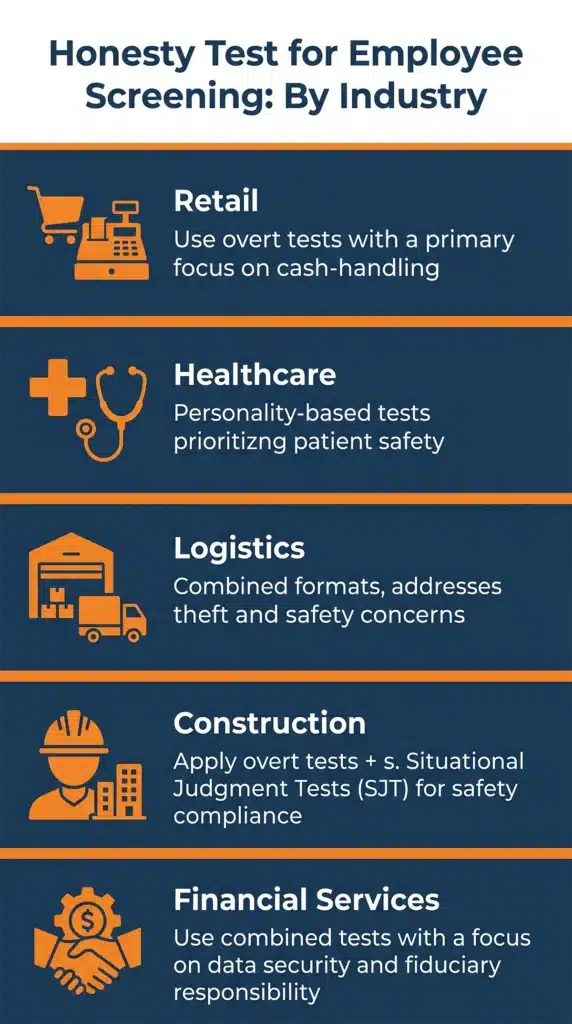
A honesty test for employee screening delivers the strongest results when matched to the specific risk profile of the industry and role. The following industry guide helps HR teams select the most appropriate format and communication approach for their context.
| Industry | Primary Risk Profile | Recommended Format | Key Outcome |
| Retail | Employee theft, cash handling, absenteeism | Overt + reverse-coded items | 50% reduction in terminations for theft documented in peer-reviewed case study |
| Healthcare | Patient safety, data privacy, conduct under pressure | Personality-based + SJT | Reduced disciplinary incidents; stronger safety culture |
| Logistics / Distribution | Safety compliance, inventory control, time theft | Combined overt + personality-based | Turnover reduction; workers’ comp claim decrease |
| Construction | Safety protocol adherence, substance risk, fraud | Overt + SJT | OSHA-recordable incident reduction; comp claim reduction |
| Financial Services | Data security, fiduciary responsibility, fraud | Combined formats + SJT | Lower fraud incidents; stronger compliance audit performance |
For construction and manufacturing, pairing honesty testing with safety-focused hiring practices reduces OSHA-recordable incident rates significantly in the first year of implementation.
How Honesty Tests Fit Into Your Full Screening Pipeline
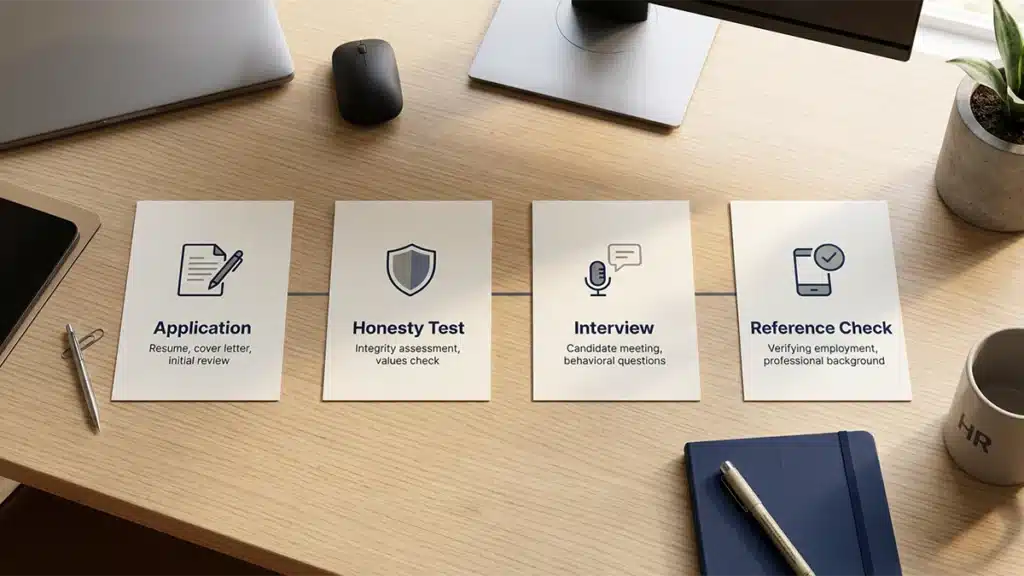
A honesty test for employee screening is most effective as one component of a multi-step evaluation process, not as a standalone disqualifier. The position within the pipeline affects both predictive accuracy and legal defensibility.
| Pipeline Stage | Honesty Test Role | Benefit | Consideration |
| Pre-application / top of funnel | Screen-in filter for high-risk, high-volume roles | Eliminates highest-risk candidates before investment in evaluation | Use overt format for efficiency; ensure job-relatedness documentation |
| Pre-interview | Primary screen-out measure | Concentrates interview time on qualified, lower-risk candidates | Communicate purpose clearly; address candidate concerns upfront |
| Post-conditional offer | Comprehensive evaluation for sensitive or senior roles | Deepest assessment depth; strongest legal defensibility | Full informed consent; combine with background verification |
Combining integrity test results with structured interviews and reference checks delivers the strongest predictive validity. Read the Integrity Assessments Guide for Smarter Hiring for a complete multi-tool screening framework.
5 Steps to Implement Honesty Tests in Your Screening Process
- Select a validated tool with documented construct and criterion validity. Confirm the vendor provides a technical manual, independent validation study, and adverse impact data. Reject vendors who cannot produce this documentation on request.
- Define role-specific criteria. Map test format and scoring thresholds to the specific risk profile of each position. Avoid applying the same assessment indiscriminately across all roles in your organization.
- Integrate with your ATS and set consistent placement in the pipeline. Pre-interview placement is most efficient for high-volume screening. Post-conditional offer placement is appropriate for senior or high-sensitivity roles.
- Communicate transparently with all candidates before the assessment begins. Provide written disclosure of purpose, format, completion time, and how results will be used. Train all recruiters on how to answer candidate questions consistently.
- Score, document, and monitor outcomes. Apply research-based scoring rubrics. Record the basis for every hiring decision in which assessment results were a factor. Audit for adverse impact by demographic group at least quarterly.
Legal and Ethical Requirements for Employee Screening
Every honesty test deployed in US employee screening must comply with EEOC employment testing guidance, which requires that assessments be job-related, consistent with business necessity, administered consistently across all candidates, and regularly reviewed for adverse impact.
According to SHRM pre-employment screening guidelines, selecting the right assessment format for the specific role and risk profile is essential for both predictive validity and legal defensibility. State laws may impose additional requirements in California, New York, Illinois, and other jurisdictions with enhanced screening regulations.
Document every stage of the screening process: the validation evidence for the tool selected, the job-relatedness justification, the adverse impact analysis, and the hiring decision rationale. This documentation is the foundation of a legally defensible screening program.
Handling Objections and Common HR Concerns
HR teams implementing a honesty test for employee screening for the first time frequently encounter internal and candidate-facing objections. Addressing these proactively reduces friction and improves adoption.
Objection: ‘Candidates will just answer what we want to hear.’
This concern is most valid for overt tests. Combining overt and covert formats significantly reduces faking susceptibility. Using reverse-scored items and inconsistency detection algorithms further mitigates coached responses. Personality-based formats are substantially harder to game (d = 0.38 vs. d = 0.90 for overt formats).
Objection: ‘We’re worried about adverse impact.’
Structured honesty tests that focus tightly on attitudes toward workplace misconduct consistently produce lower adverse impact than broader personality assessments or unstructured interviews. Quarterly adverse impact analysis, combined with annual question-set review, provides the ongoing monitoring required to identify and correct disparities before they create legal exposure.
Objection: ‘Candidates are uncomfortable with the assessment.’
Candidate discomfort is almost always a communication problem, not a test problem. Providing written disclosure before the assessment begins — explaining purpose, format, and candidate rights — resolves the most common sources of candidate anxiety. Clear communication also improves response authenticity and completion rates.
Objection: ‘Is this legal?’
Yes, when properly administered. Written and digital honesty tests are fully compliant under the Employee Polygraph Protection Act. They must meet EEOC standards for job-relatedness and adverse impact monitoring. State-level legal review is recommended for jurisdictions with enhanced screening regulations.
Frequently Asked Questions
What is a honesty test for employee screening?
A honesty test for employee screening is a validated pre-employment assessment that evaluates a candidate’s trustworthiness, reliability, and likelihood of engaging in counterproductive work behavior. The US OPM recognizes these tools as valid instruments for predicting theft, absenteeism, and job performance. They are used as one component of a multi-step screening pipeline across US industries including retail, healthcare, logistics, construction, and financial services.
How do honesty tests fit into employee screening?
Honesty tests function as a behavioral risk filter within the screening pipeline. They are most effective when placed pre-interview for high-volume, high-risk roles — concentrating evaluation time on lower-risk candidates — or post-conditional offer for senior or high-sensitivity positions. They should always be combined with structured interviews, reference checks, and background verification for the strongest predictive accuracy and legal defensibility.
Which industries benefit most from honesty testing in employee screening?
Healthcare, retail, logistics, construction, and financial services report the highest ROI from honesty testing. Any industry where counterproductive work behavior — theft, absenteeism, safety non-compliance, or misconduct — carries significant cost can benefit from structured integrity screening. Role-specific risk profiling — rather than blanket application — consistently produces the best results.
How do you choose between overt and covert integrity tests for screening?
Match the format to the role’s risk profile and candidate population. Use overt tests for high-risk, high-volume roles where direct screening efficiency matters most. Use covert or personality-based tests for leadership, customer-facing, and complex roles where behavioral depth and lower faking susceptibility are priorities. Combining both formats delivers the broadest predictive coverage.
What documentation is required when using honesty tests for employee screening?
Maintain validation documentation for the selected tool, a written job-relatedness justification for each role type screened, quarterly adverse impact analysis by demographic group, candidate disclosure records, and hiring decision rationale for every decision in which assessment results were a factor. This documentation is the foundation of EEOC compliance and legal defensibility.
Start Building a Reliable Employee Screening Process with IntegrityFirst Tests
IntegrityFirst Tests provides validated, US-compliant honesty assessments for HR teams that need reliable results and a legally defensible screening process. Our tools are designed for the full screening pipeline — from high-volume frontline hiring to senior-role evaluation. Schedule a free demo with IntegrityFirst Tests and build a honesty test for employee screening your organization can stand behind.