Schedule a call!
Choosing between an overt vs. personality-based honesty test is one of the most consequential decisions in pre-employment screening. Each format measures integrity through a fundamentally different mechanism, suits different role profiles, and responds differently to candidate attempts to present well. Selecting the wrong format for your hiring context reduces predictive accuracy, increases adverse impact risk, and ultimately costs more than the test saves.
This guide breaks down exactly how each format works, what the research says about their predictive validity and faking susceptibility, and how to match the right overt vs. personality-based honesty test to the specific roles in your organization. It also addresses the most common candidate concerns — and how to handle them transparently and compliantly under US employment law.
What Is a Pre-Employment Honesty Test?
A pre-employment honesty test is a structured assessment designed to evaluate a candidate’s trustworthiness, ethical orientation, and likelihood of engaging in counterproductive work behavior before a hiring decision is made. The US Office of Personnel Management (OPM) formally recognizes these tools as valid pre-employment instruments that predict theft, absenteeism, and overall job performance.
Honesty tests are not polygraph alternatives and they are not general personality assessments. They are purpose-built screening tools designed to identify specific behavioral risk patterns — rule-following, ethical decision-making, and attitudes toward accountability — that predict workplace conduct in ways a resume or unstructured interview cannot.
When combined with structured interviews, reference checks, and background verification, well-validated honesty tests significantly improve the predictive accuracy of the overall hiring process. Read more about how integrity tests compare to background checks.
Overt vs. Personality-Based Honesty Tests: Key Differences
Understanding the distinction between overt vs. personality-based honesty tests is essential for selecting the format that best matches your roles, risk profile, and candidate population. The two formats measure integrity through different mechanisms and produce different risk signals.
Overt Integrity Tests
Overt integrity tests ask candidates direct, transparent questions about their past behavior and attitudes toward workplace misconduct. Questions are explicit: candidates are asked whether they have ever stolen from an employer, whether they believe misusing sick days is ever acceptable, or how they would respond to witnessing a coworker taking company property.
This directness is both the format’s strength and its primary limitation. Overt tests are straightforward to administer, score, and explain to candidates. They identify clear risk indicators quickly and work especially well for roles with direct financial exposure — retail, cash-handling, logistics, and financial services.
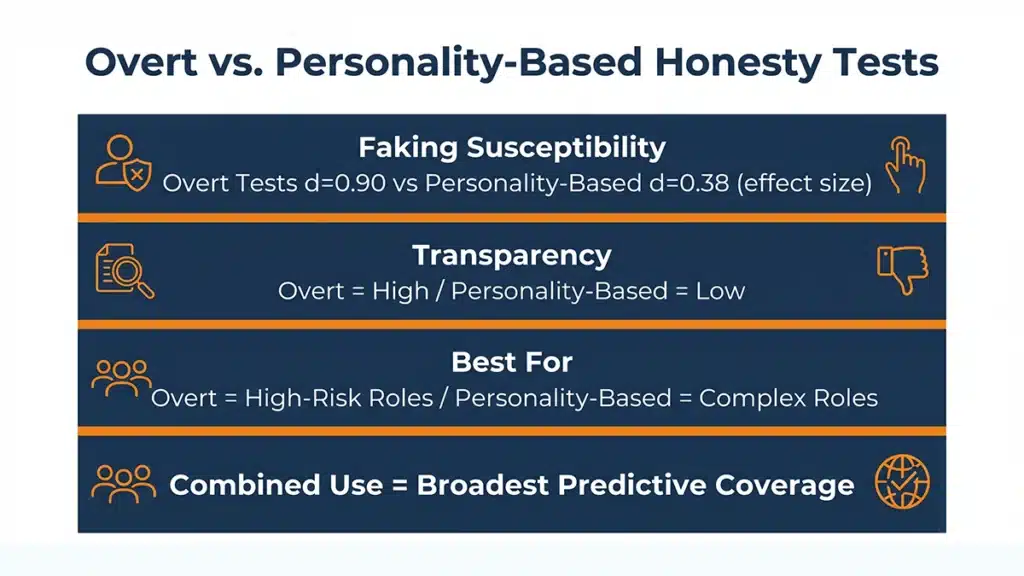
The limitation is faking susceptibility. SAGE research on faking susceptibility in integrity tests documents effect sizes around d = 0.90 for overt tests — significantly higher than personality-based formats. Candidates who recognize the intent of direct integrity questions can adjust their responses to present a more favorable profile than their actual behavior warrants.
Best suited for:
- Roles with direct access to cash, inventory, or high-value assets
- Entry-level and frontline positions where direct screening is operationally efficient
- High-volume hiring environments where speed and ease of administration matter
- Contexts where transparent screening builds rather than undermines candidate trust
Personality-Based Integrity Tests
Personality-based integrity tests assess the same underlying risk profile indirectly, through trait indicators such as conscientiousness, agreeableness, and emotional stability drawn from the Big Five personality model. Questions are less transparent in intent — candidates respond to behavioral preference statements rather than direct misconduct questions.
This indirect approach reduces faking susceptibility significantly. The same SAGE research documents effect sizes around d = 0.38 for personality-based formats — roughly half the faking susceptibility of overt tests. Candidates are less likely to recognize and game the scoring mechanism when integrity is assessed through trait indicators rather than direct questions.
The trade-off is transparency and scoring complexity. Personality-based tests are less intuitive for candidates to understand and for HR reviewers to interpret. They require more sophisticated scoring and more careful communication during the candidate experience.
Best suited for:
- Leadership, management, and senior professional roles requiring nuanced ethical judgment
- Customer-facing and collaborative roles where interpersonal conduct is a primary concern
- Environments where candidates are likely to be familiar with direct integrity test formats
- Organizations seeking broader behavioral coverage beyond rule-following and theft risk
Situational Judgment Tests (SJTs)
Situational judgment tests present candidates with realistic workplace scenarios and ask them to describe or select their most likely response. A question might describe a colleague falsifying records and ask what the candidate would do. Responses reflect ethical decision-making quality, willingness to intervene, and attitudes toward accountability under realistic conditions.
SJTs are harder to game than overt tests because there is no single obviously “correct” answer — the scoring rubric evaluates the quality of ethical reasoning, not just the surface-level response. They reduce adverse impact compared to both overt and personality-based formats when designed with appropriate role-specific scenarios.
Best suited for:
- Supervisory, people management, and high-responsibility roles
- Assessment centers where candidates are evaluated across multiple dimensions simultaneously
- Organizations prioritizing ethical decision-making quality over rule-compliance screening

Validity, ROI, and the Business Case for Each Format
A meta-analysis of 104 integrity test studies confirms corrected validity coefficients of .32 for counterproductive work behavior and .18 for job performance across both overt and personality-based formats. These figures establish honesty tests as among the strongest predictors of workplace conduct available in pre-employment screening.
|
Metric |
Typical Result |
Industry Reference |
|
Turnover reduction |
15–25% decrease |
Frank L. Schmidt meta-analysis |
|
Employee theft decline |
20–30% decrease |
IntegrityFirst Tests client data |
|
Test-retest reliability |
r = .75–.87 |
Multiple peer-reviewed studies |
|
Predictive validity (CWB) |
r = .32 (corrected) |
PubMed-indexed meta-analysis of 104 studies |
|
Faking susceptibility — overt |
d = 0.90 (high) |
SAGE Journals peer-reviewed research |
|
Faking susceptibility — personality-based |
d = 0.38 (moderate) |
SAGE Journals peer-reviewed research |
Organizations that deploy integrity assessments systematically across high-risk roles consistently report reductions in turnover and theft-related losses. Integrity screening also reduces workers’ compensation claim frequency by removing the highest-risk candidates from the pipeline before hire.
Common Candidate Myths and Concerns About Honesty Testing
Candidates approaching a pre-employment honesty test often carry assumptions that affect their responses — and occasionally their decision to continue with the application. Addressing these concerns proactively improves response quality, reduces candidate drop-off, and demonstrates the organization’s commitment to a fair and transparent process.
Myth: Honest people always pass and dishonest people always fail.
Honesty tests measure patterns of attitude and behavior, not a binary honest-or-dishonest determination. Borderline scores require context, not automatic disqualification. A candidate with a moderate score and strong references may present a very different profile than a candidate with the same score and inconsistent interview responses.
Myth: Overt tests can be gamed with the ‘right’ answers.
This concern is partially justified. The SAGE research on faking susceptibility confirms that overt tests have higher faking susceptibility (d = 0.90) than personality-based formats (d = 0.38). Combining both formats in a screening program reduces this vulnerability significantly. Reverse-scored items and inconsistency detection algorithms further reduce the impact of coached responses.
Candidate concern: Is this a polygraph? Is it legal?
Pre-employment honesty tests are written or digital questionnaires, not physiological monitoring instruments. They are fully compliant under the Employee Polygraph Protection Act, which prohibits polygraph-based testing but explicitly permits validated written integrity assessments. Being transparent about this distinction reduces candidate anxiety and eliminates a common source of application drop-off.
Candidate concern: Will my background or personal history unfairly flag me?
This is a legitimate concern that deserves a direct answer. Explain that assessment results are one input in a multi-dimensional evaluation. EEOC employment testing guidance requires that assessments be applied consistently and reviewed for adverse impact. If a candidate raises specific concerns about a question, document the conversation and review the item for potential bias.
Which Honesty Test Format Is Right for Your Organization?
The choice between an overt vs. personality-based honesty test — or a combination of both — depends on four factors: the risk profile of the role, the candidate population, the organization’s tolerance for faking susceptibility, and the level of transparency you want to maintain with candidates.
|
Role Type |
Recommended Format |
Rationale |
|
High-risk / financial exposure |
Overt + reverse-coded items |
Direct identification of theft-risk attitudes; reverse-coded items detect inconsistent responses |
|
Customer-facing / collaborative |
Personality-based + SJT |
Broader behavioral coverage; lower faking susceptibility; evaluates interpersonal ethical judgment |
|
Leadership / management |
Personality-based + open-ended |
Surfaces nuanced ethical reasoning and decision-making quality beyond rule compliance |
|
Entry-level / high-volume |
Overt (efficient) or combined |
Overt tests are fastest to administer; combined formats add predictive depth when time allows |
|
All roles — maximum coverage |
Overt + personality-based combined |
Broadest predictive coverage; overt flags direct risk, personality surfaces subtle behavioral patterns |
According to SHRM pre-employment testing guidelines, selecting the right assessment format for the specific role and risk profile is essential for both predictive validity and legal defensibility. When in doubt, combining overt and personality-based formats delivers the broadest coverage and the strongest legal foundation.
How to Implement Honesty Tests Effectively

- Select a validated tool with documented construct and criterion validity. Confirm the vendor provides a technical manual, independent validation study, and adverse impact data on request. Reject any vendor who cannot produce this documentation.
- Define role-specific deployment criteria. Match the test format to the risk profile of the position. Avoid applying the same format indiscriminately across all roles in your organization.
- Integrate with your ATS. Connect assessment delivery directly to your applicant tracking system to ensure consistent administration timing, scoring documentation, and audit trail integrity.
- Communicate transparently with candidates before the assessment begins. Provide written notice of the purpose, expected completion time, and how results will factor into the hiring decision. Address the polygraph question proactively.
- Score, interpret, and document results in context. Apply research-based rubrics. Do not treat any single score as a standalone hiring decision. Document how the assessment result was weighted alongside other evaluation inputs.
- Audit for adverse impact at least annually. Monitor scoring outcomes by demographic group. Investigate and address any patterns that disproportionately screen out candidates from protected classes.
How to Interpret Honesty Test Results
Honesty test scores provide a risk signal — not a verdict. The following score ranges offer a general interpretation framework. Adapt thresholds based on the specific role, the validated scoring criteria for your chosen instrument, and the broader candidate evaluation context.
|
Score Range |
Interpretation |
Recommended Action |
|
80–100 |
Clear low-risk profile |
Proceed to next evaluation stage; note any outlier responses for follow-up |
|
60–79 |
Borderline — further review warranted |
Weigh against interview data, references, and background checks before deciding |
|
Below 60 |
Elevated risk profile flagged |
Consider alternatives; if proceeding, document rationale and additional mitigating evidence |
A candidate with a borderline score and strong references from multiple verified employers presents a meaningfully different profile than one with the same score and inconsistent interview responses. The score opens the conversation — it does not close it.
When results diverge sharply from other evaluation inputs, investigate before deciding. A targeted behavioral interview question — “We noticed some variation in your responses about workplace accountability. Can you walk us through a situation where you had to make a difficult ethical call?” — often clarifies the discrepancy more usefully than the score alone.
Frequently Asked Questions
What is the difference between overt vs. personality-based honesty tests?
Overt vs. personality-based honesty tests differ primarily in how they measure integrity. Overt tests ask direct questions about past behavior and attitudes toward theft and rule-breaking — they are transparent, easy to score, but more susceptible to faking (d = 0.90). Personality-based tests assess the same risk profile indirectly through trait indicators like conscientiousness and agreeableness — they are less transparent but harder to game (d = 0.38). Combining both formats delivers the strongest predictive coverage for most hiring contexts.
Can candidates fake a honesty test?
Yes, to varying degrees depending on the format. Overt tests are more susceptible to coached or socially desirable responses. Personality-based tests are significantly harder to game because the scoring mechanism is less obvious. Using reverse-scored items, inconsistency detection, and a combination of overt and personality-based formats substantially reduces the impact of faking on scoring outcomes.
Which honesty test is best for high-risk roles like retail or cash handling?
Overt integrity tests are generally the most efficient choice for high-risk, high-volume roles like retail, cash-handling, and logistics. They directly identify theft-risk attitudes and are straightforward to administer and score at scale. Adding reverse-coded items and a brief personality-based supplement provides additional depth when the role warrants it.
Are pre-employment honesty tests legal in the United States?
Yes. Written and digital honesty tests are fully compliant under the Employee Polygraph Protection Act, which prohibits physiological monitoring but explicitly permits validated written integrity assessments. They must comply with EEOC guidelines — job-related, consistently administered, and regularly reviewed for adverse impact — to remain legally defensible.
How should HR communicate with candidates about honesty testing?
Be transparent before the test begins. Inform candidates of the purpose, the expected completion time, and how results will factor into the hiring decision. Clarify that the test is not a polygraph and is fully compliant with US employment law. Address the possibility of follow-up questions based on results so that candidates are not surprised if their score prompts a clarifying conversation during the interview.
Choose the Right Honesty Test for Your Organization
IntegrityFirst Tests provides validated, US-compliant honesty assessments in both overt and personality-based formats — built for HR teams that need accurate results, legal defensibility, and a candidate experience that builds trust rather than eroding it. Schedule a free demo with IntegrityFirst Tests and find the right format for every role in your hiring process.