Schedule a call!
The honesty tests for employment facts and research that actually matter to HR are simpler than the vendor noise suggests: a handful of well-established findings about what these assessments predict, what they do not, and how to use them defensibly. You do not need another pitch to “just hire honest people.” You need to know how strong the signal is, why study design changes the headline numbers, and how that affects your ROI and risk in high-volume hiring.
The stakes are real. U.S. employers face constant churn: the Bureau of Labor Statistics’ Job Openings and Labor Turnover Survey recorded roughly three million quits per month in 2024, and every avoidable exit in a high-risk role carries replacement, coverage, and safety costs. Below are six evidence-based facts to help you decide whether an honesty test belongs in your selection system.
Fact 1: They Predict Job Performance and Counterproductive Behavior
Integrity (honesty) tests are not a general “good employee” detector, but the research base is substantial. A landmark meta-analysis of 665 validity coefficients across 576,460 data points (Ones, Viswesvaran, and Schmidt, University of Minnesota) estimated a mean operational predictive validity of about .41 for predicting supervisory ratings of job performance, and found integrity-test validities positive across situations and settings. That is enough signal to change hiring outcomes when the tool is used consistently. The practical move is to align your success metrics to the behaviors the test predicts, such as near-miss rates, policy violations, shrink, and incident investigations, rather than to broad “90-day retention” alone.
Fact 2: It’s Broader Than Theft
It is tempting to treat a pre-employment honesty test as a shrink-control tool, but the same meta-analysis found that integrity tests predict the broad criterion of organizationally disruptive behaviors better than they predict employee theft alone. In a manufacturing or warehouse environment, the larger win may be fewer rule violations (PPE, lockout/tagout) and fewer attendance problems, even when shrink stays flat. If you only track theft, you will undercount the value and misjudge whether the test is working.
Fact 3: They Work Best Inside a System
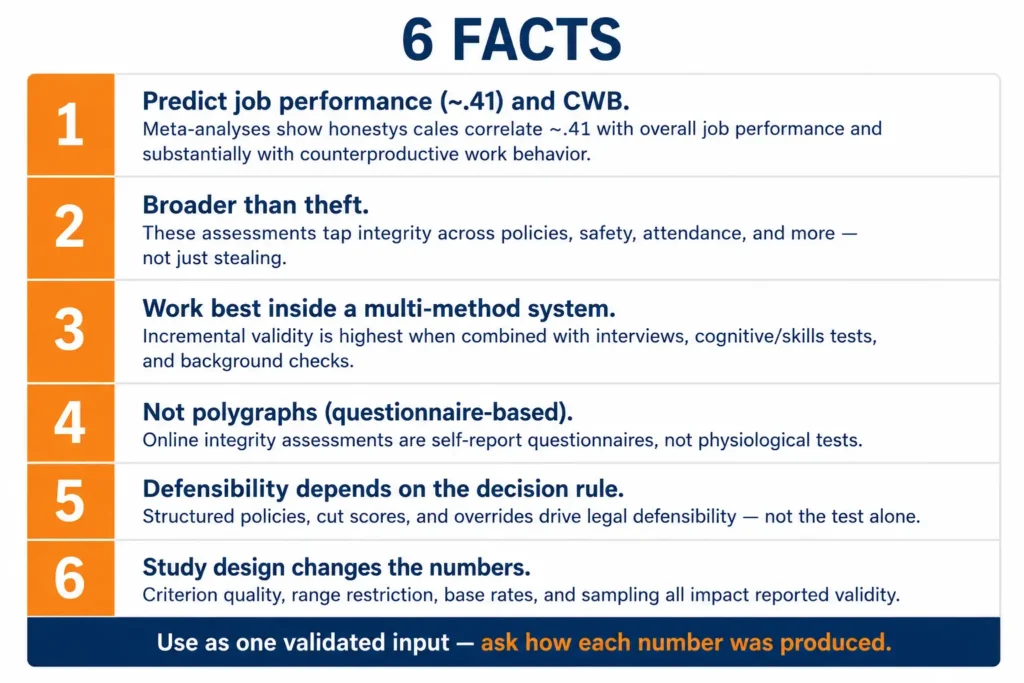
You can buy a defensible assessment and still see no improvement if you force it to carry the whole decision. Integrity measures add a distinct risk signal alongside other predictors, and they deliver the most value when combined with measures that cover different failure modes, such as a cognitive screen for training and error risk paired with an integrity measure for rule-breaking and incident-prone behavior. The implication is not “use more tests.” It is to build a stack where each tool covers a different risk, which reduces single-point failure in the process. Our guide to honesty tests for employee screening shows how the pieces fit together.
Fact 4: They Are Not Polygraphs
A common blocker is the assumption that an “honesty test” is a polygraph and therefore off-limits. It is not. The Employee Polygraph Protection Act restricts mechanical or electrical lie-detection devices, while the integrity tests used in hiring are written or online questionnaires about rule-following and past behavior, a different category. The label still matters: keep candidate-facing materials describing the tool as an integrity or work-behavior assessment, and confirm in writing that the vendor’s instrument is questionnaire-based rather than device-based. Our guide to honesty test legal compliance in hiring covers the polygraph distinction and the rest of the legal framework in detail.
Fact 5: Defensibility Depends on How You Use the Score
Even a well-researched test can create legal exposure based on your decision rule, not the questionnaire itself. Federal selection-procedure expectations emphasize investigating alternative procedures and alternative ways of using a procedure with less adverse impact. A hard cut score that auto-rejects a large share of applicants can create more exposure than using the same signal as a lower-weight screen or as part of a multi-hurdle process. Document why you chose your cut score, what alternatives you considered (such as banded ranges or different weighting), and why your approach balances business necessity against impact. The same compliance guide above details adverse-impact monitoring and the documentation a defensible program needs.
Fact 6: Study Design Changes the Headline Numbers
Much of the disagreement you will see in honesty tests for employment facts and research comes from how the studies were run, not just the instrument. The University of Minnesota meta-analysis noted that results from predictive studies conducted on applicants, using external criterion measures such as discipline records and incident reports, differ from results based on current employees or self-reports, and that those design choices shift what the test appears to predict best. The takeaway for HR: when a vendor cites a validity number, ask whether it came from applicants or incumbents and whether outcomes were operational records or self-reports, before treating it as transferable to your jobs.
What to Demand From a Vendor

You are not buying “an honesty test”; you are buying screening that will touch adverse impact and hiring velocity, and the vendor should prove it survives both. Ask for these in writing before you sign:
- Outcome-specific evidence: validity tied to counterproductive-behavior and risk outcomes, with the reported coefficients and what they predict best, not just “overall performance.”
- Study design details: whether evidence comes from predictive applicant studies or incumbents, and whether criteria used external records or self-report.
- How to use the score: recommended decision rules (cut scores, bands, weighting) plus the lower-impact alternatives they considered.
- Polygraph clarity: written confirmation the tool is a questionnaire-based integrity assessment, not a device-based lie detector.
- System fit: how the measure is intended to combine with other predictors instead of acting as a standalone gate.
- Operational metrics: expected completion rates, time-to-complete, and mobile experience so you can forecast throughput.
The Funnel Reality: Completion and Candidate Reactions
Even when the research case is solid, a program can still fail in the funnel. Integrity steps can lower starts-to-completes and increase abandonment on mobile, and in high-volume hiring a small completion drop can erase downstream gains. Treat completion rate and response quality as first-class metrics: watch completion by role and device type, and watch time-to-complete distributions to spot rushed responses. If drop-off spikes at the honesty-test step in a warehouse or CNA flow, you have a throughput problem that will change your ROI math, not a measurement problem. Our guide to the honesty test candidate experience covers how to message the step and protect completion, and the ROI of honesty tests in hiring shows how to model the tradeoff.
Honesty Tests for Employment Facts and Research: FAQ
What do honesty (integrity) tests predict best?
They predict job performance and a broad range of counterproductive work behaviors, and the research finds they predict broad organizationally disruptive behavior better than employee theft alone. Use them to reduce rule-breaking, safety and policy violations, and similar risk outcomes rather than as a general best-employee detector.
Are integrity tests mainly about theft and shrink?
No. The evidence links them to a wider set of disruptive behaviors, which is why they can matter for safety incidents, absenteeism, time-and-attendance fraud, and policy compliance even when theft does not move much.
Should you use an honesty test as a pass/fail gate?
Usually it works best as part of a system, adding risk signal alongside other predictors. A hard pass/fail gate is harder to defend and can crush a high-volume funnel; many teams do better with bands (proceed, review, do-not-proceed).
Why do vendors cite different validity numbers for the same kind of test?
Study design changes results. Applicant (predictive) studies can look different from incumbent studies, and external criteria such as discipline and incident records can produce different conclusions than self-reports. Ask who was tested and how outcomes were measured before treating a headline number as transferable.
Put the Research to Work
The honesty tests for employment facts and research point in one direction: these assessments work as one validated, job-related input in a governed selection system, not as a lie detector or a single-score veto. IntegrityFirst Tests helps US HR teams choose the right format, set defensible decision rules, and track the outcomes the research says to measure. Schedule a demo with IntegrityFirst Tests to build a program grounded in the evidence.