Schedule a call!
The same validated honesty test can sit in two companies’ funnels and produce opposite results. One team wires it into a defined workflow with clear triggers and next steps. The other drops it in as a standalone screen and watches candidates abandon the application while managers override scores they do not trust.
The test did not change. The process did. That is the part most buyers underestimate: using honesty tests in the hiring process is a workflow problem long before it is a test-selection problem.
Get the integration right and the honesty test becomes a quiet, consistent risk signal that speeds decisions. Get it wrong and you have bought friction, exception-handling, and a decision trail you cannot defend. The moving parts of using honesty tests in the hiring process are few and well understood: where the step lives, how it routes through your ATS, how it sequences with interviews and references, and how you turn a score into a documented decision.
Why Using Honesty Tests in the Hiring Process Is a Workflow Problem
An integrity test earns its keep when it is designed as a control, not a gut check with a number attached. Research consistently finds these assessments predict counterproductive work behavior and add value beyond cognitive measures, which we cover in our breakdown of the honesty tests for employment facts and research. But that signal only survives contact with your funnel if you tie it to a specific outcome and a specific action.
So start by naming the risk in plain language, theft, safety shortcuts, policy violations, attendance, and connect it to a metric you already track. Then make every result do something: assign an owner, a next step (advance, review, or add verification), and a time limit so a pending score never stalls a requisition.
Used this way, an honesty test standardizes decisions and cuts down on ad hoc exceptions. Wired in carelessly, it just gives recruiters one more flag to argue about. For the upstream version of this, defining the loss and safety risks before you assess, see our guide to how to implement an integrity risk assessment program.
Where the Test Belongs, by Role Type
Placement is the lever that makes or breaks the program, and it is the first decision when using honesty tests in the hiring process. Too early and you add friction before you know a candidate is even eligible, which drives drop-off. Too late and the result becomes noise an interviewer has already talked themselves past.
The right timing is really a judgment about cost, volume, and how much context a candidate needs to take the honesty test seriously.
| Role type | Where the test belongs | What you are optimizing for | Common failure mode |
| High-risk hourly (forklift, chemical handling, patient transport, cash handling) | After minimum qualifications, before high-touch steps | Preventing costly counterproductive behavior without spending on unqualified applicants | Running it before confirming licensure or shift availability, which inflates drop-off and credibility complaints |
| High-volume (warehouse pickers, hospitality, seasonal retail) | Early, but after a basic eligibility check | Throughput and candidate experience while still trimming interview load | Firing it the instant someone clicks “Apply,” before verifying start date, commute, or schedule |
| Professional and supervisory (charge nurses, maintenance leads, shift supervisors, buyers) | After an initial structured interview, before references and final | Adding a reliability signal where context already exists | Treating a single score as a veto over a strong interview record |
Wiring It Into Your ATS
The integration points are where good programs quietly fail: an expired link, a status that never syncs, a disclosure nobody automated. Treat the honesty test as a timed handoff inside your applicant tracking system, not a link a recruiter remembers to send.
Configure four things and the program mostly runs itself:
- A single trigger stage, so the invite fires at the same point every time.
- An expiration and reminder rule, so candidates are not lost in limbo.
- Automated disclosure language, so every applicant gets the same explanation of what the step is and how results are used.
- Score-to-disposition mapping, so a result routes to a standard next step instead of a recruiter’s inbox.
Consistency here is not just operational hygiene; it is part of responsible test use. The International Test Commission’s Guidelines on Test Use set out good-practice standards for administering, scoring, and interpreting assessments the same way for everyone and protecting test-taker rights. Uniform ATS configuration is what makes using honesty tests in the hiring process repeatable at scale, so lock access to need-to-know roles and log every event for the audit trail.
[IMAGE 2 — INFOGRAPHIC — using-honesty-tests-in-the-hiring-process-workflow-infographic.png | Infographic of a hiring workflow showing where honesty tests fit in the hiring process]
Sequencing It With Interviews and Reference Checks
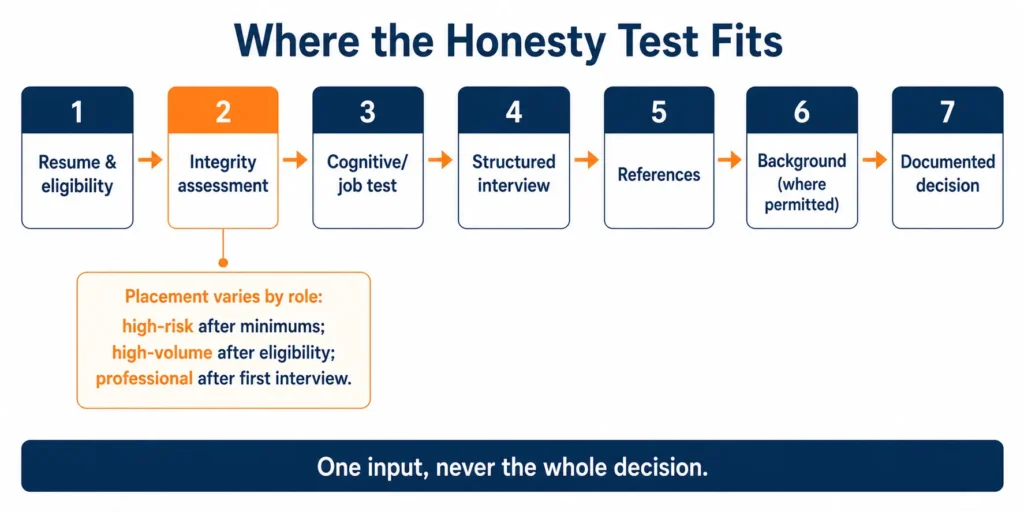
A score is one input, and the strongest programs treat it that way by giving each step a distinct job. A workable order for most roles looks like this:
- Resume and eligibility screen to confirm the basics (qualifications, schedule, work authorization).
- Integrity assessment to add an early, standardized read on reliability and counterproductive-behavior risk.
- Cognitive or job-specific assessment where the role warrants it, since integrity plus ability predicts better than either alone.
- Structured interview that probes the same themes the score raised, such as policy adherence and accountability.
- Reference checks focused on job-relevant behavior.
- Background screening where appropriate and legally permitted.
- Documented decision that weighs all of the above.
This is not just good hiring hygiene; it reflects a core testing principle. The National Research Council’s review of high-stakes testing concluded that an important decision should never rest on a single test score, and that scores should always be combined with other sources of information, a principle laid out in the National Academies’ High Stakes report and one that travels directly into hiring.
So when a score is borderline, the interview and references are where you resolve it, not a snap rejection. For placing the step so it adds signal without bleeding off applicants, see our guide to honesty tests for employee screening, and for the broader build, how to implement integrity assessments in hiring.
Setting Cut Scores and Documenting the Decision

A cut score is not a line between good and bad people. It is a policy choice about how much risk you will accept, and you own that choice.
The APA Standards for Educational and Psychological Testing put the burden on the test user to confirm a tool has enough validity evidence and score reliability for the specific way it is being used, which is the question to answer before you set a threshold. In high-volume hiring, bands usually beat a hard pass/fail: green advances, yellow triggers a structured follow-up, red stops the process, and only the lowest band carries decisive weight.
Whatever you choose, write it down before launch: what each band triggers, who can override and on what basis, your retest rule, and who sees the score. Do that and a decision made in March is still explainable in September.
Watching for Adverse Impact
The last piece is monitoring, and it is non-negotiable once the step affects who gets hired. Track selection rates by group at the assessment stage and apply the federal four-fifths rule: if any group’s selection rate falls below 80 percent of the highest group’s, treat it as a trigger to investigate before you scale.
That responsibility stays with you even when a vendor supplies a technical manual, so keep the analysis on a set cadence and document what you found and did. Steady monitoring is what keeps using honesty tests in the hiring process defensible as you grow, and our guide to honesty test legal compliance in hiring walks through the EEOC standards, the four-fifths calculation, and the documentation a defensible program needs.
Build a Workflow You Can Defend
Using honesty tests in the hiring process well comes down to disciplined integration: the right placement, clean ATS routing, a sensible sequence, defensible cut scores, and steady monitoring.
IntegrityFirst Tests helps US HR teams configure all of it, from trigger timing to decision documentation, so the program delivers a consistent signal and holds up to scrutiny. Schedule a demo with IntegrityFirst Tests to map the workflow to your roles.