Schedule a call!
In high-volume hiring, the losses that hurt most rarely come from one dramatic event. They come from hundreds of small, unsupervised choices: a scan step skipped, a safety routine shortcut, a cash drawer treated loosely. A well-chosen honesty test gives HR a structured way to screen for the rule-following and accountability those roles depend on, so you protect throughput and can defend the process when Legal or Operations pushes back.
Used that way, a written integrity assessment is a risk-management tool, not a way to expose dishonest people. This page is the hub for how US HR teams put honesty tests to work: what they actually measure, where the signal is strongest, how to keep the program legally defensible, and how to tie results to the turnover and shrink numbers Finance already tracks. Each section points to a deeper article when you want the detail.
The Real Problem a Honesty Test Solves
A site lead watches shrink climb and assumes it is a training gap, until the same pattern shows up across shifts where no one is watching. The cost is almost never a single incident. It is the accumulation of small decisions in roles with constant discretion and thin oversight.
Honesty tests do not address the cinematic problem of unmasking a liar. They address the expensive, ordinary problem HR actually owns in high-volume hiring: preventable counterproductive work behaviors that surface as shrink, time theft, and safety shortcuts. Positioned as a way to prosecute candidates, the tool produces pushback and weak returns. Positioned as a way to lower predictable workforce risk, it fits naturally into a screening stack.
Consider the warehouse associate who keeps “finding” unscanned items, or the line worker who normalizes lockout-tagout workarounds to keep pace. Integrity testing targets the underlying pattern: how consistently someone follows rules and handles temptation when supervision is light. That focus is why the honesty test belongs in turnover and ROI conversations rather than in a debate about reading minds.
What a Honesty Test Actually Is
When most HR teams say “honesty test,” they mean a written pre-employment integrity assessment, usually delivered online, not a device that claims to detect deception. Treating the two as the same thing creates avoidable compliance risk, which is why labeling each selection step accurately matters before the program ever reaches a candidate.
The distinction has a legal basis. The federal Employee Polygraph Protection Act treats “lie detectors” broadly, covering polygraphs and similar instruments, but it explicitly excludes written and online honesty and integrity tests, whether scored by hand or by machine. Stating this upfront saves time and political capital the moment Legal or Operations hears “lie detector” and reacts. You are evaluating job-relevant signals such as rule-following and accountability, not interrogating applicants.
For the full picture of what these instruments are and how HR uses them day to day, see our overview of employee honesty tests and how HR applies them and the end-to-end view in honesty test for employee screening.
When a Honesty Test Adds the Most Signal
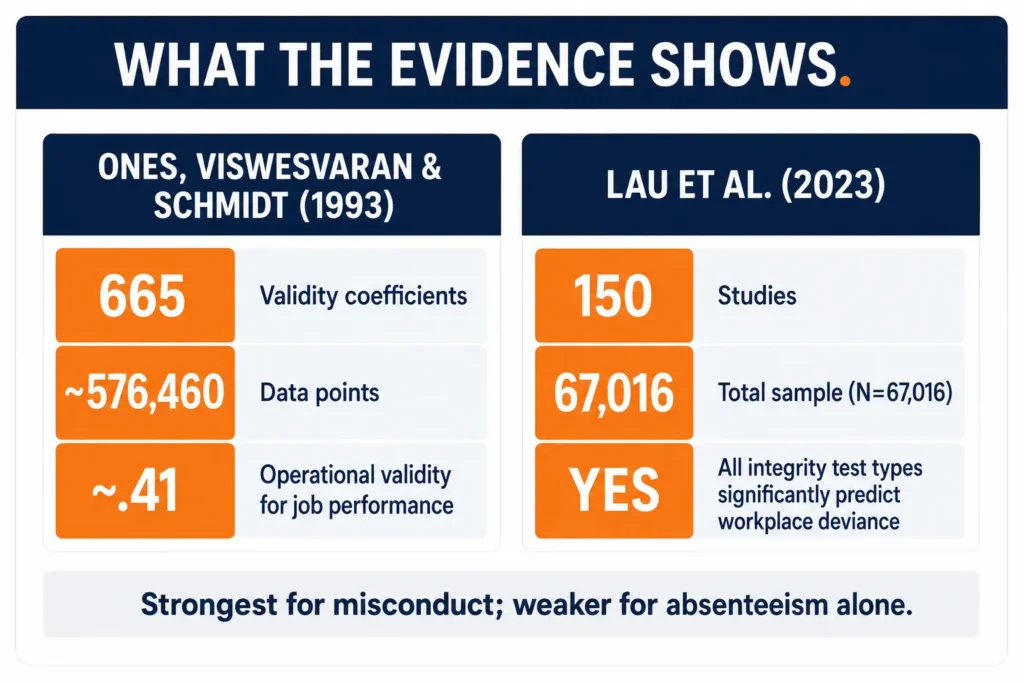
The evidence is more specific than most vendor decks admit, and you should hold it to that standard. The foundational meta-analysis by Ones, Viswesvaran, and Schmidt in the Journal of Applied Psychology (1993) aggregated 665 validity coefficients across roughly 576,460 data points and reported a mean operational validity near .41 for job performance, with generalizable validity for counterproductive behaviors such as theft, disciplinary problems, and absenteeism. More recently, a 2023 meta-analytic review in the Journal of Pacific Rim Psychology combined 150 studies (N = 67,016) and found that every category of integrity test analyzed significantly predicted workplace deviance.
That signal is real, but it is not universal. The same body of research shows integrity tests are far stronger at predicting misconduct than at predicting absenteeism alone, so a no-call/no-show problem needs other levers too. The practical question is where the signal maps onto your role’s day-to-day risk.
A honesty test works best where the job repeatedly places people in ambiguous, low-supervision moments in which a small choice becomes a large downstream cost. A high-volume picker who can bypass scan steps, or a retail associate who routinely handles cash and returns, faces that kind of frequent discretion. In those jobs, even a small improvement in rule-following shows up as fewer incidents, lower early-tenure churn, and smoother operations. The full evidence base is laid out in our breakdown of honesty tests for employment facts and research.
The signals that tell you a role is a good fit are consistent: high access to money, inventory, controlled substances, or customer data; low real-time oversight with many micro-decisions across nights, split shifts, or remote sites; known loss patterns such as shrink, safety incidents, or early-tenure drop-off; and rules that are easy to rationalize bending under pressure.
Overt vs. Personality-Based: Choosing the Right Format
The format you choose shapes how the step feels to candidates and what kind of risk signal you get back. You are typically deciding between overt integrity tests, which ask directly about attitudes toward theft, rules, and past behavior, and personality-based tests, which infer risk from traits such as conscientiousness, dependability, and impulse control.
Overt tests can feel more transparent, which helps when you want candidates to understand the purpose of the screen and you need a simple explanation for operations leaders tired of shrink and policy workarounds. That same clarity can invite coached responding, especially once applicants trade tips in high-volume labor markets. Personality-based tests are harder to reverse-engineer, which can reduce faking pressure, but they feel less obviously job-related unless you anchor them to the specific ways people slip in the role. The comparison that walks through faking susceptibility, role matching, and score interpretation is our guide to overt vs. personality-based honesty tests.
The starting point is not the format but the problem you are paying to reduce: counterproductive behaviors first, not polished résumés.
Legal Defensibility and EEOC Alignment

Whether the honesty test category is “legal” is the wrong question. The real question is whether your use is job-related and defensible if it produces adverse impact. Under the EEOC’s guidance on employment tests and selection procedures, any selection tool must be validated and consistent with business necessity, and you must monitor selection rates so you can address disparities before they become a pattern.
Two practices keep the program defensible. First, document the role’s real risk exposures, such as cash handling and safety-critical shortcuts, then align the assessment to those behaviors. Second, track selection rates by protected class across sites so you can adjust early. Professional standards reinforce this discipline: the Association of Test Publishers’ Model Guidelines for Preemployment Integrity Testing set expectations for validation, fairness, confidentiality, and alignment with federal law, including the ADA. The complete framework, including state-level limits and documentation, lives in our guide to honesty test legal compliance in hiring.
A consistent, documented honesty test program is also far easier to roll out across locations, because the same job-related rationale travels with it. The connection between a defensible process and the culture it supports is the focus of our article on honesty tests for hiring and workplace trust.
Candidate Experience Without Weakening Signal
How the step lands with candidates is an HR design choice, and it directly affects your data quality. A qualified applicant who hits an assessment link with vague instructions may assume it is a trick and close the tab; the ones who stay can shift into performance mode, which is exactly what you do not want.
Completion rates and clean data improve when you treat the honesty test like any standard, job-relevant assessment. Place it after basic eligibility checks such as work authorization and shift availability, but before time-heavy steps like panel interviews. Explain in plain language that you are measuring rule-following and reliability in roles with real discretion, and set a clear retest policy in advance. Keep communications consistent across locations so applicants do not circulate competing “how to beat it” narratives. The framework for reducing drop-off without softening standards is in our guide to the honesty test candidate experience.
Where the Honesty Test Fits in the Hiring Workflow
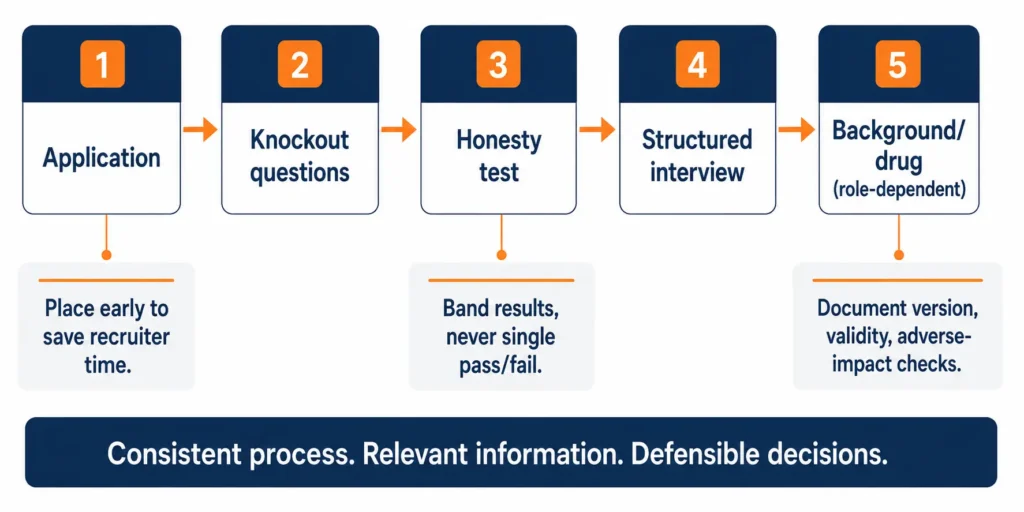
A program succeeds or fails on where the test sits and how results are handled. In a warehouse or retail hiring sprint, the sequence is usually: application, knockout questions, honesty test, brief structured interview, then background or drug screening where the role requires it. Placing the assessment early saves recruiter and hiring-manager time; wiring it cleanly into the ATS keeps the process consistent across sites.
Avoid a single pass/fail cutoff. Band results into clear tiers and combine them with structured-interview and work-history signals so no one score decides the hire. Keep a documented trail of the test version, the vendor’s validity evidence, and your adverse-impact checks. The detail on placement, trigger configuration, sequencing, and cut-score documentation is in our guide to using honesty tests in the hiring process.
Proving ROI to Leadership
You do not need a formula that converts an honesty test score directly into dollars. You need a defensible story that ties the test to costs you already own and report: early-tenure turnover, shrink, and safety incidents. In high-volume environments, small percentage shifts matter because you hire in bulk.
Start with a simple pre/post or test-versus-no-test comparison using metrics you can pull from your HRIS and incident logs, such as 30/60/90-day turnover and shrink exceptions per 100 hires. When a “red band” cohort shows higher 60-day attrition and more write-ups for scan compliance, the return becomes operational rather than theoretical: fewer poor fits entering the funnel means fewer downstream separations and fewer loss events. The full business case, including the link between integrity screening and retention, is in our guides to the ROI of honesty tests in hiring and how honesty tests reduce employee turnover. For the strategic view of how these decisions compound over time, see honesty tests for HR hiring decisions, and for a broad entry point, honesty tests for employment.
Frequently Asked Questions
Is a honesty test legal, or does it count as a “lie detector” under EPPA?
Written pre-employment integrity tests are not polygraphs, and EPPA’s lie-detector restrictions do not treat them the same way. The compliance work is in how you use the test: job-relatedness, consistency across candidates, documentation, and adverse-impact monitoring. The full framework is in our honesty test legal compliance guide.
Could a honesty test create EEOC exposure if it screens out more people in one group?
“It’s an honesty test” is not a legal shield. If selection rates differ across protected groups, you need evidence the test is job-related and consistent with business necessity, plus a process to review and adjust. Build the audit trail and monitor outcomes by role and site from day one.
How do you keep candidate experience from lowering completion rates?
Tell candidates what you are measuring, place the step before time-heavy stages, and apply a retest policy consistently. A step that feels like a trap trains people to perform rather than respond honestly. Our candidate experience guide covers the communication framework.
Can applicants fake or get coached on a honesty test?
Some will try, especially when the intent is obvious or applicants share tips in high-volume markets, so design for that reality. Match the test type to your risk and rely on score bands plus structured-interview signals rather than a single cutoff. Our overt vs. personality-based comparison explains the tradeoffs.
What is the cleanest way to explain ROI to leadership?
Tie results to costs you already report, such as early-tenure turnover, shrink, and policy-violation separations, then compare outcomes across score bands or before and after rollout. The ROI guide walks through the metrics.
Put a Defensible Honesty Test Program to Work
A honesty test pays off when it is validated, job-related, positioned honestly, and used as one input in a process your managers and candidates can predict. IntegrityFirst Tests helps US HR teams match the right format to each role, set decision rules that hold up, and wire the step into the hiring workflow so it lowers risk instead of adding friction. Talk with IntegrityFirst Tests to scope a program for your highest-discretion roles.