Schedule a call!
An honesty and integrity test for selection helps employers screen for trust, accountability, and workplace risk before costly hiring mistakes happen.
You know the cost of a single bad hire in time and budget. It can feel like every misstep in the hiring process leads to higher employee turnover. If candidates who seem dependable turn out to be risk flagged, trust in your screening tool can take a hit.
Frustration with honesty and integrity tests is widespread. From candidates who “fail” on consistency, to debates about whether screening reliability is grounded in hard science, confusion reigns. Both research and high-profile books like Adam Grant’s “Give and Take” point out, judging integrity isn’t as clear-cut as HR would hope.
Here’s the good news. A precise, actionable approach exists. This guide walks you through each step of mastering the integrity test and honesty screening process, so you can reduce risk, screen smarter, and build a talent pipeline of trustworthy team members without a hitch.
What Is an Honesty and Integrity Test for Selection?
Honesty and integrity tests for selection are structured pre-employment assessments designed to identify high-risk candidates before they become costly hires. These tests measure reliability and trustworthiness.
According to a comprehensive Journal of Applied Psychology meta-analysis, integrity tests show substantial predictive validity for job performance.
Designed as both a gatekeeper and a diagnostic tool, these assessments include overt honesty tests. These evaluate temperamental risk factors like anger propensity and dependability. Both types draw on applicant responses to reveal underlying attitudes.
Used correctly, honesty tests reduce employee screening guesswork.
Organizations that track the ROI of integrity testing often find that even small reductions in workers’ compensation claims quickly offset the cost of the assessment itself. Read more in our article: Roi Of Integrity Testing
They help hiring managers and HR teams avoid the hire and hope cycle that can drive up bad hire cost and employee turnover. As Laszlo Bock advocated at Google, rigorous assessment methods enable organizations to hire smarter and build a culture of accountability.
Choosing these tools means taking due diligence seriously, to protect your team, your brand, and your bottom line.
Step 1: Identify Key Roles and Risks for honesty and Integrity Test

You can sense your stomach drop reading about a new workplace violence case or major asset loss. That fleeting moment of concern is what you want to avoid because, as Angela Duckworth might say, grit and good intentions alone aren’t enough to prevent risk factors from becoming real costs.
Doing your due diligence on role-based risks isn’t box-ticking. It’s the foundation for workplace integrity and smarter hiring decisions.
High-Risk Job Roles:
- Financial handlers: Responsible for company assets and fraud risk.
- Security/sensitive data roles: Manage confidential data or access controls, and one mishap can lead to large-scale liability.
- Warehouse/distribution workers: High exposure to goods and equipment.
- Childcare/education positions: Charged with vulnerable populations and requiring unwavering trust.
- Customer-facing employees: Direct access to client assets with risk for both direct theft.
Core Risk Factors:
- Theft: Unauthorized removal or use of assets leads to operational and legal compliance consequences.
- Absenteeism: Reliable attendance is critical. Chronic absenteeism signals underlying responsibility risk.
- Workplace violence: Exposure increases with sensitive positions and stress, damaging culture.
Targeting high‑risk roles with integrity screening can prevent a significant share of workplace harassment incidents before they escalate into legal exposure. Read more in our article: Integrity Assessments To Prevent Workplace Harassment
- Liability: Roles with higher liability must meet higher workforce quality thresholds.
- Access to sensitive data: Poor oversight puts business data at risk. Screening applicants is essential.
Step 2: Select the Right Honesty and Integrity Test

According to a Journal of Applied Psychology meta-analysis, integrity tests show corrected predictive validities of .32 for counterproductive work behavior and .09 for turnover. That kind of statistical confidence helps move your hiring process from a best-guess to a safe hire model, especially when you factor in cost and compliance.
The reality is that some tests suit certain jobs better than others. When it comes to designing your integrity assessment process, as Patrick Lencioni might say, it pays to focus less on quick wins and more on real trustworthiness for your workplace culture.
A rubric-ready screening tool can help ensure you aren’t just checking boxes. Instead, you are actually reducing risk.
| Test Type | Predictive Validity Score | Legal Considerations | Best-Fit Roles | Anti-Faking Measures | Approximate Duration |
|---|---|---|---|---|---|
| Overt | .33 (OPM data) | Clear but state-dependent | Financial, warehouse, security | Consistency checks | 8-15 min |
| Personality-based | .28 (OPM, Personnel Psych) | EEOC/title VII caution | Broad white/blue collar, customer-facing | Inconsistency detection | 15-25 min |
When selecting a test, vet vendors for compliance with employment law and technical reliability. Confirm test validity with published assessment report samples. Look for multilingual options and flexible scoring. Always align your selection with the real risk factor overview for each job family or department.
Step 3: Integrate the honesty and integrity Test Into Your Hiring Process
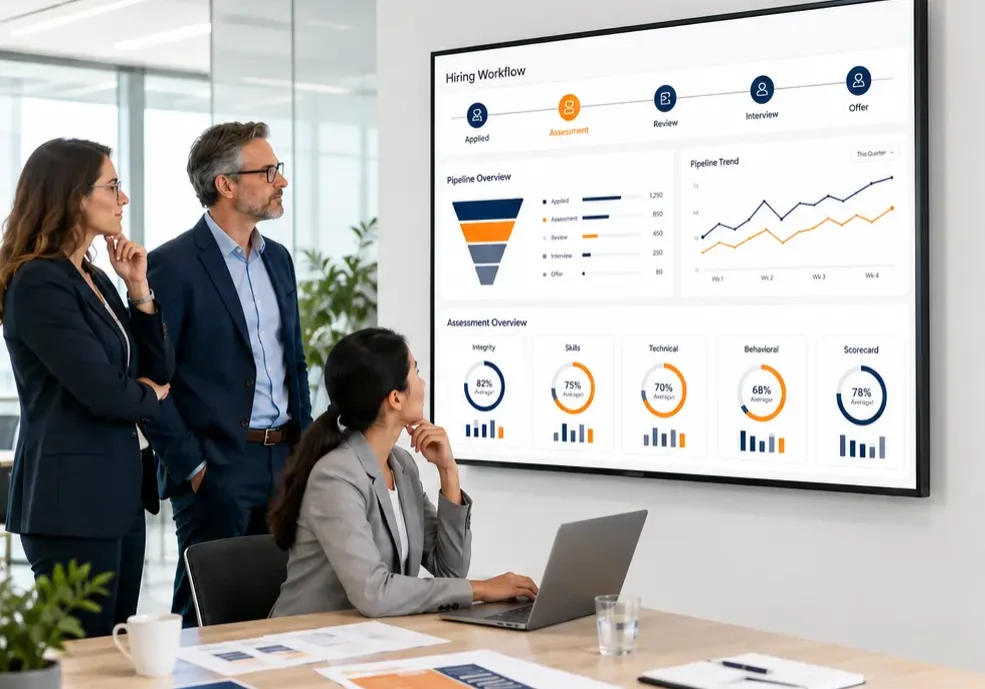
Imagine your whole hiring team in crisp blazer suits, moving through interviews with confidence, the process humming along with no surprises. That sense of control and certainty is yours when every stage follows a clear path.
Integrating candidate assessment tools seamlessly means you gain more than efficiency; you strengthen your hiring smarter reputation and ensure candidate perceptions stay positive. This also helps your company compete for the best.
1. Choose the Right Stage for the honesty and integrity Test
Placing the honesty or integrity test after initial resume screening but before background checks is best for HR workflow and fairness. For instance, adding self-report questions early nets red flag candidate insights before time investment. Ensuring the test comes before job fit interviews also keeps assessments unbiased.
2. Communicate the Test’s Purpose Clearly
Every candidate deserves to know why an integrity test is part of your screening best practices. Use a short, direct script: “We include integrity assessments for all our positions because we prioritize employee honesty and workplace safety. Your responses will be handled with confidentiality and results are one part of a broader hiring process.”
3. Set and Share Realistic Timelines
Aim for transparency by posting test duration (in minutes) in your candidate assessment portal. For example, if the process from self-report to interview spans one week, give a 48-hour window to complete the test. This builds trust and keeps hiring faster than the market average.
4. Handle Candidate Data with Care
Data security isn’t just legal compliance; it’s ethical responsibility. Restrict access to test scoring outputs and store reports through secure encrypted systems. Make sure every HR reviewer is trained on privacy and candidate screening requirements. Secure data is table stakes for today’s sensitive data roles.
5. Build User-Friendly HR Workflows
Smooth workflows speed up review and enable quick circle back when additional assessment is needed. Automate reminders (e.g. via HRIS platforms) and use dashboards for consistency checks. This ensures your team never overlooks what matters for workplace safety or employee retention.
Ensure Legal and Ethical Compliance
It sounds counterintuitive, but integrating honesty and integrity test is often trickier than implementing cognitive assessments. A Journal of Applied Psychology critique highlights that methodological errors and poor validation can undermine compliance and outcomes.
Getting it wrong is more likely to backfire than a traditional skills assessment. With Dan Ariely’s research in mind, legal pitfalls can arise from even well-intentioned screening legalities if they drift from fairness and transparency. Box-ticker compliance won’t protect your organization from potential claims. Or real reputational damage.
Start with a clear compliance checklist: verify EEOC fit, check relevant state laws, and prioritize transparency in candidate communications. Implement data privacy protections—GDPR or CCPA standards. Document candidate rights for access and recourse.
Regularly audit both test questions and interview follow-up practices for any sign of cultural bias or disparate impact. Train HR on methodology, record-keeping, and continuous improvement to keep your employee retention. And your reputation secure.
Step 4: Interpret and Act on Assessment Results
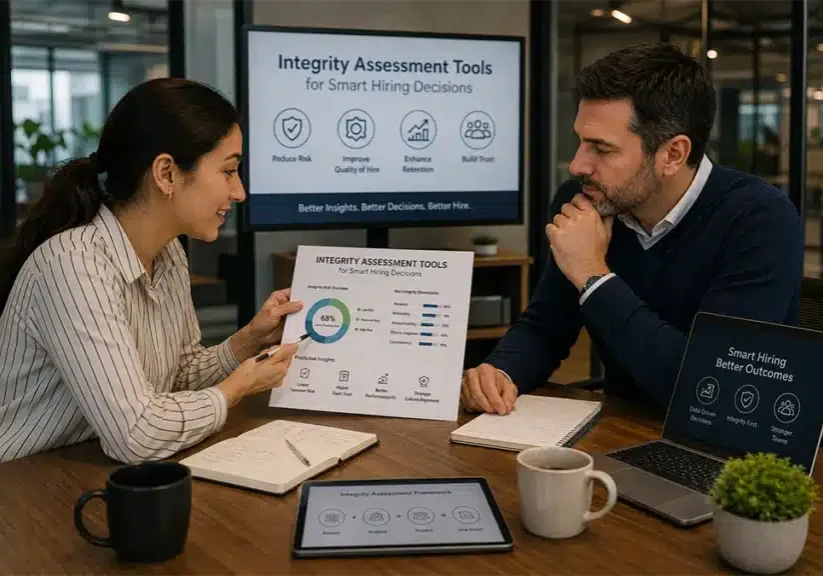
Picture this: smart-casual shoes pacing confidently as you review an assessment report that instantly highlights a culture add, not just a fit. The clarity you get from precise scoring and clear signal flags means your hiring team can pivot with speed. Interpreting honesty and integrity test results starts with checking for risk indicators.
High scores may signal a strong match, while inconsistency detection should prompt closer review and custom interview questions.
For instance, a candidate’s background checks may align, but a flagged faking scale or unaddressed problem behavior should trigger a structured follow-up interview. This helps ensure fairness and builds your organization’s paper trail. When you document each decision point, you also reinforce best practices in employment law and workplace ethics.
A transparent, stepwise approach gives everyone confidence, candidates included, that each assessment and decision is driven by objective data and ethical review, not a gut feel. That’s the foundation for hiring faster without cutting corners on quality or fairness.
Use Assessment Reports and Structured Interview Questions
Imagine an interviewer channeling Oprah Winfrey’s genuine curiosity as they dig deeper into a candidate’s risk factor overview. That type of diligence transforms candidate perceptions and ensures your job fit decisions reflect more than gut feel.
When a red flag pops up, such as a question about following directions or a reported conflict with supervisors, a personalized, gut-check question can reveal more than any automated process ever will.
Follow-Up Interview Topics:
- Exploring gaps in self-report answers: Uncover possible inconsistencies in responses for cognitive aptitude context.
- Clarifying situational judgments: Ask for examples of resolving conflicts with supervisors to probe judgment.
- Probing for attitude toward rules: Gauge responses to policies for financial roles or security roles.
- Discussing responses to hypothetical dilemmas: Assess anger propensity by testing reactions to scenarios.
- Reviewing adaptability to workplace culture: Explore how candidate would manage customer complaints or productivity issues.
- Verifying ethical standards: Tailor questions to check values for childcare hiring. For sensitive positions, tailor questions when multiple languages or diversity are factors.
Step 5: Measure Outcomes and Optimize for Better Hiring
As Simon Sinek might remind us, real leadership is measured by outcomes not just intentions. Tracking the effects of new integrity assessment initiatives gives your team data to justify decisions and drive meaningful change. Consider this straightforward benchmarking applicants approach to track real hiring impact:
| Metric | Before Test (%) | After Test (%) | Change | Notes |
|---|---|---|---|---|
| Turnover Rate | Employee retention annualized | |||
| Comp Claim Frequency/Cost | Workers comp reported in dollars | |||
| Lost-Time Absenteeism | # of hours days lost per year | |||
| High-Risk Candidate Rejection | Based on integrity test outcomes | |||
| ROI on Integrity Test Investment | Cost savings vs. test expenses |
Well‑designed integrity questionnaires can surface disengaged, high‑risk applicants whose behaviors are strongly linked to higher workers’ compensation costs and turnover. Read more in our article: How Employee Disengagement Affects Workers Compensation Costs
With this table, you can diagnose where your hiring process beats industry averages or mind the gaps. You might, for instance, find decreases in turnover paired with a greenlight for onboarding more rigorously screened new hires. Use the results to recalibrate your risk threshold and refine your approach.
Want to reduce costly turnover? See how IntegrityFirst’s evidence-based integrity tests can help streamline your hiring, schedule a demo today.
Build a Trusted, Productive Workforce With Integrity Testing
There’s a feeling of reassurance when your organization runs like a well-oiled machine with teams built on trust and real accountability. That workplace transformation is within reach. Like Michelle Obama who champions integrity at every level, you know a values-driven culture pays compounding dividends in reduced risk and greater performance.
Careful screening creates a paper trail of strong hires. These are people who back each other up and help your organization reach its goals faster. With a robust integrity process, you don’t just mind the gaps, you close them for good. Connect with IntegrityFirst for tailored support on implementing your next-generation integrity program.