Schedule a call!
Every operations leader knows the slow bleed: a little inventory missing each month, attendance that frays on the night shift, a safety corner cut that turns into a claim. No single hire ever looks like the cause, so when honesty tests for employment come up in a staffing meeting, the room usually splits in two: one camp hears “finally, something that helps,” the other hears “isn’t that basically a lie detector we’ll get sued over?” Both reactions miss.
A validated integrity test is neither a cure-all nor a legal trap. It is a standardized read on the behaviors that quietly drive cost, theft, rule-breaking, absenteeism, and injuries, and it pays off only as one input among several. So before you buy one or rule it out, it helps to know what these tests actually measure, how strong the signal really is, what the law lets you do, and where the value and the limits land.
What Honesty Tests for Employment Are and How They Work
Strip away the marketing and an honesty (integrity) test is a short written or online questionnaire that estimates how likely a candidate is to engage in counterproductive behavior at work, things like theft, rule and safety violations, time fraud, and chronic absenteeism. It does not read minds and it does not judge character. What it produces is a probability, not a verdict.
In practice, a candidate answers a set of standardized questions, the responses are scored against a validated model, and you get back an overall integrity score plus a few subscales, often something like attitudes toward theft, drug avoidance, safety, and dependability. A high score points to lower risk; a low score is a flag to slow down and look closer. The score is there to inform your decision, not to make it for you. Most tests come in one of three flavors, and picking the right one for the job matters more than the brand on the box:
- Overt tests ask candidates directly about attitudes toward theft and rule-breaking. Everyone can tell what they are measuring, which makes them easy to read and, unfortunately, easier to game. They fit clear policy-risk screens in high-volume hiring.
- Personality-based tests come at it sideways, inferring risk from traits like conscientiousness, dependability, and impulse control. They are subtler and travel well across a lot of different roles.
- Hybrids mix the two and often add consistency checks to catch answers that look too polished to be true.
If you are weighing one against the other, our comparison of overt vs. personality-based honesty tests breaks down when each makes sense.
What the Evidence Shows
Here is where most vendor decks get selective, because the research does not all point the same way. Decades of studies agree the tests predict something real; they disagree on how big that something is, and the gap almost always traces back to how a study was designed. These are the sources worth knowing.
| Source | Context | Key finding |
| Ones, Viswesvaran & Schmidt (1993), Journal of Applied Psychology | Meta-analysis: 665 validity coefficients, 576,460 data points | Mean operational validity of about .41 for job performance; integrity tests predict broad counterproductive behavior more strongly than theft alone. |
| Van Iddekinge, Roth, Raymark & Odle-Dusseau (2012), Journal of Applied Psychology | Updated meta-analysis (104 studies) | More conservative: observed validity near .12 for job performance and .26 for counterproductive behavior (corrected to roughly .15 and .32); publisher and non-publisher samples differed. |
| Oliver, Shafiro, Bullard & Thomas (2012), Journal of Business and Psychology | Field study across four industries (n = 33,418) | In every industry, unscreened employees filed workers’ compensation claims at a higher rate than integrity-screened employees, and each claim cost more on average. |
| U.S. Office of Personnel Management — Integrity/Honesty Tests | Federal assessment guidance | Recognizes integrity tests as valid predictors of theft, absenteeism, and job performance, links them to conscientiousness, finds only small score differences by race or sex, and notes strongly negative candidate reactions are rare. |
| U.S. EEOC — Employment Tests and Selection Procedures | Federal anti-discrimination guidance | Treats integrity and personality tests like any other employment test: allowed when job-related and not discriminatory, with weight on validity and consistent use. |
Put those together and the takeaway is not “the tests work” or “the tests are oversold.” It is that they carry a genuine, generalizable signal whose strength depends on who was tested (applicants behave differently from current employees) and how the outcome was measured (a discipline record is not the same as a self-report). Two things follow that are easy to act on. The signal gets stronger when you pair an integrity test with another predictor, especially a cognitive-ability measure, instead of leaning on it alone. And because score differences by race and sex tend to be small, integrity tests usually carry less adverse-impact risk than some of the screens HR already uses. If you want the methodology in full, we go deeper in our breakdown of the honesty tests for employment facts and research.
What the Law Allows
The legal worry is the first thing that kills these programs, and usually for no good reason. Integrity tests are legal in US hiring when you use them properly, and the rules are more navigable than most teams expect. Four federal frameworks do the heavy lifting:
- Title VII: Because these tests ask about attitudes and hypotheticals rather than arrest or conviction history, they sidestep the criminal-record issues that trip up other screens. They still have to be job-related, applied the same way to everyone, and free of any score adjustment by race or sex, and they are still subject to adverse-impact review.
- ADA: A standard integrity test stays away from medical history, so it rarely raises disability questions. Asking about current illegal drug use is fair game; asking about past addiction or treatment is disability-related and should wait. If a disability affects test-taking, offer a reasonable accommodation such as extra time or an alternate format.
- FCRA: A plain integrity questionnaire is not a consumer report, so the Fair Credit Reporting Act usually does not enter the picture, unless the product bundles in credit or criminal-record data, in which case its notice-and-consent rules do apply.
- EPPA: The Employee Polygraph Protection Act bars lie-detector devices for most private employers, and written or online integrity tests are a recognized, lawful alternative.
State “ban the box” timing, data privacy, and the paper trail that holds up later are worth their own read; we cover them in our guide to honesty test legal compliance in hiring.
Where the Benefits Actually Show Up
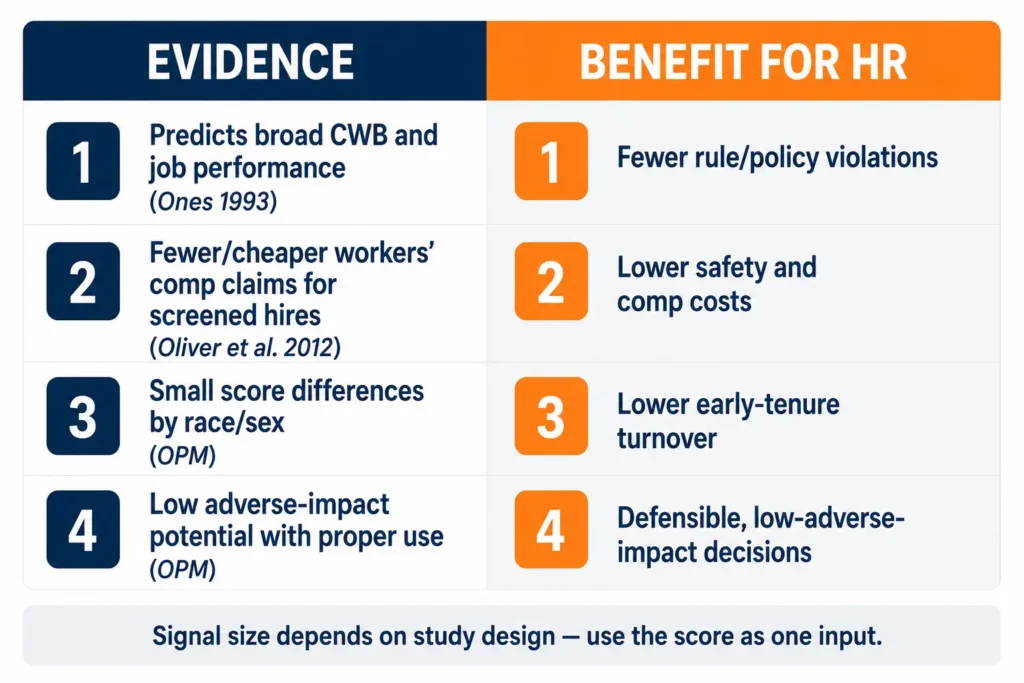
The payoff rarely arrives as one headline number. It shows up in four quieter places, and it compounds in high-volume roles where risk is a steady drip rather than a single disaster.
The most direct win is fewer counterproductive behaviors, and usually the broad pile of rule and policy slips more than theft by itself. The second lands on the safety and workers’ compensation line. The four-industry field study above linked screening to fewer and cheaper comp claims, with some field research finding unscreened hires roughly 2.5 to 4.8 times more likely to file an injury claim, and that is real money when OSHA’s business case for safety and health puts US workers’ compensation costs for disabling injuries north of a billion dollars a week. The third is retention and speed: a consistent early screen trims early-tenure quits and routes candidates the same way across every site and shift, and our guide to the ROI of honesty tests in hiring shows how to size that up and what the vendor and case-study results report. The fourth is the one people forget until an applicant challenges a decision: a documented, validated test applied consistently, with the low adverse-impact profile noted earlier, gives you a reason you can actually defend, which a gut call never does.
What They Can’t Do
It is just as important to know where these tests stop. One will not certify anyone’s character, predict what a specific person does next, or stand in for references, supervision, and the controls you run on the floor. Overt items are transparent, so some candidates tell you what they think you want to hear; the research says faking only dents validity modestly, but it is a reason to govern the test carefully, not to treat a single score as proof of anything. The tests speak to broad reliability, not specific skills, and they earn their keep in entry-level and high-volume roles more than in senior or specialized ones. And keep one thing in the back of your mind: a lot of the published evidence comes from the companies that sell the tests, so watch your own numbers to confirm the tool is doing what it promised. Lean on it as one voice in the room, never the only one.
Getting It Right: Format, Placement, and Records

Most of the value comes down to disciplined use, not the test you pick. Start with a quick job analysis so the traits you are measuring, trustworthiness, impulse control, safety attitudes, actually map to the work, and save the test for roles where reliability genuinely matters. Choose a tool that hands you a real technical manual with reliability and role-relevant validity, administer it the same way to everyone through trained staff, and slot it in after basic eligibility checks but before you spend manager hours on interviews. Read the score next to structured interviews and reference checks, follow up on borderline results instead of cutting them, and keep an eye on turnover, incidents, and selection rates by group so you can prove the program stays fair. Our guide to honesty tests for employee screening covers placement that adds signal without bleeding off applicants, and the integrity assessments guide for smarter hiring zooms out to the whole program.
Put the Evidence to Work
The case for honesty tests for employment holds up when the tool is validated, job-related, governed, and used alongside everything else you know about a candidate, which is exactly how the research and the federal guidance frame it. IntegrityFirst Tests helps US HR teams pick the right format, set decision rules they can defend, and track the outcomes that prove the value. Schedule a demo with IntegrityFirst Tests to build a program grounded in the evidence.