Schedule a call!
Integrity tests vs background checks: learn which hiring tool predicts risky behavior, verifies candidate history, and protects your business best.
If you’ve ever debated integrity tests vs background checks, you already know the confusion: a candidate “passes” a background screen yet turns into a headache six months later—or an integrity test raises concerns but their record looks spotless. That’s because these tools answer different questions at different times. Used together (in the right order), they give you speed and safety.
This guide goes deep: definitions, side-by-side comparisons, legal guardrails, an end-to-end hiring workflow, interview scripts, decision matrices, KPIs, and two mini case studies. It’s everything your team needs to make confident calls without slowing the funnel.
Integrity Tests vs Background Checks: Key Differences
- Integrity test = predicts current/future behavior under pressure. Use early to filter the pipeline.
- Background check = verifies historical facts. Use late (post-offer/conditional offer).
- The winning order: Test → Interview → Conditional Offer → Background Check → Decision.
- Document decisions, revisit cut scores yearly, and always tie tools to job-related risks.
Definitions You Can Explain to a Busy Manager
Integrity Test (8–15 minutes)
A short, validated questionnaire that measures attitudes and traits linked to counterproductive work behaviors (dishonesty, rule-bending, hostility control, risk tolerance, conscientiousness).
- Overt versions ask directly about rules/theft.
- Personality-based versions infer risk via indirect items (harder to game).
- Great primer: Personality-based integrity test.
Background Check (role-appropriate)
A factual verification of identity and history (e.g., employment, education, criminal/civil records where lawful, sanctions, professional licenses). Modern platforms like Checkr make it easier to run these verifications quickly and compliantly, without slowing down the hiring process. For a deeper industry and academic perspective, you can review this pre-employment background check research that outlines best practices, challenges, and emerging trends in verification processes.
- Goal: Validate truthfulness of claims—not predict future judgment.
Integrity Tests vs Background Checks—What Each Reveals (and Misses)

Before we compare line by line, remember that integrity tests vs background checks answer different questions. Tests predict how someone is likely to behave under pressure today; checks verify whether their yesterday matches their claims. Read the table as a quick “purpose and timing” decoder—use it to decide which tool you need for the decision in front of you.
| Dimension | Integrity Test | Background Check |
| Answers the question… | “How likely is this person to act ethically now?” | “Do past records and claims check out?” |
| Strengths | Early signal on honesty, rule respect, empathy, risk | Objective verification; compliance due diligence |
| Blind spots | Won’t confirm identity/history | Can’t predict future behavior or gray-area judgment |
| Faking risk | Low–Moderate (consistency indices) | N/A (it’s verification, not self-report) |
| Ideal timing | Early (post-résumé screen) | Late (post/conditional offer) |
| Best for | High-volume screening; remote/data-access roles | Regulated or high-trust roles; final step |
What does this mean in practice? Start with the assessment to flag behavioral risk early, then use the background check to confirm identity and history before you sign an offer. When signals conflict, don’t guess—add a structured interview round focused on the flagged dimensions.
The Risk-Based Timing Model (Who Needs What, When)
Not every role carries the same exposure. This timing model shows when to deploy each tool based on the job’s access, authority, and regulatory context. Use it to calibrate your funnel: heavier screening for high-trust roles (finance, IT admin), lighter for tightly supervised entry-level jobs—without losing speed.
| Role/Risk | Integrity Test | Background Check | Notes |
| Finance/Payroll/IT Admin | ✅ Early | ✅ Late | Non-negotiable; protect funds and systems |
| Sales with quota pressure | ✅ | ✅ | Ethics stressors + client trust |
| Healthcare/Fintech/Regulated | ✅ | ✅ | License/sanctions checks + behavior screening |
| Entry-Level, tightly supervised | ✅ | Optional | Use lighter check if jurisdiction allows |
| Remote roles with data access | ✅ | ✅ | Verify identity + assess rule respect |
| Short-term freelance/gig | ✅ (lite) | Jurisdiction-dependent | ID verification often required |
A good rule of thumb: if a role touches money, sensitive data, or big decisions, run both the assessment early and the check late. For remote or device-heavy roles, add ID verification and a work ethics test to reinforce reliability. Revisit the mix quarterly—if incident data or turnover spikes in a job family, tighten the model; if hiring stalls without safety gains, you can safely lighten the load.
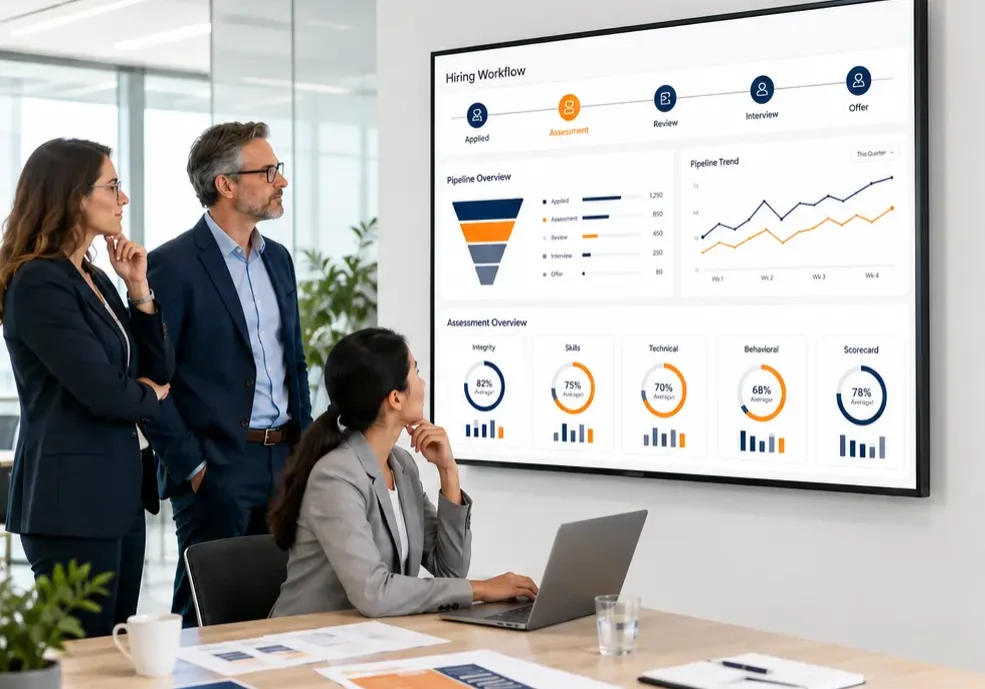
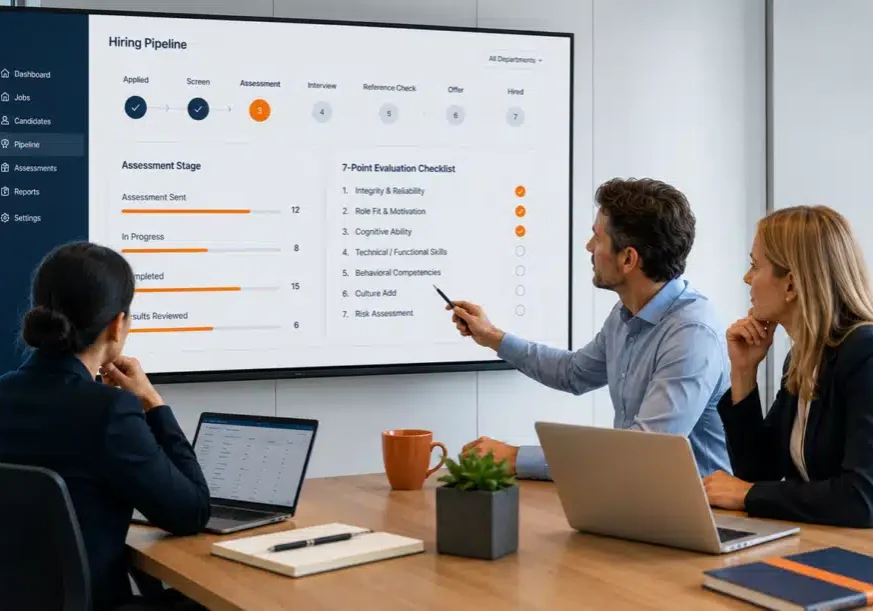
The End-to-End Workflow (Copy/Paste Into Your SOP)

Stage 1 — Apply
- Auto-invite to integrity test (10–15 minutes).
- Provide a brief privacy notice and purpose statement.
Stage 2 — Score & Triage
- Advance only those at/above benchmark.
- Pull a simple scorecard showing the dimensions (e.g., rule respect, hostility control).
Stage 3 — Targeted Interview
- Use flagged dimensions to shape questions.
- Grab ready-to-use prompts from integrity interview questions and the method in how to test integrity in an interview.
Stage 4 — Conditional Offer
- Communicate contingent language clearly.
- Start a role-appropriate background check (scope set by job risk + jurisdiction).
Stage 5 — Decision & Documentation
- Combine test + interview + background outcomes.
- Note rationale tied to job-related risks (audit-proof).
Stage 6 — Onboarding Guardrails
- Ethics pledge, data-handling training, 30/60/90-day check-ins.
- For managers, reinforce expectations from the work ethics test.
Interview Scripts for Common Scenarios (Use Word-for-Word)
If the integrity test flags “Rule Respect”
“Tell me about a time you disagreed with a policy, still complied, and then influenced a better version. What did you do first, and who did you involve?”
If the integrity test flags “Hostility Control”
“Describe the last time feedback felt unfair. How did you respond in the moment, and what did you do 24 hours later?”
If the background check shows employment gaps
“I noticed a gap in 2023. Can you walk me through what you were doing then and share a reference from that period?”
If the background check shows a discrepancy
“This title/date doesn’t match what we received. What might explain the difference? How can we verify the accurate record together?”
Decision Matrix (When Signals Don’t Agree)
| Integrity Test | Background Check | Role Sensitivity | Recommended Action |
| High risk | Clean | High (finance/IT/data) | Reject or escalate to panel; risk too high |
| Moderate risk | Clean | Medium (CS, ops) | Second interview + targeted references; possible probation |
| Low risk | Clean | Any | Proceed |
| Any | Discrepancy (material) | Any | Investigate; potential reject for dishonesty |
| High risk | Minor check issue (non-material) | Low–Medium | Case-by-case; weigh nature of issue vs duties |
Legal & Fairness Guardrails (Short, Practical)

- Consistency: Same tools & cut scores per job family.
- Job-relatedness: Map each component to duties (cash handling, data access, patient safety).
- Adverse-impact review: Audit outcomes at least annually and when you change cut scores.
- Consent & privacy: Provide disclosures and get consent; store data securely and minimally.
- Document decisions: Keep scorecards, interview notes, and final rationale.
Not legal advice—consult counsel for your jurisdictions and any FCRA/EEOC or local equivalents.
Avoid These 7 Common Pitfalls
- Running checks on everyone before screening → wastes money/time. Test first.
- Single-signal decisions → always combine test + interview + check.
- Never revisiting cut scores → calibrate yearly against performance/incident data.
- Copy-pasting the same thresholds across roles → finance ≠ field sales.
- Sharing raw test items internally → undermines validity; share dimensions instead.
- Vague candidate communication → be factual and consistent about next steps.
- No onboarding reinforcement → testing reduces risk; culture sustains it.
KPIs & ROI (What to Track and Why)
| KPI | Before (“Either/Or” Approach) | After (Combined, Right Order) |
| First-year misconduct incidents | Higher | Lower |
| Time-to-hire | Slower (rework & late surprises) | Faster (early filter + late verify) |
| % candidates needing checks | Many (waste) | Fewer (only finalists) |
| Offer rescissions | More | Fewer (issues found pre-offer) |
| Manager satisfaction (1–5) | ~3.3 | ~4.4 |
Tip: Review KPIs quarterly; adjust test thresholds or check scope where patterns emerge.
Two Mini Case Studies (What This Looks Like in Real Life)
A) Low Test, Clean Check → Proceed with Guardrails
- Role: Customer Success
- Flag: “Rule Respect” borderline
- Action: Panel interview + probation plan with policy mentorship
- Result (6 months): Strong CSAT, no violations → permanent hire
B) High Test, Check Discrepancy → Reject for Dishonesty
- Role: Financial Analyst
- Flag: Integrity test excellent, but degree misrepresented
- Action: Candidate couldn’t verify; misrepresentation deemed material
- Result: Rejection documented; position filled two weeks later with verified hire
FAQ
Q1. Can integrity tests replace background checks?
No. Tests predict behavioral risk; checks confirm history. For medium-to-high risk roles, you want both.
Q2. Are integrity tests easy to fake?
Modern, personality-based formats use indirect items and consistency indices. Attempts to “game” often lower scores.
Q3. When should we retest employees?
At promotion into higher-trust roles (finance/IT admin/leadership), after misconduct, or every 2–3 years for sensitive positions.
Q4. How many interview questions should follow the test?
Five to seven targeted probes tied to flagged dimensions. See our integrity interview questions.
Q5. What if the background check delays hiring?
Start it at conditional offer, communicate timelines, and keep candidates engaged with transparent updates.
Final Thoughts
Think of integrity tests vs background checks as headlights and a rearview mirror. Headlights (tests) show where a candidate is likely headed under pressure; the rearview (checks) confirms where they’ve been. Use both—in that order—and you’ll hire faster, spend less on dead ends, and onboard people who protect your data, customers, and culture from day one.
When you’re ready to operationalize this, start small: pilot the Test → Interview → Conditional Offer → Check flow with one job family, measure results for a quarter, then scale.