Schedule a call!
Hard skills win interviews, but work ethic test determines whether new hires thrive, stagnate, or quietly derail projects. That’s why adding a Work Ethics Test to your hiring funnel is no longer a “nice-to-have”—it’s a strategic edge. Below, we’ll unpack the science, share sample questions, and show exactly how to blend ethical screening with your existing interviews and technical assessments.
Why Work Ethic Outranks Raw Talent
| Risk of Focusing on Skills Alone | Business Impact |
| Missed deadlines despite technical proficiency | Project overruns, client erosion |
| “Brilliant jerk” who alienates team | 30 % higher voluntary turnover on that team |
| Rule-bending shortcuts | Compliance fines, reputational damage |
Great code, designs, or pitches mean little if the employee ghosts during crunch time or dodges responsibility when issues arise. A Work Ethics Test screens for reliability, honesty, and collaboration—traits every high-trust culture needs.
What a Work Ethics Test Measures

Key dimensions typically include:
- Integrity – Adherence to rules and company values
- Accountability – Willingness to own mistakes and take corrective action
- Self-Discipline – Consistent follow-through on tasks and deadlines
- Team Orientation – Respect and support for colleagues
- Growth Mindset – Openness to feedback and continuous learning
Validated tests use Likert-scale statements or situational dilemmas to quantify these behaviors. This blend of ethical behavior and workplace performance is supported by empirical research on the link between work ethics and job satisfaction, showing how strong ethical standards directly impact employee engagement and outcomes.
Related deep-dive: See how indirect questions surface hidden traits in our guide to the personality-based integrity test.
Overt vs. Personality-Based Assessments

| Feature | Overt Work Ethics Test | Personality-Based Test |
| Question style | Direct: “Is it OK to miss a deadline if no one notices?” | Indirect: “I thrive under loose deadlines.” |
| Faking difficulty | Moderate | Low (built-in lie consistency) |
| Depth of insight | Surface attitudes | Deeper trait patterns |
| Best for | High-volume frontline roles | Professional & leadership roles |
Five-Step Implementation Blueprint
| Step | Action | Tooling Tip |
| 1 | Identify high-impact roles | Finance, remote devs, client-facing managers |
| 2 | Select & benchmark a Work Ethics Test | Pilot with 30 top performers to set pass score |
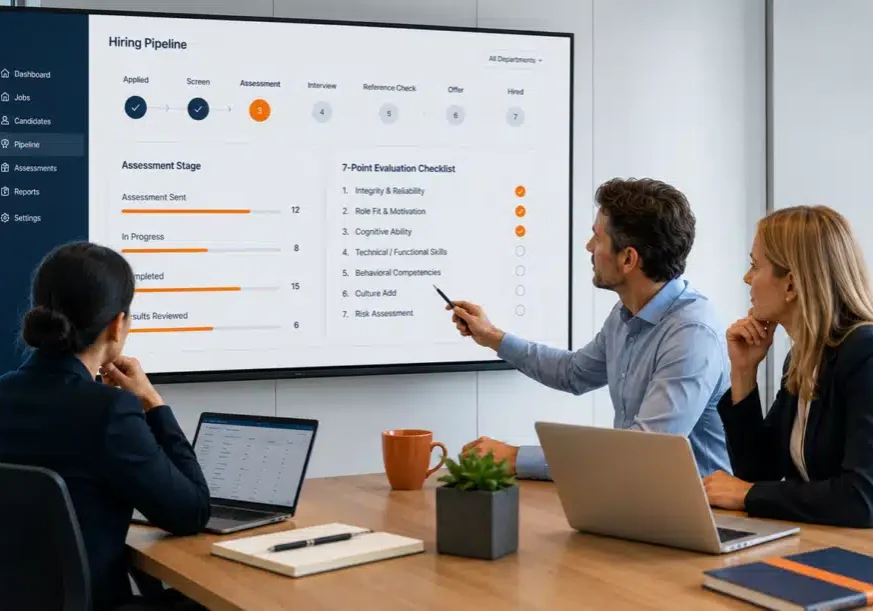
| 3 | Integrate with ATS | Auto-score; surface red flags to recruiters |
| 4 | Behavioral interview probe | Use flagged dimensions—learn how to test integrity in an interview |
| 5 | Onboard & reinforce | New-hire ethics pledge + quarterly check-ins |
Sample Questions & Scoring Guide

| Statement (1 = Strongly Disagree … 5 = Strongly Agree) | What a Low Score Signals | High-Risk Flag |
| “I double-check deadlines even when no one reminds me.” | Poor self-discipline | ≤ 2 |
| “It’s OK to stretch the truth if the customer’s happy.” | Flexible integrity | ≥ 4 |
| “I’m comfortable admitting mistakes to my team.” | Avoids accountability | ≤ 2 |
| Scenario: “A peer slacks off, hurting results. Your move?” | Inaction / blame shift | Would ignore the issue |
Composite Index Interpretation
- 0–59 = Reject
- 60–74 = Probe further
- 75–100 = Advance
Real-World ROI
| KPI | Before Work Ethics Test | After 12 Months |
| First-year turnover | 24 % | 15 % |
| Missed project deadlines | 18 per year | 6 per year |
| Customer complaints (service team) | 14 | 3 |
| Manager satisfaction (1–5) | 3.2 | 4.4 |
Result: 7× return on testing investment through reduced rehiring costs and higher client retention.
FAQ
Q1. How long does a Work Ethics Test take?
Most validated versions run 10–15 minutes, short enough to retain applicants but long enough to gather reliable data.
Q2. Can candidates fake the test?
Personality-based formats include lie scales and consistency traps that flag most fakers, who often score lower as a result.
Q3. Are these tests legal?
Yes—when they’re job-related, validated, and applied consistently across applicants.
Q4. Do ethics tests replace technical assessments?
No. Think of them as an additional filter—skills show capability; ethics show reliability.
Q5. Should we retest current employees?
Consider retesting for promotions into high-trust roles (finance, leadership) every 2–3 years.
Final Thoughts
Hiring on technical prowess alone is like building a skyscraper on sand. A Work Ethics Test cements your foundation with integrity, accountability, and teamwork, so every skill you hire yields real, lasting value. Build it into your process today, and watch quality, culture, and client trust rise in tandem.