Schedule a call!
Integrity assessment for ethical hiring and ROI addresses two critical HR imperatives that often operate in tension: hiring ethically and demonstrating measurable business value. Many organizations hesitate to implement structured integrity screening because they conflate “assessment” with bias, or because they cannot articulate the return on investment to executive leadership. Yet the data is clear: validated integrity assessments, when properly designed and transparently applied, deliver both ethical rigor and quantified financial returns—reducing turnover, lowering workers’ compensation costs, and improving workforce quality.
This guide bridges the gap between ethical principle and business outcome. It explains why integrity assessment is a defensible, legally compliant, and measurable hiring practice; how to quantify its ROI; and how to design assessment processes that protect both candidate rights and organizational interests. Whether you are building a new hiring framework or auditing your current screening process for fairness and transparency, this resource will show you how to integrate integrity assessment into your talent acquisition strategy with confidence.
Why Integrity Assessment is Ethically Justified in Hiring
Hiring is a high-stakes decision for both the organization and the candidate. Yet most hiring processes rely heavily on subjective judgment—resume screening, gut-feel interviews, informal reference checks—that reflect the biases and blind spots of the interviewer, not the job requirements or candidate capabilities. Integrity assessment, when designed with explicit job relevance and transparent scoring, actually reduces arbitrary decision-making and replaces it with defensible, evidence-based evaluation.
The ethical case for integrity assessment rests on three pillars:
1. Job Relevance
Integrity assessment measures traits directly tied to job performance and workplace safety. A meta-analysis of 104 studies found that integrity test scores produce a corrected validity of .32 for counterproductive work behavior—making these assessments among the strongest single predictors available before hire (PubMed 21319880). This predictive strength applies across role types and both overt and personality-based test formats. When your assessment measures traits that predict real-world performance, you are not discriminating arbitrarily; you are evaluating candidates on dimensions that matter to the job.
2. Transparency and Explainability
Ethical hiring requires that candidates understand why they are being assessed and how their responses are being evaluated. A well-designed integrity assessment includes clear communication of the assessment purpose, transparent scoring rubrics, and documented decision pathways. This contrasts sharply with opaque or subjective methods that candidates cannot understand or challenge. The EEOC’s Uniform Guidelines on Employee Selection Procedures explicitly require that selection tools be validated, documented, and defensible—standards that structured integrity assessment can meet.
3. Fairness and Adverse Impact Monitoring
Ethical assessment requires active monitoring for bias. Organizations that deploy integrity assessments should routinely analyze results by demographic group to ensure that screening decisions do not disproportionately exclude protected classes. Unlike subjective interviews or intuitive hiring decisions, structured assessments create a paper trail that allows you to detect and correct bias. The Society for Industrial-Organizational Psychology (SIOP) validation principles for personnel selection establish the professional standard for this kind of rigorous, transparent evaluation.
By grounding integrity assessment in job relevance, transparency, and bias monitoring, HR leaders can defend the practice to candidates, regulatory agencies, and their own executives as an ethical hiring practice—not a compliance checkbox.
The Quantified ROI: Measurable Business Case
While ethical justification matters, so does demonstrating return on investment to organizational leaders. The business case for integrity assessment is quantified, measurable, and significant.
Headline ROI Metrics
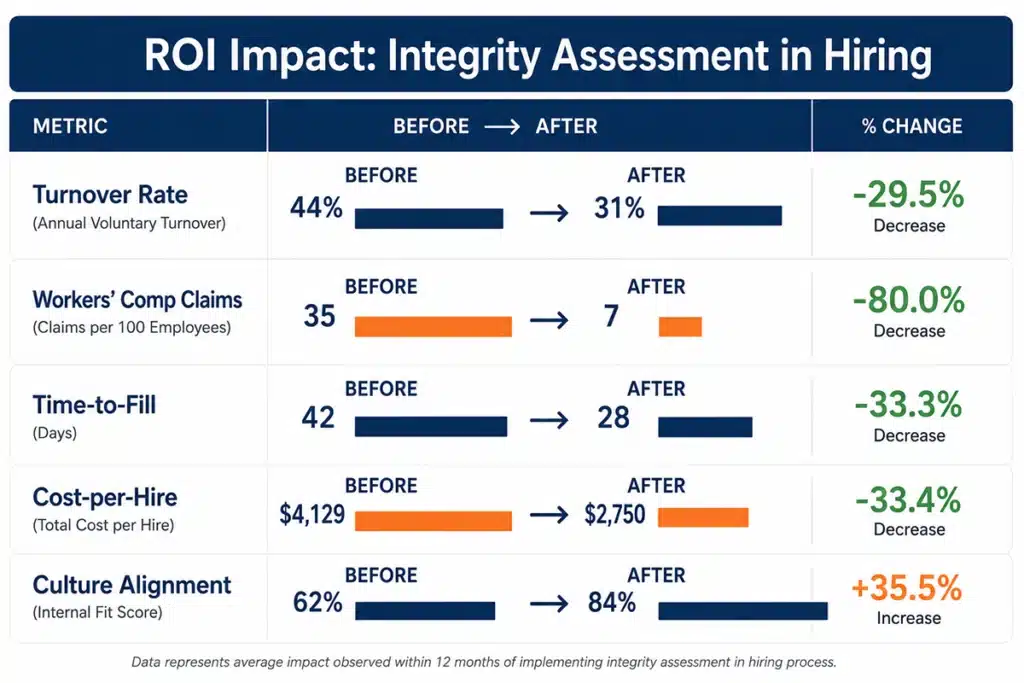
A multi-year analysis found that well-designed, validated integrity assessments deliver up to a 22x return on investment by reducing theft, workers’ compensation claims, and early-term turnover. Consider this case: a janitorial company implemented integrity-first screening and saw an 81.6% reduction in workers’ compensation claims frequency within one year, paired with a 13% drop in annual turnover rate. These are not marginal gains—they are transformational reductions in cost and risk.
How do these outcomes translate into dollars?
| Metric | Pre-Assessment | Post-Assessment | Impact |
|---|---|---|---|
| Annual Turnover Rate | 44% | 31% | -13 percentage points |
| Workers’ Comp Claims/Year | 35 | 7 | -81.6% |
| Time-to-Fill (days) | 17 | 10 | -41% |
| Cost-per-Hire | $4,100 | $3,000 | -26.8% savings |
| Culture Alignment Survey | 6.4/10 | 8.1/10 | +27% improvement |
How Integrity Assessment Drives ROI
The financial return flows from three mechanisms:
- Reduced Turnover Costs: Early-term turnover—hires who fail within the first 90 days or first year—costs organizations 50–150% of the employee’s annual salary when accounting for recruitment, onboarding, and lost productivity. By screening for traits linked to retention and performance, integrity assessment reduces this costly churn.
- Lower Workers’ Compensation and Theft Claims: Organizations with high-risk workforce behavior see elevated claims for theft, property damage, and workplace injury. Integrity assessment flags candidates at higher risk for these behaviors, allowing organizations to either screen them out or route them to lower-risk roles. The result: measurably lower claim frequency and associated insurance premiums.
- Faster Time-to-Productivity: Candidates who score well on integrity assessment and related job-fit measures tend to reach full productivity faster, require less management oversight, and integrate into team culture more successfully. This reduces ramp-time costs and improves overall hiring yield.
To justify this investment to leadership, benchmark your organization’s current turnover rate, cost-per-hire, and workers’ compensation expense against industry norms. Then project the financial impact of a 13% turnover reduction or an 81.6% reduction in comp claims in your specific sector. For context on baseline workers’ compensation costs and trends by industry, consult the Bureau of Labor Statistics.
See our integrity self-assessment ROI for HR for a deeper exploration of ROI quantification in specific role categories.
Ethical Design: Building Fair and Defensible Assessment Processes

Designing an ethically sound integrity assessment requires intentional choices at every stage. Here is how to build a process that is both rigorous and fair.
Step 1: Define Job-Relevant Criteria
Begin by conducting a job analysis to identify the specific integrity-related behaviors and traits that predict success in the role. For example, a customer-facing role might require honesty and reliability; a financial role might require rule-compliance and trustworthiness; a safety-sensitive role might require judgment and accountability. These job-related dimensions should directly support your assessment questions and scoring rubric. Do not include assessment items that are not tied to documented job requirements—inclusion of irrelevant items introduces bias and legal risk.
Step 2: Select or Develop Validated Tools
Use only assessment tools that have been scientifically validated for your specific job category. Validation means the tool has been rigorously tested to show that scores predict the job outcomes you care about (e.g., turnover, theft, safety incidents). Tools should be supported by published research or peer-reviewed studies, not just vendor claims. Ask potential vendors for validation data specific to your industry and role level—do not rely on generic benchmarks.
Step 3: Establish Clear Scoring Standards
Document your scoring rubric in writing before you administer any assessments. The rubric should specify how responses will be coded, what answers constitute “risk,” what constitutes “green,” and any gray areas requiring human review. Standardized scoring reduces interpretation errors and ensures all candidates are evaluated by the same criteria. This also creates the paper trail necessary for legal defensibility.
Step 4: Communicate Assessment Purpose to Candidates
Before administering the assessment, clearly explain to candidates why they are being assessed, what the assessment measures, and how the results will be used. For example: “This integrity assessment measures your attitudes toward workplace honesty, rule-following, and ethical decision-making—traits that directly support success in this role.” Transparency reduces candidate anxiety and demonstrates good faith in the hiring process.
Step 5: Monitor and Document All Decisions
Record every assessment result, every scoring decision, and every hiring outcome. This documentation serves two purposes: (1) it allows you to analyze results for adverse impact and bias, and (2) it provides a legal audit trail if hiring decisions are ever challenged. Documentation should include the candidate’s name, role applied for, assessment score, decision (proceed or screen out), and the specific reason for the decision.
Step 6: Regularly Review for Bias and Adverse Impact
At least quarterly, analyze your assessment results by demographic group (race, gender, age, protected status). Check whether any group is being disproportionately screened out at a rate that would trigger EEOC scrutiny (as defined in the Uniform Guidelines on Employee Selection Procedures—generally, a selection rate less than 80% of the group with the highest selection rate). If you detect adverse impact, investigate whether it reflects true job-related differences or potential bias. Adjust cutoff scores, assessment wording, or scoring logic as needed.
This methodical approach ensures that your integrity assessment is defensible, transparent, and ethically sound.
Documentation and Audit Trail: The Ethics of Transparency
One of the strongest protections against legal challenge—and one of the clearest signals of ethical hiring practice—is a documented, auditable assessment process. Organizations that can produce clear records of what was assessed, how it was scored, why decisions were made, and how results were reviewed for bias demonstrate due diligence and good faith to regulators and courts.
What to Document
- Assessment administration: Date, time, version of assessment, any accommodations provided
- Scoring and interpretation: Candidate responses, scoring decisions, any reviewer notes, cutoff scores applied
- Hiring decisions: Whether the candidate advanced or was screened out, the specific reason(s) for the decision, any approvals required
- Adverse impact analysis: Quarterly or annual reports showing assessment results by demographic group, any disparities detected, and remedial actions taken
- Validation documentation: Evidence that the assessment tool is valid for your specific job category, including published studies or vendor validation reports
This documentation serves three purposes:
- Legal defensibility: If a candidate claims discrimination, you can demonstrate that decisions were based on job-related criteria, applied consistently, and reviewed for bias.
- Continuous improvement: Your records reveal patterns—which questions candidates struggle with, which demographic groups may be underrepresented, where your process may need refinement.
- Stakeholder confidence: When you can show leadership, candidates, and legal teams that your process is transparent and auditable, trust increases.
The ethics of transparency means you can explain and defend every hiring decision. Integrity assessment, properly documented, meets this standard.
Addressing Ethical Concerns: Adverse Impact and Candidate Rights
Even with the strongest design and best intentions, organizations often encounter objections or concerns about integrity assessment. Here are the most common ethical concerns and how to address them.
Concern 1: “Doesn’t this assessment have adverse impact on certain groups?”
Adverse impact occurs when a selection practice disproportionately excludes members of a protected class. Under the EEOC Uniform Guidelines on Employee Selection Procedures, employers must monitor selection rates and investigate disparities. The key to defensibility is:
- Use a validated tool with documented validity for each job category you assess
- Monitor selection rates by demographic group
- If adverse impact is found, either (a) adjust the tool to reduce the disparity while maintaining job-relevance, or (b) provide statistical evidence that the disparity is job-related and necessary
Many well-designed integrity assessments do not show significant adverse impact because integrity traits are job-relevant across demographic groups. However, organizations must actively verify this through analysis—do not assume.
Concern 2: “Can candidates fake their responses?”
Yes. In overt assessments (which ask directly about dishonest acts), some candidates will answer in socially desirable ways. This is why best practice is to:
- Use a blended approach: combine overt assessments with covert or personality-based items that are harder to fake
- Include consistency checks: flag answers that contradict each other
- Supplement assessment results with structured interviews: ask candidates to describe real examples of ethical behavior or rule-following
- Use the assessment as one input among several, not as the sole decision point
Concern 3: “Doesn’t this violate candidate privacy?”
Privacy concerns are valid. Organizations must:
- Clearly state before the assessment that personal information will be collected
- Explain what will be done with the data (stored securely, reviewed only by authorized HR staff, kept confidential from hiring managers)
- Comply with applicable privacy laws (CCPA in California, GDPR if candidates are EU-based, etc.)
- Provide candidates with access to their results and an opportunity to dispute inaccurate scoring
- Limit data retention: delete assessment data after a reasonable period (typically 1–3 years)
A transparent privacy policy and clear consent process protect candidate rights while allowing the organization to use assessment data ethically.
Concern 4: “What about candidates who are honest but get flagged as risky?”
This is the “honest but failed” problem. Some candidates answer assessment questions very frankly—admitting, for example, that they have experimented with cannabis or have had conflict with a previous employer—and are then screened out. While honesty is valued, a single admission does not automatically disqualify a candidate. Best practice is to:
- Train hiring managers and interviewers to interpret “risky” flags with nuance: a prior marijuana use or workplace disagreement does not automatically predict future counterproductive behavior
- Use the assessment as a trigger for deeper investigation, not an automatic screening-out decision
- Allow candidates to provide context: “I tried cannabis once in 2015; I do not use it now and it would not affect my work.”
- Provide candidates with an appeals process: if they believe their assessment result is inaccurate or unfair, they can request human review
This approach balances integrity risk with compassion and fairness.
Frequently Asked Questions
Q: How long does a typical integrity assessment take to complete?
Most well-designed integrity assessments take 8–15 minutes to complete. Shorter assessments are less burdensome on candidates and reduce drop-off rates. However, they may omit depth; longer assessments can be more nuanced but risk candidate fatigue. Aim for 10–12 minutes as a practical target.
Q: Can we use the same integrity assessment for all job levels (frontline to executive)?
Not effectively. Integrity assessment should be job-specific. An assessment designed for frontline retail workers may not capture the ethical pressures or decision-making context for a finance executive. Best practice is to have at least two versions: one for frontline/operational roles and one for management or specialized roles. Customize questions to reflect actual job challenges.
Q: What cutoff score should we use—high, medium, or low threshold?
This depends on your specific tolerance for risk and your industry. A role with direct access to cash or sensitive information should use a higher (more stringent) cutoff. A role where integrity risk is lower can use a moderate cutoff. Your job analysis should inform this choice. Whatever cutoff you choose, document the rationale and monitor whether it produces adverse impact.
Q: How often should we review and update our integrity assessment?
At minimum, annually. Compare assessment results to actual hiring outcomes (turnover, misconduct, theft, safety incidents). If you find that high scorers are not performing as expected, or that some assessment items are not predicting outcomes, adjust those items. Also update assessments when job responsibilities change or when your organization enters a new market or industry.
Q: What should we do if a candidate discloses a concern or disability that affects their assessment?
Take the disclosure seriously. Under the ADA, organizations must provide reasonable accommodations for applicants with disabilities. For example, if a candidate has dyslexia, you might allow them extra time or provide the assessment in a different format. Accommodations should not alter the core content of the assessment—only the method of delivery. Consult your legal/HR counsel to ensure compliance.
Q: How do we explain integrity assessment results to candidates who are screened out?
Provide a clear, respectful explanation. For example: “Your assessment results, combined with the results of other screening steps, indicate that you may not be the right fit for this role at this time. We encourage you to reapply in the future or to explore other roles that may be a better match for your strengths.” Offer candidates a chance to ask questions or request a review if they believe the decision was unfair. This transparency builds goodwill even when you screen someone out.
Building Organizational Buy-In for Ethical Integrity Assessment
Implementing integrity assessment across your organization requires support from senior leadership, legal counsel, hiring managers, and candidates. Here is how to build buy-in:
For Executive Leadership: Lead with ROI. Show the financial impact of turnover reduction, lower workers’ compensation costs, and faster time-to-fill. Frame integrity assessment not as a compliance burden but as a business efficiency play.
For Legal/Compliance: Lead with defensibility. Demonstrate that your assessment is validated, job-relevant, documented, and reviewed for adverse impact. Show that you comply with EEOC guidelines and are prepared to defend decisions if challenged.
For Hiring Managers: Lead with usability. Make the assessment easy to administer, provide clear guidance on how to interpret results, and show how assessment data integrates with your existing hiring workflow. Train them on how to use assessment results to inform interviews, not to replace judgment.
For Candidates: Lead with transparency. Explain the purpose of the assessment, why it matters for this role, how their privacy will be protected, and how they can access their results. Make clear that one assessment result is not the sole basis for a hiring decision.
By addressing each stakeholder group’s specific concerns and interests, you increase the likelihood of successful implementation and sustained use.
Next Steps: Implementing Integrity Assessment Ethically and Effectively
Integrity assessment for ethical hiring and ROI is a learnable, implementable practice. Start with these steps:
- Audit your current hiring process. Where are the gaps in objectivity, transparency, or bias monitoring? What are your current turnover, cost-per-hire, and workers’ compensation metrics?
- Define job-relevant integrity criteria. For your target role(s), identify the specific integrity behaviors and traits that predict success. Conduct a job analysis if you have not already.
- Select or develop a validated assessment tool. Identify 2–3 reputable vendors or tools. Request validation data specific to your industry and role. Check for adverse impact studies.
- Design your documentation and audit process. Create a folder or system where you will store assessment results, scoring decisions, demographic analysis, and outcome tracking.
- Pilot with a subset of roles. Roll out integrity assessment to one job category first. Monitor results, gather feedback from candidates and hiring managers, refine your process.
- Scale based on outcomes. Once you have validated that integrity assessment improves hiring quality and reduces risk in one role category, expand to other roles.
- Establish a review cadence. Commit to quarterly adverse impact analysis and annual assessment updates.
If you want expert guidance on implementing integrity assessment ethically and effectively, IntegrityFirst Tests can help. Our team works with HR leaders to design validated, defensible, and transparent integrity assessment processes tailored to your organization’s hiring challenges and values. We provide validation documentation, adverse impact analysis, and ongoing support to ensure your assessment drives both ethical hiring and measurable ROI.
Contact IntegrityFirst Tests today to discuss how integrity assessment can strengthen your hiring process and your bottom line.
See our integrity risk assessment guide for a deeper exploration of risk quantification, and our ROI of honesty tests in hiring for additional case studies and metrics.