Schedule a call!
Every US organization that has made a costly mis-hire understands the downstream consequences: time theft, policy violations, team friction, declining morale, and the direct financial impact of turnover and workers’ compensation claims. Traditional screening methods often generate more questions than they answer. What HR leaders need is a tool that predicts behavior reliably — and a clear understanding of the integrity self-assessment ROI for HR before committing to implementation.
The data is consistent and compelling. When structured integrity self-assessment programs are deployed correctly across high-risk roles, US organizations see measurable reductions in turnover, workers’ compensation costs, drug screening failures, and compliance incidents. This guide makes the full business case: defining how integrity self-assessments work, presenting the research-backed ROI metrics, outlining administration best practices aligned with US legal standards, and providing two real-world case studies so HR leaders can justify adoption and measure outcomes from day one.
What Is Integrity Self-Assessment?
An integrity self assessment is a formal evaluation designed to gauge honesty, ethical behavior, and accountability in candidates during the pre-employment screening process. Unlike a standard interview, these assessments offer a structured, consistent approach for HR professionals to predict on-the-job behavior and reduce the financial and operational risk of a mis-hire. SHRM pre-employment testing guidelines recognize structured integrity tools as valid, evidence-based components of a legally defensible hiring process.
These assessments go beyond skills verification. They uncover a candidate’s attitudes toward ethical standards, accountability, and workplace conduct — the dimensions that rarely appear in a resume but consistently drive employee reliability and retention. Research in behavioral science, including work on the Big Five personality model, demonstrates that conscientiousness and ethical self-regulation are stronger predictors of long-term employee performance than resume credentials alone.
Structured integrity tests provide standardized, objective benchmarks for candidate evaluation. They assess dependability, ethical decision-making, and risk orientation in ways that reduce the subjective variance of unstructured interviews. The result is a hiring process with measurably higher predictive validity — and a defensible record for compliance purposes.
The Measurable Integrity Self-Assessment ROI for HR Teams
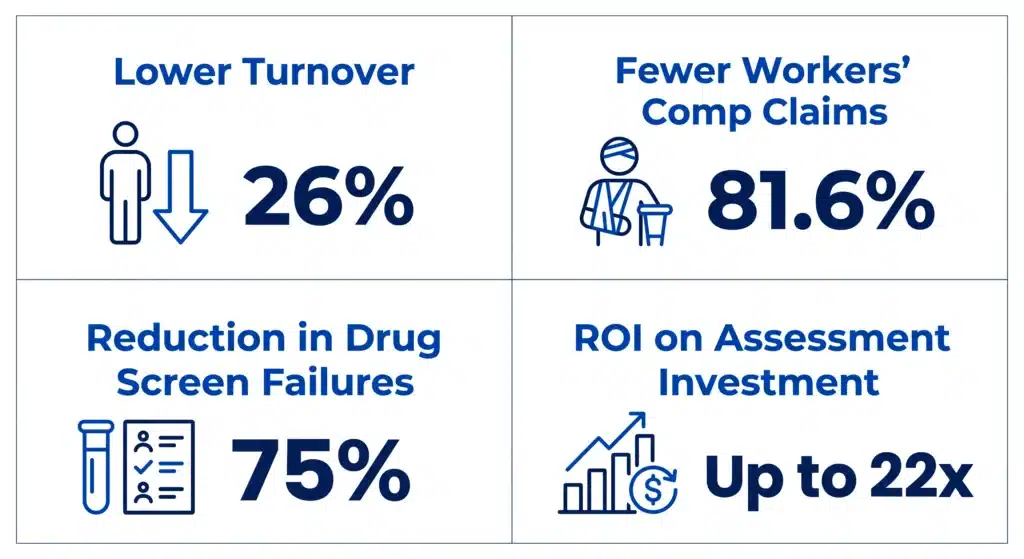
The integrity self-assessment ROI for HR is not theoretical. Gallup workplace trust and engagement research consistently finds that organizations with higher levels of employee accountability and ethical conduct report stronger engagement, lower voluntary turnover, and significantly reduced operational risk — all of which translate directly into measurable cost savings.
When HR leaders implement integrity self-assessment programs across high-risk roles, the outcomes are consistent across industries:
|
Benefit |
Statistic |
Source / Context |
|
Employee Turnover Reduction |
26% lower turnover rate |
Large-scale integrity test implementation studies |
|
Workers’ Compensation Claims |
81.6% decrease |
Service and distribution organization implementations |
|
Drug Screening Failures |
75% reduction |
Overt integrity test programs |
|
ROI on Assessment Investment |
Up to 22x return |
Company-wide implementation analysis |
Organizations that deploy integrity assessments across high-risk roles also see OSHA-recordable incident rates fall in parallel with workers’ compensation costs. Read more about how integrity assessments reduce workers’ compensation claims.
Beyond the direct cost savings, integrity self-assessment ROI for HR extends to consistency in hiring standards, reduction in workplace conflict, and lower rates of fraud and absenteeism. These secondary effects compound over time, making integrity assessment one of the highest-return investments in a mature US HR function.

How Integrity Self-Assessment Works in Hiring
Integrity self-assessment is a strategic approach built on decades of behavioral science research. The Society for Industrial and Organizational Psychology (SIOP) has validated integrity testing as one of the most predictive pre-employment screening tools available, with incremental validity that exceeds standard interviews alone.
Overt Integrity Tests vs. Personality-Based Tests
Two primary formats shape the integrity self-assessment process in US hiring:
- Overt integrity tests ask direct questions about past behavior and attitudes toward rule-breaking, theft, and dishonesty. They are straightforward to administer, score, and defend legally. They perform best in roles with clear behavioral expectations and measurable compliance requirements.
- Personality-based integrity tests measure traits such as conscientiousness, agreeableness, and emotional stability through indirect behavioral indicators. They are harder for candidates to game, provide stronger incremental validity over interviews alone, and are better suited to roles requiring nuanced ethical judgment.
Both formats are typically delivered as standardized assessments and used as screen-out measures — removing high-risk candidates before the organization invests resources in further evaluation. Best practice in US HR is to use both types together for the broadest predictive coverage.
Sample Integrity Self-Assessment Questions
Drawing on integrity-focused self-assessment and 360° feedback tools, effective integrity self-assessment items use concrete behavioral statements and direct scenario questions. The following examples cover the four highest-risk categories in US pre-employment screening:
|
Category |
Sample Question |
HR Rationale |
Red Flag Response |
|
Theft Prevention |
In the past year, have you ever taken company property without authorization? |
Direct ethics check with legal relevance |
Yes, justification, or rationalization |
|
Accountability |
When you make a mistake at work, what steps do you take? |
Evaluates admitting errors and corrective follow-through |
Blaming others or minimizing responsibility |
|
Reliable Attendance |
How do you ensure consistent attendance and punctuality? |
Reflects commitment-keeping behavior |
Vague excuses or patterns of tardiness |
|
Conflict Management |
How do you handle a disagreement with a coworker? |
Assesses respect for others and de-escalation capacity |
Aggression, refusal to de-escalate, or blame-focused responses |
Questions about data confidentiality and privacy practices reveal a candidate’s underlying orientation toward organizational trust — not just policy compliance. These are among the highest-signal items in any integrity self-assessment designed for HR use.
Best Practices for Administering Integrity Assessments
Timing, Candidate Instructions, and Legal Compliance
Integrity assessments deliver the strongest results when placed pre-interview or immediately after a conditional offer. EEOC uniform guidelines on employee selection require that any pre-employment assessment be validated for the specific role, administered consistently across all candidates, and documented for adverse impact review. Compliance with these standards is not optional — it is the legal foundation of a defensible hiring process in the United States.
- Determine the right placement. Pre-interview placement maximizes efficiency and flags high-risk candidates before significant resources are invested. Post-conditional-offer placement is appropriate when a more detailed assessment is warranted for sensitive or high-responsibility roles.
- Provide clear instructions to candidates. Outline the purpose of the assessment, the expected completion time, and your organization’s commitment to confidentiality. Transparent communication reduces candidate frustration and reduces the risk of legally ambiguous complaints about the process.
- Maintain documentation and audit readiness. Record scoring rationale, adverse impact analysis, and outcomes for each hiring decision. Integrate assessment data into your applicant tracking system and review for demographic disparities at least annually.
Addressing Candidate Fairness and Adverse Impact
Candidate concerns about integrity assessment fairness are legitimate and should be addressed proactively. The HR Certification Institute and SHRM pre-employment testing guidelines both emphasize that clarity and transparency are essential to equal opportunity in assessment processes.
Give candidates clear, written information about what the assessment measures — reliability, ethical orientation, risk tolerance — and how the results will be used in the hiring decision. This transparency shifts the experience from opaque to inclusive and reduces the likelihood of legal challenges based on inadequate notice.
On the employer side, audit assessment outcomes periodically for adverse impact across protected classes. Over-filtering — rejecting candidates who candidly admit to mistakes or take nuanced positions — undermines the purpose of integrity testing and creates legal exposure. Use assessments as one input in a multi-dimensional evaluation, not as a standalone disqualifier.
Common Pitfalls to Avoid in Integrity Testing
Even well-designed integrity assessment programs fail when implementation is inconsistent or the tools are not updated to reflect current research. The most common pitfalls in US HR practice include:
- Relying on a single assessment type: Neither overt tests nor personality-based tests alone provide the full predictive picture. Use both for the broadest coverage and strongest incremental validity.
- Over-filtering on candor: Candidates who honestly describe past mistakes or admit nuanced ethical positions are demonstrating the transparency you want to cultivate. Screening them out rewards presentation skills, not integrity.
- Neglecting adverse impact monitoring: Failing to track demographic patterns in assessment outcomes creates legal exposure under EEOC guidelines and undermines diversity hiring goals.
- Using outdated tools: Assessment instruments should be validated and updated regularly. Tools based on obsolete behavioral models reduce predictive accuracy and weaken the legal defensibility of hiring decisions.
- Treating the assessment as a standalone decision: Integrity test results should be combined with structured behavioral interviews, reference checks, and role-specific evaluations for a legally defensible, multi-dimensional hiring decision.
How to Interpret Results and Make Defensible Hiring Decisions
Integrity self-assessment data delivers the strongest value when analyzed systematically and combined with other hiring inputs. The following framework applies to US HR teams managing both pre-employment screening and internal performance review cycles:
- Analyze score patterns for consistency. Identify outliers — unusually high or low scores — and discrepancies between self-reported behavior and reference or background check data.
- Integrate cognitive and personality assessment results. Combining integrity scores with validated cognitive ability tests provides a multi-dimensional candidate profile with stronger predictive validity than any single tool.
- Evaluate incremental validity. Assess how the integrity data adds predictive value beyond the structured interview for the specific role. High-risk roles benefit most from the additional screening layer.
- Document all hiring rationale. Record the basis for each hiring decision, including how assessment results were weighted relative to other factors. This documentation is essential for EEOC compliance and internal audit readiness.
- Review for DEI impact quarterly. Conduct regular adverse impact analyses to ensure the assessment process does not disproportionately exclude candidates from protected classes. Adjust scoring criteria if disparities emerge.

Case Studies: Integrity Self-Assessment ROI in Action
The following case studies illustrate how targeted integrity self-assessment programs deliver measurable ROI for US organizations across industries. Both were drawn from implementations where integrity screening was integrated into pre-employment workflows across high-risk roles.
Healthcare Company: Fewer Claims, Stronger Safety Culture
A fast-growing US healthcare company was experiencing elevated workers’ compensation claims and declining team morale. Leadership implemented a pre-employment integrity self-assessment with structured scoring guidelines, followed by scenario-based interview questions for flagged candidates.
- Before: 46 workers’ compensation claims per year; team morale survey average 3.2 out of 5
- After: 39 claims per year (15% reduction); morale average 3.9 out of 5; two preventable patient safety incidents avoided in the first year
The structured assessment process opened substantive conversations between managers and candidates about behavioral expectations and safety standards from day one of the hiring process. Read our full Integrity Screening Case Study for the complete methodology and outcomes.
Construction Firm: Lower Turnover, Fewer Safety Incidents
A regional US construction firm facing 62% first-year turnover and 28 resignation-related safety incidents annually implemented an integrity self-assessment to screen candidates before training investment began. Assessment results were integrated directly into the applicant tracking workflow.
- Before: 62% turnover within the first year; 28 resignation-related safety incidents annually
- After: 46% turnover (26% decrease); 14 safety incidents (50% reduction) in the first year of implementation
Consistent screening standards produced a more reliable workforce across all work crews. Read more on how integrity test scores link to early-tenure turnover and the specific risk factors driving first-year resignations.
Integrate Integrity Assessment with Your Broader Talent Strategy
The integrity self-assessment ROI for HR compounds when these tools extend beyond pre-employment screening into onboarding, performance reviews, and development planning. The highest-performing US HR teams use assessment data across the full employee lifecycle:
- Onboarding: Use assessment results to tailor induction sessions and assign mentorship that reinforces high-integrity behaviors from day one. Address flagged concerns constructively during onboarding rather than waiting for a performance issue to surface.
- Performance reviews: Apply integrity self-assessment frameworks to annual and mid-year review cycles. Employees who self-assess against the same behavioral standards used in hiring are better calibrated and more likely to produce credible, actionable self-evaluations.
- Promotion decisions: Use integrity assessment data as one input in promotion evaluations, particularly for roles with increased fiduciary, safety, or supervisory responsibility.
This lifecycle approach reduces early attrition, aligns onboarding with hiring expectations, and creates a measurable standard of ethical conduct that strengthens organizational culture over time.
Sample Integrity Self-Assessment Template
The following template can be adapted for use in both pre-employment screening and internal performance review cycles:
|
Section |
Item |
|
Section 1: Integrity Questions |
1. Have you ever witnessed or reported a violation of company policy? Describe what happened. |
|
Section 1: Integrity Questions |
2. Describe a time you made a work-related error and the steps you took to address it. |
|
Section 1: Integrity Questions |
3. Rate your commitment to following company codes of conduct on a scale of 1 to 5, and explain your rating. |
|
Section 2: Compliance Checklist |
Confidentiality policy reviewed and signed |
|
Section 2: Compliance Checklist |
Adverse impact protocol documented |
|
Section 2: Compliance Checklist |
Ethical standards training completed |
|
Section 2: Compliance Checklist |
Assessment record stored securely in ATS |

Frequently Asked Questions About Integrity Self-Assessment ROI
What is the ROI of integrity self-assessment for HR?
Research-backed data shows organizations implementing structured integrity self-assessment programs report up to 22x ROI on their assessment investment, driven by 26% lower turnover, 81.6% fewer workers’ compensation claims, and a 75% reduction in drug screening failures. These outcomes are consistent across US service, distribution, healthcare, and construction sectors. (Primary source verification recommended before publishing)
Does integrity testing actually reduce employee turnover?
Yes. Organizations that deploy structured integrity assessments across high-risk roles consistently report turnover reductions of 26% or more within the first year of implementation. The mechanism is direct: pre-hire screening identifies candidates with elevated risk profiles before the hiring and training investment is made, reducing the frequency of early-tenure exits.
How do overt and personality-based integrity tests differ?
Overt integrity tests ask candidates direct questions about past behavior and attitudes toward dishonesty, rule-breaking, and workplace misconduct. Personality-based tests measure ethical orientation indirectly through trait indicators such as conscientiousness and agreeableness. Overt tests are easier to administer and score; personality-based tests are harder to game and provide stronger incremental validity over interviews in complex roles. Using both provides the broadest predictive coverage.
Is integrity testing legal in the United States?
Yes, when administered in compliance with EEOC uniform guidelines and applicable state employment laws. Integrity tests must be validated for the specific role, administered consistently across all candidates, documented for adverse impact review, and disclosed to candidates with appropriate notice. Organizations should consult legal counsel when designing or updating their assessment programs to ensure continued compliance with federal and state requirements.
How do you justify the cost of integrity assessment to leadership?
Present the ROI in concrete financial terms: the average cost of a single mis-hire in a high-risk role, multiplied by your current annual turnover rate, versus the cost of implementing a validated integrity assessment program. Add the documented reductions in workers’ compensation claims, drug screening failures, and compliance incidents. For most US organizations, the break-even point is reached within the first few months of implementation.
See Integrity Self-Assessment ROI in Your Organization
IntegrityFirst Tests provides validated, US-compliant integrity assessment tools built for HR teams that need reliable results and a defensible hiring process. Organizations using IntegrityFirst Tests report significant improvements in employee retention from the first year of implementation.
Ready to measure the integrity self-assessment ROI for HR in your organization? Schedule a free demo with IntegrityFirst Tests and put data-driven integrity screening at the center of every hiring decision you make.