Schedule a call!
Vague integrity statements are a liability in performance reviews and hiring interviews. Generic responses like ‘I always act with integrity’ give HR nothing measurable to evaluate and give employees no framework for demonstrating ethical conduct with evidence. The solution is a set of integrity self-assessment examples using STAR method — a structured approach that transforms open-ended integrity questions into specific, verifiable, and consistently comparable responses.
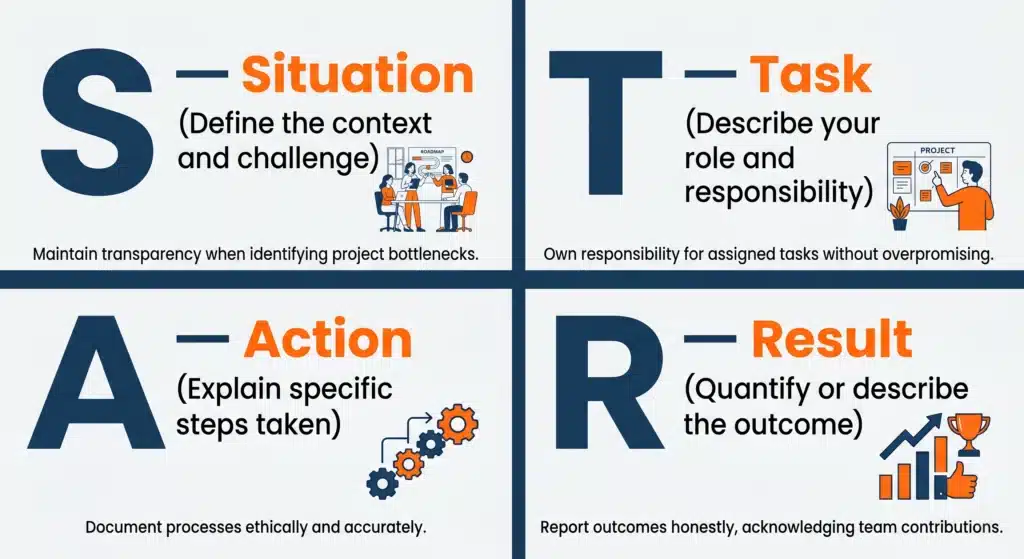
STAR stands for Situation, Task, Action, and Result. When applied to integrity self-assessment, it requires respondents to describe a real scenario, define their specific role, explain the concrete steps they took, and state the measurable or observable outcome. According to SHRM behavioral interview and self-assessment guidance, structured behavioral examples are consistently more predictive of actual job performance than unstructured responses — making STAR method integrity self-assessment one of the highest-value tools available to US HR teams.
Organizations that combine integrity self-assessments with structured integrity testing report turnover reductions of up to 37% in high-risk roles. This guide delivers seven ready-to-use integrity self-assessment examples using STAR method, covering the seven dimensions HR professionals evaluate most: honesty, accountability, ethical decision-making, professionalism, confidentiality, transparency, and growth. It also covers how to build strong STAR examples from scratch, the pitfalls most HR teams encounter, and a scoring rubric you can implement immediately.
What Are Integrity Self-Assessment Examples Using STAR Method?
Integrity self-assessment examples using STAR method are structured behavioral responses that demonstrate ethical conduct through real, specific, and verifiable professional situations. They are used across US HR functions in performance reviews, pre-employment screening, behavioral interviews, and promotion evaluations. The Society for Industrial and Organizational Psychology (SIOP) recognizes structured integrity tools as among the most predictive assessment instruments available — with validity that consistently exceeds unstructured interviews alone.
The STAR framework transforms abstract integrity questions into structured, comparable responses HR teams can evaluate objectively. Instead of asking ‘Are you honest?’ and receiving an unverifiable answer, STAR-structured integrity self-assessment examples require the respondent to describe a real scenario, their specific role, the concrete action they took, and the measurable or observable outcome. The result is a response that is specific enough to probe with follow-up questions, credible enough to verify, and structured enough to compare consistently across candidates or employees.
This makes integrity self-assessment examples using STAR method more useful than any generic self-assessment prompt — and more actionable than a character reference or ratings-only performance review.
7 STAR Method Integrity Self-Assessment Examples
The following integrity self-assessment examples using STAR method cover the seven dimensions most commonly evaluated in US performance reviews, pre-employment screening, and behavioral interviews. Each section includes a complete STAR breakdown and ready-to-use sample self-assessment sentences.

1. Honesty and Trustworthiness
Honesty responses built using STAR method move beyond declarations and into verifiable, behavioral evidence. A strong honesty STAR self-assessment example demonstrates self-regulation, dependability, and consistent respect for company values — the qualities HR reviewers look for when evaluating candidates for trust-sensitive roles.
STAR Example: Admitting a Mistake and Restoring Trust
- Situation: During a quarterly reporting cycle, I identified an error that had caused a minor overstatement in the financial projections shared with leadership.
- Task: I was responsible for correcting the data before leadership finalized decisions based on the inaccurate figures.
- Action: I notified my manager immediately, clarified the mistake and its impact during the next team meeting, and submitted revised documentation the same day.
- Result: Trust within the team increased. Leadership acknowledged my transparency, and colleagues felt more confident raising concerns early rather than allowing errors to compound.
Sample self-assessment sentences:
- I take pride in identifying and correcting errors early, before they affect decisions downstream.
- I provide honest, timely updates to my team even when the information is difficult to deliver.
Why this works:
This response demonstrates self-regulation and dependability with specific, verifiable detail. It sets a behavioral standard that others on the team can observe and follow — which is exactly what HR is looking for in an integrity self-assessment.

2. Accountability and Taking Responsibility
Accountability STAR examples show HR that a candidate or employee owns their outcomes — both successes and setbacks — and builds corrective processes rather than deflecting responsibility. This dimension is particularly valuable when evaluating candidates for supervisory or project leadership roles.
STAR Example: Owning a Project Setback
- Situation: A critical project missed its milestone because I had underestimated the resource requirements at the planning stage.
- Task: As project lead, I was responsible for addressing the oversight directly with both my team and senior management.
- Action: I proactively admitted responsibility, developed a revised corrective plan with a realistic timeline, and invited structured feedback from the team on how to prevent similar gaps in future planning cycles.
- Result: The team realigned quickly and management recognized the follow-through. The experience strengthened psychological safety on the team by demonstrating that honest accountability is valued over defensiveness.
Sample self-assessment sentences:
- I accept responsibility for both successes and setbacks, and I use feedback to build more reliable processes.
- My approach to accountability helps teams recover quickly and achieve more consistent outcomes over time.
3. Ethical Decision-Making
Ethical decision-making STAR examples demonstrate that a candidate upholds professional standards even under pressure or when a shortcut is available. The ACHE Code of Ethics and Ethics Self-Assessment — a US-based professional standard used across healthcare leadership — makes clear that codes of conduct require active personal reflection, not passive rule-following. This principle applies equally to HR practitioners and the employees they evaluate.
STAR Example: Refusing to Compromise Compliance Under Pressure
- Situation: An urgent client request conflicted with our internal data protection standards, creating pressure to expedite a process that required compliance review.
- Task: I needed to find a resolution that met the client’s timeline without compromising our compliance obligations under applicable US data protection requirements.
- Action: I escalated the conflict to leadership immediately, proposed a compliant alternative workflow, and clearly documented the reasoning in the project record for full stakeholder visibility.
- Result: The client respected our position. The company passed a subsequent compliance audit with no findings, and the approach was incorporated as a reference example in the team’s internal compliance training.
This type of ethical decision-making STAR example demonstrates that integrity is a built-in feature of how this employee works — not a behavior reserved for visible or high-stakes moments.

4. Professionalism and Leading by Example
Professionalism STAR examples reveal how a candidate’s conduct shapes team culture — particularly in mentorship and support situations that demonstrate character more reliably than high-stakes decisions. These examples are especially useful when evaluating candidates for team lead or people management roles.
STAR Example: Supporting a Team Member Under Pressure
- Situation: A new team member was struggling to meet a project deadline because of unfamiliarity with internal systems and processes.
- Task: I offered to mentor them through the process while ensuring the project deliverables met our confidentiality standards and quality requirements.
- Action: I dedicated additional time to reviewing their work, walking through best practices step by step, and providing direct, constructive feedback throughout the process.
- Result: The project was delivered successfully. The new employee gained confidence, and the experience strengthened overall team trust in the reliability of our collaborative process.
Leadership integrity at any level is most clearly demonstrated through how someone behaves when no recognition is at stake. This professionalism STAR example gives HR a window into that behavior.
5. Confidentiality and Data Protection
Confidentiality STAR self-assessment examples provide HR with concrete, verifiable evidence of how a candidate manages sensitive information. EEOC uniform guidelines on employee selection and applicable US state privacy laws require organizations to demonstrate consistent data handling standards across all HR processes — making this dimension particularly important for roles with access to employee or client records.
STAR Example: Identifying and Closing a Data Security Gap
- Situation: While preparing onboarding documentation, I noticed that personal identification information for new hires was visible on a shared platform accessible beyond the authorized team.
- Task: I needed to secure and anonymize the data immediately and establish a process to prevent the same gap from recurring in future onboarding cycles.
- Action: I updated document permissions, alerted the IT security team the same day, and ran a brief training session for the team on role-based access protocols and documentation standards.
- Result: No adverse impact or data breach occurred. The updated process passed the next compliance review, and new hire trust in the onboarding process improved measurably in the post-onboarding survey.
Sample self-assessment sentences:
- I consistently limit data access to authorized users and promptly escalate any documentation gaps to the appropriate team.
- I treat confidentiality as a behavioral standard that applies to every interaction with sensitive information — not only to formal reviews.
Key confidentiality practices to reference in self-assessments:
- Role-based access controls applied consistently across all platforms
- Immediate escalation when security gaps or unauthorized access are identified
- Regular documentation audits and access reviews
- Onboarding playbook reviews to prevent recurring data handling errors

6. Transparency and Open Communication
Transparency STAR examples demonstrate that a candidate communicates difficult information proactively and with appropriate context — a signal of professional maturity and organizational trustworthiness that HR teams value in both individual contributors and managers.
STAR Example: Communicating a Difficult Operational Change
- Situation: A safety incident required mandatory schedule adjustments that affected the entire team’s availability and workload distribution with minimal advance notice.
- Task: I needed to communicate the change clearly, manage team concerns honestly, and maintain morale and productivity through the disruption.
- Action: I called a team meeting immediately, explained the full context behind the change, established a structured channel for feedback, and followed up with a brief pulse survey one week after implementation.
- Result: Employees appreciated the transparency and the opportunity to provide input. The team adapted quickly, and post-adjustment morale survey scores improved relative to the pre-incident baseline.
Direct, evidence-based communication during difficult moments is one of the strongest signals of leadership integrity available in an integrity self-assessment — and one of the most distinctive in a pool of generic responses.

7. Growth and Self-Critique
Growth-focused STAR examples demonstrate self-awareness — the ability to identify gaps honestly, name them with specificity, and commit to measurable improvement steps. Gallup research on growth mindset and employee engagement finds that organizations cultivating development-focused cultures report significantly higher trust and engagement scores.
Sample self-assessment sentences:
- I recognized that my approach to delivering feedback under deadline pressure was inconsistent. I sought peer coaching, applied a structured feedback model in subsequent review cycles, and improved team satisfaction scores in the following quarter.
- My goal for the next review period is to strengthen the consistency of my blind review practices through targeted training and documented evaluation criteria.
- Based on team feedback from this review cycle, I have developed a structured time management plan with monthly progress check-ins and peer accountability.
Principles for growth-focused STAR framing:
- Name the specific behavior or skill gap — not a personality trait
- Describe the concrete action taken, not just the intention
- Connect the improvement to a measurable team or business outcome
- Reference progress already made to demonstrate forward momentum, not just future intent
How to Build a Strong STAR Method Integrity Self-Assessment
Building integrity self-assessment examples using STAR method does not require dramatic moments. Routine professional choices — resolving a conflict, identifying a policy gap, correcting an error, supporting a colleague — are the most credible evidence of integrity when described with behavioral specificity. SHRM behavioral interview and self-assessment guidance reinforces that structured behavioral examples drawn from everyday work situations consistently outperform vague character claims in predictive validity.
Drawing on integrity-focused self-assessment and 360° feedback tools, the most effective STAR integrity examples follow this four-step structure:
- Situation: Define the specific context and challenge with enough detail that the reviewer understands what was at stake and what made the situation relevant to integrity.
- Task: Describe your specific role and responsibility — not the team’s role, not your manager’s — yours alone.
- Action: Explain the concrete steps you took, referencing professional standards, compliance requirements, or ethical reasoning where relevant. This is the most important component in an integrity-specific STAR example.
- Result: Quantify the outcome wherever possible. Trust improvements, compliance outcomes, retention metrics, audit results, and team survey scores all qualify as measurable evidence.
Document potential STAR examples throughout the year by recording key decisions, client interactions, errors corrected, and team situations as they occur. The strongest integrity self-assessment examples using STAR method are built from evidence accumulated over time — not reconstructed from memory in the days before a review cycle opens.
Common Pitfalls in Integrity Self-Assessment
The most damaging self-assessment errors are not exaggeration — they are vagueness, self-deprecation, and statements that cannot be corroborated. HR reviewers consistently identify these patterns as the ones that undermine otherwise strong candidate and employee profiles:
| Pitfall | What It Sounds Like | Recommended Alternative |
| Bland statements | ‘I always try my best’ | Provide a specific STAR scenario with a named situation and measurable result |
| Self-deprecation | ‘I think I could have done more’ | Use forward-looking language: ‘Based on that experience, I will…’ |
| Oversharing personal context | Detailed personal anecdotes unrelated to professional impact | Limit examples to job-relevant situations with clear business or team outcomes |
| Omitting the result | ‘We just got it done’ | Specify the outcome: retention rate, audit pass, trust score, client satisfaction |
| Vague integrity claims | ‘I am honest and dependable’ | Provide a behavioral STAR example with a verifiable situation and result |
| Missing a growth area | Lists only strengths with no development dimension | Pair each strength with a named, active improvement goal and a progress update |
HR Scoring Toolkit for STAR Integrity Examples
Consistent scoring criteria reduce adverse impact and make integrity self-assessment outcomes more defensible in both performance review and hiring contexts. The following rubric is adapted from integrity-focused self-assessment and 360° feedback tools and aligned with SHRM behavioral interview and self-assessment guidance. Adapt it to your organization’s specific values and compliance requirements.
| Evaluation Criteria | Rating (1–5) | Scoring Guidance | Follow-Up Question |
| STAR example provided with specificity | 1–5: Alignment with stated values | 5 = full STAR with named situation and verifiable result; 1 = generic claim with no behavioral evidence | Can you describe another situation where you applied the same approach? |
| Evidence or feedback cited | 1–5: Specificity and verifiability | 5 = references documented outcome, peer feedback, or metric; 1 = no supporting evidence | What did you learn, and what would you do differently? |
| References compliance or professional standard | 1–5: Standards awareness | 5 = names relevant policy, regulation, or code of conduct; 1 = no standards awareness | How do you ensure your records or decisions stay audit-ready? |
| Describes a growth action or improvement | 1–5: Development focus | 5 = names specific behavior change with progress evidence; 1 = no growth area identified | What specific behavior are you actively working on this review period? |
Reviewing integrity self-assessment examples using STAR method against this rubric alongside peer observations and manager evaluations gives HR a multi-dimensional, defensible view of integrity far more reliable than any single data point or impressionistic judgment.
Case Study: STAR Method Integrity Screening ROI
A large US logistics company implemented a structured integrity self-assessment process integrated with its pre-hire workflow. Assessments averaged under 20 minutes per candidate and fed directly into the applicant tracking system for documentation and compliance review. Within the first year, annual turnover dropped by 15%, workers’ compensation claims fell by over 20%, and post-hire manager surveys confirmed measurable improvements in job fit and onboarding performance.
The case demonstrates that structured integrity self-assessment examples using STAR method deliver measurable workforce improvements — not just compliance coverage. Read our full Integrity Screening Case Study for the complete methodology and outcome data.

Frequently Asked Questions
What are integrity self-assessment examples using STAR method?
Integrity self-assessment examples using STAR method are structured behavioral responses that demonstrate ethical conduct through real professional situations. Each response follows the Situation, Task, Action, Result format: defining the context, naming the respondent’s specific role, describing the concrete steps taken, and stating the measurable outcome. STAR-structured examples are more credible and more useful to HR reviewers than general integrity statements because they can be probed, verified, and compared consistently.
How do you write a strong STAR integrity self-assessment example?
Choose a real professional situation involving an ethical decision, accountability moment, compliance challenge, or conflict. Define your specific responsibility in that situation. Describe the concrete steps you took — not your intentions. Close with a quantifiable or observable result. Keep each component specific enough that a reviewer asking follow-up questions will get consistent answers.
What makes a STAR integrity self-assessment stand out to HR reviewers?
Specificity, structure, and evidence of real behavioral change. A response that names a real situation, describes deliberate ethical action with professional reasoning, and ties the result to a team or business outcome is consistently more credible than a list of character traits. STAR responses can be probed with follow-up questions; character claims cannot.
How many STAR examples should an integrity self-assessment include?
One strong, specific STAR example per integrity dimension is more effective than multiple weak ones. For a standard US performance review self-assessment, covering three to five dimensions with one STAR example each provides sufficient behavioral evidence. For pre-employment screening, two to three well-chosen STAR examples in the most role-relevant dimensions are typically sufficient.
Can the STAR method be used for growth and development self-assessments?
Yes. Apply STAR to a situation where you identified a skill gap or received constructive feedback, describe the specific development action you took, and close with the measurable improvement or progress made. This structure transforms a vague growth statement into verifiable evidence of self-awareness and professional development.
Strengthen Integrity Screening with IntegrityFirst Tests
Strong integrity self-assessment examples using STAR method improve the quality of performance reviews and hiring decisions. They work best when paired with validated, US-compliant assessment tools that provide objective benchmarks alongside behavioral evidence. Contact us to schedule a demo and see how structured integrity screening reduces mis-hires, cuts turnover, and builds teams you can rely on.