Schedule a call!
Integrity testing services help employers identify workplace risk, improve hiring accuracy, and strengthen workforce reliability before onboarding. It’s tough to shake off the pressure when a candidate sweats through an honesty and integrity test only to feel penalized for being real. For hiring managers, each decision weighs heavily knowing a single bad apple can affect team morale and long-term reliability. The anxiety and the second-guessing are all too common, both inside the candidate pool and HR departments striving for organizational trust.
Laszlo Bock, a pioneer in data-driven hiring, championed integrity as the foundation for every high-impact team. That’s why pre-employment testing isn’t about blocking opportunities. It’s about ensuring a strong culture and workforce quality. When red flag behaviors slip through, discipline takes the hit. Done right, these assessments make your hiring bench strength deeper and your teams more resilient.
This guide clears the fog. You’ll see how these tests work, why they matter, and how both HR and job seekers stand to benefit when honesty is measured fairly, for enhanced fit, performance and organizational excellence.
What Is an integrity testing services?
An honesty and integrity test is a validated assessment for employee screening that gauges whether a candidate’s attitudes and behaviors align with workplace reliability and ethical standards. These integrity testing services go beyond a mere personality test by identifying high-risk behaviors which influence job performance and organizational trust.
The main objectives are straightforward: screen out candidates likely to engage in workplace theft or absenteeism. They reinforce a culture of dependability. Tests may be overt, directly asking about past behavior, or covert, using personality-based questions that look for traits such as conscientiousness or rules compliance.
Unlike old-school screenings, today’s tests are built on research that proves faking is common in high-stakes settings. As verified by dozens of studies, applicants can and do deliberately distort their responses on self-report personality and integrity measures in high‑stakes selection settings, which is why modern test design focuses so heavily on detecting and mitigating “faking” rather than ignoring it.
Patrick Lencioni, a leader in team trust, points out that integrity forms the basis of every high-functioning organization. For HR, the test is a bar-raiser rather than a gatekeeper. It helps flag red flag behaviors but should support a well-rounded talent strategy, including structured interviews and reference checks. Results are never the end-all. They’re one piece of disciplined due diligence in hiring for cultural fit and long-term productivity.
Key Types of integrity testing services

Choosing the right mix isn’t just a gut check. Reid Hoffman reminds leaders that hiring for trustworthiness means selecting screening tools that match each role’s risks. Do not just opt for quick “plug-and-play” assessments. Think overt tests where theft or policy adherence are key. Use integrity testing services for jobs demanding conscientiousness or emotional stability.
| Test Type | Purpose | Question Style | Predicts | HR Use Case |
|---|---|---|---|---|
| Overt Integrity Test | Directly addresses work ethic and policy adherence | Explicit behavioral | Theft and safety outcomes | Retail security |
| Covert Integrity Test | Uncovers hidden attitudes | Indirect | Absenteeism | Corporate, customer facing |
| Personality-Based Test | Measures broader traits | Trait-focused | Conscientiousness and candidate fit | Executive, team-based |
Overt tests offer clarity but can invite faking.
Organizations that pair honesty testing with role-specific integrity assessments report sharper differentiation between low- and high-risk applicants, particularly in safety‑sensitive and customer‑facing roles. Integrity Assessments Definitive Guide For Smarter Hiring
Covert forms expose subtle high-risk behaviors. Personality-based methods align best with broad job suitability. Match test to risk. Always use as one part of an integrated candidate evaluation strategy for organizational risk reduction and turnover reduction.
How Effective Are integrity testing services? What the Research Shows
A 50‑year meta‑analysis covering 150 studies and 67,016 participants found integrity testing services significantly predict workplace deviance across industries and countries, with an overall corrected validity of .43 and even higher estimates for value‑oriented (.60) and integrity‑focused cognitive ability tests (.65).
It might surprise some HR teams, but the hard data makes a compelling case for including integrity assessments in screening tool strategy. Simon Sinek might say that the “why” behind these tests is their power to prevent workforce risk and strengthen responsibility.
Pairing them with cognitive ability test scores raises predictive validity to .78. This makes employee selection more precise and productive.
That said, the results aren’t plug-and-play. Studies show women outscore men (72 vs. 69 on average). Up to 97% of so-called false positives won’t steal. Hasty use of low cutoffs can lead to adverse impact. For instance, you could see utility/ROI through turnover reduction.
One large-employer case study showed that systematically screening for integrity risk reduced preventable workers’ compensation claims by double digits in the first year. Risky Hires Stop Hiring Your Next Work Comp Claim
Contact our experts to see how IntegrityFirst Tests can be integrated with your current interviews and background checks to de‑risk hiring decisions.
Only by adding reference checks can you avoid over-reliance.
To ensure ADA compliance and legal compliance, use annual utility review to track discipline metrics and absenteeism. Always look for responsible candidate attitudes, corroborate with a paper trail, and treat integrity scores as one tool, not the final word, in high-stakes hiring.
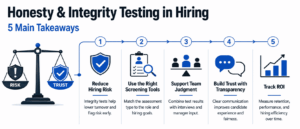
Use integrity testing services to Improve Hiring

Picture conducting your next round of interviews with true confidence. You know every hire will strengthen the team’s resilience and productivity because your process leverages the full power of honesty and integrity testing. Just like slipping on a Brooks Brothers Dress Shirt, you’re setting the right tone: polished, yet practical. Here’s how effective screening integration turns anxiety into actionable results, building morale and raising workforce standards.
1. Pair With Other Hiring Tools for Best Results
Don’t let one tool do all the heavy lifting. Integrate honesty and integrity assessments with cognitive ability tests and structured interviews. This well-rounded approach offers stronger incremental validity, helping you avoid false negatives and faulty job suitability calls. For example, supplementing with reference checks uncovers high-risk behaviors that tests alone might miss.
2. Set Expectations Through Open Communication
Candidates perform better when they know what to expect. Clearly explain the test’s purpose and the value placed on ethical decision-making. For instance, you could send a brief overview before testing, outline how results fit into overall evaluation, and answer questions during candidate communication.
3. Use Team Judgment, Not Automation Alone
Never treat a single red flag as the end of the road. Calibrate assessment cut scores and review borderline results using input from multiple assessors. Incorporate applicant honesty and emotional stability observations gathered from both screening integration and structured interviews. Or, you could convene a hire slow, fire fast panel when facing uncertainty.
4. Demonstrate a Feedback Culture for Brand Value
Invite feedback and clarifying questions, even if you can’t share every scoring detail. This reinforces job motivation, enhances your reputation, and reduces disciplinary problems. For instance, set up an email contact for post-assessment follow-up that addresses common concerns about applicant faking.
5. Audit and Adjust for ROI. Every Year
Schedule an annual utility review to track turnover and workers compensation claims.
Benchmarking integrity scores against actual theft, absenteeism, and claim events can reveal 20–30% swings in preventable losses across comparable business units. Roi Of Integrity Testing
Use this job analysis data to refine policies, escalate safety coaching, and set realistic incremental validity expectations. For instance, revalidate your process with fresh high-risk behaviors data.
Contact our experts to optimize your hiring process and reduce costly turnover.
6. Turn Insights Into Onboarding and Safety Gains
Use test insights to personalize onboarding and target coaching for new hires. Address pilferage risks or policy adherence gaps up front, translating applicant honesty results into practical organization discipline. For instance, new team members flagged for computer misuse risk could receive extra training on non-violent attitudes and company protocol.
Looking to cut hiring risks and reduce costly turnover? Choose IntegrityFirst Tests: simple, validated, HR-friendly, and proven to boost workforce reliability. Request a free demo or report.