Schedule a call!
When an integrity assessment is challenged in court, the question is not whether the tool predicted performance. The question is whether it did so without unlawful disparate impact — and whether the employer can document that it did. Integrity assessments for fair and compliant hiring require more than selecting a validated vendor. They require a working understanding of EEOC standards, a process for monitoring adverse impact, and a documentation trail that holds up to legal scrutiny.
This guide is written for HR professionals responsible for pre-employment assessment programs. It covers the legal framework governing integrity testing under Title VII, the mechanics of adverse impact measurement, what peer-reviewed research shows about subgroup score differences, and the steps required to build a defensible process. It does not cover general implementation, ROI calculations, or assessment type overviews — those topics are addressed separately in our
This guide is written for HR professionals responsible for pre-employment assessment programs. It covers the legal framework governing integrity testing under Title VII, the mechanics of adverse impact measurement, what peer-reviewed research shows about subgroup score differences, and the steps required to build a defensible process. It does not cover general implementation, ROI calculations, or assessment type overviews — those topics are addressed separately in our HR guide to integrity assessment for employee screening.
What Makes Integrity Assessments for Fair and Compliant Hiring Legally Defensible
A legally defensible integrity assessment process rests on three interconnected requirements established by federal law: the assessment must be job-related, it must be consistent with business necessity, and, if it produces adverse impact, the employer must demonstrate that no equally valid alternative with lesser impact exists.
The EEOC’s Employment Tests and Selection Procedures guidance states that tests and selection procedures can violate federal anti-discrimination laws if they disproportionately exclude people in a protected group — unless the employer can justify the procedure under the law. That justification requires documented validity evidence.
There are three recognized forms of validity under the Uniform Guidelines:
Criterion-related validity
Establishes a statistical relationship between assessment scores and measurable job outcomes such as supervisor ratings, disciplinary incidents, or theft losses. This is the most legally robust form for integrity testing because it directly connects the tool to job performance.
Content validity
Demonstrates that the assessment reflects the actual knowledge, skills, or behaviors required to perform the job. For integrity assessments, this means the scenarios or items must be grounded in realistic job situations — not generic ethical abstractions.
Construct validity
Shows that the instrument measures a defined psychological construct (such as conscientiousness or reliability) that is demonstrably linked to job performance in that role.
Validity evidence does not transfer automatically from a vendor’s database. SHRM’s reporting on the EEOC fact sheet notes that while vendor documentation can be helpful, the employer remains responsible for ensuring tests are valid under the UGESP for the specific positions and purposes for which they are used. HR leaders should request job-specific validity studies from vendors, not general-purpose summaries.
EEOC Standards for Pre-Employment Integrity Testing
The primary federal framework governing pre-employment integrity assessments is the Uniform Guidelines on Employee Selection Procedures (UGESP), codified at 29 C.F.R. Part 1607. These guidelines were adopted jointly in 1978 by the EEOC, the Department of Labor, the Department of Justice, and the Civil Service Commission. They apply to all employers with 15 or more employees subject to Title VII.
Under the UGESP, an employer is not required to conduct validity studies where no adverse impact results. However, if a selection procedure produces adverse impact against a protected group, the employer must be able to show that the procedure is job-related and consistent with business necessity — or adopt a less discriminatory alternative.
An important clarification for HR teams: integrity tests are not categorically exempt from EEOC oversight. The EEOC has confirmed, via an informal guidance letter on integrity testing, that while integrity tests asking hypothetical questions about workplace conduct do not implicate arrest and conviction guidance under Title VII, they remain subject to Title VII’s adverse impact requirements like any other selection procedure. Title VII does not prohibit integrity testing — it requires that testing be administered and evaluated in compliance with disparate impact standards.
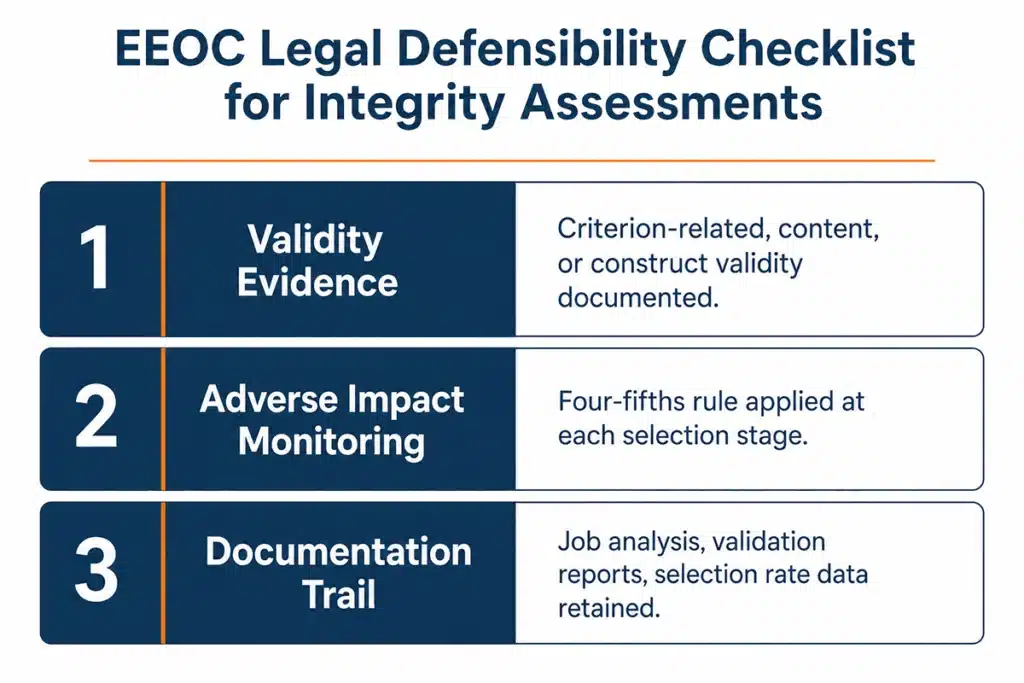
Practically, this means that HR programs using integrity assessments for EEOC-compliant hiring must:
- Maintain job analysis documentation linking each assessment to the specific role.
- Monitor selection rates by protected group at each decision point.
- Retain validity evidence capable of withstanding EEOC investigation or litigation.
Adverse Impact: How to Measure, Monitor, and Correct It
Adverse impact occurs when a selection procedure that appears neutral produces selection rates for a protected group that are substantially lower than those for the highest-scoring group. The operative standard is the four-fifths rule.
Under 29 C.F.R. Part 1607.4(D), a selection rate for any race, sex, or ethnic group that falls below four-fifths — or 80 percent — of the rate for the group with the highest rate is generally regarded by federal enforcement agencies as evidence of adverse impact. The EEOC’s guidance notes that even where the four-fifths threshold is technically met, statistically significant and practically meaningful differences can still constitute adverse impact.
How to calculate it:
Divide the selection rate for each protected group by the selection rate of the highest-selected group. If the result is below 0.80, adverse impact is indicated.
Example: If 50% of White applicants advance past an integrity screen and 36% of Black applicants advance, the ratio is 36 ÷ 50 = 0.72 — below 0.80, indicating potential adverse impact requiring further review.
HR teams should run this calculation at every decision gate, not just at the final hire stage. Integrity assessments are typically one step in a multi-stage funnel. Adverse impact may emerge or compound at any point, and monitoring only at final disposition obscures where it originates.
Corrective approaches when adverse impact is detected:
- Review cut-score calibration. Overly aggressive score cutoffs amplify group differences. A lower threshold that still separates acceptable from unacceptable risk profiles can reduce adverse impact without material loss of predictive value.
- Examine item-level data. Some items or item clusters may drive disproportionate group differences. Item-level analysis can identify whether specific content is functioning differently across subgroups — a standard part of ongoing test fairness review.
- Evaluate alternative procedures. The UGESP requires employers to consider less discriminatory alternatives that are equally valid. If a structured interview achieves equivalent criterion-related validity with lower adverse impact for a given role, the employer has a defensibility obligation to consider it.
- Check administration conditions. Group differences can be inflated by non-standardized administration — different completion environments, inconsistent instructions, or technology-access disparities. Standardizing delivery reduces this source of variability.
Adverse impact analysis for integrity assessment programs should be documented and retained. If a complaint is filed, the employer’s ability to produce contemporaneous records — not post-hoc reconstructions — is material to the outcome.
DEI Considerations in Assessment Design and Scoring
Integrating integrity assessments into a DEI-aligned hiring strategy is not a matter of relaxing standards. It is a matter of choosing instruments and scoring practices that do not create unnecessary barriers for qualified candidates from underrepresented groups.
Several design factors affect the fairness profile of an integrity assessment. Reading level is the most commonly overlooked. An integrity test written at a twelfth-grade reading level in a role where the work requires eighth-grade literacy introduces construct-irrelevant variance. The assessment is now partly measuring reading ability, not integrity — and reading level differences across demographic groups will inflate apparent group differences in scores.
Language accessibility matters in diverse applicant pools. Where candidates include non-native English speakers who are otherwise qualified for the job, assessments offered in validated translated versions reduce the risk that language proficiency is confounding integrity measurement.
Scenario selection in situational integrity tests should reflect the actual range of roles in the hiring population, including entry-level and frontline positions. Scenarios drawn exclusively from professional or managerial contexts may not engage candidates from different occupational backgrounds in the same way — introducing irrelevant context effects.
Scoring model transparency is also a legitimate DEI concern. If an integrity assessment uses algorithmic scoring with undisclosed item weights, the employer has limited ability to audit for subgroup fairness at the item level. Vendors should be able to provide item-level subgroup analysis on request.
For HR leaders working on integrity assessment DEI best practices, the core principle is this: DEI compliance in pre-employment testing is achieved through rigorous measurement quality, not through adjusting scores after the fact. Within-group norming — adjusting scores separately by demographic group — is explicitly prohibited under the Civil Rights Act of 1991, 42 U.S.C. § 2000e-2(l). Score adjustments or separate cutoffs by race, sex, or national origin are not permissible corrective tools.
The permissible path is to invest in assessment quality upstream: validated instruments, standardized administration, and ongoing subgroup monitoring.

Candidate Rights and Transparency Requirements
Candidates who take integrity assessments as part of a pre-employment process have legally established rights — and HR programs that do not address these rights create compliance exposure.
Notice and disclosure.
Employers must inform candidates that a test is being used as part of the selection process. While federal law does not mandate disclosure of every item or scoring rubric, concealing the existence of an assessment or misrepresenting its purpose may expose employers to claims under applicable state law. Several states, including California and New York, have enacted or proposed regulations requiring specific notice before pre-employment assessments are administered.
ADA accommodations.
Under the Americans with Disabilities Act, employers must provide reasonable accommodations for qualified applicants with disabilities who require them to participate in pre-employment testing. This applies to integrity assessments. The obligation is triggered when a candidate requests an accommodation; HR processes should include a clear intake mechanism for accommodation requests before testing begins.
Data privacy.
Assessment results and candidate responses are personal data. HR teams should ensure that vendor data-handling agreements address storage, access, retention periods, and destruction schedules. Organizations subject to state privacy laws — including California’s CPRA or Illinois’s BIPA — should review whether assessment data collection triggers additional obligations.
Adverse action notice.
If an integrity assessment score is a material factor in a decision not to hire, and the assessment is a consumer report under the Fair Credit Reporting Act (FCRA), employers must comply with FCRA adverse action procedures — providing a pre-adverse action notice, a copy of the report, and a summary of rights before finalizing the decision. Whether a given integrity assessment qualifies as a consumer report under the FCRA depends on how it is administered and transmitted; HR should consult legal counsel for a role-specific determination.
Documenting candidate communications — including disclosure language, accommodation requests and responses, and adverse action notices — is part of the compliance documentation trail discussed in the next section.
Subgroup Differences and What the Research Shows
The peer-reviewed record on integrity test subgroup differences is meaningfully different from the record on cognitive ability tests — and HR professionals should understand that distinction when evaluating fairness claims.
A study by Ones and Viswesvaran (1998) in the Journal of Applied Psychology examined group differences on overt integrity tests across 724,806 job applicants. The findings: race differences between Black, Hispanic, Asian, and American Indian applicants compared with White applicants were found to be trivial. Women scored higher than men on overt integrity tests. Age differences between applicants over 40 and those under 40 were very small.
These findings stand in contrast to cognitive ability tests, where Black-White mean differences are substantially larger — typically in the range of one standard deviation. The foundational meta-analysis by Ones, Viswesvaran, and Schmidt (1993) in the Journal of Applied Psychology, which synthesized validity data across hundreds of integrity test studies, established that integrity tests predict both overall job performance and counterproductive work behaviors with generalizable validity — and do so with substantially smaller adverse impact than cognitive measures.
More recent research on selection composite design has confirmed this pattern. Work examining the validity-diversity trade-off in selection systems has found that including integrity tests — while reducing or eliminating the weight given to cognitive ability tests — can maintain criterion-related validity while substantially decreasing Black-White adverse impact at the composite level.
What this means for HR practice:
Integrity tests, when properly validated and administered, represent one of the lower-adverse-impact selection methods available to HR. That said, “lower than cognitive ability tests” is not the same as “no adverse impact.” Individual assessments vary. Item content, reading level, norming samples, and administration context all affect subgroup performance. HR programs should treat the research literature as establishing a favorable baseline — not as a categorical guarantee of zero adverse impact for any specific instrument.
For integrity assessment subgroup differences research to translate into practice, HR must request subgroup analyses from vendors as part of the procurement process, not as an afterthought.
Building a Compliance Documentation Trail
Legal defensibility in pre-employment assessment is not established at the point of a complaint — it is established before one. The documentation assembled during the design and operation of the program determines whether the employer can mount a substantive defense.
The minimum documentation set for a legally defensible integrity assessment program includes:
Job analysis records.
A current job analysis for each role in which the assessment is used, documenting the knowledge, skills, abilities, and other characteristics (KSAOs) that the assessment is intended to predict. The job analysis is the foundation of content and criterion-related validity arguments.
Validity evidence.
The vendor’s technical manual, supplemented by any local validation study data. If a local validation study has not been conducted, document why (sample size constraints are common) and retain the criteria used to evaluate vendor-provided validity evidence.
Adverse impact monitoring logs.
Selection rate data by race, sex, and national origin at each decision stage, calculated on a rolling basis (at minimum annually, or after significant hiring volume accumulates). Include the four-fifths rule calculation results and any corrective actions taken.
Assessment administration records.
Documentation of standardized administration procedures, training for administrators, and any accommodation requests and responses.
Vendor agreements.
Contracts that specify the vendor’s obligations regarding test security, data handling, ongoing technical support, and notification of material changes to the assessment or its scoring.
Review cycle records.
Notes from periodic program reviews documenting that adverse impact data was examined, findings were acted upon, and the assessment continues to meet the job-relatedness standard for current roles. SHRM guidance on EEOC employment testing best practices recommends that these records be retained for the duration of the assessment program plus a reasonable period after discontinuation, consistent with applicable record-retention requirements under Title VII and the ADEA.

FAQ
Are integrity assessments covered by EEOC anti-discrimination rules?
Yes. Integrity assessments used in pre-employment selection are subject to Title VII’s adverse impact provisions and the Uniform Guidelines on Employee Selection Procedures. While the EEOC has clarified, via an informal guidance letter, that integrity tests asking hypothetical workplace conduct questions are not covered by its arrest and conviction guidance, they remain subject to the same validation and adverse impact monitoring requirements as any other selection procedure. Employers are responsible for ensuring that the assessments they use are job-related, consistent with business necessity, and not producing unlawful disparate impact against protected groups.
Do integrity tests produce adverse impact against racial minority applicants?
Peer-reviewed research, including the Ones and Viswesvaran (1998) study of nearly 725,000 job applicants, found that race differences on overt integrity tests were trivial. This is a favorable profile compared with cognitive ability tests, which produce substantially larger Black-White mean differences. However, adverse impact depends on the specific instrument, its administration conditions, and the applicant population. HR programs should conduct their own adverse impact monitoring rather than relying solely on the research literature or vendor claims.
What is the four-fifths rule, and how does it apply to integrity testing?
The four-fifths (or 80%) rule is the primary federal standard for detecting adverse impact, established under 29 C.F.R. Part 1607.4(D). It states that a selection rate for any demographic group below 80% of the rate for the highest-selected group is generally treated as evidence of adverse impact. For integrity assessments, HR should calculate this ratio at each selection stage where the assessment influences decisions. A ratio below 0.80 does not automatically mean the assessment is unlawful — it triggers an obligation to evaluate job-relatedness and to consider less discriminatory alternatives.
Can HR adjust integrity test scores by demographic group to improve DEI outcomes?
No. Score adjustments by race, sex, color, religion, or national origin — including within-group norming — are explicitly prohibited by the Civil Rights Act of 1991, 42 U.S.C. § 2000e-2(l). The permissible path to reducing adverse impact is to select instruments with strong fairness profiles, calibrate cut-scores appropriately, and standardize administration conditions. If adverse impact is detected, the UGESP requires exploring equally valid alternative procedures with less discriminatory effect — not adjusting results post-hoc.
What documentation should HR retain to demonstrate a legally defensible integrity assessment process?
At minimum: a current job analysis for each role, the vendor’s validity evidence (technical manual and any local validation data), selection rate logs by protected group, adverse impact calculations, accommodation request records, assessment administration procedures, and periodic program review notes. This documentation should be maintained for the life of the program plus any applicable retention period under Title VII and the ADEA. Documentation assembled before a complaint, not in response to one, carries greater legal weight.