Schedule a call!
Ethical hiring with integrity assessments is a process design problem, not an ethical philosophy question. The tools themselves are validated for predicting workplace behavior—rule-following, reliability, risk attitudes—and the legal and psychometric case for using them is well-established. What determines whether the process is ethical in practice is how it is built and run: whether integrity is defined narrowly enough to be job-relevant, whether candidates understand what they are agreeing to, whether scoring decisions are governed and documented, and whether the review trail can reconstruct any decision weeks or months after a requisition closes.
This guide covers the execution layer of ethical process design for integrity assessment: purpose statements that tie the tool to job-relevant risks, candidate disclosure standards, candidate communication, scoring governance, dispute resolution, and audit documentation. This is not a guide to the ethical justification for integrity assessments or to EEOC adverse impact compliance—those are covered separately. This guide addresses the operational decisions that determine whether ethical hiring with integrity assessments works in practice once the decision to use one has been made.
For an overview of integrity and work-ethics test formats, see this guide to integrity and work-ethics assessments.
Defining Scope: The Purpose Statement
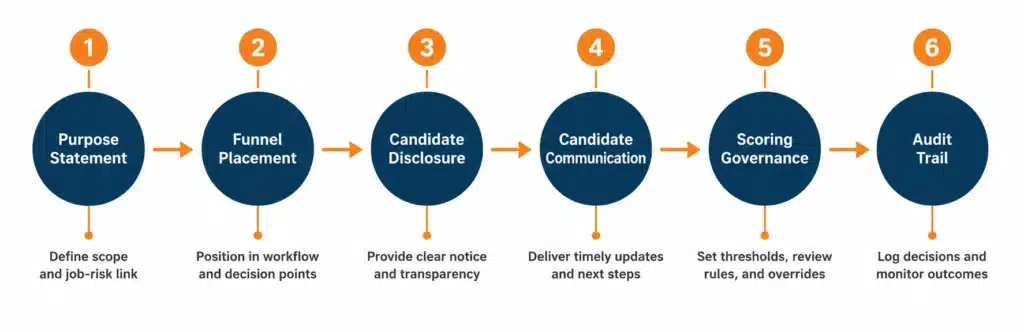
If you do not define what “integrity” means in the context of a specific role, the vendor’s scoring model defines it for you. Candidates often interpret a generic integrity screen as moralizing or a trick filter. A purpose statement addresses this by narrowing integrity to the job-relevant behaviors and risks that are measurable, explainable, and defensible.
A purpose statement is not a legal document. It is the internal working document that makes ethical hiring with integrity assessments operational: it narrows the scope of the assessment for that role family, aligns your team on what the tool is and is not measuring, and gives your recruiters a plain-language explanation they can use confidently with candidates.
Build the purpose statement around five elements:
| Element | What to Define | Example (Warehouse Role) |
| Role-risk link | The specific on-the-job behaviors you are trying to reduce | Safety shortcuts, falsified time records, inventory control violations |
| Behavioral definition | What high-integrity behavior looks like in this role | Following procedures under time pressure, accurate incident reporting, escalating conflicts rather than bypassing them |
| Scope boundary | What you are not claiming to measure | Morality, character, medical or psychological conditions, physiological deception detection |
| Decision intent | How results will be used | One input among others; borderline results trigger a structured follow-up interview, not automatic rejection |
| Candidate-facing rationale | A recruiter-ready one-sentence explanation | “We use a brief work-ethics assessment to support consistent, job-relevant hiring decisions for roles with safety and asset-responsibility requirements.” |
Writing the purpose statement also surfaces a common process error: treating the vendor’s summary score as a generic pass/fail gate without a documented rule connecting the score to the specific risk the organization is trying to reduce. If the score does not map to a named, measurable job risk, the gate is indefensible. For a detailed framework on defining job-relevant risk criteria before tool selection, see our article on how to select and validate integrity assessment tools.
Placing the Assessment in the Hiring Funnel
Placement determines how the assessment functions in practice. Placed too early as a hard gate, it functions as an automated filter rather than a decision support tool. When a score automatically eliminates candidates before any human review, the process has outsourced a hiring decision to a vendor algorithm without documented accountability—the opposite of ethical hiring with integrity assessments as a controlled, human-reviewed process. Placed correctly, it functions as one input that can trigger a structured follow-up rather than an automatic outcome.
A workable default for high-volume hourly roles: administer the assessment after basic eligibility verification and before final interviews. Define it explicitly as decision support—a score that can trigger a required follow-up step, not a binary pass/fail. For instance, in a logistics role where the primary risk is safety rule-bending under production pressure, a high-risk flag should require a brief safety-scenario interview with a second reviewer before a decline decision is made, not an automatic screen-out.
In high-volume roles, integrity testing works most effectively when it is positioned as structured decision support rather than an automated early gate. For implementation details on funnel placement and ATS workflow, see our article on how to implement integrity assessments in hiring.
Building Candidate Consent and Disclosure

Candidate consent and disclosure for integrity testing is a compliance requirement, not a candidate experience enhancement. When candidates receive an assessment link with no context, three outcomes occur: the best-qualified candidates with employment alternatives disengage, remaining candidates switch to game-the-test mode, and the data quality of the responses degrades. None of these outcomes serves the purpose of the assessment, and each one undermines the goal of ethical hiring with integrity assessments as a transparent, job-relevant process.
A legally compliant and operationally sound disclosure covers five elements:
- What the assessment measures: workplace honesty, rule-following, and work-ethics relevant to the role—not character, morality, or psychological conditions
- How results will be used: one input in the hiring decision; borderline results may trigger a structured follow-up conversation
- Who sees results: HR and a defined set of trained reviewers; not shared broadly with hiring managers or third parties outside the process
- Privacy and retention: how long data is kept, where it is stored, and how it is protected
- Explicit acknowledgment step: a statement candidates confirm before beginning, such as: “I understand this assessment will be used as part of my employment application, and I agree to answer the questions truthfully.”
One element the disclosure must never include: any language that implies the assessment detects deception or functions as a lie detector. The Employee Polygraph Protection Act (EPPA) prohibits most private employers from requiring or even suggesting polygraph-type testing in pre-employment screening. Written and online integrity assessments that do not use physiological measurement devices fall outside EPPA’s scope. However, framing the assessment in candidate-facing materials as “truth verification,” “voice stress analysis,” “deception detection,” or anything that implies physiological lie detection creates EPPA exposure regardless of the actual instrument. Review all vendor-supplied candidate-facing copy before launch and remove any language of this kind.
Writing Candidate Communication That Works
Integrity assessment candidate communication best practices are a core component of ethical hiring with integrity assessments—less about candidate experience polish and more about data quality and completion rate. Unclear or overly sparse invitations produce three measurable problems: elevated candidate drop-off, increased “game the test” behavior where candidates guess at the socially desirable answer rather than responding honestly, and accommodation requests that arrive late because the process was not explained in advance.
A well-structured invitation covers exactly what a candidate needs to engage seriously with the step:
- What it is: “A short work-ethics and workplace judgment assessment”—not “a personality test,” “a background check,” or an unexplained link
- Why you use it: “To support consistent, job-relevant decisions for roles with safety and asset-responsibility requirements”—one sentence, specific to the role type
- How it is used: “One input in your application; results may lead to a brief follow-up question with our team”
- Time and logistics: estimated completion time, device requirements (mobile-compatible or kiosk-only), deadline, and where to go for accessibility support
- Help path: a named contact or ticketed path for technical issues, and a clear process for requesting accommodations before the deadline
The instinct to say as little as possible in candidate communications typically backfires. Confusion generates drop-off, complaint volume, and sloppy responding—all of which reduce the quality of the signal you are trying to collect. Plain-language communication does not reveal how the tool scores responses; it explains what the step is and why it is part of the process for this role.
Ethical Scoring Governance in Integrity Assessment Hiring

Ethical scoring and interpretation of integrity tests requires documented rules and named accountability. The most common governance failure is allowing the ATS to auto-disposition candidates based on an integrity score without a human review step and without a documented rationale. When that happens, the scoring decision is effectively owned by the vendor’s algorithm and no one in the organization can explain why a specific candidate was declined. That is not a more objective process. It is a less accountable one.
Two rules must be written down and enforced:
Rule 1 — Restrict score access. Full integrity scores should be visible only to HR and a small set of trained reviewers. Hiring managers should see only decision-relevant status flags—“advance,” “review required,” or “not recommended”—not item-level responses or raw scale scores. Distributing scores widely increases the likelihood they are used casually, inconsistently, and without the context needed to interpret them correctly.
Rule 2 — Define a borderline band that triggers structured follow-up. Rather than a binary pass/fail cutoff, define a score range that requires a structured, job-relevant follow-up interview before a decline decision is made. This serves two purposes: it prevents automatic rejection of candidates whose score reflects a specific item pattern rather than a general risk profile, and it creates a documented decision point that can be reconstructed if the outcome is questioned. A structured follow-up interview using consistent, job-relevant questions is a defensible alternative to a silent automated rejection.
Name a reviewer for every decline decision that involves an integrity score flag. Without a named reviewer and a documented reason code, the audit trail cannot reconstruct what happened. This is the accountability structure that distinguishes ethical hiring with integrity assessments from an automated screening process with no documented owner.
Running a Dispute Resolution Process
An integrity assessment dispute resolution process is a program design element, not an exception case. In high-volume hiring, device failures, accessibility needs, and deadline conflicts occur regularly. Without a defined, consistently applied path for candidates to raise these issues, the process reads as unappealable. That perception erodes trust and generates complaint volume that requires improvised responses—a failure mode that ethical hiring with integrity assessments is specifically designed to prevent.
Route all challenges through a single intake channel—a shared inbox or ticketed path with a named owner. Triage by category:
- Technical and access issues: device failure, broken link, session timeout, or incomplete submission due to technical error. Offer a time-boxed retake under a written, consistently applied rule (for example, one retake within 48 hours of the reported failure with a verified system log)
- Accommodation requests: extended time, alternate format, or device type. These must follow the same documented accommodations path as other selection steps, with a named contact and a response SLA
- Result questions: candidates asking why their score affected their application. Provide a process-level explanation (the assessment is one input; borderline results trigger a review) without disclosing item-level content or vendor scoring logic. If the outcome was a decline, confirm that the decision was reviewed by a named reviewer and explain the channel for further questions
Apply the same rules to every candidate in the same role. If a retake is granted based on a phone failure, that rule applies to all candidates in that role with the same type of documented failure, not selectively. Inconsistent retake handling is a source of both adverse impact risk and candidate complaints.
Maintaining an Audit-Ready Review Trail
If you cannot reconstruct how an integrity score influenced a specific hiring decision three weeks after a requisition closes, the process was not documented at a standard that protects the organization or the candidate. In high-volume hiring, the ethical failure that undermines ethical hiring with integrity assessments most often is not intentional unfairness. It is missing context when someone asks why they were declined or why two candidates in the same role were treated differently.
Maintain a lightweight documentation packet for each role family that can be pulled for any requisition:
- Job linkage: the purpose statement for this role family, the risk behaviors the assessment is intended to address, and a note on where the assessment sits in the funnel
- Consistent administration: the candidate script and disclosure text used, the accessibility and accommodation path, and any retake rules in effect at the time of the requisition
- Vendor materials: current test description, the scoring bands and cutoff logic in use at the time of hire, and a change log if the vendor updated items or norms between requisitions
- Decision records: the reviewer name, the rule that triggered follow-up or decline, and a short reason code. Keep item-level content out of candidate-facing records and out of the reason code
- Retention and access controls: retention period, storage location (ATS field versus vendor portal), and the list of roles with results access
The documentation standard to apply: you should be able to reconstruct, for any specific candidate and requisition, who administered what, who reviewed the result, what rule governed the outcome, and where the record is stored. If any of those questions produce a “we’d have to check with the vendor” answer, there is a documentation gap.
Common Failure Modes and How to Prevent Them
Most integrity assessment processes do not fail because of intentional bias. The common failure in ethical hiring with integrity assessments occurs when automation removes human accountability from the decision and no one can explain the outcome. The predictable failure modes are all preventable with documented rules enforced at the design stage:
- Auto-disposition on a single score: block any ATS rule that declines or advances a candidate based solely on an integrity result without a documented human review step and a reason code
- Lie-detector framing in candidate materials: remove any language that implies physiological deception detection. Review vendor-supplied candidate-facing copy before launch and after any vendor content update
- Unrestricted score access: restrict full results to trained reviewers; share only decision-relevant status flags with hiring managers
- No consistent retake path: establish one intake channel and a written, consistently applied retake rule before the assessment launches
- No review trail: require a reviewer name and a reason code for every outcome where the assessment influenced the decision. Without this, no one can reconstruct what happened
Each of these failure modes has a simple structural fix. The challenge is implementing the fix before launch rather than diagnosing it after a complaint.
Frequently Asked Questions
What do you tell candidates if the assessment affects their application?
Tell them the assessment is one part of a job-related selection process and that results may trigger an additional review step. Provide a clear channel for reporting technical problems or requesting accommodations. Do not disclose item-level content, vendor scoring logic, or the candidate’s specific score. Keep the explanation at the process level: the assessment is a consistent, job-relevant step applied to all candidates for this role—which is the foundation of ethical hiring with integrity assessments at scale.
Should you allow retakes?
Yes, under a written rule you can apply consistently. The most defensible retake policy allows one retake within a defined window for verified technical failures or approved accommodation requests. Allowing retakes on candidate request without a qualifying condition trains candidates to treat the step as a game and weakens the scoring signal. Whatever rule you set, apply it to every candidate in the same role under the same conditions.
Who should be able to see integrity assessment results?
Full results—scale scores and response patterns—should be visible only to HR and a small set of trained reviewers. Hiring managers should see only decision-relevant status flags. The broader the distribution of scores, the more likely they become informal labels used inconsistently and without the context required for defensible interpretation.
What documentation do you need to stay audit-ready?
At minimum: your purpose statement and risk criteria for the role, the candidate-facing disclosure and acknowledgment text, the scoring bands and cutoff logic in effect at the time of hire, and a decision record for every outcome where the assessment influenced the result. If a vendor updates their configuration or norms, save the change log so you can explain what was in place at the time of a specific decision.
Can you describe the assessment as a “lie detector” style tool?
No. The Employee Polygraph Protection Act (EPPA) prohibits most private employers from requiring or suggesting polygraph-type testing. Written and online integrity assessments that do not use physiological measurement devices fall outside EPPA’s scope—but framing the tool as deception detection in any candidate-facing or internal materials creates legal exposure. Keep all descriptions at the level of “work-ethics and workplace judgment assessment” and avoid any language that implies truth verification or physiological measurement.
For a complete overview of integrity assessments — including what they predict, how validity evidence works, compliance requirements, and how to build a defensible implementation — see our integrity assessments guide.
Next Steps: Building an Ethical Integrity Assessment Process
Ethical hiring with integrity assessments is the product of decisions made before the assessment launches: a purpose statement that ties the tool to job-relevant risks, a disclosure that explains what candidates are agreeing to, scoring rules that name human reviewers and require documented reason codes, a dispute resolution path that applies consistently to every candidate, and an audit trail that can reconstruct any decision on demand.
IntegrityFirst Tests works with HR leaders to build integrity assessment programs that meet this standard. Our implementation support covers purpose statement design, candidate communication templates, scoring governance documentation, and audit trail configuration—so your process is defensible from the first hire through any review that follows.
Contact IntegrityFirst Tests to discuss how to build an ethical integrity assessment process for your hiring environment.