Schedule a call!

Hiring the wrong person is expensive. The U.S. Bureau of Labor Statistics consistently reports that voluntary turnover costs employers thousands per position — and most HR professionals know the real damage goes far beyond the price of a job posting. When trust breaks down inside a team, performance suffers, culture erodes, and managers spend more time managing fallout than driving results.
The root cause is often invisible during the interview: a misalignment of values, a history of unreliable behavior, or ethical blind spots that no resume can surface. That is exactly where a structured employee self-assessment for HR comes in.
This guide breaks down 10 proven, actionable strategies for using employee self-assessments across the full HR lifecycle — from pre-employment screening to annual reviews to culture-building. Whether you are an HR director designing a new evaluation framework or a recruiter looking to reduce risk on day one, these approaches will help you make smarter hiring decisions, build more accountable teams, and improve retention in measurable ways.
Want to see how IntegrityFirst Tests supports employee self-assessment for HR at every stage? Explore our business solutions.
What Is an Integrity Self-Assessment?
An integrity self-assessment is a structured evaluation tool that asks employees or candidates to reflect on and rate their own ethical behavior, reliability, and alignment with organizational values. Unlike external testing administered purely by an employer, self-assessments bring the individual into the process — making them a more collaborative, transparent, and development-oriented approach.
These evaluations can be applied at multiple stages of the HR lifecycle: as part of pre-employment screening, embedded in onboarding, used during mid-year check-ins, or built into annual performance reviews.
Effective self-assessments do more than check boxes. They generate structured data that HR leaders can use to identify behavioral risk early, start more honest conversations about performance, and build teams where accountability is expected — not exceptional.
For a broader look at integrity testing tools, see our Integrity Assessments: Definitive Guide for Smarter Hiring.
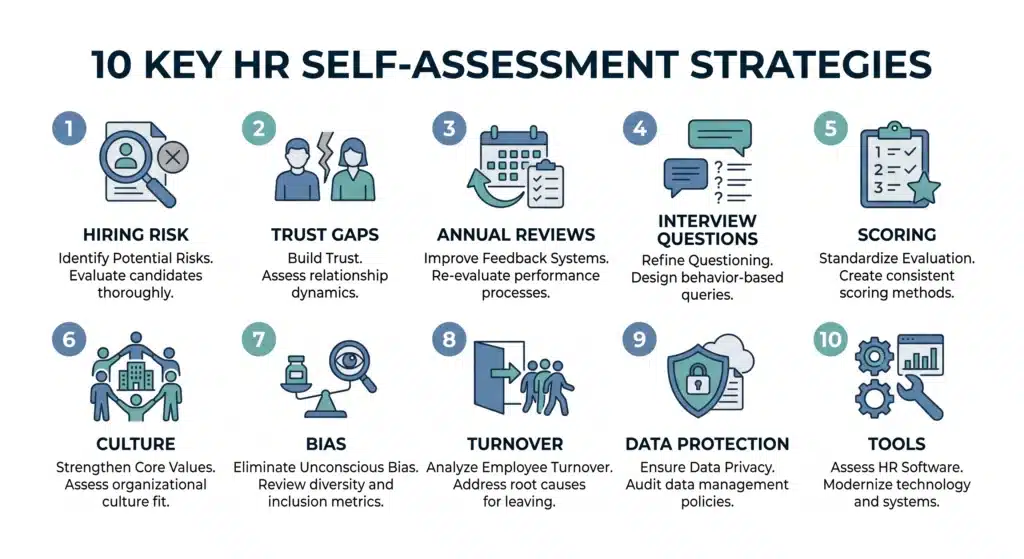
1. Use Self-Assessment to Reduce Pre-Employment Hiring Risk
The most direct application of employee self-assessment for HR is at the screening stage. A well-designed pre-employment integrity self-assessment asks candidates to reflect on their own attitudes toward honesty, accountability, and workplace behavior — surfacing information that a resume and a 30-minute interview rarely can.
Pre-employment integrity tools typically combine two elements: overt questions that ask directly about past behavior and attitudes toward dishonesty, and personality-based dimensions that infer integrity from broader behavioral profiles. Together, they give HR teams a more complete picture of who a candidate actually is.
According to SHRM’s guidance on pre-employment testing, well-designed assessments built on objective criteria can meaningfully reduce human bias in hiring while supporting legal compliance standards.
Practical application:
- Add a validated self-assessment tool to your hiring workflow after initial resume review, before final interviews.
- Use scenario-based prompts that surface real-world decision-making patterns, not just self-reported values.
- Combine self-assessment results with structured behavioral interview questions for stronger predictive validity.
2. Spot and Address Trust Gaps Before They Become Costly
Trust problems inside a team rarely appear overnight. They build slowly — through unmet commitments, inconsistent communication, and behavioral patterns that go unaddressed — until they surface as disengagement, conflict, or turnover. Integrating employee self-assessment into your HR process gives you an earlier signal.
When applied consistently across a team or department, self-assessment results can reveal patterns that might otherwise go unnoticed until the damage is done.
Early warning signs of trust deficits:
- Repeated missed deadlines with no acknowledgment or explanation.
- Teammates avoiding direct feedback with one another.
- Managers deflecting accountability onto their direct reports.
- Consistently low self-ratings on reliability or transparency dimensions across multiple team members.
HR action steps:
- Combine self-assessment data with pulse survey results to identify where stated values diverge from observed behavior.
- Use the STAR method in follow-up conversations to explore specific situations flagged in assessment results.
- Run small-group workshops on psychological safety and transparent communication when trust scores dip.
- Set clear, measurable team-level accountability goals and review them quarterly.
3. Integrate Employee Self-Assessment Into Annual Performance Reviews
Annual reviews often rely too heavily on manager perception rather than documented, observable behavior. Embedding structured employee self-assessment into the review cycle corrects this — and gives both managers and employees a shared data point to build the conversation around.
The The U.S. Office of Personnel Management’s guidance on integrity and honesty tests outlines how structured, evidence-based assessment prompts help organizations identify behavioral risk — a framework that applies directly to HR performance reviews.
How to integrate employee self-assessment into performance reviews:
- Add 3 to 5 self-evaluation questions focused on integrity dimensions — reliability, transparency, follow-through — to your standard review template.
- Ask employees to rate themselves and provide a brief evidence-based rationale for each rating.
- Compare self-ratings to manager and peer ratings to surface meaningful gaps for coaching conversations.
- Track self-assessment results across review cycles to identify consistent patterns, positive or negative.
For ready-to-use templates, see 10 Integrity Self-Assessment Examples for Reviews and Interviews.
4. Ask the Right Self-Evaluation Questions in Interviews
The quality of a self-assessment depends almost entirely on the quality of the questions. Generic prompts produce generic answers. Scenario-based and behavioral questions produce signal that is actually useful.
Pre-Employment Self-Evaluation Questions
| Question | What to Look For |
|---|---|
| ‘Describe a time you witnessed unethical behavior at work. What did you do?’ | Specific action, not just passive observation. Deflection or vague answers are flags. |
| ‘Have you ever faced a conflict between following an instruction and doing what you believed was right?’ | Clarity of values, willingness to escalate appropriately, no rationalization. |
| ‘Walk me through how you handle sensitive or confidential information in your role.’ | Specific protocols and habits, not just general statements about discretion. |
| ‘Tell me about a significant mistake you made. How did you handle it?’ | Ownership, corrective action, learning — not blame-shifting. |
Annual Review and Development Questions
- Where have you demonstrated integrity in a situation that was not easy or convenient?
- What would you do if you observed a teammate acting in a way that violated company policy?
- Where do you see the strongest opportunity to improve fairness or transparency on our team this year?
5. Score Self-Assessments Consistently, Reliably, and Objectively
The value of employee self-assessment for HR depends on how rigorously the results are measured and applied. Without structured scoring criteria, self-assessments become subjective — and subjective evaluation undermines the fairness they are designed to deliver.
Drawing on ALCOA+ principles — a data integrity framework used in regulated industries and adapted by many HR teams — assessment scoring should meet these standards:
| Category | Definition | Objective Criteria | Sample Evidence |
|---|---|---|---|
| Consistency | Stable behavior across time and contexts | Few discrepancies across multiple assessment cycles | Self-ratings align with manager and peer observations across reviews |
| Reliability | Dependable in task completion | Documented on-time delivery; accurate status updates | Meets 95% or more of assigned deadlines without follow-up required |
| Follow-Through | Sustained execution beyond minimum requirements | Proactive documentation; measurable impact on team outcomes | Completes projects ahead of schedule; flags risks before they escalate |
Practical scoring guidelines:
- Establish a standardised rubric before assessments begin — not after results are collected.
- Use multiple raters for higher-stakes roles to reduce individual bias in interpretation.
- Document the scoring rationale for every candidate or employee so decisions are defensible.
- Review and update criteria at least annually to reflect changes in role requirements.
6. Use Employee Self-Assessment to Strengthen Workplace Culture
Culture is built through repeated behavior — and behavior is shaped by the standards an organization consistently measures and reinforces. Using employee self-assessment for HR on a regular basis sends a clear signal about what the organization actually values, not just what it states in a handbook.
Practical culture-building applications:
- Include self-assessment dimensions in quarterly pulse surveys, not just annual reviews.
- Use results to recognise employees who consistently demonstrate reliability and transparency — not only those with strong output metrics.
- Build self-evaluation benchmarks into your onboarding playbook so new hires understand from day one how integrity is measured here.
- Share anonymised, team-level self-assessment trends with managers to support regular coaching conversations.
7. Overcome Bias and Common Pitfalls in Self-Assessment Design
Even well-intentioned self-assessments can undermine fairness if they are poorly designed or inconsistently administered. The EEOC Uniform Guidelines on Employee Selection Procedures provide clear standards for whether a screening tool produces adverse impact on protected groups — a critical compliance consideration for any self-assessment used in hiring decisions.
Common pitfalls:
- Question framing that assumes a particular cultural context or work style, disadvantaging candidates from non-traditional backgrounds.
- Overpenalising nuanced or context-dependent answers — a sign of thoughtful judgment, not low integrity.
- Single-rater scoring that introduces personal bias into the interpretation of self-reported results.
- Lack of transparency about how self-assessments are scored, which candidates experience as inherently unfair.
Bias mitigation checklist:
- Pilot new self-assessment instruments with a demographically representative sample before full deployment.
- Have all questions reviewed for neutrality by HR professionals with diverse professional backgrounds.
- Apply blind review for initial scoring where the role and context allow.
- Disclose the general scoring framework and what assessors are looking for to all candidates.
- Retain all scoring records and documentation for the duration required by applicable law.
8. Reduce Turnover and Improve Performance With Targeted Action Plans
Employee self-assessment for HR creates its most lasting value when results are tied to structured follow-up — not filed away after the hiring decision or review cycle is complete. Organizations that pair self-assessment screening with onboarding and safety training consistently see measurable reductions in early-stage turnover. For more on how integrity screening affects workplace safety outcomes, see Risky Hires: Stop Hiring Your Next Work Comp Claim.
For individual employees:
- Log daily commitments and track completion rate weekly — simple visibility drives accountability.
- Reframe self-assessment gaps as concrete development goals, not performance deficiencies.
- Build a habit of giving and receiving candid feedback with peers outside of formal review cycles.
- Review your own self-assessment results monthly and acknowledge specific behavioral improvements.
For HR teams and managers:
- Build follow-through checkpoints into performance cycles — do not wait for the next annual review.
- Use pulse surveys to verify that action items from self-assessment results are being implemented.
- Refresh your onboarding playbook to include self-evaluation benchmarks from the first week.
- Recognise and share examples of strong integrity behavior in team and all-hands meetings.
9. Protect Data and Ensure Fairness Throughout the Assessment Process
Self-assessments involve sensitive information — behavioral profiles, self-reported admissions, and employment decisions. How that data is handled is itself a signal of organizational integrity. The U.S. Department of Labor Equal Opportunity guidance establishes the baseline for fair, non-discriminatory hiring practices. Best practice goes beyond the minimum.
| Key Pillar | Best Practice | Practical Safeguard |
|---|---|---|
| Confidentiality | Restrict access to self-assessment data on a need-to-know basis | Role-based access controls and encrypted storage |
| Compliance | Align with EEOC guidelines and maintain complete audit trails | Schedule regular process reviews; document all decisions |
| Equal Opportunity | Apply consistent scoring criteria across all candidates | Blind initial scoring; bias training for all assessors |
| Feedback Loops | Share outcomes with candidates clearly and consistently | Written summaries; uniform feedback process for all applicants |
10. Tools and Expert Resources for Your HR Self-Assessment Program
A strong employee self-assessment program does not require building every component from scratch. A growing set of tools can streamline implementation, improve consistency, and reduce the administrative burden on your team.
Recommended tools:
- Applicant Tracking Systems like Greenhouse and Lever offer native integrations for pre-employment self-assessment workflows, reducing friction in candidate management.
- Culture Amp and Lattice provide pulse survey features that complement formal self-assessments with real-time team trust data.
- Use structured templates for self-evaluation forms, scoring rubrics, and feedback summaries — stored in a centralised, access-controlled location.
For professional development on compliance, bias reduction, and structured interviewing, LinkedIn Learning and SHRM offer practical US-focused training resources.
Why Employee Self-Assessment for HR Delivers Measurable Results

Employee self-assessment for HR works because it shifts evaluation from intuition to structured evidence — and it does so in a way that respects the individual’s perspective. When organisations consistently measure and develop integrity across the full employee lifecycle — screening, reviews, culture, and performance — they build teams that are not just capable, but genuinely trustworthy.
The benefits compound: stronger hires reduce early-stage turnover; richer review data supports fairer advancement decisions; a culture that measures and recognises integrity attracts people who share those values.
Ready to build a more structured, fair, and effective self-assessment program? Contact our team today and let us show you what IntegrityFirst Tests can do for your HR process.
Frequently Asked Questions

What is employee self-assessment for HR?
Employee self-assessment for HR is a structured process in which candidates or employees evaluate their own ethical behavior, reliability, and alignment with organizational values. HR teams use these evaluations to support hiring decisions, performance reviews, and ongoing culture development.
How is a self-assessment different from an external integrity test?
An external integrity test is administered and scored entirely by the employer. A self-assessment asks the individual to reflect on and rate their own behavior, making it more collaborative and development-oriented. In practice, the most effective programs combine both approaches.
Are employee self-assessments legal to use in hiring in the US?
Yes, self-assessments are generally legal to use in US hiring, provided they comply with EEOC guidelines, do not produce adverse impact on protected groups, and are applied consistently across all candidates. Document your scoring criteria and retain records.
How often should HR use self-assessments beyond the hiring stage?
Most HR professionals recommend integrating self-assessment dimensions into annual performance reviews and quarterly pulse surveys. Consistency across the employee lifecycle reinforces values and creates an earlier signal for behavioral issues.
How can HR teams reduce bias in self-assessment design?
Key strategies include piloting instruments with demographically diverse samples, reviewing questions for cultural neutrality, applying blind initial scoring, disclosing the scoring framework to candidates, and auditing results regularly for adverse impact patterns.