Schedule a call!
Writing a strong integrity self-assessment can feel surprisingly hard. You know your work ethic matters, but putting it into words — especially under the scrutiny of a formal review — is a different challenge entirely. The good news: with the right examples and a clear structure, it doesn’t have to be.
This guide gives you 10 ready-to-use integrity self-assessment examples for performance reviews and job interviews. Each one can be tailored to your actual situation. Whether you need to document accountability, demonstrate honesty, or address a mistake professionally, you’ll find a statement that works.
For HR professionals, the same examples serve as a practical framework for evaluating integrity across your team — clearly, consistently, and without ambiguity.
For the full picture, see our Integrity Self Assessment: The Complete Guide for HR, which explains what it is, the main formats, and how to use it across hiring, performance reviews, and culture audits.
What Is an Integrity Self-Assessment?
An integrity self-assessment is a formal process in which employees reflect on their own honesty, accountability, and ethical behavior at work. These assessments typically appear in annual performance reviews or as part of pre-employment evaluation. Unlike general performance metrics, they ask employees to document specific behaviors — moments when they made principled decisions, admitted mistakes, or upheld organizational values under pressure.
According to HR thought leader Dave Ulrich, integrity self-assessments function as a strategic tool: they ensure that professionalism and fairness stay at the core of decision-making for both individuals and organizations. When done well, they reinforce trust and contribute meaningfully to workplace culture.
Organizations that use structured pre-employment integrity assessments often see measurable improvements in retention and risk reduction — a point explored further in our analysis of how a pre-employment test cuts workers’ comp claims.
Integrity Self-Evaluation Examples for Annual Reviews
Annual performance reviews reward specificity. Generic statements like “I always try to act with integrity” are easy to overlook; concrete examples that tie behavior to outcomes are not. The table below gives you a quick-reference guide organized by situation.
| Situation | Example Statement | Format |
| Annual Review | Consistently upheld our company’s ethical standards by proactively surfacing issues and communicating them through the right channels. | Generic |
| Interview | When a data protection risk surfaced on my team, I identified the issue, escalated it to our IT lead, and ensured all patient privacy protocols were met. | STAR |
| Mistake Admission | I identified an error in project documentation, took immediate ownership, and worked with the team to implement a corrective process within 48 hours. | STAR |
| Teamwork | Supported an inclusive team environment by actively encouraging equal participation and modeling respectful communication in every group setting. | Generic |
| Feedback | Maintained impartiality when giving peer feedback, focusing on observable behaviors rather than assumptions. | Generic |
| Compliance | After a policy update, I organized a team training session to ensure full compliance and documented completion for our records. | STAR |
The four annual review examples below go deeper, covering the situations where integrity is most visible — and most scrutinized.
1. Demonstrating Consistent Values and Reliable Results
“Maintained consistent professional standards by meeting all project deadlines, honoring commitments to colleagues, and communicating proactively when circumstances changed. Delivered key milestones on schedule across all assigned workstreams.”
Why it works: Ties integrity to concrete performance outcomes. Reviewers see reliability, not just good intentions.
2. Taking Ownership in Challenging Situations
“When a critical deadline was at risk, I reallocated resources, identified the workflow bottleneck, and stepped in to resolve it — without waiting to be asked. The project was delivered on time.”
Why it works: Shows leadership integrity in practice. Accountability and initiative are visible without self-promotion.
3. Modeling Honesty in Reporting
“Identified a resource shortfall early and reported it to leadership before it could affect deliverables. Helped develop a realistic recovery plan that protected both the timeline and the team’s trust with stakeholders.”
Why it works: Demonstrates the kind of preemptive transparency that separates high performers from reactive ones.
4. Navigating an Ethical Dilemma Transparently
“When facing a decision that created tension between team goals and company policy, I paused to evaluate all options with the management team rather than acting unilaterally. We reached a decision aligned with organizational standards — and documented the process.”
Why it works: Shows mature ethical reasoning. Reviewers see someone who involves others and creates a record — both signs of institutional integrity.
Integrity Examples for Job Interviews: Honesty & Accountability

Interview questions about integrity test whether you can articulate your values with specific, credible evidence. Vague answers — “I always do the right thing” — do not build trust. Structured examples do.
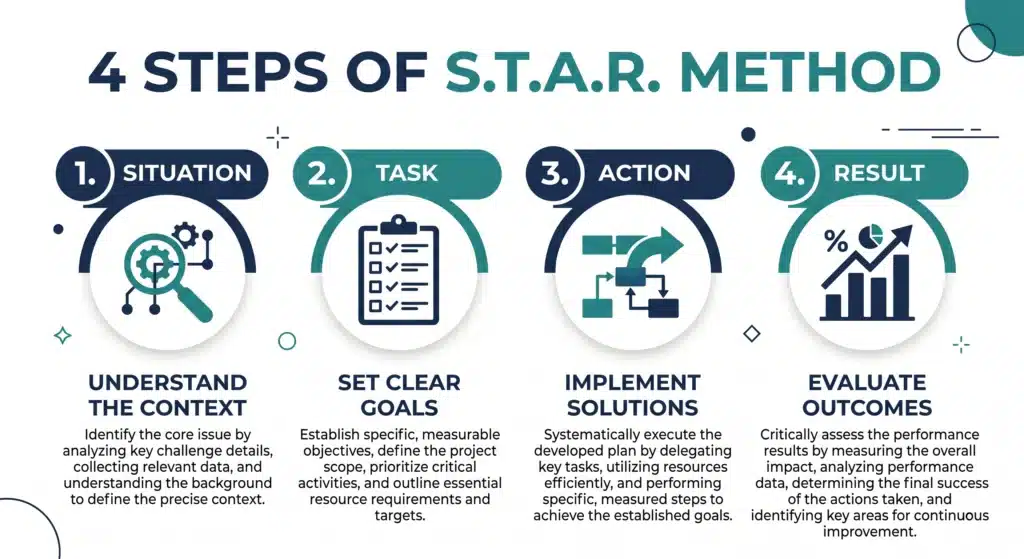
The four scenarios below are designed for common integrity-focused interview questions. Each follows the STAR framework (Situation, Task, Action, Result) in a way that sounds natural rather than rehearsed.
1. Handling an Ethical Dilemma With Objectivity
“I was facing conflicting priorities — a client deadline and a compliance requirement that couldn’t both be met at once. I flagged the conflict immediately, consulted our compliance team, and made a transparent decision that prioritized policy. The client appreciated our honesty and the timeline was adjusted with their agreement.”
2. Admitting a Mistake Under Pressure
“I caught a documentation error on a live project and reported it to my manager the same day, even though the review cycle was already underway. I submitted a correction plan and followed up until it was resolved. My manager later cited this as an example of the accountability standard she wanted across the team.”
3. Advocating for Fair Treatment
“During a project kickoff, I noticed that workload distribution was uneven in a way that would consistently disadvantage two team members. I raised the concern in our planning meeting, proposed a revised structure, and the project lead agreed to rebalance assignments. Team morale during the project was notably strong.”
4. Prioritizing Process Integrity Over a Quick Win
“When given the option to close out a compliance audit early using a shortcut, I chose to complete the full review — even though it added three days to the timeline. The thorough audit identified a reporting gap we would have missed. My manager noted this in my next review as evidence of sound professional judgment.”
For more background on what structured integrity assessments look for — and how they connect to long-term hiring outcomes — the NATO Building Integrity handbook offers a useful public-sector framework that translates well to private organizations.
Addressing and Admitting Mistakes
Admitting mistakes in a self-assessment isn’t just about honesty — it’s about demonstrating the kind of self-awareness and follow-through that organizations want in every role. The statements below are structured to acknowledge the error, describe the response, and highlight what was learned.
| Statement Type | Example |
| Clear Admission | Took immediate ownership of a reporting error and communicated it to the team along with a timeline for correction. |
| Collaborative Resolution | Brought the issue to my project group the same day it was identified, and we worked together to determine root cause and a path forward. |
| Corrective Action | Developed a structured action plan after identifying the error, shared it with stakeholders, and provided progress updates until resolution. |
| Learning Focus | Acknowledged the mistake, documented the specific factors that contributed to it, and implemented two process changes to prevent recurrence. |
| Process Improvement | After missing a deadline, I initiated a workflow review that resulted in a revised scheduling approach now used by the full team. |
| Follow-Up Accountability | Provided weekly status updates to leadership from the time the error was identified through final resolution — without being asked. |
Teamwork and Trustworthiness Statements
Integrity in teamwork is less about dramatic decisions and more about consistent, daily behavior. These statements are designed for collaborative roles or management tracks where reliability and professional trust are core evaluation criteria.
| Statement Type | Example |
| Dependable Delivery | Consistently met project timelines and provided proactive updates at each milestone, keeping the full team aligned without additional follow-up. |
| Peer Support | Volunteered for additional responsibilities during a high-pressure sprint to support a colleague who was managing competing priorities. |
| Transparent Communication | Maintained an open communication approach with team members, addressing concerns directly rather than through indirect channels. |
| Trusted Resource | Became a consistent go-to for peer feedback and process questions — a role that reflected the team’s trust in my judgment and objectivity. |
| Leadership Consistency | Modeled professional conduct on high-priority projects, which contributed to a team dynamic where accountability became the standard, not the exception. |
| Respect for Diverse Perspectives | Actively sought out and incorporated diverse viewpoints in group decision-making, particularly in cross-functional projects. |
How to Turn Generic Statements Into STAR-Format Integrity Examples

Generic integrity statements are easy to write and easy to ignore. A statement like “I always try to act honestly with clients” gives reviewers nothing to evaluate. The STAR method — Situation, Task, Action, Result — changes that by giving context to every claim you make.
Research from NATO’s Integrity Self-Assessment Process review confirms that structured, evidence-based integrity assessments are significantly more effective than open-ended self-reporting — particularly when integrated into regular evaluation cycles.
Here’s the same statement rewritten with STAR:
Before: “I always try to act honestly with clients.”
After (STAR): “When a client’s delivery was delayed due to a supply chain disruption (Situation), I took responsibility for communicating the issue the same day it was confirmed (Task). I contacted the client directly, apologized, and arranged expedited shipping at our cost (Action). The client responded positively to our transparency, and their repeat order volume increased by roughly 10% over the next quarter (Result).”
Notice what changed: the revised version specifies what happened, who was involved, what steps were taken, and what the outcome was. That level of detail is what allows HR professionals to assess impact and pattern — not just intent.
The same approach works for any integrity scenario. If your example doesn’t include all four STAR components, it’s worth expanding it before your next review cycle or interview.
For additional guidance on building strong self-evaluation habits, SHRM’s performance management resources (https://www.shrm.org/topics-tools/topics/performance-management) offer practical frameworks for HR professionals and employees alike.
Overcoming Self-Doubt in Self-Evaluations
One of the most common challenges in integrity self-assessments is calibration: how honest is too honest? How much advocacy crosses into exaggeration? Most HR professionals have seen both extremes — the self-assessment that reads like a list of apologies, and the one that reads like a promotional brochure.
The right approach sits in the middle. Use precise, outcome-focused language. Replace “I helped with projects” with “I delivered three key milestones ahead of schedule.” When addressing growth areas, frame them as active pursuits rather than weaknesses: “I’m seeking more leadership opportunities in client-facing work to expand my project scope.”
If you’re documenting a setback, include what happened next. “Missed a deadline but immediately coordinated a recovery plan and delivered within 72 hours” shows accountability without undermining your overall record.
For employees from underrepresented groups or those navigating cultural norms around self-promotion, the advice is the same: use evidence, not assertion. “I exceeded the project target by 15%” is more credible — and harder to overlook — than “I did a great job.” Seek feedback from colleagues who can validate your examples if you’re unsure how they read.
Navigating Difficult Situations: Sensitive Integrity Scenarios
Not all integrity examples are straightforward. Some involve confidentiality, workplace conflict, or emotionally charged situations where the right course of action wasn’t obvious. In these cases, how you frame the example matters as much as what you did.
The NATO Integrity Self-Assessment Questionnaire identifies clear codes of conduct and transparent standards as essential for navigating complex integrity situations professionally. The same principle applies in private organizations: when the situation was hard, show that you used a process — not just instinct.
The fill-in-the-blank templates below are designed for situations where discretion matters:
- “Faced a situation involving a sensitive compliance issue, I followed established protocol and escalated through the appropriate channels while keeping relevant stakeholders informed.”
- “In an emotionally charged team situation, I focused on reinforcing our communication norms and offering support, rather than taking sides or escalating prematurely.”
- “When I identified a potential compliance risk during a routine review, I flagged it to the appropriate team immediately — before the formal audit window opened.”
- “During a stakeholder disagreement, I maintained objectivity by focusing the conversation on documented requirements rather than individual preferences.”
- “Supported a team member navigating a personal difficulty by connecting them with the right resources while protecting their privacy.”
In each case, the framing protects confidentiality while still demonstrating principled action. Reviewers don’t need all the details — they need to see that you had a process and followed it.
FAQs: Common Questions About Integrity Self-Assessments

What if I can’t think of a specific example?
Start with patterns, not events. If you consistently deliver honest updates to leadership or regularly meet commitments without being chased, those behaviors are worth documenting — even without a single dramatic moment. Reference peer feedback, recurring project work, or routine behaviors that reflect your values over time. Consistency is its own form of integrity.
Should I include failures or mistakes in my self-assessment?
Yes — and not just because it’s honest. Self-assessments that include setbacks alongside successes are generally perceived as more credible, not less. The key is framing: always pair the acknowledgment of a mistake with the corrective action you took. “I missed a project milestone but immediately coordinated a recovery plan and delivered within 72 hours” shows accountability without undermining your record.
How specific do I need to be?
Specific enough to be credible, not so specific that you compromise confidentiality. Reference the type of project, the general outcome, and the behavior you demonstrated — without naming clients, sharing sensitive details, or quoting private conversations. Numbers and percentages help, when you have them. “Reduced review cycle time by two days” is more compelling than “improved the process.”
Do I need documentation or evidence to support my examples?
Not always, but evidence strengthens credibility when it’s available. If your organization uses a performance management platform, attach relevant project notes or outcome summaries. If not, a well-written STAR example is often sufficient on its own — reviewers are evaluating your judgment and self-awareness, not auditing your records. Focus on accuracy. An honest example that’s slightly incomplete is always better than an embellished one that unravels under questioning.
Use Integrity Self-Assessment Examples to Strengthen Hiring and Culture
Integrity self-assessment examples are more than a compliance checkbox. When employees bring specific, honest examples to every review and interview, they signal something important to the entire organization: that accountability is valued, that transparency is safe, and that professional standards mean something.
For HR professionals, structuring integrity evaluations with consistent criteria makes selection more defensible and onboarding more predictable. Harvard Business Review’s research on self-management consistently shows that employees with strong self-awareness outperform peers across nearly every competency — and integrity self-assessments are one of the few direct ways to evaluate that capacity during hiring.
For employees, the examples in this guide are a starting point. The goal isn’t to find the perfect statement — it’s to build the habit of documenting your values in action, so that when the review cycle comes, you already have the evidence.
Ready to strengthen your integrity hiring process?
IntegrityFirst Tests helps HR teams screen for honesty, accountability, and reliability before the hire — reducing turnover and building stronger teams from day one. Schedule a demo at integrityfirsttests.com.