Schedule a call!
Selecting integrity assessment tools for smart hiring decisions requires more than reviewing vendor feature sheets. Different tools measure different constructs, cite different evidence bases, and operate under very different assumptions about what “integrity” predicts in a specific work environment. The result is a market where two tools share a category label while producing completely different outcomes—one reducing cash-handling loss, the other predicting attendance reliability. This guide shows how to evaluate and compare integrity assessment tools for smart hiring decisions: how to anchor the selection to specific risk targets, what validity evidence to require, and how to build a compliant, defensible implementation.
For a complete overview of integrity assessments — including what they predict, how validity evidence works, compliance requirements, and how to build a defensible implementation — see our integrity assessments guide.
Defining the Hiring Risks Your Assessment Must Predict
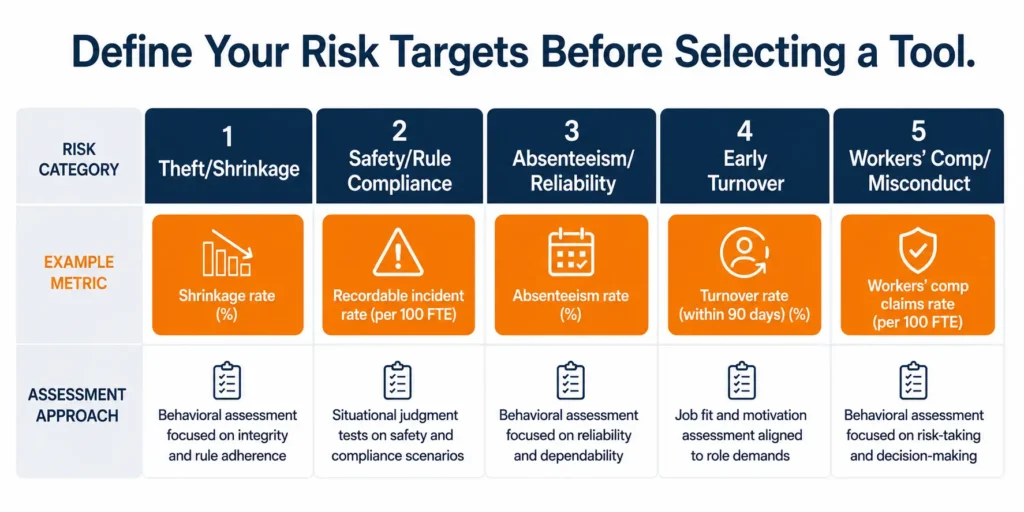
Selecting the highest-rated assessment on the market will not produce meaningful outcomes if that tool is calibrated to a different loss mode than the one your organization faces. When tool selection is disconnected from specific risk targets, the assessment fails to move the metrics that matter—and the organization absorbs the cost of turnover, safety incidents, and shrinkage that a better-matched tool could have reduced.
The market sells integrity assessment tools under a broad category label that bundles mismatched constructs. A vendor summary score labeled “integrity” may draw from rule-following, honesty, risk tolerance, and counterproductive work behavior in proportions that have no explicit relationship to your specific operational risks. In a high-volume warehouse environment, the primary integrity-linked losses may not be theft at all—they may be timecard inaccuracy, chronic unexcused absence, or safety shortcuts under production pressure. Without a defined loss mode, a vendor’s construct coverage and validation claims cannot be meaningfully evaluated.
Define three to five hiring risks the tool must predict, and tie each to a metric your organization already tracks:
- Theft and shrinkage: cash handling variances, inventory adjustments, internal loss incident reports
- Safety and rule compliance: OSHA recordable incidents, near-miss reporting rates, policy violations, equipment damage logs
- Absenteeism and reliability: no-call/no-show rate, late-to-shift frequency, attendance points, schedule adherence
- Early turnover: 30/60/90-day attrition, terminations for policy violation, probationary period washout
- Workers’ compensation and misconduct: claim frequency and severity, guest or patient complaints, workplace investigation rates
Once these risks are defined, vendor construct maps and validation evidence become directly evaluable rather than abstract. A tool optimized for theft prediction may be a poor predictor of 90-day turnover; a tool validated against absenteeism may provide limited signal for safety incidents. Risk definition converts tool selection from a vendor comparison exercise into a controlled matching process—and it is the first step toward selecting integrity assessment tools that support smart hiring decisions rather than generic honesty screening.
For a detailed framework on connecting pre-hire screening to measurable risk outcomes, see our article on how to measure employee risk before hiring.
Why the Category Label Is Not a Selection Standard
“Integrity assessment” is a category label, not a product specification. Vendors use the term to describe tools with meaningfully different construct coverage, scoring logic, and evidence quality. A tool that primarily measures reliability may address a distribution center’s no-call/no-show problem effectively while providing no useful signal about cash-handling loss. A tool validated against broad counterproductive work behavior may not predict safety shortcuts in a construction environment. Treating integrity assessment tools as interchangeable because they share the label produces tool-risk mismatches that do not surface until outcomes fail to move.
When evaluating vendors, require explicit answers to three questions before reviewing any feature sheet: What does this tool measure, at the construct level? Which outcomes has it been validated against, with what effect sizes? What peer-reviewed or independently audited evidence supports those claims? A vendor response of “we reduce risk” or “our clients see results” does not answer any of these questions. The EEOC Uniform Guidelines on Employee Selection Procedures establish that validity evidence must be job-related and documented—vendor assurances are not a substitute for technical documentation.
Validity Evidence That Should Drive Your Shortlist
In most vendor demonstrations, validity is presented as positioning rather than evidence. A polished presentation with outcome claims is not a substitute for specific information about what the assessment predicts, how strongly, and under what conditions. If a vendor cannot link scores to your defined risk metrics with documented effect sizes, the evaluation of integrity assessment tools has shifted from measurement quality to marketing review.
The published research foundation for integrity assessment validity is substantial. Ones, Viswesvaran, and Schmidt conducted a comprehensive meta-analysis based on 665 validity coefficients across 576,460 data points, finding that integrity test validities are substantial for predicting job performance and counterproductive behaviors on the job, including theft, disciplinary problems, and absenteeism. The estimated mean operational predictive validity of integrity tests for predicting supervisory ratings of job performance is .41. This is the caliber of evidence—peer-reviewed, large sample, independent replication—that separates a defensible tool from a vendor claim.
On the question of overt versus personality-based tests: the same meta-analytic evidence base shows that both types demonstrate comparable predictive validity for overall job performance and broad counterproductive work behavior, with no clear empirical basis for preferring one category over the other based on format alone. Construct coverage and job-risk alignment—not test format—should drive format selection.
When reviewing vendors, require documentation on four specific points:
- Construct map: Which traits and behaviors sit under the “integrity” score—rule-following, reliability, risk tolerance, counterproductive work behavior—and how each maps to your defined risk targets
- Criterion evidence: Which outcomes the tool has actually predicted (turnover, shrinkage, incidents, workers’ compensation claims), with effect sizes and study methodology, not summary outcome claims
- Study quality and vendor validation requirements: Peer-reviewed publications or clearly documented technical reports including sample sizes, job families, and validation time horizon—not a single before/after slide or an internal whitepaper with no disclosed methodology
- Local defensibility plan: How selection rates and outcomes will be monitored by demographic group and job category, and what process the vendor supports for detecting and addressing adverse impact
Treat validation as an ongoing local responsibility rather than a credential the vendor provides at purchase. Build lightweight local evidence by tracking pass rates and downstream outcomes by role and location, and use the EEOC Uniform Guidelines on Employee Selection Procedures four-fifths rule—a selection rate below 80% of the highest-selecting group—as a signal for investigation.
Integrity Assessment Tools for Smart Hiring Decisions: Selection Criteria

Selecting integrity assessment tools for smart hiring decisions fails most often not because HR chose the wrong vendor, but because the comparison did not include the right criteria. A tool that demonstrates strong published validity in general can still be a poor operational fit if its construct coverage does not align with your risk targets or if its scoring outputs cannot be applied consistently in a high-volume environment.
Compare tools against five criteria before finalizing a shortlist:
| Selection Criterion | What to Ask the Vendor | What Good Looks Like |
| Job fit and use case | Which job families and environments does your model fit, and which of our risk targets is it designed to predict? | Documented role-specific fit (hourly, high-volume, safety-sensitive) tied to your defined risk outcomes |
| Construct coverage | What sits under the “integrity” score, and how does each construct link to our outcome metrics? | Transparent construct map covering rule-following, reliability, risk tolerance, and CWB, mapped to your tracked metrics |
| Scoring and thresholds | How are cut scores and decision bands set, and what are the throughput versus risk tradeoffs at each level? | Documented, defensible threshold guidance with explicit tradeoff analysis, not vendor defaults |
| Documentation and monitoring | What technical documentation and monitoring outputs do you provide for ongoing selection-rate and outcome review? | File-ready validation documentation plus practical monitoring tools for selection rates and outcomes by job and group |
| Operational integration | How does the tool integrate with your ATS and hiring workflow without reducing completion rates? | Confirmed compatibility with your ATS, multilingual support, and minimal manual workarounds |
Organizations that apply integrity assessment tool selection criteria for HR consistently—across all vendor evaluations, not just the final shortlist—typically avoid the most common gap: documentation that was never collected and outcome data that cannot be reconstructed when leadership or legal counsel asks for it.
Compliance and Defensibility Requirements
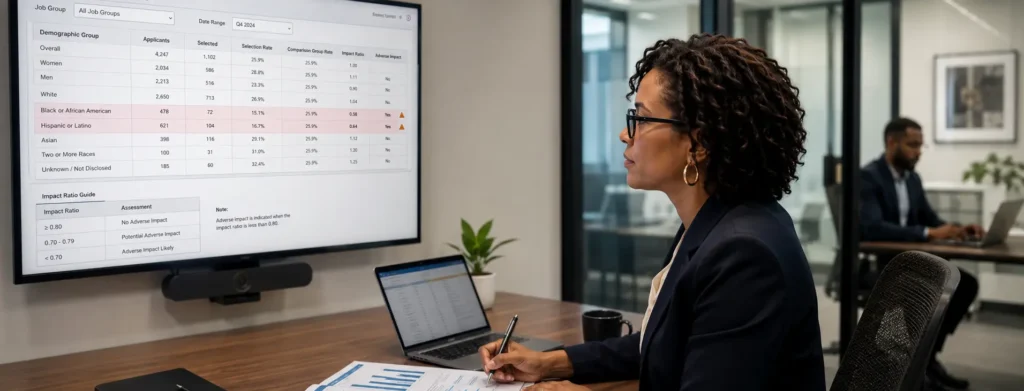
Adverse impact in a selection process does not become a compliance problem at the moment a complaint is filed—it becomes a problem at the point where selection rates diverge and no monitoring system detects the signal. The EEOC Uniform Guidelines on Employee Selection Procedures require organizations to maintain selection-rate impact information by race, sex, and ethnic group, and to have validity evidence and documentation available if adverse impact appears. Organizations that treat this requirement as a post-complaint response rather than an ongoing operational process face significantly higher remediation risk.
When evaluating integrity assessment tools, implement the four-fifths rule as a routine monitoring threshold, not a legal standard to invoke under pressure. If the selection rate for any group falls below 80% of the highest-selecting group at the assessment decision point, treat it as a signal to review process consistency, scoring logic, and job linkage before continuing at the same threshold.
Confirm that the assessment does not create exposure under the Employee Polygraph Protection Act. The EPPA prohibits most private employers from using lie detector tests, either for pre-employment screening or during the course of employment. Written integrity assessments that do not use physiological measurement devices are not covered under EPPA (Employee Polygraph Protection Act, U.S. Department of Labor). However, assessments framed as detecting deception or positioned as a lie detection measure—rather than as a measure of integrity-relevant attitudes and behaviors—create EPPA exposure risk. Require vendors to confirm that their instrument’s framing, marketing materials, and candidate disclosures do not characterize the tool as a lie detector or deception identification system.
For a detailed review of compliance requirements in integrity testing, see our article on whether integrity tests discriminate and how to monitor for adverse impact.
Implementation in High-Volume Hiring Environments
A well-validated integrity assessment tool that cannot be deployed consistently in a high-volume workflow produces inconsistent data. This is one of the most common implementation failures when comparing integrity assessment platforms for hiring: strong validity evidence that does not translate to measurable outcomes because the workflow was never properly configured. Operational friction—additional manual steps, unclear manager guidance, inconsistent ATS trigger points—is the primary reason validity evidence does not translate to measurable outcomes at scale. In environments running hundreds of weekly hires across multiple locations, any process step that depends on recruiter discretion rather than system automation introduces variation that undermines both measurement quality and compliance posture.
Map the exact decision points in your ATS before launch: where the assessment link triggers, what the system does when a candidate does not complete within the defined window, and which user roles can see results at each stage. Establish a clear, documented rule for whether the assessment precedes or follows an initial offer, and apply that rule consistently across all sites. If open hiring events or kiosk-based application flows require a different delivery format, configure that workflow in the ATS rather than relying on location-level improvisation.
After the workflow is mapped, audit the maintenance details that generate compliance exposure over time: multilingual support and its coverage for your applicant population, documented accommodations and alternate format procedures with assigned ownership, retest policy criteria, and audit trail exports including score versioning and cutoff change records. If the vendor cannot specify who owns each operational component—talent acquisition, HR operations, safety, loss prevention—the program is likely to develop undocumented exceptions over time.
For guidance on ATS integration for assessment tools, see our article on talent assessment tools and ATS integration.
Candidate Communication and the Assessment Experience
Candidate drop-off in a high-volume hiring process is a data quality and compliance problem, not only an experience issue. When candidates abandon an assessment because the purpose is unclear, the connection to the job is not apparent, or the time requirement was not communicated in advance, the resulting completion pattern is non-random. Candidates with more employment options or stronger alternatives are more likely to disengage from poorly explained screening steps. The resulting applicant pool is shaped by assessment friction rather than job-relevant criteria.
Communicate the assessment purpose in plain, job-specific language before the candidate begins. For a safety-sensitive role, an explanation might read: “This assessment measures reliability and rule-following in workplace situations. It takes approximately 10 minutes. Results are one input in our hiring review and are kept confidential.” This disclosure reduces abandonment, reduces legal exposure from insufficient notice, and reduces the likelihood that candidates interpret the assessment as an arbitrary screening obstacle.
Design friction at the content level, not at the administration level. A scenario-based item tied to a specific job situation—lockout/tagout compliance in a maintenance role, cash variance in a retail context—communicates job relevance and produces more defensible scoring evidence than a generic honesty question with no situational grounding.
Building Your Vendor Shortlist and Pilot Plan
Vendor demonstrations show presentation quality, not predictive validity. Understanding how to evaluate pre-employment integrity assessment vendors is a more useful frame than how to select the best vendor demo—because the demo reflects what a vendor can present, not what their tool can predict. Two vendors with comparable demo capabilities may differ substantially in construct coverage, documentation quality, and operational fit once real candidates interact with the tool at scale. The fastest path to a defensible selection is a short, criteria-anchored shortlist followed by a structured pilot tied to the outcomes your organization already tracks.
Narrow to two or three vendors using the five selection criteria above. Require a construct map linked to your defined risk metrics, file-ready technical documentation, confirmed ATS integration, and explicit threshold guidance before advancing any vendor to pilot. Remove vendors from consideration who cannot provide these in writing before the demonstration.
Run a 30 to 60 day pilot in one or two high-volume roles across a limited number of locations. Before the pilot begins, establish documented baselines on the specific outcome metric the tool is intended to move—for example, 60 to 90 day turnover rate, cash variance, or workers’ compensation claim frequency. Define a minimum completion rate threshold and a protocol for what to do if completion falls below it. If the baseline metric cannot be defined before the pilot starts, the pilot will not produce defensible evidence to support a full rollout decision.
Contact IntegrityFirst Tests to discuss how to evaluate and implement integrity assessment tools matched to your organization’s specific hiring risks.
Frequently Asked Questions
Should you choose overt or personality-based integrity tests?
Test format should not be the primary selection criterion. Meta-analytic evidence shows that overt and personality-based integrity tests demonstrate comparable validity for overall job performance and broad counterproductive work behavior, with no consistent basis for preferring one format over the other as a category. Match construct coverage and validation evidence to your defined risk targets rather than selecting based on item format.
What should you do if adverse impact appears after launch?
Treat it as an investigation trigger rather than an anomaly to explain. Pull selection-rate and outcome data by job family and location, apply the four-fifths rule as an early signal threshold, and investigate process consistency—placement stage, scoring logic, threshold application—before drawing conclusions about the instrument. Maintain EEOC Uniform Guidelines documentation throughout, including the investigation steps and any adjustments made.
Can candidates retake an integrity assessment?
Yes, subject to a clearly defined retake policy. Without a policy, retake requests create an inconsistent process that undermines scoring reliability and introduces adverse impact risk. Define the conditions that qualify for a retake—confirmed technical failure, documented accommodation request—set a consistent cooldown period, and apply the same policy across all locations.
Which roles are integrity assessments most appropriate for?
Roles where specific, measurable integrity-linked losses occur with sufficient frequency to establish a baseline and detect change: safety-sensitive hourly work, cash or inventory access, controlled substance handling, and high-turnover positions where reliability drives overtime and incident costs. If the downstream outcome metric cannot be named before implementation, the business rationale for the assessment is not yet sufficient.
What ROI should you expect from integrity assessment tools?
ROI is only measurable when the tool is tied to a specific outcome with a documented baseline and a consistent deployment in a stable workflow. IntegrityFirst client data shows that organizations implementing validated integrity assessment programs have achieved a 48% reduction in workers’ compensation claim frequency, a 30% reduction in turnover, and a 19% reduction in claim severity (IntegrityFirst client data). These outcomes depend on consistent implementation and ongoing monitoring—not on tool selection alone.