Schedule a call!
Integrity assessments are pre-employment screening tools that evaluate a candidate’s likelihood of engaging in counterproductive workplace behaviors—rule violations, theft, safety shortcuts, attendance fraud, and conduct problems that create measurable organizational loss. They are among the most extensively researched tools in the pre-employment testing literature, with meta-analytic validity evidence spanning more than five decades and hundreds of thousands of data points.
Used correctly, integrity assessments function as risk controls: they reduce the probability of hiring candidates whose behavioral patterns predict specific, expensive outcomes. Used incorrectly—as a character verdict, a performance predictor, or a pass/fail gate without documented job linkage—they create compliance exposure and erode the trust of candidates and managers alike.
This guide covers the fundamentals every HR professional needs before deploying, evaluating, or defending integrity assessments in a hiring program: what they measure and what they do not, how their validity evidence works and what it means for your specific use case, how to choose between test formats, how to integrate them defensibly under EEOC and UGESP standards, and how to structure the candidate-facing process. Each section links to deeper, topic-specific guides in the IntegrityFirst resource library for HR teams that need more detail on any specific dimension.
What Integrity Assessments Measure
An integrity assessment is not a measure of a person’s moral character. It is a structured psychometric instrument designed to predict the probability that a candidate will engage in behaviors that create organizational risk. The distinction matters because it shapes how you set expectations with candidates, how you explain the tool to hiring managers, and how you document its use under selection procedure guidelines.
The behaviors integrity assessments are designed to predict fall into a category industrial-organizational psychologists call counterproductive work behavior (CWB). In operational terms, these include:
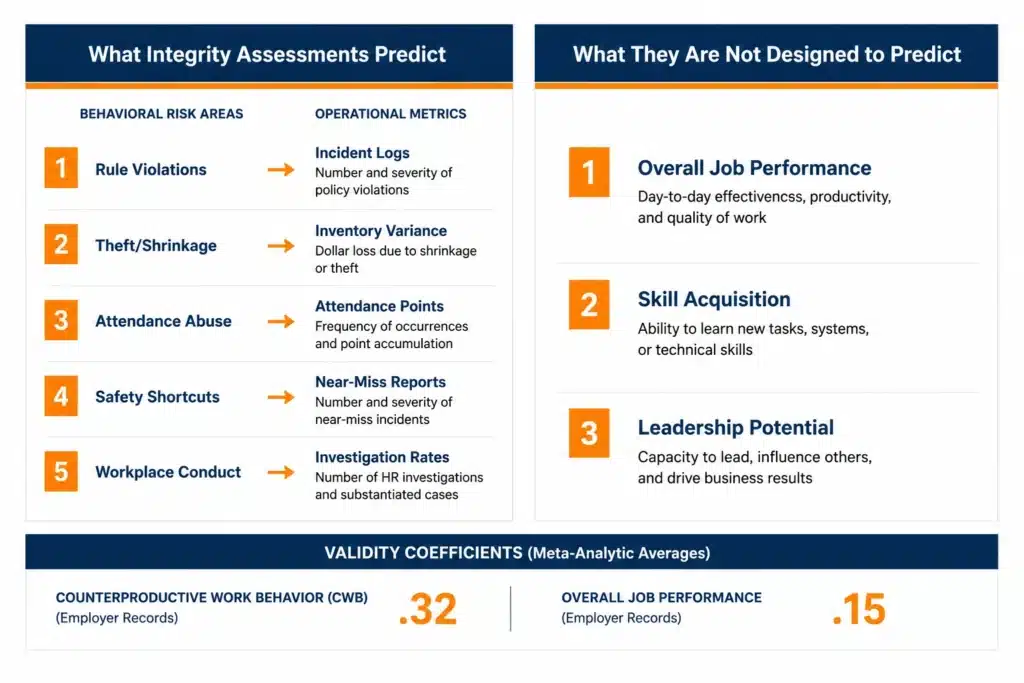
- Rule-bending and policy violations: bypassing procedures, ignoring safety protocols, circumventing access controls
- Theft and shrinkage: taking company property, manipulating transactions, cash handling irregularities
- Time and attendance abuse: timecard fraud, chronic no-call/no-show, early departure, buddy-punching
- Safety shortcuts: skipping required steps under production pressure, ignoring hazard controls, underreporting near-misses
- Workplace conduct: interpersonal aggression, harassment, persistent conflict that disrupts operations
What integrity assessments are not designed to predict: overall job performance, skill acquisition speed, or leadership potential. The research on this distinction is consistent and directly relevant to how you build the business case. The foundational Ones, Viswesvaran, and Schmidt meta-analysis of 665 validity coefficients across 576,460 data points reported a mean operational predictive validity of .41 for supervisory ratings of job performance [(Ones, Viswesvaran & Schmidt, Journal of Applied Psychology, 1993, Vol. 78, No. 4)](https://psycnet.apa.org/record/1994-00453-001). An updated meta-analysis applying stricter methodological criteria found corrected validity of .32 for counterproductive work behavior and .15 for job performance when using employer records rather than self-reported behavior as the criterion [(Van Iddekinge et al., Journal of Applied Psychology, 2012, PubMed 21319880)](https://pubmed.ncbi.nlm.nih.gov/21319880).
The practical implication is direct: if your business problem is “we need higher performers,” an integrity screen will not carry that strategy alone. If your business problem is “we need fewer conduct incidents, fewer workers’ compensation claims, and less shrinkage,” integrity assessment addresses the right target—provided you select and validate the tool for those specific outcomes.
For a deeper exploration of how integrity assessment outcomes map to hiring economics and ROI, see our guide on integrity assessment for ethical hiring and ROI.
Two Test Formats: Overt and Personality-Based
Integrity assessments are produced in two formats that differ in how they measure integrity-relevant behavior. Understanding the tradeoffs is necessary before selecting a tool, because each format creates different failure modes in high-volume hiring environments.

Overt Integrity Tests
Overt tests ask candidates directly about their attitudes toward dishonest acts, their past behavior, and their judgments about theft and rule-breaking. Examples: “Is it ever acceptable to take small items from work?” “How often do you think employees take things that don’t belong to them?”
Overt tests are transparent: candidates generally understand what is being measured. This supports internal defensibility—it is easy to explain to hiring managers and candidates why the question relates to the role. The tradeoff is susceptibility to coaching. In high-volume environments where candidates share application tips through social networks or group chats, the signal quality of an overt test can degrade if the candidate pool learns the socially desirable answers. Research on faking suggests overt tests are more susceptible to both “fake good” responding and coaching than personality-based formats [(Ones, Viswesvaran & Korbin, Personnel Psychology, 2007)](https://onlinelibrary.wiley.com/doi/abs/10.1111/j.1744-6570.2007.00074.x).
Personality-Based (Covert) Integrity Tests
Personality-based tests infer integrity-relevant risk from responses to trait and style items—conscientiousness, dependability, risk tolerance, rule-following orientation—without directly asking about theft or dishonest acts. Candidates typically experience these as standard personality or work-style surveys and do not identify them as integrity screening.
The advantage is reduced faking susceptibility: it is harder to identify and coach the “correct” pattern across a behavioral trait inventory. The tradeoff is lower transparency—candidates and managers may not immediately understand the connection to job risk, which requires more deliberate communication during the candidate disclosure process.
Meta-analytic comparisons show both formats demonstrate meaningful validity for predicting counterproductive work behavior, with no consistent empirical basis for preferring one format over the other at the category level. Overt tests show modestly stronger validity for theft-specific outcomes; personality-based tests show stronger validity for absenteeism prediction [(Ones, Viswesvaran & Schmidt, 1993)](https://psycnet.apa.org/record/1994-00453-001). In practice, format selection should be driven by your primary risk target, your volume and channel, and your tolerance for coaching-related signal degradation.
For a practical comparison of assessment tool types and selection criteria, see our guide on integrity assessment tools for smart hiring decisions.
What Integrity Assessments Predict: The Validity Evidence

The validity evidence for integrity assessments is one of the most examined bodies of research in applied psychology. Understanding the key findings—and their limitations—prevents two common errors: dismissing the tools as pseudoscience, and overclaiming their predictive power in leadership conversations.
Three findings from the research base are directly relevant to HR practitioners:
1. Integrity tests predict CWB, not overall job performance. The corrected validity of .32 for counterproductive work behavior, derived from independent (non-publisher) validation studies using employer records as the criterion, is the most conservative and defensible figure to use in stakeholder communication [(Van Iddekinge et al., PubMed 21319880)](https://pubmed.ncbi.nlm.nih.gov/21319880). Validity for job performance hovers around .15 when measured against employer records rather than self-report. This is not a weakness—it reflects the correct use case for the tool.
2. Criterion type changes the number substantially. When the criterion is self-reported deviance (asking candidates themselves whether they engaged in counterproductive behavior), corrected validity rises to approximately .42. When the criterion is employer records (incident logs, attendance data, investigation records), it falls to approximately .15. This gap explains why vendor validity claims often appear higher than what organizations experience in practice: many publisher studies use self-report criteria. When evaluating vendor documentation, always ask what the criterion was and how it was measured.
3. Validity generalizes across job types and settings. The large Ones et al. (1993) meta-analysis found that validity generalizes across job families, industries, and demographic groups. This is the foundation for the transportability argument—using published evidence to justify use in your specific context without a full local validation study—though transportability requires documented job similarity, not just an assumption.
For a detailed guide to evaluating validity evidence, selecting a validation strategy, and understanding transportability requirements, see our article on how to select and validate integrity assessment tools.
Where Integrity Assessments Fit in the Hiring Funnel
Placement in the hiring funnel determines whether the assessment functions as a decision support tool or an automated filter. The two errors are predictable: placing it too early creates an automated gate that eliminates candidates without human review; placing it too late wastes recruiter and interviewer time on candidates whose behavioral risk profile should have been identified earlier.
The defensible default for high-volume hourly and safety-sensitive roles: administer the assessment after basic eligibility verification and before scheduling supervisor interview time. This protects interview capacity from the highest-risk candidates while avoiding the compliance and data quality problems that come from very early unproctored administration—particularly the risk of answer-sharing when assessments are delivered as a top-of-funnel online link.
Placement also determines what decision rule is appropriate. An assessment used pre-interview in a large candidate pool can justify a conservative cutoff score as a screen. An assessment used post-interview alongside reference checks operates as a risk input that informs the final decision rather than driving it. Neither approach is inherently better—the right choice depends on your volume, your risk tolerance, and the quality of your other screening steps.
Key placement decisions to document before launch:
- Trigger stage: which ATS status triggers the assessment invitation
- Decision rule: cut score (hard stop), score band (triggers follow-up), or advisory input (one factor among several)
- Override policy: conditions under which a reviewer can advance a candidate who scored below the threshold, with required reason codes
- Retest policy: whether retesting is permitted, under what conditions, and with what waiting period
For a complete guide to ATS integration, workflow configuration, and pilot governance, see our article on how to implement integrity assessments in hiring.
Interpreting Scores: Decision Rules and Avoiding Overreach
Integrity assessment scores estimate the probability of specific behavioral patterns. They do not certify that a candidate is honest or identify that a candidate is dishonest. Treating a score as a character determination—rather than a risk probability—creates two problems: it overstates the tool’s certainty, and it generates defensibility risk if the assessment is challenged under EEOC selection procedure standards.
Three scoring approaches are common in practice, each with appropriate use cases:
Cut scores: a defined threshold below which candidates do not advance. Appropriate when you can document a job-related risk threshold—tied to outcomes you actually track, such as shrinkage rate, safety incident frequency, or attendance points—and when the volume and risk level justify an automatic screen. A cut score without documented job linkage is legally indefensible under UGESP.
Score bands: defined ranges that trigger different actions. A high-risk band triggers a structured follow-up interview before a decline decision; a mid-range band advances with a note for the interviewer to probe specific areas; a low-risk band advances normally. This approach provides more nuance than a binary cut score and produces more defensible decisions because the human review step is documented.
Advisory input: the score is visible to trained reviewers and informs the decision alongside other factors (reference check, structured interview, skills verification) without serving as a standalone decision rule. Appropriate for higher-stakes or lower-volume roles where the full candidate profile matters more than throughput.
Whatever approach you use, the decision rule must be written down, applied consistently across all candidates in the same role, and connected to a documented job risk rationale. Inconsistent application is the primary source of legal exposure in selection process challenges—not the assessment itself.
For guidance on building the business case for integrity assessment and connecting scores to operational outcomes, see our article on integrity assessments for smarter hiring decisions.
Legal Compliance: EPPA, EEOC, UGESP, and ADA

Integrity assessments operate within a compliance framework that HR professionals must understand before deployment. Four federal standards are directly relevant:
Employee Polygraph Protection Act (EPPA)
The Employee Polygraph Protection Act prohibits most private employers from using lie detector tests for pre-employment screening. Written and online integrity assessments that do not use physiological measurement devices fall outside EPPA’s scope. The compliance risk arises from positioning: if candidate-facing materials, vendor marketing, or internal policy language describe the assessment as detecting deception, truth verification, or lie detection, EPPA exposure exists regardless of the actual instrument. All candidate-facing communications and vendor materials should describe the tool as a measure of work-related integrity attitudes and behavioral tendencies, not as a deception detection system.
EEOC and Uniform Guidelines on Employee Selection Procedures (UGESP)
The EEOC Uniform Guidelines on Employee Selection Procedures apply to any selection procedure that affects candidate movement, including integrity assessments. Key requirements:
- Job relatedness: the assessment must be connected to job-relevant behaviors and risks specific to the role. Generic integrity claims are not sufficient. Document which behaviors you are screening for and how the assessment maps to them
- Validity evidence: when adverse impact is detected, you must have validity evidence on file. Content validity does not apply to trait-based measures; criterion-related validity or a documented transportability argument is required
- Adverse impact monitoring: track selection rates by protected class at each stage where the assessment affects candidate movement. Apply the four-fifths rule as an early warning threshold. If adverse impact appears, investigate process and job linkage before adjusting thresholds
Americans with Disabilities Act (ADA)
Integrity assessment items must stay within work-related dispositions and behavioral tendencies. Items that probe medical history, mental health diagnoses, substance use disorders, or psychological conditions outside of explicit job-related behavioral patterns risk crossing into ADA territory. Provide reasonable accommodations for candidates whose disability affects their ability to complete the assessment in the standard format—extended time, alternate delivery, or format modifications—without altering the core construct being measured.
For a detailed walkthrough of the ethical justification for integrity assessments and their full compliance framework, see our guide on integrity assessment for ethical hiring and ROI. For guidance on adverse impact monitoring and EEOC compliance in practice, see our article on integrity assessment for fraud prevention and risk reduction.
Adverse Impact and Fairness Monitoring
Treating adverse impact monitoring as a post-complaint response rather than an ongoing measurement practice is one of the most common integrity assessment program failures. By the time a hiring manager flags a subgroup pass-rate pattern or a candidate’s attorney requests records, the lack of proactive monitoring has already become the central evidence problem.
At minimum, track selection rates by protected class at each stage where the assessment affects candidate movement: invitation, completion, score band, and hire. Compute the four-fifths ratio—if one group’s selection rate falls below 80% of the highest-selecting group’s rate at any stage, treat it as a signal requiring investigation before continuing at the same threshold.
When adverse impact appears, the investigation should cover:
- Process consistency: same administration mode, same trigger stage, same decision rules across all sites and shifts
- Criterion validity: does the evidence support job relatedness for this specific job group in this environment
- Alternative approaches: score bands instead of cut scores, adjusted thresholds, reduced weight alongside other factors
The goal is not to eliminate a useful risk control the moment a disparity appears. The goal is to distinguish process variation from instrument bias and to document your investigation and response. Organizations that monitor proactively, document their findings, and adjust thoughtfully are in a substantially stronger compliance position than those that monitor only when challenged.
Candidate Disclosure and Ethical Process Design
How integrity assessments are presented to candidates affects both data quality and the organization’s ethical and legal standing. Candidates who receive an unexplained assessment link without context respond in two ways: they disengage (dropping out of the funnel, reducing your applicant pool) or they switch to game-the-test mode (reducing signal quality). Neither outcome serves the purpose of the screen.
An effective candidate disclosure covers five elements: what the assessment measures (work-related rule-following and reliability, not character or morality), how long it takes, how results will be used (one input, not a sole determinant), who will see results (HR and a defined set of trained reviewers), and how to request an accommodation or report a technical problem. Including an explicit acknowledgment step before the assessment begins—“I understand this assessment is part of my application and agree to answer truthfully”—creates a documented consent record.
The candidate communication standard to maintain: every recruiter in every location should be able to explain what the assessment measures and why it matters for the role in one sentence. If that explanation is not available, the process is not yet defensible.
For a complete guide to ethical process design, scoring governance, dispute resolution, and audit documentation, see our article on ethical hiring with integrity assessments.
Building the Business Case: ROI and Outcome Measurement
An integrity assessment program earns sustained funding when it is connected to outcomes leadership already tracks and budgets for. Generic “quality of hire” claims do not survive budget reviews. Specific metric improvements do.
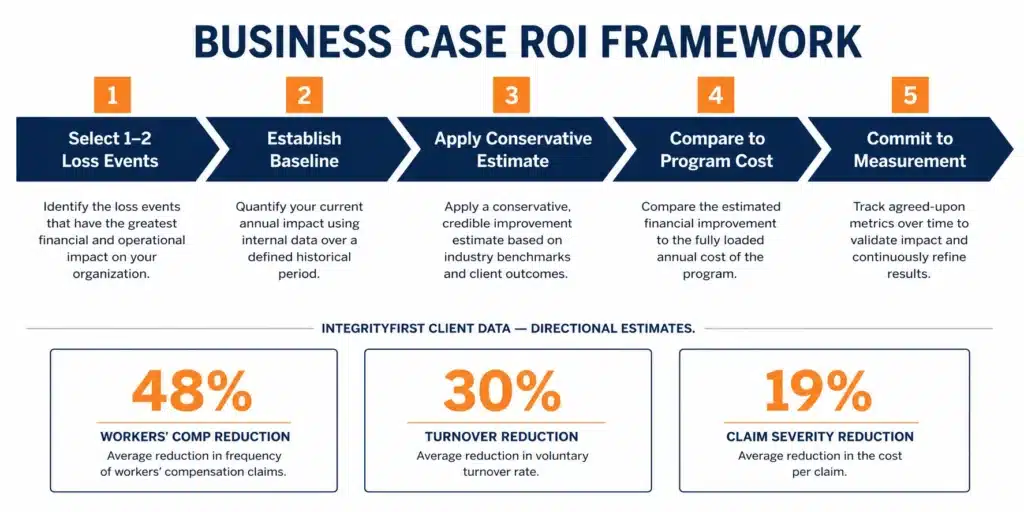
The standard ROI framework for integrity assessment programs:
- Select 1–2 loss events the screen should reduce: workers’ compensation claim frequency, shrinkage rate, 90-day attendance-driven terminations, or safety incident rate
- Establish a pre-implementation baseline: pull the current annual rate and cost for each selected metric in your target role family
- Apply a conservative improvement estimate: IntegrityFirst client data shows organizations implementing validated integrity assessment programs have achieved a 48% reduction in workers’ compensation claim frequency, a 30% reduction in turnover, and a 19% reduction in claim severity (IntegrityFirst client data). Apply these directionally, not as guarantees
- Compare projected savings to program cost: assessment licensing, ATS integration, training, and monitoring overhead
- Commit to measurement: define how outcomes will be tracked and attributed before launch. A business case without a measurement plan will not survive a second budget cycle
The most convincing ROI cases are built on one or two specific, expensive outcomes—not on a broad quality-of-hire narrative. Connecting integrity assessment outcomes to workers’ compensation premiums, insurance classification rates, or shrinkage impact on margin creates a financial case that operations and finance leaders recognize.
For a comprehensive framework connecting integrity assessment to business outcomes and hiring economics, see our article on integrity assessments for smarter hiring decisions.
Implementation: Piloting, Validating, and Scaling
Deploying an integrity assessment without a structured pilot produces one of two outcomes: you generate insufficient evidence to justify continued investment, or you generate misleading early data from an inconsistently administered tool. A governed pilot in a limited number of comparable sites is the foundation for both sustainable funding and defensible validation evidence.
A well-structured pilot covers five elements:
- Controlled deployment: one role family, two to four comparable sites, consistent ATS workflow with locked rules from day one
- Pre-defined success scorecard: completion rate, time-to-fill impact, override rate, adverse impact by stage, and one to two early outcome indicators (attendance points, early involuntary terminations) tracked against a documented baseline
- Conservative initial cutoffs: start with a wider score band and tighten based on outcome data rather than setting a restrictive threshold without evidence
- Realistic timeline expectations: a 60-to-90-day pilot will generate leading indicators but will not produce statistically reliable signal for rare outcomes like recordable incidents or confirmed theft. Set that expectation with leadership before launch
- Documentation from day one: purpose statement, candidate disclosure text, scoring rules, reviewer names, and reason codes for every outcome where the assessment influenced the decision
For a complete guide to the selection and validation process—including validation strategy selection, criterion definition, transportability requirements, and adverse impact monitoring—see our article on how to select and validate integrity assessment tools.
Frequently Asked Questions
What is the difference between an integrity assessment and a personality test?
Integrity assessments are specifically designed and validated to predict counterproductive work behavior—theft, rule violations, attendance abuse, safety shortcuts. Personality assessments measure broader trait dimensions (the Big Five, for example) that relate to many work outcomes including performance, leadership potential, and teamwork. Some integrity assessments use personality-style item formats (covert or personality-based tests), but they are validated specifically against CWB outcomes rather than broad job performance. The distinction matters for job linkage documentation: you need evidence that the specific instrument predicts the specific behaviors you are screening for in your specific role family.
How are integrity assessments different from background checks?
Background checks surface documented past behavior—criminal records, employment history, credential verification. Integrity assessments measure current attitudes and behavioral tendencies that predict future conduct, particularly for candidates who have no disqualifying criminal record. The ACFE 2024 Report to the Nations found that 87% of fraud perpetrators had no prior criminal history at the time of their offense. This is the core gap integrity assessments address: background checks cannot screen for risk in candidates with clean records.
Can integrity assessments be used for all roles, or only high-risk positions?
Integrity assessments are most defensible and most impactful when applied to roles with clear, frequent opportunities for the behaviors they predict: cash handling, inventory access, safety-sensitive work, controlled substance access, and high-turnover positions where reliability and attendance drive operational stability. For roles where the predicted behaviors are not a primary job risk, the assessment adds friction without proportionate risk reduction—and the job linkage documentation required under UGESP is harder to establish.
What is the EPPA, and does it apply to integrity assessments?
The Employee Polygraph Protection Act prohibits most private employers from using lie detector tests (physiological measurement devices) for pre-employment screening. Written and online integrity assessments fall outside EPPA’s scope because they do not use physiological measurement. The risk is in framing: describing the assessment as deception detection or truth verification in any materials creates EPPA exposure regardless of the actual instrument.
How do you handle candidates who score poorly but seem like strong applicants?
The assessment score is one input, not a verdict. When a candidate scores in a borderline or high-risk range but other indicators are strong, the appropriate response is a structured follow-up interview that probes the specific behaviors the score flagged—not automatic rejection. This approach is more defensible, reduces false negatives, and produces a documented decision trail that can withstand scrutiny. Score bands that trigger structured follow-up interviews, rather than binary cut scores that trigger automatic rejection, are the standard recommended practice for this reason.
What documentation do you need to keep after using an integrity assessment?
At minimum: the purpose statement documenting which job risks the assessment addresses, the candidate disclosure text and acknowledgment record, the scoring rule in effect at the time of hire (cut score, band thresholds), a review record for every decision influenced by the assessment (reviewer name, rule triggered, reason code), and adverse impact monitoring outputs by assessment stage. If a vendor updates their configuration or norms, save the change log so you can explain which version was in use at the time of any specific hiring decision.
Next Steps: Implementing Integrity Assessments
Integrity assessments, when properly selected, validated, and governed, are among the most cost-effective risk controls available to HR leaders managing high-volume or safety-sensitive hiring. The evidence base for their effectiveness is substantial. The compliance framework for using them defensibly is clear. The process design that makes them work in practice is learnable and implementable.
IntegrityFirst Tests works with HR leaders across industries to build integrity assessment programs that are validated for specific job families, integrated into existing ATS workflows, monitored for adverse impact, and documented to survive audit. Our approach connects assessment outcomes to the operational metrics that leadership cares about: workers’ compensation claim frequency, turnover in high-risk roles, shrinkage, and safety incident rates.
Contact IntegrityFirst Tests to discuss how integrity assessments can reduce measurable risk in your hiring environment.