Schedule a call!
Every HR professional knows the feeling: a candidate who looked great on paper joins the team and, within months, starts eroding trust. It costs time, money, and momentum. And for candidates, the frustration of “failing” an integrity self-assessment despite answering honestly can feel deeply unfair — like the system is rigged against authenticity.
The reality is more nuanced. When integrity self-assessment for hiring is done well, it benefits both sides. It gives organizations a science-backed, data-driven way to evaluate honesty and ethical judgment before extending an offer — and it gives candidates a fair, transparent process that rewards consistency over performance.
This guide breaks down exactly what integrity self-assessments are, how they work, and how HR teams can implement them in ways that reduce turnover, improve hiring quality, and hold up to compliance scrutiny.
For the full picture, see our complete guide to Integrity Self Assessment: The Complete Guide for HR, which explains what it is, the main formats, and how to use it across hiring, performance reviews, and culture audits.
What Is an Integrity Self-Assessment?
An integrity self-assessment is a structured evaluation tool that measures workplace honesty, ethical decision-making, and rule-following behavior. In the hiring context, it functions as a targeted pre-employment integrity assessment designed to identify whether a candidate’s values and behavioral tendencies align with an organization’s ethical standards.
Unlike a standard personality test, integrity assessments focus specifically on job-relevant behaviors: reliability, accountability, rule adherence, and honesty under pressure. They are used both during recruitment — as part of a broader employee screening process — and in ongoing performance reviews and leadership evaluations for existing staff.
Key characteristics of a strong integrity assessment include:
- Non-discriminatory design validated against adverse impact standards.
- Compatibility with ATS platforms like Workday or Greenhouse for seamless workflow integration.
- Clear audit documentation to support HR compliance requirements.
- Scientifically validated scoring with documented reliability and validity evidence.
According to SHRM’s guidelines on pre-employ9ment testing, well-designed assessments improve hiring quality while protecting organizations from legal risk when properly validated and consistently applied.
Why Employers Use Pre-Employment Integrity Assessments
Pre-employment integrity assessments are strategic investments, not just screening filters. They help HR teams go beyond what interviews can reveal — surfacing patterns of ethical judgment that only emerge through structured, consistent evaluation.
What They Help Organizations Achieve
- Reduced fraud and theft risk. Integrity assessments detect behavioral tendencies associated with counterproductive workplace behavior — risks that résumés and interviews rarely surface.
- Stronger compliance culture. Teams screened for ethical alignment are more likely to follow policies, flag violations, and uphold regulatory standards — especially important in healthcare, finance, and logistics.
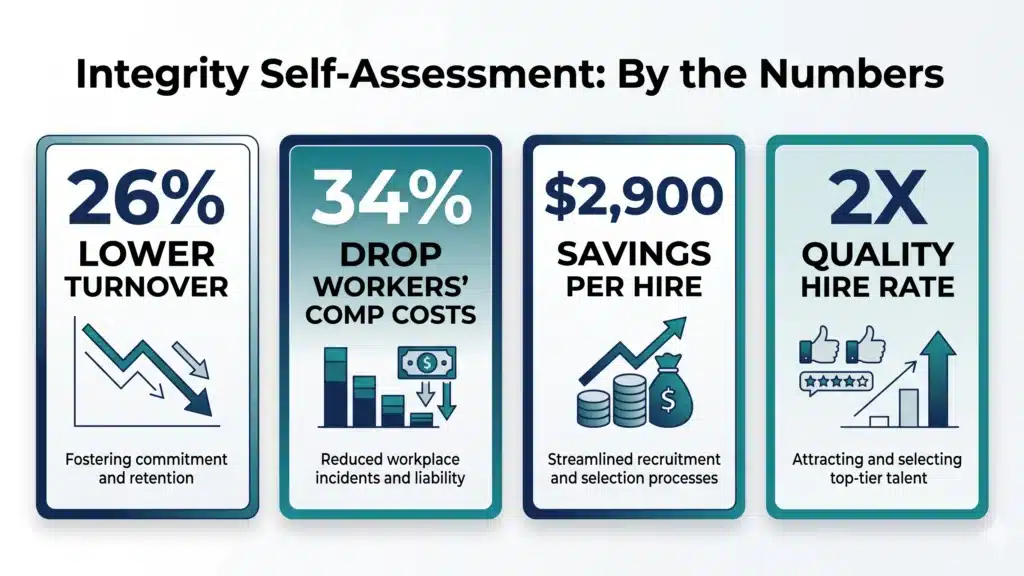
- Lower employee turnover. Research consistently links pre-employment integrity testing to reduced turnover. One analysis found organizations using validated integrity screening reduced annual turnover by more than a third in the first year of implementation.
- Measurable ROI. Beyond culture, integrity assessments deliver financial returns through reduced hiring costs, lower workers’ compensation claims, and faster time-to-productivity for new hires.
The EEOC’s Uniform Guidelines on Employee Selection Procedures provide the legal framework for ensuring these tools are applied fairly and without discriminatory impact.
4 Types of Integrity Assessments Used in Hiring
Not all integrity assessments are built the same. Understanding the differences helps HR teams select the right tool for their hiring context.
- Pre-Employment Integrity Tests. Standardized questionnaires administered before an offer is extended. They assess personal standards and behavioral tendencies — particularly around reliability, substance use, and rule-following. Example: “Taking office supplies without permission is never acceptable.” Best used in early-stage candidate screening.
- Overt Honesty Tests. Direct, unambiguous questions about past behavior. Example: “Have you ever lied to a supervisor?” The goal is to evaluate transparency. Honest disclosures — even about past mistakes — are generally viewed positively when accompanied by context and accountability.
- Personality-Based Integrity Questions. These measure underlying character traits — particularly conscientiousness, rule adherence, and ethical orientation. Example: “I always complete my assigned work even when no one is checking.” Results inform team fit, succession planning, and leadership potential.
- Situational Dilemma Assessments. Scenario-based questions that test how candidates apply values to ambiguous, real-world situations. Example: “If you saw a coworker bending safety rules, what would you do?” These are especially effective in interview-integrated or digital video formats for assessing practical ethical reasoning.
How Integrity Self-Assessments Work: Formats, Questions, and Scoring

Modern integrity self-assessments are delivered through digital platforms that offer real-time data capture, ATS integration, and standardized scoring. Paper formats exist for accessibility situations, and video-based assessments — through platforms like HireVue — are increasingly common for senior or safety-sensitive roles. The administration method should match your organization’s compliance requirements and hiring volume.
Question types fall into two main categories:
- Overt questions directly address honesty, past behavior, or compliance — useful for clear alignment checks.
- Covert questions are embedded within personality or situational prompts, designed to reveal subtler behavioral tendencies without telegraphing what’s being measured.
Scoring uses a combination of algorithm-driven pattern recognition and human review. Assessments are designed to catch response inconsistencies — candidates who answer very differently to structurally similar questions are flagged for further review. This is intentional: consistency under repetition is itself a meaningful integrity signal.
Common Integrity Test Questions and Formats
The following question categories represent typical integrity assessment formats used in pre-employment screening:
- Accountability: “Describe a time you took ownership of a mistake at work.”
- Honesty: “Have you ever reported a coworker for violating company policy?”
- Compliance: “How do you handle requests to bend rules for business reasons?”
- Workplace behavior: “How would you respond if you witnessed theft in your department?”
- Rule-following: “When company guidelines are unclear, how do you typically proceed?”
Rotating these question types across an assessment helps build a more complete picture of a candidate’s ethical profile — and reduces the risk of socially desirable responses skewing results.
Integrity Assessment Best Practices for HR Teams
Implementing an integrity self-assessment for hiring is most effective when it follows a structured, evidence-based process. The following framework aligns with both SHRM assessment guidelines and OPM pre-employment testing standards.
- Select a Validated Assessment Tool. Choose a tool with documented reliability and validity evidence specific to your industry and role types. Ask vendors for validation studies — reputable providers will share them readily.
- Review Legal and Compliance Requirements. Work with legal counsel to ensure your assessment meets anti-discrimination standards under EEOC guidelines. Document every assessment’s use, scoring, and rationale to maintain an audit-ready paper trail.
- Integrate With Your ATS. Connect your assessment tool with platforms like Workday or Greenhouse to automate invitations, centralize records, and map assessment data to candidate profiles. This eliminates manual tracking errors and speeds up processing.
- Prioritize Candidate Transparency. Provide clear instructions before each assessment. Explain its purpose, how results will be used, and what candidates can expect. Transparent communication improves response quality and protects your employer brand — even with candidates who don’t advance.
- Define Clear Scoring Criteria. Establish a rubric upfront that distinguishes strong alignment from red flags. Train all evaluators on consistent application. Assign weights to integrity factors based on role-specific risk levels, and calibrate quarterly.
- Measure and Iterate. Track outcomes over time: correlate assessment results with 90-day performance, turnover rates, and compliance incidents. Use that data to refine your question sets and scoring thresholds each cycle.
Red Flags and Pitfalls in Interpretation
Even well-designed assessments can be misapplied. Watch for these common interpretation errors:
- False positives: Scoring algorithms can over-penalize honest candidates who disclose minor past mistakes. Context matters — self-awareness is a strength, not a liability.
- Cultural bias: Questions rooted in a single cultural context may unfairly disadvantage candidates from different backgrounds. Validate for adverse impact across demographic groups.
- Non-job-related items: Including questions unrelated to actual job duties creates legal exposure and alienates qualified candidates.
- Overinterpretation of gray-area responses: Not all rule-bending signals an ethics problem — some responses reflect sound judgment in ambiguous situations.
- Punishing honest disclosure: Automatically disqualifying candidates who acknowledge past mistakes removes your best signal of genuine self-awareness.
Real Results: Cost Savings and Turnover Reduction With Integrity Testing

For one mid-sized manufacturing firm that implemented IntegrityFirst Tests, the results were measurable and rapid. Before integrating pre-employment integrity assessments, annual turnover held steady at 24%, and workers’ compensation claims costs continued to rise despite traditional screening efforts.
Before & After: IntegrityFirst Tests Results
28% reduction in annual turnover 34% drop in workers’ compensation claims costs $2,900 reduction in average cost per hire 2x increase in offer acceptance rates among high-integrity candidates
Over 18 months, the company saved more than $325,000 in hiring costs alone. Managers recalibrated their interview focus toward values alignment. Recurring absenteeism dropped. The firm’s leadership attributed the results to tighter integration between assessment data and hiring decisions — not to any single question or score.
For organizations in safety-sensitive industries, the impact extends beyond turnover. When pre-employment integrity testing is aligned with high-risk roles, some employers report OSHA recordable incident rates dropping materially, with measurable effects on insurance premiums. The connection between workforce integrity and workplace safety is well-documented — pre-employment testing can cut workers’ compensation claims significantly when screening is targeted and consistent.
The Science Behind Integrity Self-Assessments: Key Statistics
Not all pre-employment assessments deliver equal results. The following data reflects performance benchmarks for well-validated integrity tools:
| Metric | Typical Range | What It Means |
| Validity (correlation with job performance) | 0.35–0.52 | Moderate to strong predictive power for on-the-job outcomes |
| Self-assessment accuracy | 82–87% | High reliability when paired with structured scoring and reference checks |
| Overestimation rate | 10–19% | Most candidates slightly overrate their integrity; clear prompting reduces this |
| Underestimation rate | ~16% | Some strong candidates downplay their strengths — context review is important |
| Adverse impact risk | 1–3% | Lower than most cognitive ability tests when validated and monitored properly |
According to APA employment testing guidelines, validity evidence is the single most important criterion when selecting a pre-employment assessment. Validity scores in the 0.40+ range represent meaningful predictive power — enough to materially improve hiring outcomes over time. (Specific validity ranges should be verified against the assessment vendor’s published validation studies.)
Common Myths About Integrity Assessments (And the Truth)

| Myth 1: “Integrity tests only catch liars.”Reality: These assessments measure consistency, not deception. Red flags arise from contradictory response patterns across similar questions, not from any single “wrong” answer. |
| Myth 2: “Admitting past mistakes will disqualify you.”Reality: Transparent disclosures typically signal self-awareness and maturity — qualities that validated integrity tools are designed to reward, not penalize. |
| Myth 3: “All questions need to be directly job-related.”Reality: Some questions test underlying ethical reasoning and values. These are legally defensible when the tool has demonstrated job-relatedness through validation research — a key reason vendor vetting matters. |
Integrity Self-Assessment Phrases for Performance Reviews
The language used in performance reviews shapes how integrity is defined within your organization. These self-evaluation phrases help employees articulate ethical behavior clearly:
- “Regularly clarifies ethical expectations for the team to reduce ambiguity.”
- “Promptly brings policy violations to management’s attention.”
- “Leads by example across all compliance requirements.”
- “Promotes open, honest feedback during team discussions.”
- “Acknowledges mistakes proactively and outlines corrective steps.”
- “Addresses lapses in team behavior directly and constructively.”
- “Consistently follows data protection and confidentiality protocols.”
- “Applies standards and expectations evenly across team members.”
- “Encourages participation in ethics and compliance training.”
- “Reinforces agreed-upon standards as an accountability partner.”
Using structured, specific language like this in performance cycles creates a documentation trail that supports both employee development and organizational compliance.
Start Using Integrity Self-Assessment for Hiring Today
Integrity self-assessment for hiring is one of the few pre-employment tools with both strong scientific validity and clear business ROI. When implemented correctly — with a validated tool, transparent candidate communication, and structured scoring — it reduces turnover, lowers compliance risk, and builds teams that perform reliably over time.
The key is consistency: assessments only deliver results when they’re integrated into a repeatable hiring process, not used selectively or informally.
| Ready to build a more ethical, resilient workforce?Request a free demo of IntegrityFirst Tests and see how a validated pre-employment integrity assessment fits your hiring process. |
→ Request a free demo of IntegrityFirst Tests
IntegrityFirst Tests provides science-backed pre-employment integrity assessments for HR teams in mid-sized and enterprise organizations. Our validated tools are designed for compliance, scalability, and measurable workforce impact.