Schedule a call!
Achieving honesty test legal compliance in hiring requires more than selecting a validated assessment tool. It requires a structured, documented process aligned with federal and state employment law — one that withstands EEOC scrutiny, protects candidates’ rights, and produces hiring decisions that are defensible under audit.
For HR teams, the stakes are concrete. Pre-employment honesty tests that are not job-related, consistently administered, or regularly reviewed for adverse impact create legal exposure — regardless of how well-validated the tool itself may be. This guide covers the full compliance framework: what the law requires, how to build a legally defensible testing process, and the most common pitfalls that turn a sound screening program into a liability.
What Is a Pre-Employment Honesty Test?
A pre-employment honesty test is a structured assessment that evaluates a candidate’s trustworthiness, reliability, and likelihood of engaging in counterproductive work behavior before a hiring decision is made. The US Office of Personnel Management (OPM) formally recognizes these tools as valid pre-employment instruments that predict theft, absenteeism, and overall job performance.
Two primary formats are used in US hiring. Overt tests ask candidates direct questions about past behavior and attitudes toward theft and rule-breaking. Personality-based tests assess the same risk profile indirectly through trait indicators such as conscientiousness and dependability.
A meta-analysis of 104 integrity test studies confirms corrected validity coefficients of .32 for counterproductive work behavior and .18 for job performance — establishing honesty tests as among the most predictive pre-employment screening tools available to US HR teams.
Organizations that deploy integrity assessments report measurable reductions in theft, turnover, and workers’ compensation claims. Read how integrity screening reduces workers’ compensation claims.
The Legal Framework for Honesty Test Compliance in Hiring
Understanding honesty test legal compliance in hiring begins with the federal standards that govern all pre-employment assessments in the United States. Non-compliance with these standards creates liability regardless of test quality or business intent.

EEOC Standards and Adverse Impact
The EEOC employment testing guidance requires that any pre-employment assessment be job-related, consistent with business necessity, administered consistently across all candidates, and regularly reviewed for adverse impact. These are not optional best practices — they are the legal foundation of a defensible screening process.
Adverse impact occurs when a selection procedure disproportionately screens out candidates from a protected class — race, sex, national origin, religion, or age — without a demonstrable business justification. The standard measure is the four-fifths rule: if the selection rate for any protected group is less than 80% of the rate for the highest-scoring group, adverse impact is indicated and requires investigation.
HR teams must conduct adverse impact analyses at least annually, document findings, and take corrective action when disparities are identified. Failure to monitor and respond to adverse impact is one of the most common — and most legally costly — compliance failures in pre-employment testing programs.
The Employee Polygraph Protection Act
The Employee Polygraph Protection Act (EPPA), enforced by the US Department of Labor, prohibits most private employers from using lie detector tests — including polygraphs, voice stress analyzers, and other physiological monitoring instruments — for pre-employment screening.
Written and digital honesty tests are not subject to the EPPA restriction. The Act explicitly permits validated paper or digital integrity assessments. However, employers must never frame a written honesty test as a polygraph alternative or suggest that physiological monitoring is involved. Doing so creates EPPA liability even when only written tools are used.
Communicating clearly with candidates that the assessment is a written questionnaire — not a physiological monitoring instrument — eliminates the most common source of EPPA-related complaints in the hiring process.
State and Local Employment Laws
Federal standards set the floor for honesty test compliance, but state and local employment laws frequently impose additional requirements. California, New York, Illinois, and several other states have enacted legislation governing the use of personality assessments, data privacy in hiring, and candidate disclosure rights that go beyond federal requirements.
According to SHRM pre-employment testing guidelines, HR teams should consult legal counsel before deploying honesty tests in jurisdictions with enhanced screening regulations. State requirements can affect disclosure language, data retention policies, candidate challenge rights, and permitted test formats.
Documenting legal review for each jurisdiction where testing is deployed — and updating that review annually — provides the strongest protection against state-level compliance challenges.

DEI and Fairness in Honesty Testing
Honesty test legal compliance in hiring is inseparable from diversity, equity, and inclusion commitments. A test that is legally compliant in its administration but produces disparate outcomes for protected groups is a compliance problem — and a DEI failure.
The most common source of adverse impact in honesty testing is question design. Items that reference culturally specific norms, situations, or language can disproportionately flag candidates from certain demographic backgrounds without any relationship to job-relevant integrity risk. Structural bias in scoring rubrics compounds this effect.
Mitigating DEI risk in honesty testing requires four ongoing practices:
- Quarterly adverse impact analysis by demographic group with documented findings and corrective actions
- Annual review of question content for cultural sensitivity and subgroup differential item functioning
- Consistent administration across all candidates — same instructions, same timing, same scoring criteria
- Clear candidate communication that explains the assessment’s purpose and how results are used
Compliance Checklist: What HR Must Document
The following checklist reflects the core documentation requirements for honesty test legal compliance in US hiring. Maintain a complete compliance file for each assessment program and each individual hiring decision in which assessment results were a factor.
| Compliance Area | Required Documentation | Review Frequency |
| Test validation | Published validation study and technical manual from vendor | Before deployment; re-verify annually |
| Job-relatedness | Written justification linking test content to specific role requirements | Before deployment; update for each new role added |
| Adverse impact analysis | Scoring outcomes by demographic group with statistical analysis | Quarterly; document findings and corrective actions |
| Candidate notification | Written disclosure provided to all candidates before testing | Every hiring cycle; update when process changes |
| Hiring decision rationale | Record of how assessment results were weighted against other inputs | Every hiring decision involving assessment data |
| State legal review | Legal counsel sign-off for each jurisdiction where testing is deployed | Annually; when entering new jurisdictions |
| Policy updates | Revised testing procedures reflecting legal changes or outcome data | Annually; when material changes occur |
How to Communicate Honesty Tests to Candidates
Candidate communication is both a legal requirement and a practical tool for improving response quality. Candidates who understand the purpose and process of an honesty test before they begin are less likely to disengage, respond defensively, or file complaints based on inadequate disclosure.

Every candidate should receive the following information in writing before the assessment begins:
- The purpose of the assessment and what it measures
- The estimated completion time
- How results will factor into the hiring decision
- A statement confirming the assessment is a written questionnaire — not a polygraph or physiological monitoring instrument
- How to raise concerns or request accommodation
- How assessment data will be stored and who will have access to it
Sample disclosure language: “As part of our hiring process, we use a validated written integrity assessment to evaluate workplace conduct and reliability. This assessment is not a polygraph test and is fully compliant with US employment law. Results are one factor in a multi-dimensional evaluation and are held confidentially in accordance with our data privacy policy.”
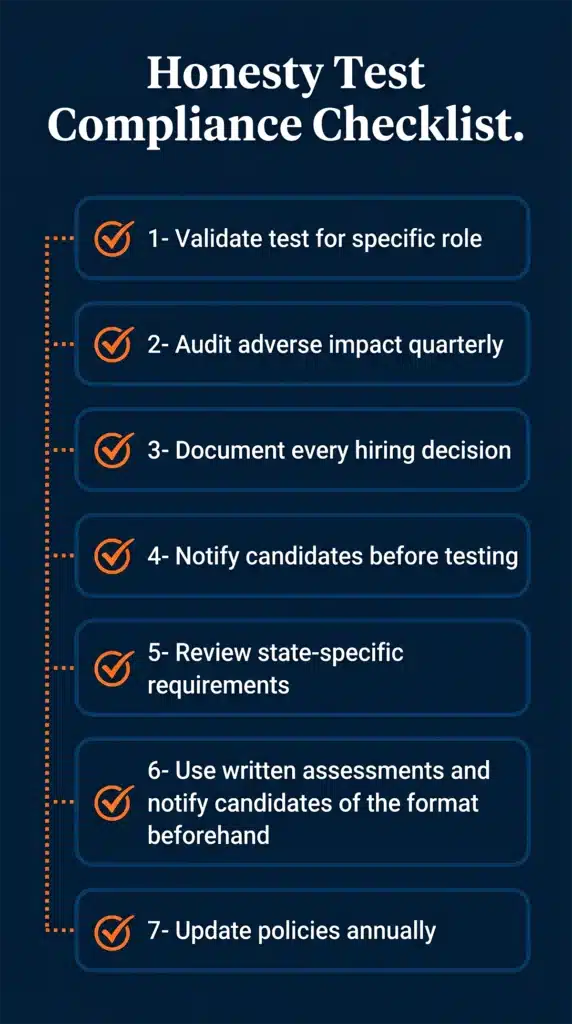
7 Steps to Implement Honesty Tests Compliantly
- Select a validated tool with documented construct and criterion validity, an independent validation study, and a complete technical manual. Confirm the vendor provides adverse impact data and legal documentation on request.
- Define role-specific deployment criteria based on the position’s risk profile: cash access, data sensitivity, safety exposure, or supervisory responsibility. Avoid applying the same assessment indiscriminately across all roles.
- Obtain legal review for each jurisdiction where the assessment will be deployed. State laws vary significantly — California, New York, and Illinois impose requirements that exceed federal standards.
- Integrate assessment delivery with your ATS. Consistent administration timing — pre-interview or post-conditional offer — is essential for both legal defensibility and scoring reliability.
- Communicate clearly with all candidates before the assessment begins. Provide written disclosure of purpose, process, and candidate rights. Address the polygraph question proactively.
- Score, interpret, and document every hiring decision. Record how assessment results were weighted against interviews, references, and background data. This documentation is the foundation of EEOC compliance.
- Audit for adverse impact at least quarterly. Investigate and correct any patterns that disproportionately screen out candidates from protected classes. Update policies annually to reflect legal changes and outcome data.
Common Compliance Pitfalls to Avoid
- Deploying a test without documented job-relatedness justification. Job-relatedness is a legal requirement. Every assessment must be linked to specific behavioral requirements of the role before deployment begins.
- Failing to conduct adverse impact analysis. Organizations that skip quarterly adverse impact reviews accumulate legal exposure without knowing it. By the time disparities are identified, they may already have triggered EEOC scrutiny.
- Misrepresenting the assessment to candidates. Describing a written honesty test as a “lie detector” or polygraph-adjacent tool — even informally — creates EPPA liability.
- Using test scores as the sole hiring decision factor. Honesty test results are legally defensible only as one input in a multi-dimensional evaluation. Sole reliance on assessment scores exposes the organization to discrimination claims.
- Neglecting to update state compliance documentation annually. State employment laws change. An HR team that reviewed California requirements two years ago may be out of compliance today.
- Inadequate documentation of edge cases. When assessment results diverge from other evaluation inputs, HR must document the reasoning behind the final hiring decision. Gaps in this documentation create audit risk.

Frequently Asked Questions
What does honesty test legal compliance in hiring require?
Honesty test legal compliance in hiring requires that the assessment be job-related, consistently administered across all candidates, regularly reviewed for adverse impact, and fully documented at every stage. Under EEOC employment testing guidance, employers must also be able to demonstrate business necessity for any test that produces disparate outcomes for protected groups.
Is a pre-employment honesty test legal in the United States?
Yes, when properly administered. Written and digital honesty tests are fully compliant under the Employee Polygraph Protection Act. They must meet EEOC standards for job-relatedness, consistent administration, and adverse impact monitoring. State laws may impose additional requirements depending on the jurisdiction.
What EEOC rules apply to pre-employment honesty testing?
The EEOC’s Uniform Guidelines on Employee Selection Procedures require that any pre-employment test be job-related, consistent with business necessity, and monitored for adverse impact by protected class. When adverse impact is identified, the employer must either demonstrate business necessity for the selection rate differential or modify the testing process to reduce the disparity.
How do you avoid adverse impact in honesty testing?
Conduct quarterly adverse impact analysis by demographic group. Review question content annually for cultural sensitivity and differential item functioning. Use role-specific rather than generic assessments. Combine honesty tests with structured interviews and reference checks. Document all findings and corrective actions in your compliance file.
Can candidates challenge or appeal a honesty test result?
Yes. Candidates have the right to understand how their results were used in the hiring decision and to raise concerns about the process. Providing clear written disclosure before the assessment begins — including how to raise concerns — is both legally prudent and operationally effective. Document all candidate challenges and the organization’s response as part of the compliance record.
Build a Compliant Honesty Testing Program with IntegrityFirst Tests
IntegrityFirst Tests provides validated, US-compliant honesty assessments built for HR teams that need legal defensibility alongside measurable results. Our tools are designed to meet EEOC standards, support adverse impact monitoring, and deliver the documentation your compliance team needs. Schedule a free demo with IntegrityFirst Tests and put legal compliance at the foundation of every hiring decision you make.