Schedule a call!
Pre hiring assessment tools compared side by side to help HR teams choose faster, smarter screening solutions for better hiring outcomes. Picture this: another talented candidate bails halfway through your cumbersome pre-employment assessment. Your team faces the same old story—ineffective tools and high turnover. That drop-off rate should keep no HR leader up at night. All too often, it does.
Laszlo Bock, the architect behind some of Google’s data-driven hiring revolutions, proved that streamlined talent assessment software can flip this script. Smooth integrations and candidate-friendly tests don’t just save time. They boost retention and workforce quality.
This definitive guide will empower your hiring team to sift and sort top talent using easy-to-integrate pre-hiring assessment tools, not gut feel. Forget endless demos. Here, you’ll find a field-tested roadmap to compare platforms and focus on the candidate journey. Turn wasted motion into measurable results, fast.
What Are Easy-to-Integrate Pre-Hiring Assessment Tools?
A large meta-analysis of 81 samples found that traditional prehire experience measures are very weak predictors of outcomes. The analysis showed corrected correlations of just .06 with job performance, .11 with training performance, and .00 with turnover, suggesting that structured, science-based assessments are far more reliable for forecasting success and retention. View the research here.
Connect with our experts to design an integrity-led assessment process that reduces workers’ compensation claims and first-year turnover.
Easy-to-integrate pre-hiring assessment tools are digital platforms designed to slot seamlessly into your existing HR tech stack. These tools let you assess candidate skills and integrity from within your ATS. Plug-and-play integration is no longer a luxury. It is a baseline expectation for talent pipeline tracking.
These platforms offer far more than skills assessment. Many include customizable assessments and analytics from the start. Integration with ATS systems ensures you don’t waste energy on manual data entry or lose crucial context during screening candidates. Remote proctoring makes it easy to give every candidate the same fair shot, whether hiring on-site or remote.
Best-in-class candidate assessment tools should focus on both predictive validity and a positive candidate experience. With features like intuitive candidate dashboards, multi-language support, and job-specific assessments, these solutions become the backbone of objective hiring decisions. As Dr. John Sullivan reminds us, harnessing technology is key for turning workforce quality into your top business advantage.
Unlike solutions that promise a silver bullet but underdeliver, these platforms work in practice. They cut time-to-hire, reduce churn, and let HR leaders screen in, not out, to build a sustainable talent advantage.
One recent analysis of IntegrityFirst Tests customers found that pairing integrity assessments with structured skills testing cut first-year turnover by more than a third in high-volume roles. Easy To Integrate Pre Hiring Assessment Tools Definitive Guide
Why Integration and Candidate Experience Matter

Few things frustrate a smart, driven HR professional like toggling from screen to screen copying candidate test results by hand. It’s the digital equivalent of walking in circles: chasing down completion rates and tracing missing data. The wastes in a disconnected process are hard to ignore. The irritation can spread from hiring teams to candidates fast.
Adam Grant, whose research highlights the power of making work meaningful and efficient, would cringe at clunky psychometric assessments that pile friction onto both sides. Integrated online testing platforms flip this pain on its head. With robust API integration, candidate comparison and grading flow right into your ATS without a manual effort or rekeying.
When you optimize candidate experience, you don’t just boost satisfaction. You reduce drop-off and shrink time-to-hire. Plug-and-play integration means recruiters can focus on actionable insights, not busywork. In today’s talent pipeline, efficiency and transparency go hand in hand. For instance, assessment templates and custom workflows now make benchmarking and job role fit crystal clear for both sides of the hiring desk.
Types of Pre-Hiring Assessments: Core Categories Explained
It’s tempting to think all assessments predict job success equally, but not all tests are cut from the same cloth. Each category offers a different lens for understanding candidates and refining modern, data-driven hiring. Tomas Chamorro-Premuzic, a leading voice in psychometrics, often stresses that no single method is a hard stop. Variety and precision matter. The following are key categories that help HR leaders ensure both compliance and return on investment.
Skills Assessments
Skills assessments measure what matters most on Day 1: job-specific competencies and technical skills. Focused technical skills testing, especially in entry-level assessments, provides clear evidence of immediate contribution. For example, a sales skills module might measure lead qualification knowledge, while a customer service test evaluates conflict resolution. Watch for fairness and always align scenarios with the actual job role so candidates can hit the ground running.
- Use case: Screen for baseline or advanced capabilities depending on role seniority.
- Caution: Overly generic questions can miss domain-specific strengths.
Cognitive Ability Tests
Cognitive assessments, including aptitude tests, measure problem-solving. These tools are powerhouse predictors for job performance and increase retention. For instance, roles demanding quick learning or analytics benefit greatly. However, improper use may create compliance concerns due to adverse impact. Always review defensibility and validation.
- Use case: Predict which candidates will adapt fastest in changing environments.
- Caution: Use only when compliant with legal guidelines.
Integrity Tests
Integrity tests forecast honesty and reliability. These tests are cost-effective for high-volume hiring. For instance, retail and warehouse companies use them to reduce workers’ comp and turnover rates. While predictive, results should be supplemented with other assessment experts’ input to avoid bias.
- Use case: Screen in high-trust roles such as finance, logistics, or customer support.
- Caution: Results can be affected by social desirability bias.
Behavioral and Personality Assessments
Personality assessments and behavioral assessments, such as the Big Five or dark triad frameworks, inform role fit and culture fit. Leadership assessments often use these to spot key soft skills. Defensibility matters. Consult dedicated support to ensure legal compliance and fairness in scoring.
- Use case: Combine with job simulations or structured interviews to predict team fit.
- Caution: Should never be used as the sole screen, since legal and ethical concerns arise.
Technical and Coding Assessments
Technical skills testing and coding assessments simulate real work. Tasks might involve live coding or problem-solving. Kicking the tires by piloting these tools prior to rollout ensures relevance.
- Use case: Validate skill claims for industry-specific assessments (e.g., software, engineering).
- Caution: Avoid tasks not representative of actual on-the-job challenges.
Situational Judgement Tests and Job Simulations
Situational judgement tests and work-sample tests place candidates in real-life scenarios. For example, a job simulation for a manager could test multitasking and decision outcomes. These assessments help screen in, not out, talent and reveal those who might outperform on the front line.
- Use case: High-volume or frontline hiring, as well as leadership pipelines.
- Caution: Scenarios must be regularly refreshed to preserve predictive power.
Key Features: What to Look For in Assessment Platforms

Any HR leader in a smart casual blazer knows that tech details matter less than meaningful business outcomes. Modern assessment platforms must do more than score tests. They shape data-driven hiring decisions with every touchpoint. Every feature on this list supports a best-in-class process, and missing any is a red flag.
- Integration: Seamless connections with ATS and HRIS. Smooth test scheduling and candidate tracking reduce time-to-hire and close technology gaps.
- Assessment Library: Templates and domain-specific assessments let you configure coding assessments and leadership assessments with ease; one-size-fits-all platforms won’t move your metrics.
- Test Customization & Authoring Tools: Create or clone tests for any role. Custom workflows help HR teams cover any skills gap and fine-tune employee evaluations.
- Anti-Cheat & AI Proctoring: Detect fraud and guarantee integrity through AI-powered assessments and robust anti-cheat tools.
- Analytics & Candidate Comparison Dashboards: Live data dashboards accelerate actionable insights and allow you to compare top performers at a glance. You can only reduce hiring bias if you know what’s working.
- White-Label Branding: Offer a seamless candidate journey with branded interfaces that reinforce your employer value proposition and improve candidate experience.
- Multi-Language Support: Access global talent and ensure fairness. Not having this is a hard stop for multinational hiring.
- Mobile Compatibility: Candidates expect testing on any device. Mobile compatibility is critical especially when conducting entry-level hiring.
- Security & Compliance: Safeguard assessment data and stay ahead of regulations. This is non-negotiable for trust.
Focus on these features to transform everyday hiring into a strategic advantage. Modern tools turn every candidate touchpoint into business results, and the right platform helps you benchmark, scale, and stay ahead, without compromise.
Top Easy-to-Integrate Pre-Hiring Assessment Tools: Side-by-Side Comparison
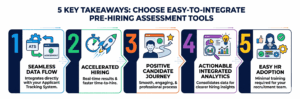
Independent reviews of leading platforms show that many of the top pre-employment assessment tools, such as TestGorilla and Criteria, offer extensive libraries (from technical and cognitive tests to culture and behavior measures), validated science-backed instruments, and native integrations or flexible APIs that plug into dozens of major ATS and HRIS systems. This enables unified workflows and richer reporting. See detailed review.
In today’s market, it’s no longer enough to focus only on test depth or question mechanics. Reed Hastings, known for championing a rigorous, efficient talent culture, would point out that the difference is in how seamlessly platforms connect and push actionable insights to every touchpoint in your process.
Below is a table comparing popular easy-to-integrate pre-hiring assessment tools. These choices reflect the latest in user experience, anti-cheat measures, and secure analytics. Review which platform best aligns with your requirements for candidate experience, integration speed, and depth of assessment library.
| Platform | Integration Options | Assessment Types | Customization | Anti-Cheat/Proctoring | Analytics/Reporting | Price Range | Pros | Cons |
|---|---|---|---|---|---|---|---|---|
| TestGorilla | ATS, HRIS, API | Skills, cognitive, personality | Advanced | AI proctoring | Robust, automated | $-$$ | Fast integration, wide library | Basic plans lack live proctoring |
| Criteria | ATS, HRIS, API | Cognitive, skills, behavioral | High | Secure browser | Deep, exportable | $$-$$$ | Validated tests, research-driven | Complex UI, steeper pricing |
| Harver | ATS, HRMS, API | Situational, work sample | Role-based | Lockdown browser | Custom dashboards | $$ | Strong candidate experience | Less flexible for niche roles |
| SHL | ATS, HRIS, HRMS, API | Cognitive, personality, coding | High | AI, manual proctoring | Predictive analytics | $$$-$$$$ | Global reach, best-in-class validation | Expensive, onboarding required |
| Berke | ATS, HRIS, API | Personality, skills | Moderate | Anti-cheat | Real-time, easy export | $-$$$ | Clear reports, simple branding | Smaller test library |
Among the standouts, SHL gets top marks for validated performance metrics. This is crucial if compliance and security are your hard stop. TestGorilla shines for candidate experience and rapid-fire integration. This makes it a hit for lean teams or those ramping up high-volume hiring. Berke appeals with real-time results. Its assessment library can be limited for technical roles. Each tool leverages anti-cheat tools and analytics. Consider which touchpoints in your workflow need the most lift when making your decision.
Compare Integration With ATS, HRIS, and HRMS
Imagine orchestrating complex multi-stage hiring with the snap of a finger. No cut-and-paste muddle. Efficient integration frees HR leaders to focus on matching every candidate to the right-seat, right-bus not on administrative details. Plug-and-play connections to Greenhouse and Workday make this scenario a reality, as each solution lets you sync candidate data and minimize manual mapping.
- Greenhouse: Most easy-to-integrate pre-hiring assessment tools offer native real-time sync, and recruiters enjoy automated candidate movement. Almost no IT intervention required.
- Workday: Robust APIs drive seamless assessment and onboarding integrations, as data moves in both directions, reducing redundancy and fast-tracking candidate reviews.
- iCIMS: Integration flexibility enables workflow triggers so each new touchpoint fits existing processes. Mapping is quick but may require occasional admin setup.
- BambooHR: Simple plug-and-play capability means new assessments go live instantly. Perfect for teams managing high-volume roles.
With rapid integration, recruiter workload shrinks. Teams stop worrying about dropped candidates.
Evaluate Test Customization and Assessment Libraries
The best platforms don’t just offer pre-set tests; they enable tailored hiring for every unique role. As Dave Ulrich emphasizes, organizations win when they can build both capability and adaptability throughout their teams. Flexible assessment libraries let HR target not only technical skills but soft skills.
- Assessment Library Breadth: Top tools provide vast, role-based or industry-specific content. This ensures you can select from hundreds of technical and leadership modules to match every position, not just generic fill-ins.
- Question Authoring and Custom Workflows: Robust editing capabilities and workflow tools empower HR leaders to develop custom sequencing. Edit test items or sequence questions in ways that create actionable comparison points.
- Benchmarking and Industry Templates: Only best-in-class vendors deliver up-to-date templates with norms against global benchmarks. This lets you measure against real-world expectations. This precision supports higher workforce quality.
An adaptable library isn’t just a back-end advantage. It’s your ticket to improving candidate fit at scale.
Assess Security, Anti-Cheat, and Compliance Capabilities
Forty-three percent of HR leaders surveyed at the last HR Tech Conference ranked data privacy and assessment integrity as their top purchase drivers.
Organizations that implemented integrity testing as a formal risk-control measure saw double-digit reductions in OSHA-recordable incidents alongside measurable declines in workers’ compensation claim costs. Pre Employment Test Cuts Workers Comp Claims
In high-stakes sectors, overlooking these is like leaving your doors unlocked and wondering why there’s trouble. With more assessments delivered remotely, foundational security measures aren’t just extras. They’re must-haves.
- Anti-Cheat/AI or Live Proctoring: Every modern tool uses some combination of AI monitoring and lockdown browsers to ensure results are authentic and fair. Other platforms also rely on video reviews or biometric checks to safeguard hiring reputation.
- Data Encryption and Privacy Compliance: The best vendors deliver full encryption at rest and in transit, along with granular user controls. Candidate data must align with GDPR or CCPA requirements in regulated environments.
- Legal Defensibility: Adhering to EEOC guidance protects employers from claim risks. Some solutions also support ADA compliance and provide audit trails and accessible scoring for stronger defensibility.
A solution that can’t demonstrate robust compliance, just like your favorite branded company polos on demo day, simply won’t cut it when stakes are this high.
Candidate Experience and Minimizing Drop-Off Rates
A 2019 report from the Society for Human Resource Management found that 60% of job seekers have abandoned an application process because it was too long, underscoring how clunky poorly designed assessments directly fuel candidate drop-off and damage employer brand. See the SHRM report.
Picture your best candidates stuck trying to navigate mobile-unfriendly tests or slogging through irrelevant questions. When Ariana Huffington champions well-being at work, she points to processes that engage the opposite of demoralizing fatigue.
A candidate-first strategy means minimizing assessment length and friction. Contextualize every task. Use employer branding to guide and motivate and “screen in” for strengths. Clearly explain why each step matters. You could, for example, limit tests to critical job requirements and schedule them flexibly so work doesn’t get derailed.
The payoff: higher assessment completion, a net promoter score (NPS) worth bragging about, and deeper bench strength for your team. Investing in experience drives stronger candidate pools and sets the tone for engagement and performance post-hire.
Drive Down Turnover and Claims Now
Ready to cut turnover and compensation claim costs? Book a consultation with IntegrityFirst Tests and see how easy pre-hiring assessments can transform your hiring outcomes.
Analytics, Reporting, and ROI: Making Data-Driven Decisions
Numbers don’t just tell a story. They drive smarter, faster hires. Modern hiring is all about measuring what matters, not going with gut instinct alone. “Who: The A Method for Hiring” has long championed using dashboards and analytics as the central nervous system for talent teams.
Sophisticated reporting dashboards empower teams to compare candidates side by side and track the entire talent pipeline. Candidate comparison is now instant and structured, making interviews less subjective and more predictive of on-the-job success.
In 2026, 78% of HR leaders reported that integrated assessment analytics helped them meaningfully improve hire quality. AI-powered automation delivered productivity boosts of 20%, a figure no traditional screening approach can match. For example, you might see ROI rise as low-quality applications are filtered out early while high-fit candidates are surfaced quickly and objectively.
A refined data-driven process doesn’t just optimize performance. It reduces turnover. Investments in analytics move the needle on workforce quality, helping HR leaders make each hiring decision count.
Legal, Compliance, and Diversity Considerations
Every HR leader knows that compliance isn’t just a checkbox; it safeguards both brand and results. Barack Obama, well known for championing fairness, often highlighted how small process shifts can build true inclusivity. High-performing pre-hiring assessment tools help organizations stay clear of legal minefields and they weave equity into every stage of hiring.
Top platforms support EEOC and ADA requirements. That means using only validated test content and maintaining accessible formats. Structured scoring methods keep candidate scores objective so no one is sidelined by subjective bias.
The real payoff: reduced hiring bias and a sustainable workforce that reflects both compliance and your organization’s diversity vision. Legal readiness is core to every great HR strategy. You always hire with confidence.
Case Study: How Easy Integration Cut Turnover by 30% for a Mid-Sized Company
Before adopting easy-to-integrate assessments, Summit Industries, a 500-person manufacturing company, found hiring more guesswork than science. Their HR team lived on spreadsheets. Turnover topped 38%, and workers’ comp claims rose two years running. Frustration grew as the team felt buried by low-fit hires and endless re-screens.
Everything shifted when they piloted IntegrityFirst Tests. Plug-and-play integration with their ATS meant launch took days, not weeks. Summit’s team rolled out integrity assessments to all hourly roles with zero IT complexity. The built-in analytics dashboard revealed real-time candidate patterns, making it easy to spot better fit and cut interview time.
Drawing on guidance from “Work Rules!” by Laszlo Bock, Summit adjusted their hiring process to focus on structured data, not intuition. In twelve months, first-year churn plummeted from 38% to 26%.
Across multiple client studies, integrity assessments consistently reduced involuntary terminations and absenteeism, producing ROI multipliers that outpaced traditional background checks alone. ROI Of Integrity Testing
The number of work comp claims dropped by nearly half. The average time-to-hire fell by six days, letting managers spend less time reacting and more time leading. One change, modern assessment integration, moved the entire organization from reactive to proactive hiring.
FAQs on Pre-Hiring Assessments and Integration
Picture a world where every hiring manager has answers at their fingertips. They never sweat that compliance audit, candidate ghost, or vendor bluff. Like something out of “Give and Take” by Adam Grant, clarity here leads to better decisions and stronger teams. Let’s break down the common questions from your peers.
Will Tough Assessments Drive Away Top Candidates?
Not if you design with the candidate in mind. Short, job-relevant, and mobile-friendly assessments keep completion strong, especially when paired with clear branding and value messaging. If high bar, context, and feedback are well-communicated, quality talent will be drawn in, not scared off.
How to Ensure Legal Defensibility?
Always choose validated, bias-tested instruments and automate audit trails. Scenario: If challenged, your best ally is documentation. Score rationales and EEOC compliance are key. Use assessment platforms that update content to reflect current legal and security standards.
Are Skills, Integrity, or Personality Tests Most Predictive of Success?
It depends on the role. For front-line jobs, skills and integrity tests reliably predict day-one performance. Leadership, sales, or customer-facing roles often gain more from blended batteries that assess soft skills, learning agility, and cultural fit. Predictive validity always goes up when you combine approaches.
Buy Off-the-Shelf or Build In-House?
Off-the-shelf options are best for most. Speed and research backing trump DIY versions unless you have unique ongoing needs and in-house psychometric expertise. Even then, building is costlier and slower for integration.
How Fast Can Integration Really Be?
Modern assessments connect to most ATS or HRIS systems within a week. With plug-and-play modules (think BambooHR or iCIMS), integration is often near-instant. Sometimes, it’s live in under 48 hours.
Take Action: Simplify and Strengthen Your Hiring With Assessment Tools
Imagine the relief of confidently filling tough roles. No spreadsheet headaches no nail-biting over potential claims and no unwelcome turnover surprises. Like updating to reliable Lenovo ThinkPad laptops, powerful hiring platforms just work, lifting stress and putting you back in control. Every assessment you automate is a step closer to efficient, objective hiring for your entire organization.
Contact our experts today to implement easy-to-integrate integrity assessments that cut turnover and compensation claim costs across your workforce.
Easy-to-integrate assessment tools are about much more than cutting costs. They deliver better hires and measurable risk reduction. They streamline admin work, speed up decisions, and help you deliver the kind of data-driven insights your leadership expects.
It’s time to simplify and strengthen your hiring outcomes. Connect with IntegrityFirst Tests to craft a custom assessment strategy, tailored to your unique culture and compliance needs. Your best hires and lower turnover are just one click away.