Schedule a call!
The ROI of honesty tests in hiring is one of the most compelling and well-documented business cases in HR. Organizations that deploy structured pre-employment integrity assessments consistently report measurable improvements across the workforce metrics that drive labor costs: employee theft, turnover, absenteeism, and workers’ compensation claims.
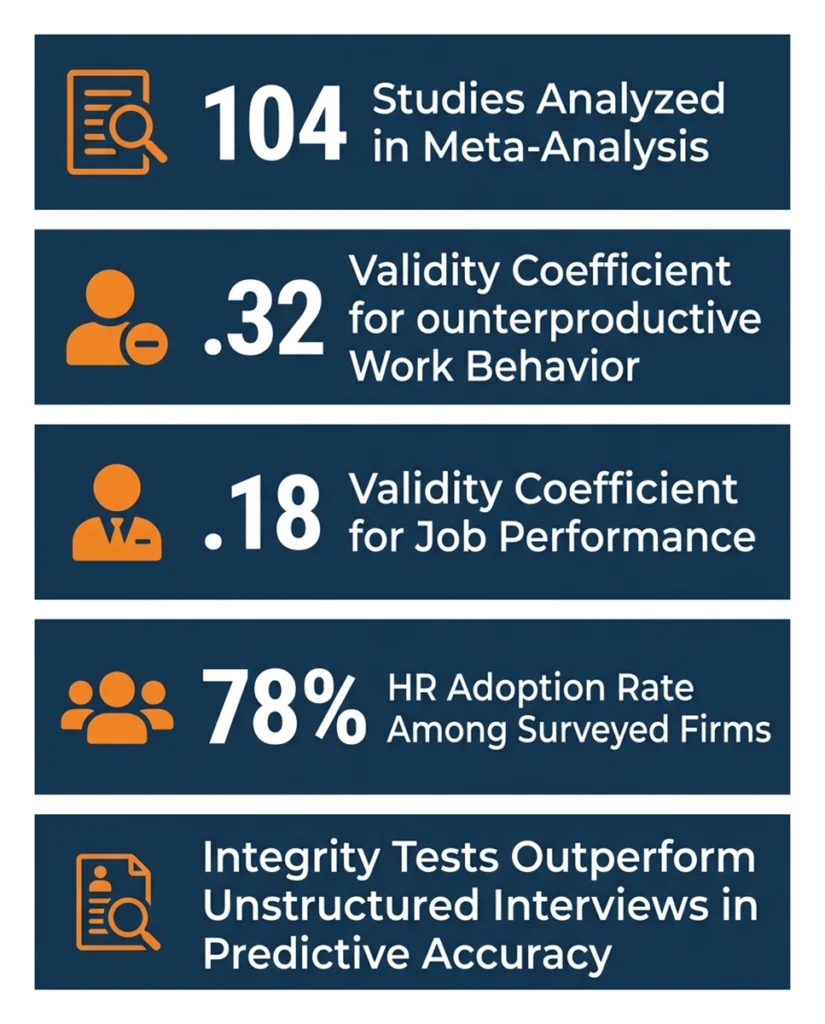
The numbers are concrete. A national retailer that introduced integrity screening across frontline roles documented a 57% reduction in employee theft, a 12% drop in turnover, and a 78% HR adoption rate within the first year. These results reflect what a meta-analysis of 104 integrity test studies consistently predicts: structured honesty tests identify high-risk candidates before they reach the workforce.
This guide breaks down the full business case — what drives those outcomes, how to measure them, and how to implement a program that delivers real, sustainable returns for your organization.
What Is a Pre-Employment Honesty Test?
A honesty test is a structured pre-employment assessment designed to identify a candidate’s trustworthiness, reliability, and likelihood of engaging in counterproductive work behavior. The US Office of Personnel Management (OPM) formally recognizes these tools as valid instruments that predict theft, absenteeism, and overall job performance.
Unlike personality assessments or general aptitude tests, honesty tests are built specifically around the behaviors that drive workforce risk: rule-following, ethical decision-making, and attitudes toward accountability and workplace conduct.
Two primary formats are used in US hiring. Overt tests ask candidates direct questions about past behavior and attitudes toward theft and rule-breaking. Covert tests assess the same risk profile indirectly, through personality trait indicators such as conscientiousness and dependability.
| Test Type | Example Question | Primary Purpose |
| Overt Integrity Test | “Is it ever acceptable to take company property for personal use?” | Directly identify high-risk candidates in roles with asset or cash exposure |
| Covert Integrity Test | “I prefer following established rules to improvising my own approach.” | Predict long-term dependability and ethical alignment indirectly |
| Situational Judgment Test | “Describe how you would respond if you witnessed a coworker falsifying records.” | Evaluate real-world ethical decision-making in role-relevant scenarios |
How to Measure the ROI of Honesty Tests in Hiring
Quantifying the ROI of honesty tests in hiring requires tracking the four workforce categories that integrity screening most directly influences: theft, turnover, absenteeism, and workers’ compensation claims. Each has documented baselines and measurable outcomes.

Theft Reduction
Employee theft is among the most direct and quantifiable returns from honesty testing. Organizations deploying integrity assessments across frontline and cash-handling roles consistently report significant declines in inventory shrinkage, cash discrepancies, and time theft within the first year.
The national retailer case study documented a 57% reduction in theft-related losses after introducing structured integrity screening. For large retail, logistics, and financial services organizations, this figure can represent millions of dollars in recovered annual revenue.
Turnover Savings
Turnover is one of the most expensive workforce problems facing US organizations. SHRM estimates that replacing an employee costs between 50% and 200% of their annual salary, depending on role and seniority level.
Organizations that systematically deploy honesty tests across high-risk roles report turnover reductions of up to 37%. The 12% reduction in the retailer case study is a conservative result — representing thousands of dollars per avoided exit across a workforce of several hundred employees.
Absenteeism and Productivity
Beyond theft and turnover, integrity tests predict a broad range of counterproductive work behaviors — including absenteeism, time fraud, and interpersonal misconduct.
Organizations that add honesty testing to their pre-employment screening process report approximately a 10% reduction in productivity-related absenteeism within the first year of consistent deployment.
For a 200-person workforce where employees average eight unjustified absences per year, a 10% improvement represents 160 recovered workdays annually — a direct productivity gain with a clear dollar value.
Workers’ Compensation and Safety
The connection between integrity screening and safety outcomes is well established. Implementing honesty tests alongside safety-focused hiring practices reduces OSHA-recordable incident rates by double-digit percentages, with corresponding reductions in insurance premium exposure and claim management costs.
Removing the riskiest 8–10% of applicants from the pipeline before hire directly reduces claim frequency and severity. Read more about how pre-employment tests cut workers’ compensation claims.

Honesty Test Research: Validity and Adoption Data
Understanding the ROI of honesty tests in hiring also means understanding why they work. The predictive power of these tools is grounded in decades of peer-reviewed research — not anecdotal outcomes.
The meta-analysis of 104 studies referenced earlier establishes corrected validity coefficients of .32 for counterproductive work behavior and .18 for job performance. These figures represent statistically robust predictive power that consistently outperforms unstructured interviews in forecasting workplace conduct.
The 78% HR adoption rate among organizations reporting measurable workforce improvements reflects how widely this evidence has translated into practice. When HR teams have access to a validated tool that demonstrably predicts the behaviors they care most about, adoption follows naturally.
For a broader view of how these metrics translate into hiring outcomes, see 6 ways honesty and integrity transform hiring outcomes.
Matching Honesty Test Types to Your Hiring Roles
Selecting the right test format is essential for maximizing the ROI of honesty tests in hiring. Not every format delivers equal value across all role types.
| Role Type | Recommended Format | Rationale |
| High-risk / financial roles | Overt + reverse-coded items | Directly identifies theft-risk attitudes; reverse-coded items detect inconsistent responses |
| Customer-facing roles | Situational + covert | Evaluates real-world ethical judgment; less susceptible to socially desirable faking |
| Team-driven / leadership roles | Open-ended + behavioral | Surfaces interpersonal conduct patterns and ethical decision-making quality |
| General staff / high-volume hiring | Covert + overt combination | Broadest predictive coverage; balances efficiency with validity across large candidate pools |
Combining overt and personality-based formats delivers the strongest predictive coverage for most US organizations. Overt tests flag direct risk indicators early; personality-based tests surface behavioral patterns that predict long-term reliability and team fit.
Digital delivery integrates directly with most applicant tracking systems, improves scoring consistency, and reduces administrative cost without affecting predictive validity — making it the standard approach for high-volume hiring environments.

6 Steps to Implement Honesty Tests and Maximize ROI
Achieving the full ROI of honesty tests in hiring requires a structured process aligned with US legal standards. For a comprehensive framework, see the Integrity Assessments Definitive Guide for Smarter Hiring.
- Select a validated assessment tool. Choose a honesty test with documented construct and criterion validity, an independent validation study, and transparent scoring documentation. Confirm the vendor provides adverse impact data and a technical manual on request.
- Define role-specific deployment criteria. Identify which positions genuinely benefit based on their risk profile: cash access, inventory exposure, data sensitivity, safety responsibility, or supervisory authority.
- Integrate with your ATS workflow. Connect assessment delivery directly to your applicant tracking system. Consistent administration timing — pre-interview or post-conditional offer — is essential for legal defensibility.
- Communicate transparently with candidates. Inform applicants of the assessment’s purpose, expected completion time, and how results factor into the hiring decision. Clear communication improves response quality and reduces legal risk.
- Score, interpret, and document every decision. Apply research-based scoring rubrics, flag inconsistent responses, and record the basis for each hiring decision. This documentation is the foundation of EEOC compliance and audit readiness.
- Monitor outcomes and refine regularly. Track post-hire turnover, theft incidents, workers’ comp claims, and absenteeism by hiring cohort. Review for adverse impact annually and adjust scoring thresholds based on what the data shows.
How to Interpret Honesty Test Results Accurately
Honesty test scores are not pass-or-fail verdicts. They are evidence — one input in a multi-dimensional hiring decision. Treating them as the sole basis for a decision reduces their value and creates legal exposure.
When reviewing results, focus on patterns rather than isolated responses. Consistently high integrity scores across multiple dimensions carry more weight than any single answer. Sharp inconsistencies — contradictory responses to related questions — are more meaningful than individual low scores.
When results are surprising, investigate before drawing conclusions. A targeted follow-up question during the structured interview often provides more useful information than the score alone.
Always combine honesty test data with structured interviews, reference checks, and role-specific skill evaluations. This multi-input approach maximizes predictive validity, minimizes adverse impact, and produces the most legally defensible hiring decisions.
Legal and Ethical Compliance in Honesty Testing
Every pre-employment honesty test deployed in the United States must comply with EEOC employment testing guidance, which requires assessments to be job-related, consistent with business necessity, regularly reviewed for adverse impact, and fully documented for compliance audit readiness.
- Validate the test for the specific role. Job-relatedness is a legal requirement. Use only tools with published validation studies linked to the role types you are screening for.
- Audit for adverse impact quarterly. Monitor scoring outcomes by demographic group and address any patterns that disproportionately screen out candidates from protected classes.
- Document every hiring decision. Record how assessment results were weighted alongside other evaluation inputs. This paper trail protects the organization during EEOC audits and candidate-initiated legal challenges.
- Communicate clearly with all candidates. Provide written notice of the assessment’s purpose, how results are used, and how to raise concerns.
- Never use polygraph-based instruments. The Employee Polygraph Protection Act prohibits physiological monitoring in US pre-employment screening. Written and digital honesty assessments are fully compliant under federal law.
Common Pitfalls That Reduce Honesty Test ROI
Even well-validated honesty testing programs underperform when implementation is inconsistent. These are the most common mistakes that reduce the ROI of honesty tests in hiring:
- Over-relying on test scores. Treating honesty tests as the sole decision-making tool reduces hiring quality and creates legal exposure. Always combine results with structured interviews and reference checks.
- Skipping validation checks. Deploying tools without published validation data creates adverse impact risk and produces less predictive results. Verify technical documentation before selecting a vendor.
- Neglecting candidate communication. Applicants who receive no explanation of the assessment’s purpose are more likely to disengage or respond defensively.
- Ignoring adverse impact monitoring. Failure to track demographic patterns in scoring outcomes creates EEOC compliance exposure.
- Using one format for all roles. Applying the same assessment indiscriminately across every position reduces predictive accuracy and produces false positives in low-risk roles.
- Not documenting edge cases. Outlier results deserve a documented review before a hiring decision is made. Skipping this step wastes talent and creates audit gaps.

Frequently Asked Questions
What is the typical ROI of honesty tests in hiring?
The ROI of honesty tests in hiring is consistently strong across US industries. Documented outcomes include a 57% reduction in employee theft, turnover improvements of 12–37%, approximately 10% less absenteeism, and double-digit declines in workers’ compensation claims within the first year. A meta-analysis of 104 studies confirms predictive validity of .32 for counterproductive work behavior and .18 for job performance.
How long does it take to see ROI from honesty testing?
Most organizations report measurable improvements within the first year of consistent implementation. Theft and absenteeism reductions tend to appear earliest. Turnover improvements accumulate over 12–18 months as screened hires demonstrate stronger retention patterns than previous cohorts.
Can small businesses benefit from honesty testing?
Yes. For small businesses, a single problematic hire in a cash-handling, client-facing, or supervisory role can have an outsized impact on operations and culture. Pre-employment honesty tests are available at accessible price points and can be deployed without enterprise-level HR infrastructure.
Do honesty tests work for every industry?
Honesty tests deliver the strongest ROI in industries with elevated theft risk, high safety exposure, or significant trust requirements. Healthcare, retail, logistics, construction, and financial services consistently report the highest outcomes. Any organization where counterproductive work behavior carries significant cost can benefit from systematic integrity screening.
How do I choose the right honesty test for my organization?
Start by identifying the risk profile of the roles you are screening for: financial exposure, safety responsibility, data access, or supervisory authority. Then select a validated tool with published criterion validity data, documented adverse impact analysis, and a technical manual. Combine overt and personality-based formats for the broadest predictive coverage.
Measure the ROI of Honesty Tests in Your Organization
IntegrityFirst Tests provides validated, US-compliant pre-employment honesty assessments built for HR teams that need measurable results and a legally defensible process. Our clients report consistent improvements in theft reduction, employee turnover, and workforce quality from the first year of implementation. Schedule a free demo with IntegrityFirst Tests and start building the business case with real data.