Schedule a call!
If you are trying to add integrity screening to high-volume hiring, you have probably already learned the hard part: a tool does not create a program. You only have a program when every site follows the same rules for what you assess and what you document, so you can defend decisions and improve outcomes.
This guide walks through how to implement an integrity risk assessment program as a practical, HR-ready build. You will define which roles and behaviors drive your incidents and claims, design a simple integrity risk scoring matrix that produces consistent dispositions, and pair it with mitigation and exception controls that managers cannot improvise around.
You will also see how to integrate the integrity signal with the rest of your selection system, plus a case study where standardizing the workflow cut first-year turnover by 50% and workers’ compensation claims by 42%.
This build sits inside the bigger picture covered in our guide to integrity risk assessment for HR, from risk identification through reporting.
What an Integrity Risk Assessment Program Is in HR

An integrity risk assessment program is the set of rules and ownership that turns hiring-risk signals into consistent decisions, with a paper trail. It is not “adding an integrity test.” It starts with role-based risk definitions, runs structured inputs (tests and interviews) through a defined gate, and ends in clear decision points: proceed or stop.
For example, if you hire 200 warehouse associates a month, the program defines who reviews flagged results and what you document for audits and adverse-impact monitoring. If those gates are not explainable, you still have a tool, not a program.
Building an HR integrity risk assessment program is mostly about making those gates repeatable across sites and shifts. In other words, how to implement an integrity risk assessment program is largely a governance problem, not a tooling one: the same risk definitions, the same scoring, and the same documentation every time. The integrity risk assessment program steps below move from role definition through scoring, mitigation planning, and reporting.
Step 1 — Define Roles and Risk Domains
Start with role-based integrity risk screening: list the job families where a lapse creates the most loss, then name the risk domains that matter for each. The two are not the same, so do not default to one set of domains for every role.
Typical high-exposure roles include warehouse associates and forklift operators, line leads, drivers, cash-handling retail roles, patient-facing aides, and supervisors with authority over schedules and discipline. The domains worth weighting include safety and rule compliance, theft and shrink, harassment and aggression, falsification and policy evasion (timecards, certifications, standard operating procedures), and workers’ compensation claims behavior.
A cashier’s integrity profile should weight cash handling and confrontation differently than a machine operator’s, even when both sit under the same hourly umbrella. Weighting domains by role is also a compliance point: federal guidance expects selection procedures to be evaluated in the context of the specific job rather than applied as a blanket screen.
Step 2 — Get Your Data and Governance Ready
A single inconsistent override can turn a clean-looking screening step into a liability you cannot explain later. When audit questions arrive, missing ownership and messy data are what make a “standard” process fall apart across sites.
Before you score a single applicant, lock down the inputs and the decision owners for your integrity risk assessment process. Otherwise integrity flags get handled case by case as they surface, and the process becomes a pile of one-off exceptions with recruiters making judgment calls that do not match what Operations and Legal think you are doing.
At minimum, put these in place:
- A role catalog tying each requisition to a job family and its risk domains.
- Outcome codes to track (rescinds, terminations for cause, safety incidents, comp claims, shrink, policy violations).
- A single source of truth for assessment results and dispositions.
- Clear ownership: HR for process and adverse-impact monitoring, Safety/Operations for what “high risk” looks like on the floor, Legal/Compliance for validation and change control, and Talent Acquisition for recruiter workflows.
Step 3 — Build an Integrity Risk Scoring Matrix for HR
An integrity risk scoring matrix for HR only works if it turns your risk domains into the same decision every time, even when a different recruiter runs the requisition. The goal is consistent, defensible decisions at scale, so that informal judgment does not quietly become your real selection system.
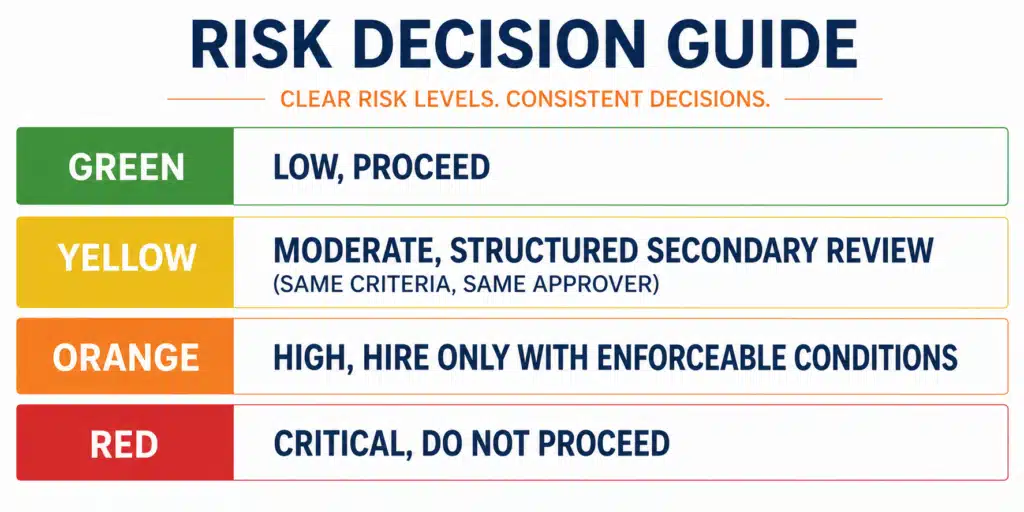
Start with a simple likelihood × impact approach per role and domain. Likelihood asks how often that type of integrity failure shows up in the job family given your environment and hiring volume. Impact asks how bad it is for people or assets if it happens. Use three levels for each (low, medium, high) so teams can agree and apply it at scale, then translate the result into a disposition band:
- Green (low): proceed in the workflow.
- Yellow (moderate): structured secondary review required, same criteria and same approver every time.
- Orange (high): hire only with conditions or controls you can actually enforce.
- Red (critical): do not proceed for that role.
You will know the matrix is doing its job when a hiring manager cannot pressure you into downgrading a Red to a Yellow without changing the role’s defined impact or likelihood criteria.
Step 4 — HR Integrity Risk Mitigation Planning and Accountability
Once you have defined Green, Yellow, Orange, and Red, you need a matching playbook or the bands become opinions. The common failure is letting recruiters and hiring managers improvise, which turns a Yellow into a Red at one site and into “ignore it” at another. HR integrity risk mitigation planning fixes that by naming an owner, an action, and an approval point for each band.
Build a simple rule set for Yellow and Orange. A Yellow on falsification risk for a food-production role might trigger a structured probe in the interview, while an Orange on safety compliance for a forklift operator might require Operations sign-off. At minimum, define the trigger (which score and domain causes the step), the action (second-look review, structured interview questions, reference checks, conditional offer terms, or onboarding retraining), the owner, and the exception path: who can override and what documentation they must leave behind.
Step 5 — Document, Communicate, and Report
Document the why and the how, not just the score. Keep a role-based rationale for each domain and cutoff, the exact disposition rules, and the exception workflow with a named approver and reason. Apply the same recordkeeping discipline you already use for safety, and report the two signals that prove control: adverse-impact rates and override rates by site. If your override rate is high, your matrix is advisory, and you are the one carrying that risk.
Be explicit that you are using a written or oral assessment, not a polygraph, so no one describes the program like a lie detector policy. The Employee Polygraph Protection Act restricts lie detector tests for most private employers, but it does not prohibit written or oral integrity assessments used for pre-employment screening.
Integrating Integrity Risk Assessment With Your HR Strategy
Recruiters should be able to move candidates forward without translating scores or chasing one-off interpretations. Integrating integrity risk assessment with HR strategy means deciding, up front, how the integrity signal combines with interviews and background checks into one coherent disposition: route the candidate (proceed, structured review, or stop), act as a gate or a weighted input, and trigger other steps when risk flags appear. For the build inside the hiring funnel and applicant tracking system, see our guide to how to implement integrity assessments in hiring.
Set a fixed cadence to confirm the combined system stays defensible. At least quarterly, review adverse-impact and override rates by job family and location, then adjust the instrument or weighting if you can achieve the same risk reduction with less adverse impact. That is the standard the EEOC applies: a selection procedure should be job-related and consistent with business necessity, and you should adopt an equally effective alternative with less adverse impact when one exists.
If a role involves remote or unproctored testing, our guide to integrity in online assessments covers the added controls that keep the integrity signal reliable.
Case Study: Results and ROI in 9 Months
In one high-volume hourly environment, rolling out a role-based integrity risk assessment program cut first-year turnover by 50% and reduced workers’ compensation claims by 42%, delivering a return on investment inside nine months (IntegrityFirst client data). The biggest shift was not the assessment itself; it was replacing site-by-site improvisation with the same risk bands, the same secondary reviews, and the same exception approvals every time a candidate flagged.
That kind of payback is consistent with federal guidance: the U.S. Office of Personnel Management notes that integrity tests deliver a high return on investment in settings where counterproductive behaviors such as theft and absenteeism are highly disruptive. The results become finance-ready when documentation makes the controls visible: fewer rescinds and terminations for cause, and a tighter decision trail when Legal asks why a candidate was advanced or stopped.
Frequently Asked Questions
Is an integrity risk assessment program legal for pre-employment screening?
Yes, when you use job-related, non-polygraph assessment methods and apply them consistently. The Employee Polygraph Protection Act generally bans lie detector tests for most private employers, but it does not prohibit written or oral integrity assessments.
How do you manage adverse impact without scrapping the program?
Monitor adverse impact by job family and location, and adjust the selection system if you can achieve the same risk reduction with less adverse impact. Do not outsource this to a vendor; you still own the obligation to show job-relatedness and business necessity.
Will candidates drop out because of it?
Candidates drop out when the process feels arbitrary or accusatory. Frame it as a standardized, role-relevant assessment that supports safety and fair hiring, keep instructions clear, limit redundant steps, and make the next step predictable.
How do you set risk bands without making them feel subjective?
Tie bands to role-specific risk domains and defined outcomes, then calibrate using your tracked data (override and incident rates) instead of debating hypotheticals. If you cannot explain why a cutoff exists in business terms, you are not ready to enforce it.
How do you keep multi-site hiring consistent when managers push for exceptions?
Route every Yellow and Orange result through the same secondary review, and require named approval with a documented reason for any override. If one site can change decisions informally, the program is not standardized.
Build a Program That Pays for Itself
Knowing how to implement an integrity risk assessment program comes down to the same discipline you use for any other risk control: defined criteria, consistent execution, documented decisions, and a scheduled outcome review. Done well, it turns scattered screening into a governed system that lowers claims, shrink, and early-tenure turnover. IntegrityFirst Tests provides validated integrity assessment tools built for United States HR teams that want measurable, defensible results.
Ready to stand up the program in your operation? Contact IntegrityFirst Tests to schedule a demo, and we will help you map roles, build the scoring matrix, and set the reporting your leadership will act on.