Schedule a call!
Single-method screening has a quiet flaw: every test type can be beaten in its own way. Ask candidates directly about theft and the savvy ones simply give you the answer they know you want. Measure personality traits instead and you gain faking resistance but lose the sharp, behavior-specific signal.
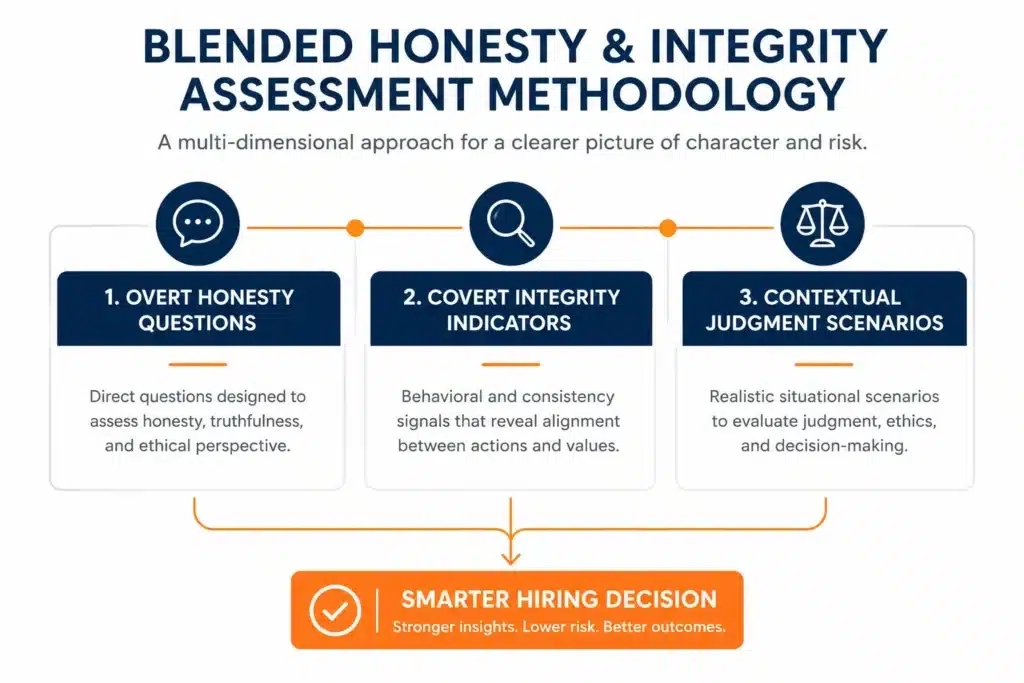
A honesty and integrity assessment for smarter hiring closes that gap. Instead of relying on one method, it blends direct questions, personality measurement, and situational judgment into a single instrument that is much harder to game and much better at predicting risk.
This is not a logistics article about which platform to buy or how to wire a test into your applicant tracking system. It is about the methodology underneath the score: what overt, covert, and situational approaches each measure, where each one fails on its own, and why the combined model has become the standard for smarter hiring.
Why One Test Type Leaves Blind Spots
Structured integrity testing in the US grew out of a legal shift. When the Employee Polygraph Protection Act of 1988 restricted lie-detector use in the private sector, employers needed a lawful way to screen for honesty, and written assessments filled the gap.
The earliest were overt tests, also called clear-purpose tests, which ask directly about attitudes toward rule-breaking and about past behavior. Their strength is real: high face validity and a direct line to acute problems like theft and policy violations. A candidate who openly endorses bending the rules tells you something useful.
But the transparency that makes overt tests intuitive is also their weakness. Because the intent is obvious, overt items are the most exposed to “fake-good” responding, and a candidate with average cognitive ability can usually guess the approved answer.
Covert, or personality-based, tests were built to solve that problem. Instead of naming theft, they measure traits statistically tied to reliability, chiefly conscientiousness, along with emotional stability and impulse control, through everyday statements the candidate rates on a scale.
Because the purpose is obscured, faking is much harder. A controlled study in Frontiers in Psychology (2018) put this to the test: when participants were instructed to fake, they could shift their scores on both item types, but did so far more easily on overt items, while covert items held a stable meaning that resisted deliberate distortion.
The tradeoff is that covert tests work by proxy. Low conscientiousness predicts chronic problems like absenteeism and unreliability well, but it is a blunter instrument for an acute, calculated act like embezzlement. Neither format alone is enough, which is the whole case for a combined honesty and integrity assessment.

The Combined Method: Overt, Personality, and Situational in One Instrument
The combined methodology does not simply combine two separate tests. It interleaves three layers, direct overt questions, covert personality items, and situational judgment scenarios, so each one verifies the others.
Think of it as a built-in consistency check. The overt items set an explicit baseline on attitudes toward honesty. The covert items quietly probe whether the underlying traits support or contradict those stated attitudes. The situational items then show how the candidate actually reasons through an ethical conflict under pressure.
The payoff is in the contradictions. When someone gives flawless, compliant answers on the overt section but their personality profile reads as impulsive, low in conscientiousness, and high in risk tolerance, the conflict itself becomes the signal. That internal inconsistency reveals more than a low score on any single section, because it points to deliberate impression management rather than a one-off weak answer.
| Layer | What it measures | Best at catching | Weakness it offsets |
| Overt (clear-purpose) | Direct attitudes and admissions about rule-breaking | Acute risk: theft, fraud, blatant violations | Adds the direct behavioral signal covert tests lack |
| Covert (personality) | Traits like conscientiousness, emotional stability | Chronic risk: absenteeism, unreliability, toxicity | Resists the faking that overt items invite |
| Situational (SJT) | Judgment in realistic ethical dilemmas | How rules hold up under real pressure | Bridges abstract traits and real-world action |
This layering matters because integrity failures rarely announce themselves. A study published in the Consulting Psychology Journal that analyzed 1,843 white-collar criminal cases found that 86 percent of those convicted had no prior record, and noted that serious integrity violations are usually concealed.
Background checks miss exactly this kind of risk. That is why a layered honesty and integrity assessment does work a records search cannot: it reads disposition and judgment, not just history.ions are usually concealed. Background checks miss exactly this kind of risk, which is why a layered psychological read does work a records search cannot.
What the Evidence Says About Combined Methods
The case for combining methods is not a matter of preference; it shows up in the validity numbers. A 2023 meta-analytic review in the Journal of Pacific Rim Psychology, drawing on 150 studies and 67,016 people, found that integrity tests overall predict workplace deviance with a corrected validity near .43, a strong figure for any selection tool.
The detail that matters for methodology is what scored highest. Value-oriented and situational-judgment measures reached about .60, and integrity-linked cognitive measures about .65, both well above what a single clear-purpose test delivers on its own. In other words, the more an assessment layers methods, the more predictive it becomes.
The same review is a useful reality check on context. Predictive validity was largest in highly structured, high-stakes settings, military and law enforcement, followed by customer service, retail, and sales, and it remained solid in manufacturing and finance.
It was smaller in healthcare and not statistically significant in education, where the definition of “deviance” is far more situational. The practical reading for HR: a combined integrity assessment earns its keep fastest in roles with clear rules and tangible risk, and should be weighted more cautiously where the work is highly autonomous and relational.
How Combined Tests Resist Faking
The reason a blended instrument holds up is that it assumes candidates may try to manage their image, and it is built to catch the attempt. Three mechanisms do most of the work.
The first is social-desirability scoring. Items that capture implausibly perfect claims, never feeling frustrated with a coworker, never telling even a small lie, flag profiles that look too clean, and the algorithm discounts an integrity score that appears artificially inflated.
The second is cross-format consistency. By asking about the same underlying trait as a direct question, then as an indirect personality item, then inside a scenario, the assessment tests whether a candidate can hold a coherent story across very different formats. That is cognitively demanding, and most people who are faking slip somewhere.
The third is response latency. Honest answers are quick because the brain simply reports what is true; deceptive answers take longer, because the candidate has to recognize the intent, suppress the truthful response, and construct a plausible substitute. A foundational study by Dwight and Alliger (1997) showed that response-latency patterns alone could correctly sort test-takers into honest, fake-good, and coached groups 59 percent of the time, well above the 33 percent expected by chance.
One tactic is worth a caution. Aggressive “we will detect faking” warnings sound useful but can backfire: research has found they make honest candidates over-think their answers, adding noise to the traits you are trying to measure, while well-built covert items already resist faking without the threat. The stronger defense is structural, the layered design itself, not intimidation.
Honesty and Integrity Assessment for Smarter Hiring: Making the Method Work
A sophisticated instrument still depends on disciplined use. A honesty and integrity assessment for smarter hiring should never operate as an automated reject button, because even fundamentally honest people occasionally trip a flag through an inconsistent answer or a misread item. The score belongs inside a wider evaluation, not above it.
The strongest workflow treats a flag as a prompt, not a verdict. If a combined score suggests a tendency to shift blame or low composure under stress, the hiring team turns that into specific, behavioral interview questions and cross-checks it against references and a work sample.
Two design choices reinforce fairness. First, pair the integrity assessment with a cognitive measure, since the research shows that combination produces the most accurate selection.
Second, monitor outcomes for adverse impact. Well-validated integrity tests generally show negligible average score differences across gender and across racial and ethnic groups, typically under 0.2 standard deviations according to OPM. That favorable profile is part of what makes them more defensible than records-based screens, but you still verify it in your own data. The full compliance framework lives in our guide to honesty test legal compliance in hiring.
For the building blocks behind the blended model, our comparison of overt vs. personality-based honesty tests breaks down the two core formats, and our overview of honesty and integrity test definitions, types, and HR benefits maps the full family. Our explainer on the covert integrity test covers personality-based screening in depth, and for the broader context see integrity assessments for smarter hiring.

Put a Combined Assessment to Work, and Connect It to Your Hiring
A combined honesty and integrity assessment gives you a deception-resistant read on candidate risk, but it delivers the most value when it is matched to the role and wired into a process your team can act on. IntegrityFirst Tests provides a fast, blended integrity screen built for the pre-interview stage, so HR can flag reliability risk before recruiters and managers invest more time. Schedule an IntegrityFirst demo to see the combined methodology in practice.
When you want that screen connected to the rest of hiring, applicant tracking, custom skill tests, scorecards, interview scheduling, and automation, Discovered brings the assessment into one hiring system, so a risk flag flows directly into the next step instead of sitting in a separate tool. IntegrityFirst gives you the focused integrity signal; Discovered connects it to the workflow around it.