Schedule a call!
Online integrity assessments help HR teams reduce on-the-job risk, such as shrink, theft, and safety violations, when they are run as validated selection tools rather than cheat-proof “gotcha” screens. This guide brings together everything an HR or talent-acquisition leader needs: what these assessments actually predict, why the “online” part is rarely the real variable, how to keep the program defensible under EEOC standards, and how the pieces fit together across security, fairness, administration, and implementation.
The stakes are concrete. The National Safety Council puts the total cost of work injuries at $181.4 billion in 2024, roughly $48,000 per medically consulted injury, before you add theft and turnover. A screening step that reliably lowers even a fraction of that exposure is worth running well. The rest of this guide, and the linked deep-dive articles, show you how.
What Online Integrity Assessments Are
An online integrity assessment is a standardized, typically self-report questionnaire delivered digitally to estimate a candidate’s likelihood of counterproductive work behavior (CWB): theft, safety and procedure violations, falsification, and chronic absenteeism. It is not a lie detector and not a measure of moral character. It produces a probabilistic, risk-relevant signal you apply consistently at scale, usually inside an applicant tracking system (ATS).
Integrity assessments are generally grouped into two families:
- Overt (clear-purpose) tests ask directly about attitudes toward dishonesty and rule-breaking.
- Personality-based tests measure traits such as conscientiousness and dependability that relate to counterproductive behavior.
Both can work online; the right choice depends on the job risk you are screening for and how explainable the signal needs to be.
How These Tools Differ From Other Pre-Employment Tests
Boundaries matter for defensibility and for setting stakeholder expectations. An integrity test is not a skills test, which asks whether a candidate can do the job, and not a background check, which reports past records where legally permissible. It estimates the likelihood of future counterproductive behavior, a different question with a different evidence base. A warehouse hiring flow might use an integrity measure to flag higher misconduct risk, then still rely on a structured interview and a safety-knowledge check to decide who can reliably follow procedures on a night shift.
That separation keeps each tool doing the job it is validated for. When teams blur the lines, they tend to over-rely on one signal and under-invest in the controls that actually move outcomes, such as access controls for theft or supervision for safety.
Matching the Tool to Your Industry Risk
The same assessment supports different decisions depending on the work. In retail, the risk that matters is usually cash handling and returns fraud; in warehousing and manufacturing, safety-rule compliance and procedure shortcuts; in healthcare, documentation integrity and protocol adherence. Defining that risk in plain, role-specific terms is what makes the score interpretable and the program defensible. A score used to flag higher cash-handling risk for a retail shift lead should not be applied unchanged to a maintenance technician whose main exposure is lockout/tagout compliance.
What These Assessments Actually Predict
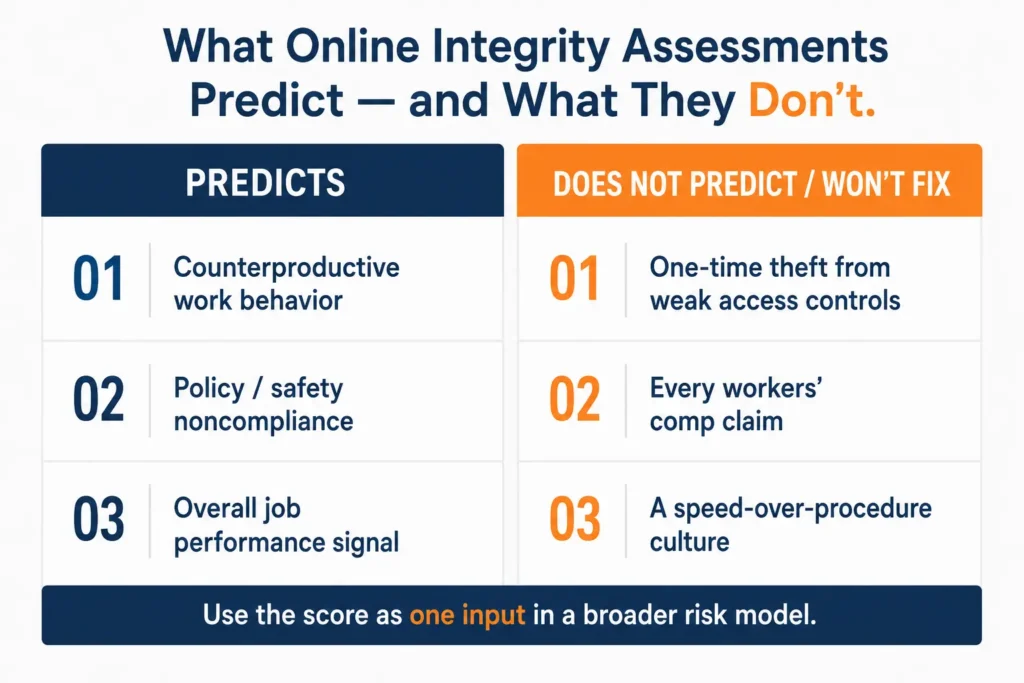
Integrity assessments predict the likelihood of counterproductive work behavior and, often, overall job performance. The U.S. Office of Personnel Management describes integrity and honesty tests as valid predictors of job performance and counterproductive behaviors such as theft and absenteeism, with a strong return on investment in settings where those behaviors are disruptive. In practice, that shows up as fewer policy write-ups, fewer repeat coaching cycles, and less cash-handling loss, rather than a single dramatic number.
The distinction matters because it changes how you judge success. An integrity score will not tell you who will file a workers’ compensation claim (claims have many causes), it will not stop a one-time theft created by weak access controls, and it cannot fix a supervisor culture that rewards speed over procedure. Treat the score as one predictor in a broader risk model that also weighs job exposure and controllable workplace conditions. For the upstream view of quantifying that exposure, see our guide to how to measure employee risk before hiring.
Fairness and Candidate Experience at a Glance
Because these tools sit in front of every applicant, fairness and candidate experience are part of the program, not afterthoughts. Clear, advance communication about what the assessment measures and how results are used improves completion rates and response quality, while a published accommodation path protects access for candidates with disabilities. Our guide to secure and fair online integrity assessments covers how to balance proctoring against fairness without turning the assessment into a surveillance event.
Why “Online” Is Not the Real Variable
When an assessment feels too easy to game because it is unproctored, the instinct is to tighten proctoring. More often the decisive factors are the construct the test measures and how the score is used, not the delivery medium. A poorly targeted questionnaire dropped into an ATS can screen out conscientious candidates while missing rule-benders who learned to answer “correctly.” A well-validated assessment with clear job relevance and defensible scoring works online at scale because it is built to predict counterproductive behavior, not to manufacture the appearance of control.
Before changing proctoring settings, ask three questions:
- Does the vendor show validity tied to outcomes you care about (CWB, shrink) under EEOC expectations?
- Can you map the content to a job analysis and business necessity for your environment?
- Do your cut scores and workflows produce consistent decisions, or just more flags for recruiters to argue over?
A defensible online program depends more on implementation governance (decision rules, overrides, retesting, audit trails) than on proctoring intensity alone.
Where the Assessment Fits in the Hiring Process
Placement decides what the assessment measures and what you can defend. Sent at the very front of a high-volume funnel, it largely captures who tolerates friction; sent too late, it wastes interviewer time on risk you could have flagged earlier. A workable pattern is to screen after minimal candidate buy-in (a quick recruiter contact or a realistic job preview), then confirm under tighter controls only for finalists or higher-risk roles. The right placement varies by role and by how much your decision depends on the score, which is why consistent rules across sites matter more than any single setting. Our guide to online integrity assessment best practices walks through funnel placement and cut-score philosophy in detail.
Keeping the Program Defensible Under EEOC Standards
Whatever a vendor’s marketing says, you remain accountable for the selection procedure. The EEOC’s Employment Tests and Selection Procedures guidance treats integrity and personality tests like any other selection tool: they must be job-related and consistent with business necessity, and if they produce adverse impact you must be able to justify them or adopt an equally effective alternative with less impact. The operative screen is the four-fifths rule: a selection rate for any group below 80 percent of the highest group’s rate is generally treated as evidence of adverse impact.
Defensibility comes from your own documentation, not a vendor slide that says “EEOC compliant.” Build a packet before rollout: a job-risk link tying the assessment to specific role risks, written use rules (placement, how scores affect decisions, who can override), the validity evidence you reviewed, and an ongoing monitoring plan that tracks selection rates and triggers a review if impact appears.
The Implementation Governance Checklist
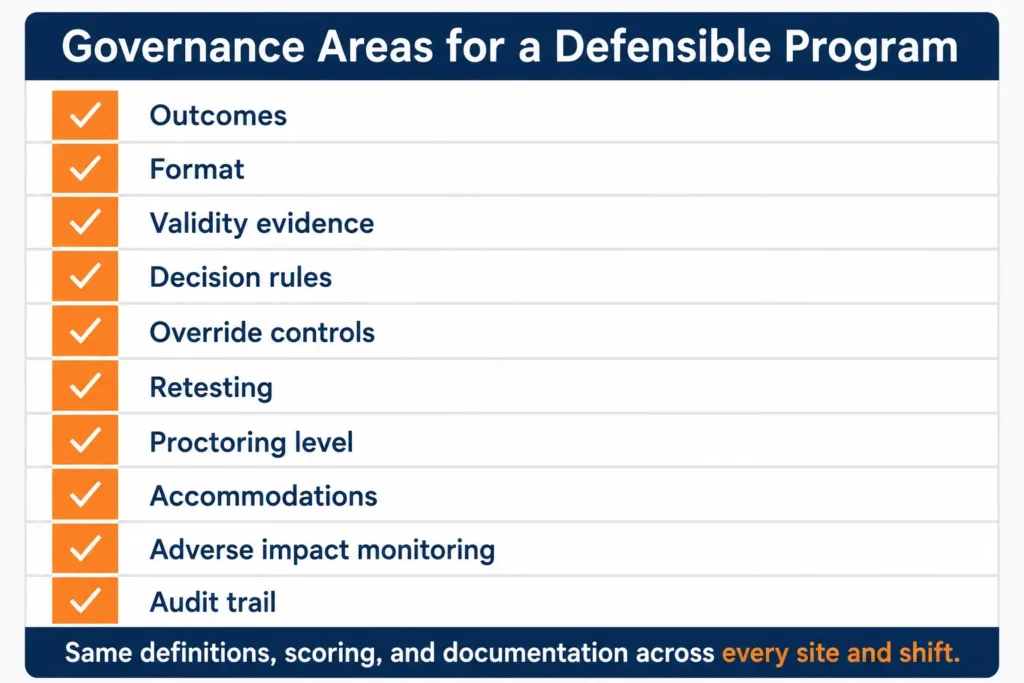
A reliable online integrity program is mostly governance: the same definitions, scoring, and documentation applied the same way across sites and shifts. The areas below are where programs succeed or quietly drift. The guides linked below go deep on each.
| Governance area | What to define |
| Outcomes to track | The downstream signals you expect to move (shrink, safety write-ups, early-tenure turnover) and how you measure them at 60 to 180 days. |
| Format choice | Overt vs. personality-based, matched to job risk and to how explainable the signal must be, with criterion evidence tied to CWB. |
| Validity evidence | Criterion-related evidence and content/scoring that map to your target roles, not generic vendor claims. |
| Decision rules | Pass/fail cutoffs vs. bands, with each band locked to a workflow action (advance, structured follow-up, hold). |
| Override controls | Overrides only with documented reason codes and periodic review of override rates by site and recruiter. |
| Retesting policy | Standard eligibility, waiting period, and which score counts, applied identically across candidates. |
| Proctoring level | Identity, environment, and behavior controls matched to role risk, not maximized by default. |
| Accommodations | A published ADA request path with a named owner and documented decisions, separate from recruiter discretion. |
| Adverse impact monitoring | Selection-rate tracking by group, review triggers, and a defined cadence and sign-off. |
| Audit trail and versioning | Versioned records of instrument, thresholds, cut-score changes, and override reasons for defensibility. |
Where to Go Deeper
This guide is the starting point. Each one below goes deeper on a single part of running these assessments well, from digital security to day-to-day administration.

Secure and Fair Online Integrity Assessments for Hiring
Security and fairness pull on the same controls (identity proofing, monitoring, timing), so tightening one can erode the other. This article shows how to treat security as evidence rather than surveillance, set a minimum bar for identity and score integrity, and build an accommodation path you can defend. Read secure and fair online integrity assessments for hiring.
Online Integrity Assessment Best Practices for HR
The operational playbook: where to place the assessment in the funnel, how to match proctoring to risk, how to keep cheating controls and fairness monitoring defensible, and how to integrate results into your ATS. Read online integrity assessment best practices for HR.
How to Implement Online Integrity Assessments in Hiring
The implementation guide, including the proctoring-controls comparison from audit trail through biometrics, the documentation packet for UGESP defensibility, and how to wire the assessment into a multi-site ATS without breaking candidate experience. Read how to implement online integrity assessments in hiring.
For the general (not online-specific) build inside any hiring funnel, see how to implement integrity assessments in hiring. When you are ready to map score bands to ATS dispositions, our overview of what an ATS is explains the system of record these assessments plug into.
Frequently Asked Questions
Are online integrity assessments lie detector tests under EPPA?
No. The Employee Polygraph Protection Act restricts polygraphs and similar lie-detector devices for most private employers; it does not cover standard self-report integrity questionnaires used in pre-employment screening. Keep your language clean and never describe your assessment as a lie detector.
If a vendor says there is “no adverse impact,” are you covered?
No. You own monitoring in your own applicant pool, for your jobs, using your decision rules. Even when a vendor reports minimal adverse impact elsewhere, run selection-rate checks on your data and be ready to revisit cut scores or workflows if a pattern appears.
How long does a typical rollout take in high-volume hiring?
If the ATS integration is straightforward, you can usually configure, pilot, and launch in a few weeks. Governance takes longer than the technology, so plan time for job-analysis linkage, decision-rule sign-off, the accommodations flow, and recruiter training to avoid inconsistent dispositions.
What should you retain for audits or challenges?
Keep a versioned record of the instrument (form and version), your job-related rationale (job analysis and business necessity), the publisher’s validity documentation, your adverse-impact monitoring outputs, and change logs showing when and why you adjusted scoring or process.
Build a Defensible Program
Online integrity assessments deliver measurable risk reduction when they are validated, job-related, governed, and monitored, not when they are simply locked down. IntegrityFirst Tests helps US HR teams select role-specific assessments and build the placement, scoring, proctoring, and monitoring that keep a program defensible. Schedule a demo with IntegrityFirst Tests to design your program.