Schedule a call!
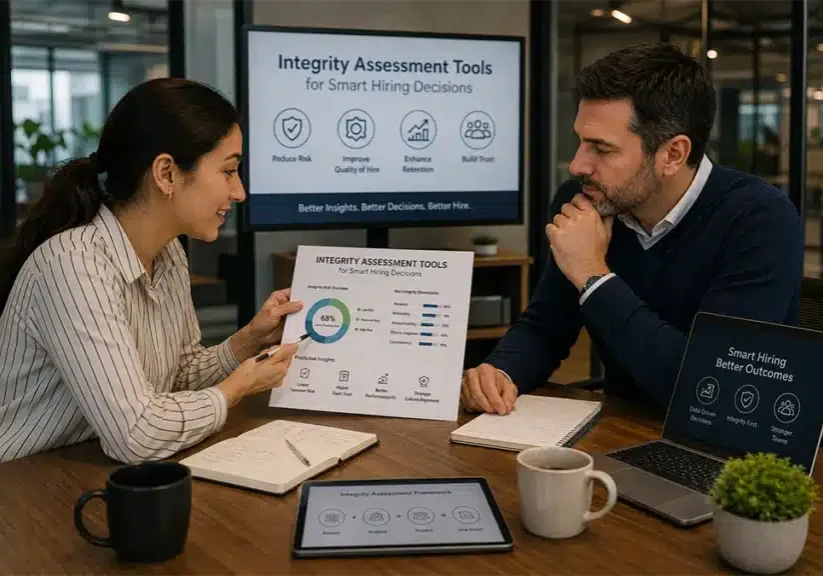
Online integrity assessment best practices for HR start with one decision: run the assessment as a governed selection control, not a generic “good people” screen. If you have ever added an integrity test to your ATS because leaders wanted a cleaner funnel, you have probably seen the tradeoffs immediately, with candidates dropping off and managers pushing for auto-reject cut scores. These tools can reduce risk and make hiring more consistent, but only when administration is deliberate.
This guide gives you operational best practices for administering online integrity assessments in high-volume hiring: where to place them in the funnel, how to match proctoring to risk, how to keep cheating controls and fairness monitoring defensible, and how to integrate results into your ATS so recruiters and operations leaders follow one repeatable, auditable process.
What Online Integrity Assessments Are in a Digital Hiring Context
In hiring, an online integrity assessment is a standardized, typically self-report test you send digitally to estimate a candidate’s likelihood of counterproductive work behaviors (CWB) such as theft, safety violations, or policy breaches. You are not testing honesty in a moral sense; you are measuring risk-relevant tendencies in a consistent way you can apply at scale in an ATS-driven funnel.
Boundaries matter for defensibility. Integrity assessments are not skills tests (can they do the job) or background checks (past records, where legally permissible). They earn their place because they predict real outcomes: the QIC-WD research summary on integrity tests reports that integrity tests are strong predictors of job performance and counterproductive work behaviors, and that combining an integrity test with a cognitive ability measure is the most powerful two-method predictor of performance. Treat results as one risk-control input, not a turnover guarantee or a character verdict.
Online Integrity Assessment Best Practices for HR: Design Principles
To hold up operationally and legally, build the assessment into your selection system rather than using it as an informal signal. Risk spikes when the tool becomes a generic screen and leaders reinterpret scores week to week; in high-volume environments, that drift shows up as inconsistent decisions and more candidate complaints. SIOP’s position is that selection procedures should be validated and job-related, the same standard the Uniform Guidelines set, as reaffirmed in SIOP’s guidance on the Uniform Guidelines.
Make five design choices explicit and repeatable:
- Define the construct in work terms: tie it to the misconduct you want to reduce (time theft, asset loss), not “honesty” as a character label.
- Align to role risk: decide what integrity risk means for that job family (cash-handling retail vs. medication-access healthcare vs. lone-shift warehouse).
- Set a cut-score philosophy: use results as a flag for review or as a hard gate, deliberately; do not let stakeholders default to auto-reject just because the ATS can.
- Write retest rules now: define when you allow retakes and waiting periods before a referral candidate fails, not after.
- Place it intentionally in the funnel: early enough to reduce downstream cost, late enough that you are not adding friction before candidates have a reason to engage.
Document the choices, train to a single interpretation, and audit consistency across sites and shifts.
Where the Assessment Sits in the Hiring Funnel
Placement determines what the assessment does in your system: either a low-friction screen that trims downstream cost, or a higher-control confirmation step that protects you from coached answers. Sending it at application just because the ATS can often trades efficiency for higher drop-off, especially in hourly, mobile-first funnels.
A practical model is screen, then confirm. Use an unproctored integrity assessment after you have created minimal buy-in (a quick recruiter text screen or realistic job preview), then confirm under tighter controls only for finalists or high-risk roles. For warehouse associates you might screen pre-interview to reduce interview volume; for medication-access roles you may confirm post-offer with identity checks. Match control strength to role risk and to your drop-off tolerance, and treat the early step as a conversion moment: fewer steps, clear timing, no surprises. A consistent implementation plan with scoring rules, retest policy, and recruiter playbooks is what keeps the assessment from turning into ad hoc gatekeeping, as detailed in our guide to how to implement integrity assessments in hiring.
Selecting and Configuring Proctoring for HR Use
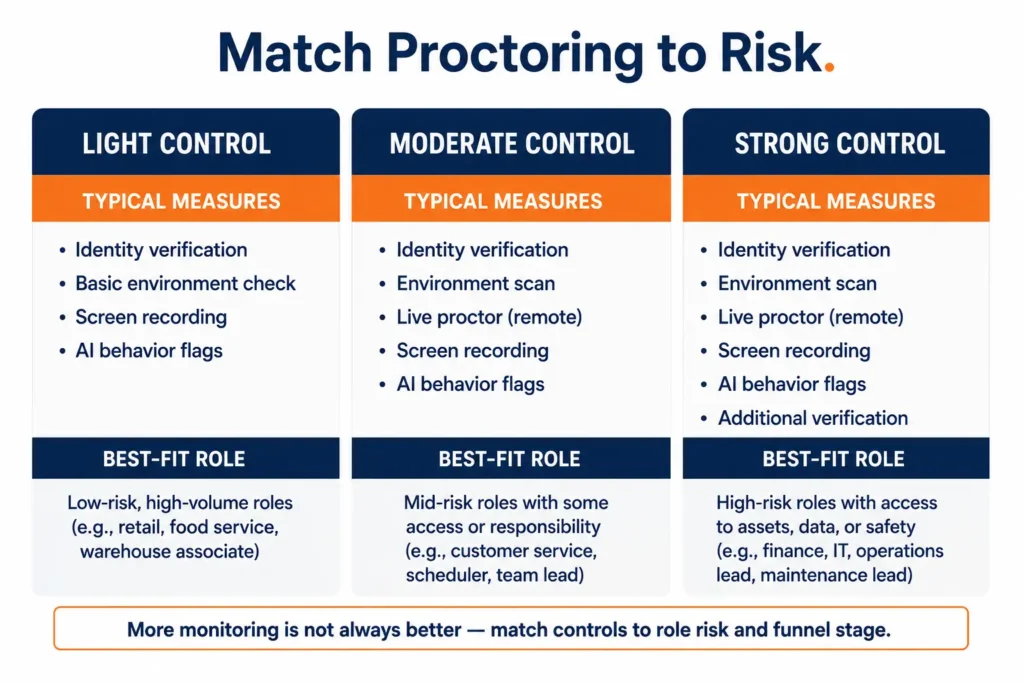
Proctoring works only when it matches the risk you are controlling. Jumping straight to full remote proctoring for a self-report assessment can create more problems than it solves, with higher drop-off and more privacy friction. You do not need maximum controls everywhere; you need clear boundaries for how much identity risk or coached responding you will tolerate.
| Control level | Typical measures | Best fit |
| Light (most high-volume screens) | Login link and time window; basic browser checks; clear attestation language; consistent retest policy | Early screening for hourly roles where completion rate matters |
| Moderate (higher sensitivity or later stage) | ID selfie match; device/IP anomaly checks; copy-paste restrictions; short confirmation questions | Narrowed pool where you want more confidence without heavy monitoring |
| Strong (safety-critical or high-access roles) | Live or recorded proctoring; tighter identity verification; stricter environment rules | Finalist confirmation for safety-critical or high-access roles |
If you hire 200 warehouse associates a month, you might keep the initial screen mobile-friendly with light controls, then add moderate identity checks only for equipment operators. If you cannot explain why you are collecting video or biometric-style data for a 10-minute screen, you are probably over-collecting. The companion guide to secure and fair online integrity assessments covers identity proofing and proctoring tradeoffs in depth.
Cheating Controls That Hold Up
Cheating is not one problem with one fix, and turning on proctoring rarely holds up by itself. What holds up in high-volume hiring is a layered plan that answers two questions in advance: what exactly you are preventing (identity substitution or coached responding), and what you will do when you see a signal.
Wire controls to levers you can run without a surveillance event. Use one-time links and basic account matching for identity, with ID selfie match reserved for finalist confirmation. Restrict copy-paste and obvious multi-tab behavior where your vendor supports it, but do not pretend you can fully control a candidate’s room. Use short completion windows so links are not shared for days. Rotate forms or item pools where possible; if you cannot, tighten retest rules so practice runs do not become a strategy. Add a clear honesty attestation and a brief rationale, which lowers casual misrepresentation at far less cost than heavy monitoring. When stakes rise, re-check consistency with a short, controlled follow-up rather than trying to perfectly secure the first screen.
Operationally, you need prewritten if-then responses recruiters apply the same way every time. In a warehouse funnel, multiple attempts or unusual device switching should route to a standardized integrity follow-up, not an automatic rejection. If a flag does not map to a specific next step, you are generating noise instead of running a control.
ADA, Privacy, and EEOC Compliance in Practice
Compliance breaks down fastest when it lives in Legal’s inbox instead of your ATS workflow. You need artifacts your team runs the same way across sites: what you collect, why you collect it, and how you handle exceptions. The baseline is to keep the assessment job-related and consistent with business necessity, and to monitor for adverse impact, the same standard our companion guides on fair and compliant hiring and secure and fair online assessments document for ADA accommodation and the four-fifths rule.
Operationalize it with five deliverables:
- Accommodation workflow (ADA): a posted request path, a named reviewer, and standard options such as extra time or an alternate format.
- Documentation story (EEOC): a job-related rationale, vendor technical docs, scoring rules, and a change log so a cut-score adjustment is recorded, not improvised.
- Data minimization and retention (US privacy): collect only what you use, set retention by stage, and delete proctoring artifacts on schedule. Where state laws apply, such as California’s CPRA or Illinois’s BIPA, confirm whether your data collection triggers extra obligations.
- State-specific rules: some states regulate integrity tests directly. The QIC-WD summary notes that states including Massachusetts and Rhode Island have specific requirements, so confirm local rules before you deploy.
- Consistent administration: the same timing windows, retest rules, and escalation steps across every location.
Candidate Communication Best Practices for Online Testing
Candidate communication is a compliance requirement and a completion-rate lever, not a nicety. A vague “it’s a personality test” increases drop-off and creates grounds for complaints; overstating the assessment as a deterministic truth measure creates legal exposure. Every candidate should receive a standardized disclosure before they begin that covers what the assessment measures, how long it takes, how results are used (one input among interviews and eligibility checks), a plain-language privacy statement, and a clear accommodation path with a named contact and deadline.
Standardizing this disclosure across all recruiters and locations removes variation in how the assessment is introduced, which protects both candidates and the organization. In high-volume hourly hiring, a one-paragraph disclosure paired with a named accommodations contact measurably reduces non-completion because candidates understand what they are agreeing to and what comes next.
Maintaining Assessment Fairness at Scale
If you do not monitor an integrity assessment like any other selection control, it will quietly change your hiring outcomes. Track adverse impact by stage (invite, complete, pass, hire) and watch for drift in pass rates by location and month. Set escalation rules in advance: if a protected group’s selection rate at any stage drops below your threshold (often anchored to the four-fifths rule), pause auto-reject and review items, cut scores, and messaging; if a site’s pass rate swings materially week over week, audit configuration changes, retest volume, and proctoring flags before blaming the labor market. Our implementation guide lays out a quarterly adverse-impact audit cadence you can adopt directly.
Integrating Online Integrity Assessments With Your ATS
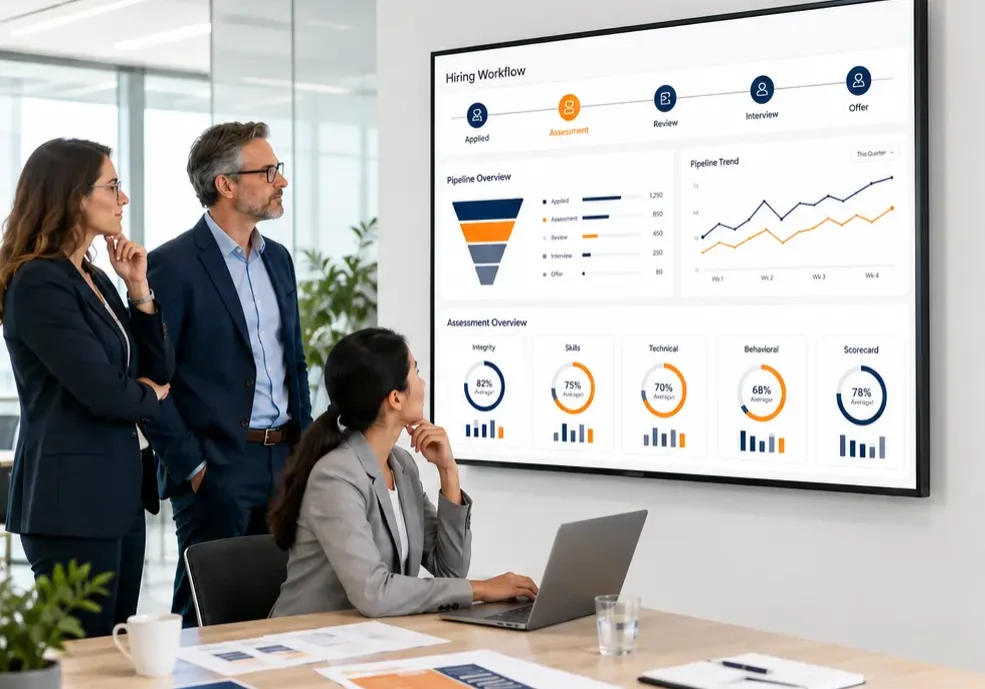
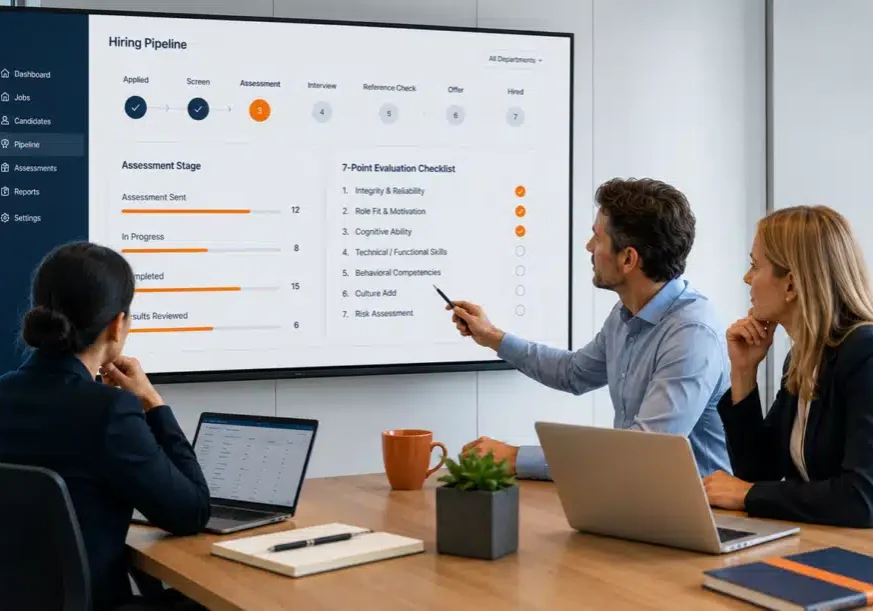
If the assessment lives in a vendor dashboard instead of your ATS workflow, the exceptions become the real process: recruiters chasing links and managers requesting screenshots. You do not fix that with more training; you fix it through workflow design. Make the ATS the system of record for invitations, outcomes, and next steps.
Configure four things and you will run a repeatable, auditable program: map score bands to standardized dispositions (advance or review), auto-trigger the next step, log every event, and restrict access so only need-to-know roles can view results. In a high-volume warehouse requisition, recruiters might see a simple eligible/review status while HR operations can audit overrides. For platform selection and integration depth, see our guide to talent assessment tools that integrate with your ATS.

Frequently Asked Questions
How predictive are online integrity assessments, really?
They predict counterproductive work behavior and job performance well, and are strongest when combined with a cognitive ability measure, per the QIC-WD research summary. They are a weaker predictor of turnover, so use results as a risk-control input rather than a retention solution.
Do you need to support mobile, or can you require a desktop?
In high-volume hourly hiring, mobile support is usually not optional because many candidates start on phones. If you require desktop, do it intentionally: warn candidates up front and keep the link valid long enough to switch devices.
Should you allow retakes if a candidate asks?
Yes, but only under a written rule applied the same way every time. Set eligibility (who and when), a waiting period, and whether the retake uses a new form or a controlled confirmation step, so you do not create favoritism claims or score-shopping.
What do you do when a candidate disputes a result or says the test was unfair?
Route the complaint into a standard review path: confirm identity and check for technical issues. For high-stakes roles, offer a consistent confirmatory step (a short follow-up under tighter controls) rather than ad hoc exceptions.
Put These Online Integrity Assessment Best Practices to Work
IntegrityFirst Tests helps HR leaders deploy validated, role-specific online integrity assessments with the funnel placement, proctoring, fairness monitoring, and ATS integration that make a program defensible and repeatable. Schedule a demo with IntegrityFirst Tests to build an online screening process your team can run the same way every time.