Schedule a call!
You want secure and fair online integrity assessments for hiring that stop cheating without punishing honest candidates. You also need a process you can defend, with documented selection-procedure rationale that holds up under federal anti-discrimination law. If your current approach is “add more proctoring,” you have probably seen the tradeoff firsthand: higher drop-off and more complaints, while you still cannot clearly explain why a score is trustworthy.
This guide shows you how to treat security as evidence rather than surveillance, and how to build fairness you can audit. You will learn how to define the hiring risk you are buying down, set a minimum bar for identity and score integrity, and put guardrails around the workflow: consistent retest rules, an accommodation path that does not require candidates to fail first, and adverse impact monitoring using the four-fifths rule.

Why “Secure” and “Fair” Pull on the Same Levers
In online integrity assessments, security and fairness draw on the same controls: identity proofing, monitoring, timing, and device requirements. When you tighten those controls, you often raise the burden on candidates who already face access constraints (shared devices, noisy homes, older phones, limited bandwidth, disabilities). When you loosen them, you invite score contamination from collaboration or impersonation, then treat a tainted score as objective. That default hides the subjectivity inside your tooling and skips the basics of job analysis and criterion-related validity.
More Security Can Create New Barriers
Security features that feel standard to procurement can land as unequal friction in high-volume hiring. Requiring webcam-on proctoring and strict time limits can screen out candidates who can do the job but cannot meet the testing environment. In an hourly manufacturing or warehousing pipeline, that appears as drop-off at the assessment step, more accommodation requests, and louder candidate complaints, even when your scoring rubric stays consistent.
Less Security Can Undermine Defensibility
If candidates can take an integrity assessment with a friend off-camera, use a second device, or have someone else complete it, you do not just get a little cheating. You risk building selection decisions on data that no longer reflects the person you are hiring. That becomes a fairness problem too, because you may disproportionately screen out honest applicants who took the test as intended.
You can pressure-test your balance by watching a few signals: assessment abandonment rates by device type and time of day; accommodation volume and root causes (environment, time pressure, assistive-tech conflicts); identity mismatches or anomaly flags (location or device shifts, rapid response patterns); and selection-rate ratios by group against the four-fifths rule. Your job is not to pick secure or fair. It is to decide which frictions you will impose, which risks you will accept, and how you will prove both choices were reasonable.
Fraud-prevention steps are easiest to defend when they are tied to a specific cheating vector, such as impersonation or off-camera collaboration, rather than added as generic “more proctoring.” For the candidate-side view of how this process feels and where transparency reduces drop-off, see our guide to the honesty test candidate experience.
Define the Risk You Are Buying Down
You get a cleaner hiring funnel when every control has a named purpose and every bit of friction reduces a loss you can explain to operations and legal. If you do not name the risk, you will buy features instead of reducing exposure, and more features usually means more friction, more drop-off, and more fairness risk. A security control only makes sense when it blocks a specific problem you can see or cannot afford, not when it sounds like what serious employers do.
Start by translating “integrity” into the business outcome you are protecting. In a warehouse or food-production role, the cost of one bad hire might be a safety incident, a workers’ compensation claim, or a preventable termination that restarts the hiring cycle. In retail or hospitality, it might be cash-handling loss or timecard abuse. If you cannot tie the assessment step to a measurable downstream loss, you are optimizing for perceived control rather than risk reduction.
To narrow scope, answer these in your hiring-risk language. What are the top one or two counterproductive behaviors you must prevent in the first 90 days? What is the event that cannot happen twice (an injury or equipment damage)? Where does cheating change your decision, meaning you would hire someone you would have rejected if the score reflected the real person? If your biggest exposure is forklift and lockout-tagout compliance, you care less about whether someone looked up a definition and more about whether someone else took the assessment for them, because impersonation destroys any link between the score and on-site behavior.
The Minimum Security Proof to Trust a Score
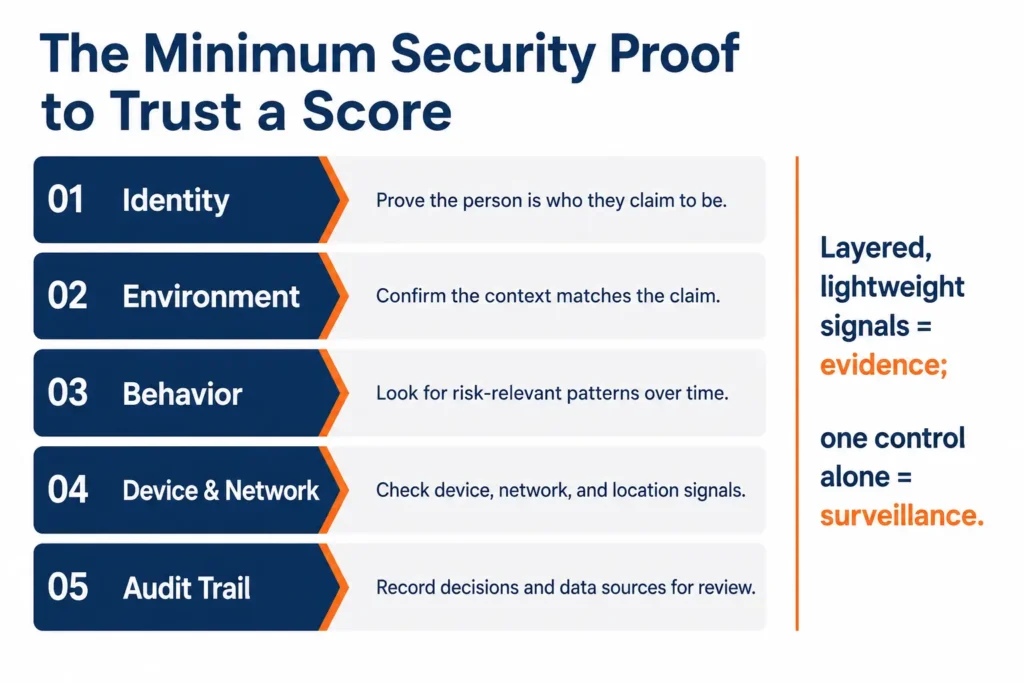
If you are going to use an integrity score to reject a candidate or clear them for a safety- or loss-sensitive role, you need more than “the vendor has anti-cheat.” You need enough proof that the score came from the right person, under reasonably controlled conditions, and that you can explain your handling if the result is challenged in your ATS or HRIS. The common error is betting the whole workflow on a single control such as webcam proctoring or a secure browser. That is surveillance, not evidence.
Identity is the load-bearing control. NIST’s Digital Identity Guidelines (SP 800-63-4) define identity proofing and graduated assurance levels, which gives HR a vendor-neutral way to specify how strongly identity must be established for a given role rather than accepting a marketing claim. Use this as your minimum bar for trusting scores in digital hiring:
- Identity: a documented workflow for verifying who took the assessment, with stronger proofing for higher-risk roles.
- Environment: reasonable checks that reduce off-camera help without demanding a perfect testing room.
- Behavior: anomaly detection you can interpret, such as repeated focus loss, impossible completion times, or non-human response patterns.
- Device and network: signals that catch obvious tampering, including device changes mid-test, location jumps, and proxy indicators where relevant.
- Audit trail: time-stamped logs and flags you can export and review, so you handle disputes consistently.
For a warehouse role with heavy-equipment exposure, you do not need to prove someone never glanced away. You need enough identity and anomaly evidence to prevent impersonation and to show later why you trusted or questioned a score.
Proctoring Options and Tradeoffs
Across several market-research estimates, the online proctoring market for 2026 averages roughly USD 1.3 billion, and the options on offer are not a single lever. Proctoring is closer to a control you set tighter or looser, where every adjustment changes who makes it through. If you assume more monitoring is always better, you may filter for process tolerance instead of job-relevant safety, reliability, and honesty. Keep the controls proportional to the risk.
| Approach | Deterrence | Candidate friction | Privacy exposure | Operational load |
| AI proctoring | Medium | Medium to high (false flags, tech issues) | Higher (video and behavioral signals) | Lower day to day |
| Live proctoring (human) | High | High (scheduling, environment constraints) | Highest | Highest |
| Secure browser / lockdown only | Low to medium (blocks simple copying or switching) | Low | Lower | Low |
| Hybrid (secure browser + light identity checks + targeted review) | High (especially impersonation) | Medium | Medium | Medium |
For high-volume employers, the most practical posture is usually layered controls that raise confidence in identity and score integrity without turning the assessment into a surveillance event. For the broader treatment of integrity in digital testing, see our pillar guide (A4 Pillar — placeholder link).
Making Online Integrity Assessments Defensibly Fair
“Fair” does not mean everyone has the same experience. It means you can show the assessment is job-related, administered consistently, and monitored for unequal outcomes, even when you add security controls. The clearest statistical trigger is the four-fifths rule in 29 C.F.R. § 1607.4(D): if one group’s selection rate falls below 80 percent of the highest group’s rate, that is generally treated by federal enforcement agencies as evidence of adverse impact. If you wait until rollout is complete to look, you have already scaled the problem.
Start with job relevance you can defend in plain language: which early-tenure risks the assessment predicts, such as timecard abuse or safety-rule violations, and what evidence you keep on file to support that link. Then design for access. Publish an ADA accommodation path that does not require candidates to fail first, and confirm that proctoring steps do not break assistive technology or demand unrealistic testing environments. The obligation is concrete: in EEOC v. DaimlerChrysler, the EEOC required the employer to provide a reader accommodation on a pre-employment test for hourly, unskilled manufacturing jobs, a direct precedent for how accommodation applies to online screening.
Operationally, make fairness auditable. Use the same cutoff logic and retest rules across locations and shifts, with documented exceptions. Set US privacy boundaries through data minimization: collect only what you need, state purpose and retention, and limit who can review proctoring artifacts. Where state laws apply, such as California’s CPRA or Illinois’s BIPA, confirm whether your assessment data collection triggers additional obligations. Then track selection rates by group, and if any group’s rate falls below 80 percent of the highest group’s rate, treat it as a trigger to investigate before you scale further.
Build Your Vendor Shortlist and Rollout Plan
Shortlisting goes faster when requirements are pass-fail gates, not a feature wishlist, and when you demand evidence early. If a vendor cannot give you exportable logs, interpretable flags, a clear accommodation workflow, and the ability to apply the same rules across sites and shifts, you do not have a secure and fair integrity assessment. You have a procurement artifact that will not hold up.
Build a shortlist of two to three by insisting on layered identity and device signals you can explain in plain language; documented privacy controls and retention; and operational fit for high-volume hiring, including mobile compatibility and low failure rates. Then roll out in phases. Pilot one high-risk role at a few locations, monitor abandonment, accommodation volume, and selection-rate ratios, tune cutoffs and exception handling, and only then expand to additional roles and geographies.

Case Study: Security and Fairness Outcomes Together
In one high-volume hourly hiring rollout, stronger integrity controls paired with better access cut turnover from 28 percent to 16 percent and reduced candidate complaints by 50 percent. The lesson is not that surveillance worked. The team treated proctoring as evidence plus process, then measured outcomes the way leaders do, using OSHA incident logs and workers’ compensation loss runs.
They used a hybrid posture (light identity verification, secure-browser controls for simple tampering, and targeted review of clear anomaly flags), paired with fairness guardrails: a visible ADA accommodation path, consistent retest rules across sites and shifts, plain-language instructions, and restricted access to proctoring artifacts. Every control mapped to a specific problem, which is what made the program defensible. For the legal and DEI foundation behind this approach, see our guide to integrity assessments for fair and compliant hiring.
Frequently Asked Questions
What documentation do you need to defend an online integrity assessment?
Keep a job-related rationale (which early-tenure risks you are screening for), your administration rules (cutoffs, retest policy, exception handling), and exportable logs (timestamps, identity checks used, and any flags reviewed) so you can show a clean record for the score.
If a vendor says the test is “validated,” are you covered?
No. Federal guidance treats integrity and personality tests as selection procedures, and you still own defensibility even if a vendor built the tool. You need your own file showing job relevance, consistent use, and adverse impact monitoring.
What is the cleanest way to handle ADA accommodations without breaking security?
Publish an accommodation path up front and offer controlled alternatives, such as extended time, a different device flow, or a staff-scheduled verification step, so candidates do not have to fail a proctored session to access support.
How long should you keep proctoring data and logs?
Use a documented retention schedule that matches your purpose. Keep only what you need to investigate disputes and audit fairness, restrict access, and delete artifacts on a defined timeline rather than storing video or behavioral data indefinitely.
Should you allow retests after a flag or a failure?
Yes, but only with rules you can apply across sites and shifts: define when you retest (a technical failure versus suspected misconduct), what changes (a stronger identity step or supervised workflow), and who approves it, so you do not create uneven treatment.
Build Secure and Fair Online Integrity Assessments with IntegrityFirst
IntegrityFirst Tests provides validated, US-compliant integrity assessments built to raise identity and score confidence while protecting candidate access and your legal standing. Schedule a demo with IntegrityFirst Tests to design a secure and fair online screening process you can defend.