Schedule a call!
Knowing how to implement online integrity assessments in hiring comes down to one move: tie the test to a specific job risk and place it deliberately in your remote workflow. Do that and you reduce shrink and safety incidents without driving candidate drop-off or creating UGESP defensibility problems. The mistake is treating an integrity assessment like a plug-in for your ATS: send a link, get a score, auto-reject.
In reality, you are designing a selection step candidates will read as either a fair risk control or a distrustful hoop, and you remain accountable for job-relatedness and adverse impact even if a vendor promises “compliance.” This guide covers the practical decisions that make or break results in remote hiring, from defining the risk outcome to choosing proctoring and integrating with your ATS. For the general (not online-specific) build, see our guide to how to implement integrity assessments in hiring.
How to Implement Online Integrity Assessments in Hiring: Start With the Risk
Treat a pre-employment integrity test like a generic add-on and you will pick the wrong instrument for the risk, mis-size proctoring, and end up with a score you cannot defend when challenged. Integrity measures tend to predict counterproductive work behaviors more strongly than broad performance, so your business case should usually anchor on outcomes like shrink or safety incidents, not vague “better people.”
Write down the specific risk you are trying to reduce, then wire that risk into the workflow decision the test supports. In a high-turnover warehouse you might care less about perfect attendance and more about safety-rule compliance under time pressure, because one forklift incident costs more than two no-shows. In retail you may focus on cash-handling violations and returns fraud; in healthcare, on procedure adherence and documentation integrity. Track these signals:
- Leading indicators: 90-day terminations for policy or safety reasons, incident write-ups per 100 hires, shrink exceptions tied to new hires.
- Lagging indicators: workers’ compensation claim rate and average claim cost, safety incident rate, theft or shrink rate, involuntary turnover.
- Process health: assessment completion rate, time-to-complete, drop-off by stage, pass-through rates by location or shift.
- Compliance monitoring: adverse impact signals using both practical and statistical differences.
For the role-by-role version of this risk mapping and a scoring matrix, see our guide to how to implement an integrity risk assessment program.
Choose Where the Assessment Sits in Your Hiring Workflow
You can do everything else correctly and still undermine the program if the assessment lands in the wrong spot. Place it too early and you filter for patience; place it too late and you waste recruiter and hiring-manager time on candidates a risk screen would have flagged. At the very front, you are largely measuring willingness to push through friction before you have invested anything in the candidate, which is hard to justify under EEOC selection-procedure guidance.
A workable rule is to match scrutiny to both role risk and candidate commitment. In a safety-sensitive warehouse role, an integrity screen after a quick recruiter phone screen (or automated knockout questions plus a realistic job preview) often reduces drop-off while still protecting you before you schedule onsite time. In high-volume retail, you may run a short integrity measure after basic eligibility checks but before interviews. Decide up front how the score affects movement, and avoid a single hard cut unless you can defend and monitor it:
- Tiering: route higher-risk results to a structured follow-up (policy-scenario questions, reference focus, second reviewer) instead of auto-reject.
- Weighted decisioning: combine integrity with other hurdles (eligibility, background timing, safety knowledge) so one score does not dominate.
- Conditional gating: reserve stricter rules for truly risk-heavy roles (cash handling, controlled-substance access, driving, safety-critical equipment).
Make It Defensible Under UGESP, Not Vendor Claims
Integrity measures relate more strongly to counterproductive work behaviors than to broad job performance, so your documentation has to tie the test to real job risk. UGESP defensibility does not come from a vendor slide that says “EEOC compliant.” You need to show, in your context, that the assessment maps to job risk and is used consistently with business necessity, and to monitor outcomes against the four-fifths rule in 29 C.F.R. § 1607.4(D): a selection rate for any group below 80 percent of the highest group’s rate is treated as evidence of adverse impact. Build a simple documentation packet before rollout:
- Job-risk link: a short role profile tying the assessment to specific risks (shrink exceptions, policy violations, safety incidents, claims) and how those risks appear on the floor.
- Use rules: where it sits in the workflow, how scores affect decisions (tiering or weighted decisioning), and who can override with what justification.
- Evidence you reviewed: a vendor technical-manual summary (what the test predicts and for whom) plus your rationale for why it matches your job risks.
- Ongoing monitoring plan: monthly pass-through and completion rates, and adverse impact checks with a trigger to review alternatives if impact appears.
One governance point: do not let anyone call this a lie detector. As the Employee Polygraph Protection Act (EPPA) sets out, polygraphs are a separate legal category restricted for most private employers, and sloppy language can create avoidable confusion during procurement and policy review. Self-report integrity assessments used in hiring are not polygraphs.
Set Scoring Rules You Can Explain
Expect your scoring policy to be stress-tested the first time a location leader challenges a rejected candidate, or a candidate asks what happened after spending 12 minutes testing. If your only answer is “the vendor score said no,” the decision will not hold up. Treat the score as a governed risk signal, not a vendor verdict.
In most high-volume environments, bands beat thin cutoff scores. For a warehouse role with safety exposure, a green/yellow/red approach where only the lowest band triggers a structured follow-up (a second reviewer, a short policy-scenario screen, tighter reference questions) reduces risk without pretending the test can separate candidates on a one-point difference. Lock these decisions before rollout:
- Decision use: pass/fail cutoff vs. bands, and what happens in each band (advance, follow-up, hold).
- Retest rule: if you allow retakes, set a window (for example, 6 to 12 months) and require the same process for everyone.
- Exception handling: who can override, what documentation they enter in the ATS, and what exceptions you will not allow (such as overriding for a single understaffed shift).
- Score visibility: who sees what (recruiters vs. hiring managers) so the score supports consistent decisions instead of biasing interviews.
Proctoring for Online Integrity Assessments: Match Friction to Role Risk
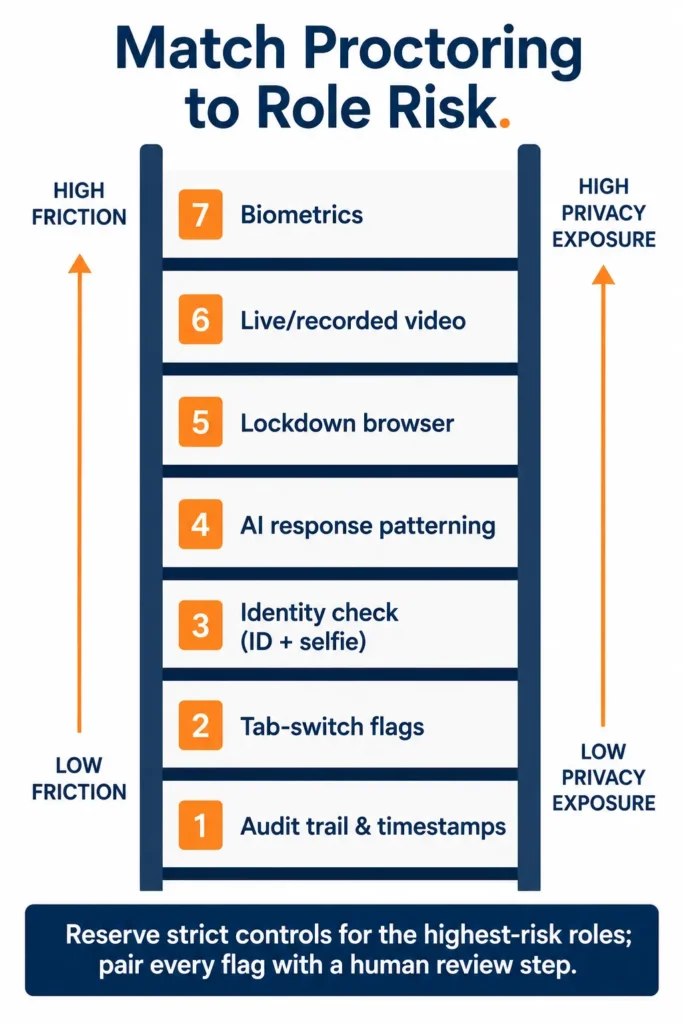
Right-sized proctoring protects the signal without making candidates feel like suspects. The more you verify identity and monitor behavior (ID checks, webcams, biometrics), the more you reduce impersonation and coached responding, but the more you raise privacy exposure and drop-off. This is the strongest unique decision in online implementation, so match controls to two variables: what the role can lose, and how much your decision depends on the score.
| Proctoring control | What it does | Best fit (role risk / score use) | Candidate friction | Privacy / operational notes |
| Audit trail and timestamps | Logs start/end time, device/browser, completion context | Baseline for most roles, especially when the score is one input (bands/weighted) | Low | Supports investigations and governance without added surveillance. |
| Identity check (ID + selfie) | Confirms the test-taker is the applicant | Higher-risk roles, or when the score materially gates next steps | Medium | Requires clear data-retention rules and a support path for verification failures. |
| Live/recorded video proctoring | Captures video during testing to deter misconduct | Highest-risk roles; when the score is a meaningful gate | High | Expect higher drop-off and privacy objections; plan accommodations and escalation. |
| Lockdown browser | Restricts navigation, copy/paste, external apps/sites | Roles where outside resources would materially change results | High | Increases tech issues (especially mobile); test compatibility and provide troubleshooting. |
| Tab-switch / window-focus flags | Detects leaving the test window or multitasking | Mid-to-high risk where you want deterrence without full lockdown | Medium | Use as a review signal, not automatic failure, to avoid brittle rules. |
| Biometrics (keystroke / face match) | Verifies identity patterns during or across sessions | Highest-risk environments with repeat testing or strong identity-assurance needs | High | Elevated privacy sensitivity; ensure lawful basis, retention limits, and vendor security review. |
| AI-based response patterning | Flags unusual patterns (over-consistency, rapid responding) suggesting coached or low-effort answers | When you need a scalable review layer across high volume | Medium | Treat as triage for follow-up, not a sole basis for rejection; document review rules. |
| Secondary review workflow (human-in-the-loop) | Routes flagged sessions/bands to a structured follow-up | Any role using bands/tiering rather than auto-reject | Low–Medium | Improves consistency and defensibility; define reviewers, SLAs, and documentation. |
If you default to heavy proctoring because it feels more rigorous, you can end up selecting for who tolerates surveillance rather than who is lower risk on the job. Biometric controls deserve special care: the FTC’s policy statement on biometric information warns that collecting facial or keystroke data can be an unfair practice unless you assess foreseeable harms first, avoid surreptitious collection, vet the vendors handling the data, train the staff who use it, and monitor the technology for accuracy. The FTC also notes facial recognition can have higher error rates for some groups, which is a direct fairness risk in a hiring screen. For identity-proofing depth, see our companion guide to secure and fair online integrity assessments.
Set your baseline with three questions: What is the plausible downside of a false pass (shrink, controlled access, vehicle operation, claim severity)? How easy is it to cheat in your context (unproctored, mobile-first applicants raise impersonation risk)? What will candidates experience as invasive (webcam and biometrics trigger privacy pushback fast)? Reserve strict proctoring for the highest-risk requisitions rather than one setting for everything.
Implement in Your ATS Without Breaking Candidate Experience
In practice, ATS implementation is where a good integrity assessment turns into candidate drop-off, especially across a multi-site Workday, UKG, or ADP stack. Do not treat it as “send link, get score.” Treat it as a timed handoff with clear rules: what application event triggers the invite, how long the link stays valid, what happens if a candidate starts on mobile and finishes on desktop, and what recruiters do when a vendor status does not sync. If you hire across many warehouse sites, set role-based automation so the assessment triggers only after eligibility knockouts and shift confirmation, not immediately after “Apply.”
- Invite message: short and specific about time and purpose (risk and safety, not “personality”).
- Completion access: mobile-friendly, ADA/WCAG-aligned, reasonable time windows, a simple support path.
- Data handling: result visibility in the ATS, a retention period, and override logging.
- Close the loop: reminders, a clear next-step message on completion, and a fail-safe path when integrations break.
Candidate experience tends to break at integration points (expired links, mobile handoffs, status-sync failures), so mapping the ATS workflow matters as much as the assessment. For platform selection and integration depth, see our guide to talent assessment tools that integrate with ATS. Then manage the assessment as an ongoing control: review completion and pass-through weekly for the first month and monthly after, and review outcome metrics quarterly with Operations and Safety. If workers’ compensation claim rates do not move but completion drops after you add webcam proctoring, you did not reduce risk, you reduced applicants.
Frequently Asked Questions
Are online integrity assessments the same as polygraphs under EPPA?
No. The Employee Polygraph Protection Act mainly restricts polygraph (lie detector) testing for most private employers, which is different from the self-report integrity assessments used in hiring. Keep your internal and candidate-facing language clean and do not label your assessment a lie detector.
How do you handle privacy if you use remote proctoring?
Add only the least invasive controls that match the role’s risk, and tell candidates what you collect (ID check, webcam, tab-switch flags), why, and how long you retain it. For biometric data specifically, the FTC expects you to assess harms, avoid surreptitious collection, vet vendors, and monitor accuracy. If you cannot explain the data use in plain language, you are not ready to deploy that level.
Should you allow retakes?
Yes, but only with a written, consistent rule so recruiters do not improvise under pressure. Most teams set a fixed waiting period (for example, 6 to 12 months) and apply the same retest policy to every candidate for the same role family.
What about accommodations for disabilities?
Treat the integrity assessment like any other selection procedure: offer reasonable accommodations and ensure the vendor supports accessible delivery. Operationally, you need a documented request path, a response SLA, and an alternate form or timing option that does not change what you are measuring.
What if you see adverse impact after launch?
Do not ignore it and do not change cutoffs midstream to mask it. Pause and review whether the assessment is job-related for that role, whether your scoring use (bands vs. hard cutoff) is too aggressive, and whether an alternative with less impact can meet the same business necessity.
Implement Online Integrity Assessments With Confidence
Knowing how to implement online integrity assessments in hiring is ultimately about discipline: a defined risk, deliberate placement, proctoring matched to the role, and monitoring you can defend. IntegrityFirst Tests helps HR leaders implement validated, role-specific online integrity assessments with the funnel placement, proctoring, and ATS integration that keep a program defensible and repeatable. Schedule a demo with IntegrityFirst Tests to map your roles, set your scoring bands, and build the monitoring your leadership will act on.