Schedule a call!
Bad hires rarely look expensive at the moment you make the offer. The cost shows up later. A new employee stops showing up. A supervisor spends hours correcting behavior. A safety shortcut becomes a claim. A client complains about a placement. A team has to cover another empty shift. A manager says, “They interviewed well, but they were not the person we thought we were hiring.”
Employee integrity testing helps employers identify those risks earlier.
IntegrityFirst gives business owners and HR leaders a practical way to evaluate honesty, reliability, accountability, safety judgment, rule-following, workplace conduct, and hiring risk before a candidate reaches the job.
If your organization is ready to implement an employee integrity testing service, request a custom quote based on your hiring volume, industry, and workflow.
Reliable Employees Start with Integrity Testing
IntegrityFirst is built for employers that need more than a resume, interview, and background check.
- A resume tells you what a candidate says they have done.
- An interview tells you how they communicate.
- A background check may verify certain records.
- An employee integrity test helps evaluate job-related risk before hire.
That matters most in roles where reliability and trust affect daily operations. Employee integrity testing can help employers screen for:
- honesty,
- accountability,
- reliability,
- rule-following,
- safety judgment,
- attendance risk,
- theft or property misuse risk,
- workplace conduct,
- willingness to report problems,
- trustworthiness in unsupervised work.
The goal is not to label candidates as “good” or “bad.” The goal is to give hiring teams a structured signal before they invest more time in onboarding, training, equipment, uniforms, scheduling, and replacement hiring.
If your team is still comparing screening options, read Best Behavioral Screening Tools for High-Volume Hiring. If you are comparing vendors, use Pre-Employment Testing Companies: How to Choose the Right One.
Key Benefits of Employee Integrity Testing
Employee integrity testing is most valuable when bad hires create measurable business cost.
For many employers, that cost appears through turnover, claims, absenteeism, theft, conduct issues, safety shortcuts, or unreliable placements.
Fewer Bad Hires
A candidate can interview well and still present risk around reliability, honesty, attendance, safety, or workplace conduct.
IntegrityFirst helps employers evaluate those risk signals before the candidate moves deeper into the hiring process.
That can help hiring teams avoid candidates who may create preventable problems after hire.
Lower Turnover
Turnover is not always a sourcing issue. Sometimes it is a screening issue.
If new hires leave quickly, fail to show up, ignore job expectations, or create manager frustration, the hiring process may be advancing the wrong candidates.
Employee integrity testing helps screen for reliability, accountability, and work integrity before the offer.
For a deeper explanation of the turnover problem, read How Pre-Employment Tests Reduce Employee Turnover.
Safer Workplaces
In safety-sensitive environments, one unreliable hire can create real operational risk.
Employee integrity testing can help evaluate attitudes toward rules, shortcuts, safety procedures, accountability, and responsible workplace behavior.
This is especially useful for employers in construction, logistics, transportation, manufacturing, field service, warehouse, staffing, healthcare support, and other operational environments.
Better Hiring Consistency
Without structure, hiring decisions often vary by recruiter, manager, location, or urgency.
Employee integrity testing gives teams a consistent pre-employment screen that can support more objective decisions.
That does not mean every candidate is judged by a single score. It means HR can apply the same process, result bands, review steps, and decision rules across the organization.
Stronger Candidate Shortlists
Recruiters and hiring managers have limited time.
By identifying risk earlier, employee integrity testing helps hiring teams focus interviews on candidates who are more likely to meet job expectations.
That can reduce wasted interviews and improve the quality of the shortlist.
How IntegrityFirst Employee Integrity Testing Works
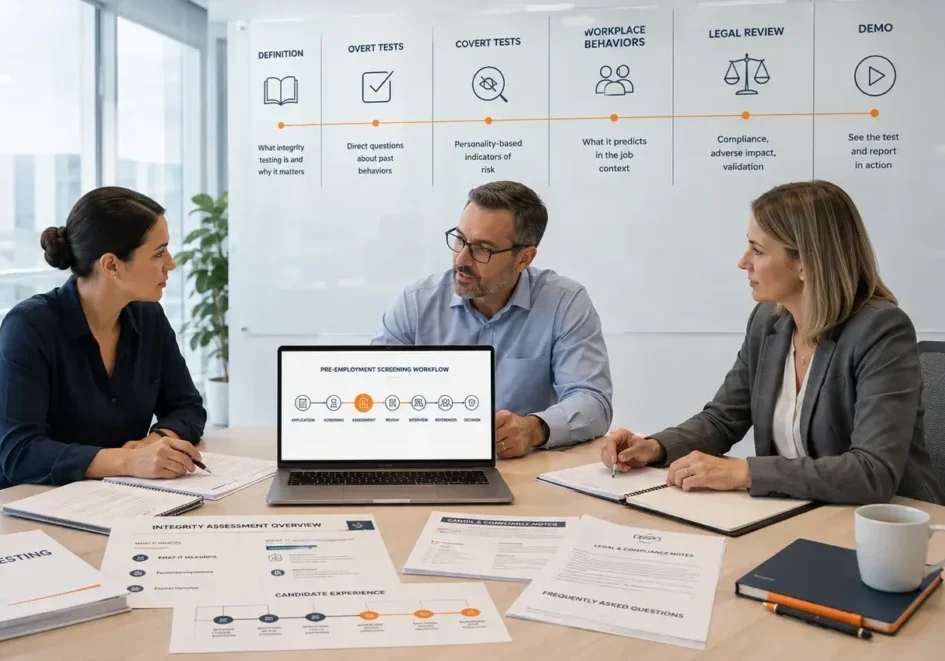
IntegrityFirst is designed to fit early in the hiring workflow, before recruiters and managers spend too much time on candidates who may not be a good fit.
A typical workflow looks like this:
Application received
Minimum qualifications reviewed
Employee integrity test sent
Candidate completes the assessment
Results are returned
Hiring team reviews the score or result band
Qualified candidates move forward
Review candidates receive structured follow-up
Not qualified candidates follow the approved disposition process
The process is designed to support faster, more consistent hiring decisions without adding unnecessary complexity.
Step 1: Assessment Setup
IntegrityFirst works with your team to understand the roles, hiring volume, and workforce risk you need to address.
That may include:
- role types,
- hiring volume,
- industry,
- screening stage,
- recruiter workflow,
- result access,
- candidate communication,
- reporting needs,
- implementation timeline.
The goal is to make employee integrity testing fit your hiring process rather than forcing your team into a disconnected workflow.
Step 2: Candidate Completion
Candidates complete the employee integrity test as part of the hiring process.
The assessment is designed to evaluate workplace risk signals tied to honesty, accountability, reliability, rule-following, and work integrity.
Candidate communication should be simple and neutral.
For example:
“Please complete this short pre-employment assessment as the next step in your application. It helps us evaluate candidates consistently for this role.”
Step 3: Actionable Hiring Scores
The value of an employee integrity test depends on how easy it is to use.
Hiring teams need clear results, not confusing reports.
A practical model may include:
| Result type | Hiring action |
| Qualified | Move the candidate forward |
| Review | Apply structured secondary review |
| Not qualified | Follow the approved disposition process |
| Incomplete | Send reminder or close based on policy |
This helps recruiters and managers act consistently.
Step 4: Workflow Integration
Employee testing services are more useful when they connect to the hiring workflow.
If recruiters have to leave the ATS, send links manually, check completions in another system, and copy results into candidate records, adoption will suffer.
IntegrityFirst is part of the broader Discovered hiring ecosystem, which can support applicant tracking, candidate communication, workflows, scorecards, interviews, and automation.
IntegrityFirst provides the focused integrity signal.
Discovered supports the connected hiring process around it.
Industries We Serve
Employee integrity testing is especially valuable in industries where reliability, safety, conduct, attendance, trust, and turnover directly affect business performance.
Staffing
Staffing companies need to place reliable people quickly. A bad placement can damage client trust, increase replacement work, and create operational cost. IntegrityFirst helps staffing teams screen for reliability, honesty, accountability, and workplace conduct before candidates are placed.
Manufacturing
Manufacturing employers need people who show up, follow safety rules, and work consistently. Integrity testing can support better screening around attendance risk, safety shortcuts, rule-following, and accountability.
Retail
Retail employers face risk around cash, inventory, customer interaction, attendance, and conduct. Employee integrity testing helps evaluate trust signals before a candidate steps behind a register, enters a stockroom, or interacts with customers.
Healthcare Support
Healthcare support roles require reliability, documentation accuracy, workplace conduct, and trust. Integrity testing can help employers screen for accountability, rule-following, and dependability before hire.
Logistics and Transportation
Logistics and transportation teams need employees who can follow procedures, work safely, and stay reliable under time pressure. Employee integrity testing can help evaluate rule-following, safety judgment, attendance risk, and accountability.
Construction and Field Service
Construction and field service roles often involve tools, equipment, client sites, safety exposure, and limited supervision. Integrity testing can help employers evaluate whether candidates are likely to act responsibly when managers are not always present.
Hospitality
Hospitality teams rely on attendance, customer trust, professional conduct, and consistent service. Integrity testing can help reduce preventable risk before candidates reach guest-facing roles.
What Does Employee Integrity Testing Cost?
IntegrityFirst pricing depends on your organization’s hiring volume, industry, and screening needs. Because employers hire at different volumes, a custom quote is the most accurate way to price employee integrity testing. Pricing may depend on:
- projected annual hiring volume,
- number of locations,
- industry,
- role types,
- implementation needs,
- workflow requirements,
- reporting needs,
- whether the assessment is used across one team or multiple business units.
IntegrityFirst uses tiered subscription pricing based on projected annual hiring volume. The goal is to make employee integrity testing affordable for organizations of different sizes. To get accurate pricing, request a custom quote for your organization.
Why Pricing Should Be Compared Against Bad-Hire Cost
The right question is not only “What does the test cost?”
The better question is:
“What does one preventable bad hire cost our business?”
A single bad hire can create costs through:
- recruiting,
- interviews,
- onboarding,
- training,
- uniforms or equipment,
- overtime,
- manager time,
- replacement hiring,
- claims,
- customer or client complaints,
- theft or property misuse,
- lost productivity,
- team disruption.
For high-volume employers, even a small improvement in hiring quality can create meaningful savings over time.
That is why employee integrity testing should be evaluated as a risk-control and hiring-quality investment, not only as a per-candidate cost.
Compliance and Validation
Employee integrity testing should be used responsibly. Employment tests are selection procedures, which means employers should apply them consistently, document how results are used, and monitor outcomes. A strong employee integrity testing program should support:
- job-related use,
- consistent administration,
- clear candidate communication,
- documented result interpretation,
- review rules,
- compliance support,
- validation evidence,
- adverse impact monitoring,
- recruiter and manager training.
IntegrityFirst is designed for employers that need a focused, validated integrity screen before hire. As with any employment selection tool, organizations should involve HR, compliance, and legal stakeholders when implementing screening at scale.
How Fast Can Employee Integrity Testing Be Implemented?
Implementation time depends on your hiring process, volume, number of locations, and workflow requirements.
A simple rollout may be faster when:
- the target roles are clearly defined,
- the assessment stage is already chosen,
- recruiter responsibilities are clear,
- candidate communication is approved,
- result access is defined,
- review rules are documented.
A more complex rollout may take longer if the company needs multi-location training, workflow integration, reporting design, or internal compliance review. The best way to confirm implementation timing is to request a custom quote and discuss your hiring workflow with the IntegrityFirst team.
What to Prepare Before Requesting a Quote
You do not need a perfect implementation plan before talking to IntegrityFirst. But it helps to have a few details ready:
| Detail | Why it helps |
| Estimated annual hiring volume | Helps determine pricing tier |
| Industries or business units | Helps identify use cases |
| Target roles | Helps match assessment use to hiring risk |
| Number of locations | Helps plan rollout |
| Current hiring workflow | Helps decide when the test should happen |
| ATS or hiring platform | Helps identify integration or workflow needs |
| Current turnover or risk issues | Helps define business goals |
| Desired launch timeline | Helps scope implementation support |
If you do not have all of this information yet, you can still request a quote. The IntegrityFirst team can help define the right scope.
Common Objections and Answers
“Will this slow down hiring?”
Employee integrity testing is designed to help hiring teams move faster by identifying risk earlier.
When placed after minimum qualifications and before major interview time, the assessment can reduce wasted recruiter and manager effort.
The key is workflow design. The test should be easy for candidates to complete and easy for recruiters to act on.
“Will candidates be uncomfortable?”
Candidate communication matters.
The assessment should be presented as a standard pre-employment step, not as an accusation.
A neutral message can explain that the assessment helps evaluate candidates consistently for the role.
“Is this just another personality test?”
No.
Employee integrity testing is focused on workplace risk signals such as honesty, accountability, reliability, rule-following, safety judgment, attendance, and conduct.
General personality assessments may provide broad work-style insight, but they may not directly address the integrity-related risks that create turnover, claims, theft, or conduct problems.
“Can we use this with our current hiring process?”
In most cases, yes.
IntegrityFirst can be used as an early screening step and can fit into broader hiring workflows. If your team uses Discovered, the integrity signal can also connect with applicant tracking, workflows, candidate communication, scorecards, interviews, and automation.
“How do we know if it works?”
Define success metrics before launch. Common metrics include:
- first-30-day turnover,
- first-90-day turnover,
- no-shows,
- absenteeism,
- claims,
- safety incidents,
- theft or property misuse indicators,
- policy violations,
- manager replacement requests,
- candidate completion rate,
- result distribution,
- override frequency.
The goal is to measure whether employee integrity testing improves hiring quality and reduces risk over time.
“How quickly will we receive pricing?”
Request a custom quote and the team will follow up based on your organization’s needs.
The recommended CTA for this page is: Response within one business day.
FAQ
What is employee integrity testing?
Employee integrity testing is a pre-employment screening method used to evaluate job-related risk signals such as honesty, reliability, accountability, rule-following, safety judgment, attendance risk, theft attitudes, and workplace conduct.
What does an employee integrity test include?
An employee integrity test may include questions that assess honesty, accountability, reliability, rule-following, safety judgment, workplace conduct, and attitudes toward theft or misconduct.
How much does employee integrity testing cost?
Pricing depends on projected annual hiring volume, industry, number of locations, role types, workflow needs, and implementation scope. Request a custom quote to get pricing for your organization.
Is employee integrity testing the same as an integrity check?
Not exactly. An integrity check can refer to different screening methods. Employee integrity testing is a structured pre-employment assessment designed to evaluate job-related integrity and workplace risk signals.
Is employee integrity testing legal?
Employee integrity testing can be used legally when it is job-related, consistently applied, properly documented, supported by validation evidence, and monitored for fairness.
How long does implementation take?
Implementation timing depends on your hiring process, target roles, number of locations, integration needs, and internal review. The best way to estimate timing is to request a quote and discuss your workflow.
What industries use employee integrity testing?
Employee integrity testing is used by employers in staffing, manufacturing, retail, logistics, transportation, construction, healthcare support, field service, hospitality, warehouse, and other high-volume or risk-sensitive industries.
Does employee integrity testing reduce turnover?
Employee integrity testing can help reduce turnover by screening for reliability, accountability, attendance risk, workplace conduct, and work integrity before hire.
Does IntegrityFirst integrate with hiring workflows?
IntegrityFirst can support employee integrity testing as part of the hiring process. Through the broader Discovered hiring ecosystem, employers can connect screening with applicant tracking, candidate communication, workflows, interviews, scorecards, and automation.
How do I get pricing?
Request a custom quote for employee integrity testing. Share your hiring volume, industry, target roles, and workflow needs so the team can recommend the right setup.
Request Your Custom Quote
If your organization is ready to reduce bad hires, turnover, workers’ comp risk, workplace conduct issues, and unreliable placements, employee integrity testing can help you screen earlier and hire with more confidence.
IntegrityFirst helps employers evaluate honesty, accountability, reliability, and workforce risk before recruiters and managers invest more time.
Discovered connects that screening into the broader hiring workflow with applicant tracking, automation, candidate communication, scorecards, interviews, and process visibility.
IntegrityFirst gives HR the focused integrity signal.
Discovered gives HR the connected hiring system around it.
Request a custom quote for employee integrity testing at your organization.
Response within one business day.