Schedule a call!
A honesty test is one of the most validated and cost-effective pre-employment screening tools available to US HR teams. When deployed correctly, it identifies the behavioral risk factors that interviews, background checks, and reference calls consistently miss — attitudes toward accountability, rule-following, and workplace conduct — before a costly hiring decision is made.
The research behind employee honesty tests is both extensive and consistent. A meta-analysis of 104 integrity test studies confirms corrected validity coefficients of .32 for counterproductive work behavior and .18 for job performance. Organizations that deploy these assessments systematically report measurable reductions in employee turnover, workplace theft, workers’ compensation claims, and safety incidents.
This complete guide for HR covers everything teams need to know about employee honesty tests: what they are, how each format works, what the research shows, where they fit in the hiring pipeline, the key business outcomes they produce, and the legal standards that govern their use in the United States.
What Is a Honesty Test?
A honesty test is a structured pre-employment assessment designed to predict a candidate’s likelihood of engaging in counterproductive work behavior before they are hired. The US Office of Personnel Management (OPM) formally recognizes these tools as valid instruments that predict theft, absenteeism, and overall job performance.
Honesty tests are not polygraph alternatives, general personality assessments, or cognitive ability tests. They are purpose-built instruments that measure the specific attitudes and behavioral orientations — toward accountability, ethical decision-making, and rule-following — that predict workplace conduct in ways that standard hiring tools cannot.
Two primary formats are used in US hiring: overt tests, which ask candidates direct questions about past behavior and attitudes toward theft and rule-breaking, and personality-based tests, which assess the same risk profile indirectly through trait indicators. A third format, the situational judgment test, evaluates ethical decision-making through realistic workplace scenarios.
Types of Honesty Tests Used in Hiring
Selecting the right honesty test format for the specific role and risk profile is one of the most consequential decisions in pre-employment screening. For a detailed comparison of formats — including faking susceptibility data and role-matching guidance — see the full article on the overt vs. personality-based honesty test.
Overt Integrity Tests
Overt integrity tests ask candidates direct, transparent questions about their past behavior and attitudes toward theft, absenteeism, and rule-breaking. These are the most straightforward to administer and score, making them efficient for high-volume hiring in roles with direct financial or asset exposure.
Their primary limitation is faking susceptibility. SAGE research on faking in integrity tests documents effect sizes around d = 0.90 for overt formats — candidates who recognize the intent of direct questions can adjust responses to appear more favorable than their actual behavior warrants.
Best suited for: retail, cash-handling, field service, logistics, and entry-level roles where direct financial risk is the primary screening concern.
Personality-Based Integrity Tests
Personality-based integrity tests assess the same risk profile indirectly, through trait indicators such as conscientiousness, agreeableness, and emotional stability. Candidates respond to behavioral preference statements rather than direct misconduct questions, making the scoring mechanism significantly harder to game.
The same SAGE research confirms faking susceptibility of d = 0.38 for personality-based formats — roughly half that of overt tests. The Association of Test Publishers Model Guidelines confirm that personality-based formats also outperform overt tests in predicting absenteeism specifically.
Best suited for: healthcare, supervisory, leadership, and complex customer-facing roles where interpersonal conduct and ethical judgment under ambiguity are primary concerns.
Situational Judgment Tests
Situational judgment tests present candidates with realistic workplace scenarios and ask them to describe or select their most likely response. This format evaluates the quality of ethical decision-making rather than stated attitudes, making it the most difficult format to game and the most job-relevant from the candidate’s perspective.
SJTs are resource-intensive to develop and score but consistently produce the highest candidate acceptance rates and the lowest application drop-off among the three formats.
Best suited for: supervisory and people management roles, assessment centers, and organizations prioritizing ethical decision-making quality over rule-compliance screening.
The Research Behind Honesty Tests: Validity and Predictive Power
The scientific foundation of employee honesty tests is among the strongest of any pre-employment assessment category available to HR teams. The evidence spans decades of peer-reviewed research across hundreds of thousands of data points.
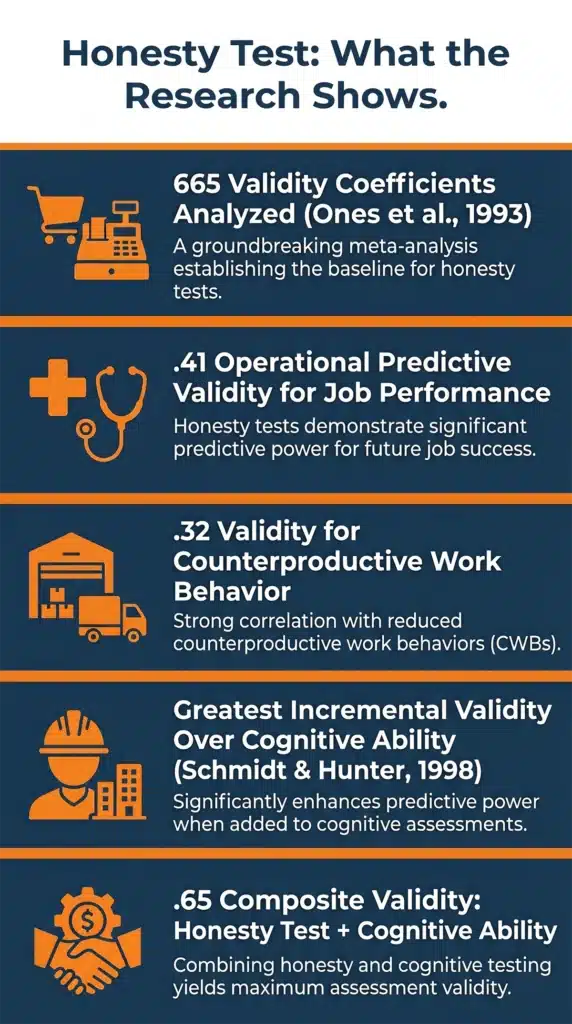
Ones, Viswesvaran, and Schmidt’s landmark meta-analysis — based on 665 validity coefficients across 576,460 data points, published in the Journal of Applied Psychology — found a mean operational predictive validity of .41 for supervisory ratings of job performance and confirmed that integrity test validities generalize across jobs, settings, and organizations.
Schmidt and Hunter’s 85-year review of personnel selection methods, published in Psychological Bulletin, identified honesty tests as the selection method with the greatest incremental validity over cognitive ability for predicting job performance. Combining a cognitive ability test with a honesty test produces a composite validity of .65 — the highest two-predictor combination in the review.
A second PubMed-indexed study confirms that integrity tests predict a broad range of counterproductive work behaviors — not only theft, but absenteeism, time fraud, and interpersonal misconduct. This breadth of prediction is what distinguishes honesty tests from narrower background verification tools.
How a Honesty Test Fits Into the Hiring Process
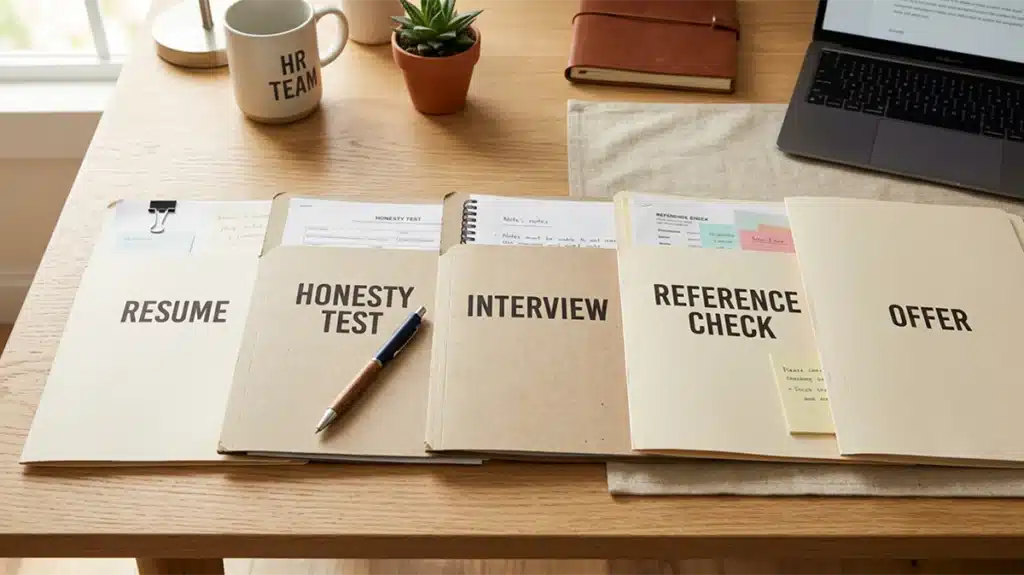
A honesty test is most effective as one component of a multi-step screening pipeline, not as a standalone disqualifier. For a comprehensive guide to integrating honesty tests across industries and pipeline stages, see the full article on the honesty test for employee screening.
| Pipeline Stage | Honesty Test Role | Best Format | Key Benefit |
| Pre-application / top of funnel | High-volume screen-in filter | Overt | Eliminates highest-risk candidates before evaluation investment |
| Pre-interview | Primary screen-out measure | Overt or combined | Concentrates interview time on lower-risk candidates |
| Post-conditional offer | Comprehensive behavioral evaluation | Combined formats | Deepest assessment depth; strongest legal defensibility for senior roles |
Honesty test results are most predictive when combined with structured behavioral interviews, reference checks, and background verification. No single screening tool should serve as the sole basis for a hiring decision.
Key Benefits of Using a Honesty Test in Employee Selection
The business case for structured honesty testing is grounded in decades of consistent organizational outcomes. The four most measurable categories of impact are turnover reduction, theft decline, workers’ compensation claim frequency, and workplace safety.

Reducing Employee Turnover
Organizations that systematically deploy honesty tests across high-risk roles report turnover reductions of up to 37%. The mechanism is direct: honesty testing identifies candidates whose attitudes toward accountability and rule-following predict early departure behavior, catching the risk before onboarding investment is made.
For a detailed analysis of the turnover reduction evidence and how to quantify this outcome for your organization, see the full guide on how honesty tests reduce employee turnover.
Lowering Workplace Theft and Absenteeism
A peer-reviewed Journal of Business and Psychology case study documented a 50% reduction in employee terminations for theft, illegal drug use, and violence over five years following the introduction of a written integrity assessment at a major US home improvement retailer.
Personality-based formats are especially effective at predicting absenteeism, outperforming overt tests on this criterion according to the Association of Test Publishers Model Guidelines. Organizations deploying combined overt and personality-based formats report the broadest coverage across both theft and absenteeism outcomes.
For the full ROI data across theft, turnover, absenteeism, and workers’ compensation, see the article on the ROI of honesty tests in hiring.
Reducing Workers’ Compensation Claims
Organizations that screen out the riskiest 8–10% of applicants using targeted honesty tests report workers’ compensation claim frequency dropping by double-digit percentages within the first year of implementation. Candidates who score poorly on integrity assessments are statistically more likely to engage in unsafe workplace behaviors, file fraudulent claims, or fail to follow established safety protocols.

Improving Workplace Safety
In safety-critical industries, pairing integrity screening with safety-focused hiring practices reduces OSHA-recordable incident rates by double-digit percentages within the first year. Candidates who score higher on pre-employment integrity assessments are more likely to follow safety protocols, report hazards proactively, and hold peers accountable to workplace safety standards.
Legal and Compliance Requirements for Honesty Testing in the US
Every honesty test deployed in the United States must comply with EEOC employment testing guidance, which requires assessments to be job-related, consistent with business necessity, administered consistently across all candidates, and regularly reviewed for adverse impact.
Written and digital honesty tests are fully compliant under the Employee Polygraph Protection Act (EPPA), which prohibits physiological monitoring but explicitly permits validated written integrity assessments. Employers must never frame a written honesty test as a polygraph alternative.
State and local employment laws may impose additional requirements beyond federal standards. California, New York, and Illinois have enacted legislation governing data privacy, candidate disclosure rights, and assessment formats that go beyond EEOC minimums. Legal counsel review is recommended before deployment in these jurisdictions.
Documentation is the foundation of a legally defensible program. Maintain validation evidence for the selected tool, a written job-relatedness justification, quarterly adverse impact analysis by demographic group, candidate disclosure records, and hiring decision rationale for every assessment-informed decision.
For the complete legal compliance framework — including the EEOC adverse impact standard, EPPA requirements, state law considerations, and a 7-item compliance checklist — see the full guide on honesty test legal compliance in hiring.
The Honesty Test Candidate Experience
How candidates experience a honesty test directly affects the quality of the results. Candidates who feel blindsided by an assessment respond defensively, disengage mid-process, or abandon the application entirely. Each of these outcomes reduces screening quality and increases the likelihood of a mis-hire.
Candidates who receive clear advance communication about the assessment’s purpose, format, and legal standing consistently provide more authentic responses and report higher satisfaction with the hiring process. This transparency is both legally required under EEOC guidance and operationally effective.
Every candidate should receive written confirmation before the assessment begins: what the test measures, how results are used in the hiring decision, that the assessment is a written questionnaire and not a polygraph, and how to raise concerns or request accommodation.
For the complete candidate communication framework — including scripts for common concerns, guidance on real-world scenario questions, and advice on reducing application drop-off — see the full guide on the honesty test candidate experience.
Limitations and Risks to Manage
Employee honesty tests are among the most validated pre-employment tools available, but they are not risk-free. Managing the following limitations proactively is what separates a high-performing integrity screening program from one that creates legal exposure or wastes talent.
- Faking susceptibility in overt formats. Candidates who recognize the intent of direct questions can adjust their responses. Combining overt and personality-based formats, using reverse-scored items, and deploying inconsistency detection algorithms significantly reduce this risk.
- False positives. Overly broad scoring criteria can flag trustworthy candidates unnecessarily. Use role-specific, validated question sets with documented job-relatedness rather than generic integrity surveys applied uniformly across all positions.
- Adverse impact. Question items that reference culturally specific norms or situations can disproportionately screen out candidates from protected groups. Quarterly demographic analysis and annual question-set review are required to identify and correct disparities before they create legal exposure.
- Over-reliance on test scores. Honesty test results are legally defensible and most predictive when combined with structured interviews, reference checks, and background verification. Treating a single score as a disqualifier creates both legal exposure and hiring quality risk.
- Candidate communication failures. Candidates who receive no explanation of the assessment’s purpose are more likely to disengage, respond defensively, or file complaints. A brief written disclosure before the assessment resolves the most common sources of candidate anxiety.
Best Practices for Implementing a Honesty Test
For a complete implementation framework by industry — including pipeline placement strategy, objection handling, and documentation requirements — see the full guide on the honesty test for employee screening.
The following checklist covers the core requirements for a compliant, effective honesty testing program:
- Select a validated tool with documented construct and criterion validity, an independent validation study, and a technical manual. Reject vendors who cannot produce this documentation on request.
- Define role-specific criteria. Map test format and scoring thresholds to the risk profile of each position. Do not apply the same assessment indiscriminately across all roles.
- Provide written pre-assessment disclosure to every candidate covering purpose, format, completion time, and candidate rights.
- Integrate with your ATS for consistent administration timing and complete audit trail documentation.
- Score, interpret, and document every hiring decision in which assessment results are a factor. This documentation is the foundation of EEOC compliance and audit readiness.
- Audit for adverse impact quarterly. Review question content annually. Update policies when legal standards or outcome data change.
According to SHRM pre-employment testing guidelines, selecting the right assessment format for the specific role and risk profile is essential for both predictive validity and legal defensibility.
Explore Every Dimension of Honesty Testing
This guide covers the full landscape of employee honesty tests at a summary level. Each of the following articles covers one dimension in depth — with detailed implementation guidance, industry-specific data, and complete compliance frameworks.
| Topic | What you’ll find | Article |
| How honesty tests reduce employee turnover | Turnover mechanism, industry data, 37% reduction evidence, implementation for high-risk roles | How Honesty Tests Reduce Employee Turnover |
| ROI of honesty tests in hiring | Theft reduction metrics, turnover savings, absenteeism data, workers’ comp outcomes | ROI of Honesty Tests in Hiring |
| Overt vs. personality-based honesty test | Format comparison, faking susceptibility data (d=0.90 vs d=0.38), role-matching guide, score interpretation | Overt vs. Personality-Based Honesty Test |
| Honesty test legal compliance in hiring | EEOC framework, adverse impact, EPPA, state laws, 7-item compliance checklist | Honesty Test Legal Compliance in Hiring |
| Honesty test candidate experience | Candidate concerns, communication scripts, drop-off prevention, transparency framework | Honesty Test Candidate Experience |
| Honesty test for employee screening | End-to-end screening pipeline, industry applications, pipeline placement, objection handling | Honesty Test for Employee Screening |
Frequently Asked Questions
What is a honesty test?
A honesty test is a validated pre-employment assessment that evaluates a candidate’s trustworthiness, reliability, and likelihood of engaging in counterproductive work behavior. The US OPM recognizes these tools as valid instruments for predicting theft, absenteeism, and job performance. They are used across US industries as one component of a multi-step pre-employment screening pipeline.
How do honesty tests work?
Honesty tests work by presenting candidates with structured questions or scenarios that assess attitudes toward accountability, rule-following, and ethical conduct. Overt tests ask direct questions about past behavior. Personality-based tests assess the same risk profile indirectly through trait indicators. Situational judgment tests use realistic workplace scenarios to evaluate ethical decision-making quality. Results are scored against research-validated rubrics and interpreted alongside other screening inputs.
Are honesty tests legal in the United States?
Yes, when properly administered. Written and digital honesty tests are fully compliant under the Employee Polygraph Protection Act. They must meet EEOC standards for job-relatedness, consistent administration, and adverse impact monitoring. State laws may impose additional requirements in certain jurisdictions. Legal review is recommended before deployment in states with enhanced employment screening regulations.
What types of honesty tests exist?
Three primary formats are used in US hiring: overt integrity tests (direct questions about past behavior), personality-based integrity tests (indirect trait indicators), and situational judgment tests (realistic ethical dilemma scenarios). Overt tests are most efficient for high-volume screening. Personality-based tests have lower faking susceptibility. Situational judgment tests produce the highest candidate acceptance rates. Combining overt and personality-based formats delivers the broadest predictive coverage.
How accurate are honesty tests?
Honesty tests are among the most accurately validated pre-employment screening tools available. Ones, Viswesvaran, and Schmidt’s meta-analysis of 665 validity coefficients found a mean operational predictive validity of .41 for supervisory ratings of job performance. Schmidt and Hunter identified honesty tests as the selection method with the greatest incremental validity over cognitive ability, with a composite validity of .65 when combined with a cognitive ability test.
How do you implement a honesty test?
Select a validated tool with documented validity and a technical manual. Define role-specific deployment criteria. Integrate with your ATS for consistent administration. Provide written candidate disclosure before the assessment begins. Score, interpret, and document every decision. Audit quarterly for adverse impact. For a complete implementation guide by industry and pipeline stage, see our article on the honesty test for employee screening.
Build a Stronger Workforce with IntegrityFirst Tests
IntegrityFirst Tests provides validated, US-compliant pre-employment honesty assessments for HR teams that need measurable results and a legally defensible screening process. Our clients report consistent reductions in employee turnover, workplace theft, workers’ compensation claims, and OSHA-recordable incidents from the first year of implementation. Schedule a free demo with us and put data-driven integrity screening at the center of every hiring decision you make.