Schedule a call!
Most HR teams reach for integrity testing for one reason: they are tired of betting payroll on a good interview and a quick read of the room. A honesty integrity test for effective hiring decisions promises something firmer than charm under fluorescent lights, a way to see how a person handles rules, temptation, and pressure before they ever clock in. That promise is real. It is also fragile. The same tool that sharpens your decisions can quietly wreck them when candidates start gaming it and managers start treating one score as a verdict.
So this is not a sales page for testing. It is a working guide to using it well: where the evidence actually backs you up, where it does not, how the format you pick changes the signal you get, and how to keep the whole thing defensible when adverse impact or a frustrated hiring manager puts it under a microscope. Get those four right and the test pays for itself. Get them wrong and you have bought an expensive way to reject good people.
When a Honesty Integrity Test Improves Hiring Decisions
A honesty integrity test improves hiring decisions in exactly one lane: workforce risk. Not “who will be our top performer,” not “who will stay five years,” but who is more likely to follow the rules when no one is watching. Decades of research keep landing in the same place, that these tests track counterproductive behavior far more tightly than they track broad performance or retention. Load the score with jobs it was never built to do and you will over-weight it, then wonder why your “better hires” did not move a single number the executive team cares about.
The fix is to name the risk before you name the tool. A distribution center does not need a test that spots the fastest picker; it needs fewer falsified safety checks and less time theft. A retail floor cares about shrink and the cash drawer. A home-health visit comes down to dependability when a supervisor is nowhere in sight. Write down the two or three loss events that actually cost you, decide how you will measure them in the first 60 to 180 days, and you have turned a vague hope for “good people” into a target a test can hit. Skip that step and you are not buying decision quality. You are buying the feeling of control.
What the Evidence Says (and What It Doesn’t)
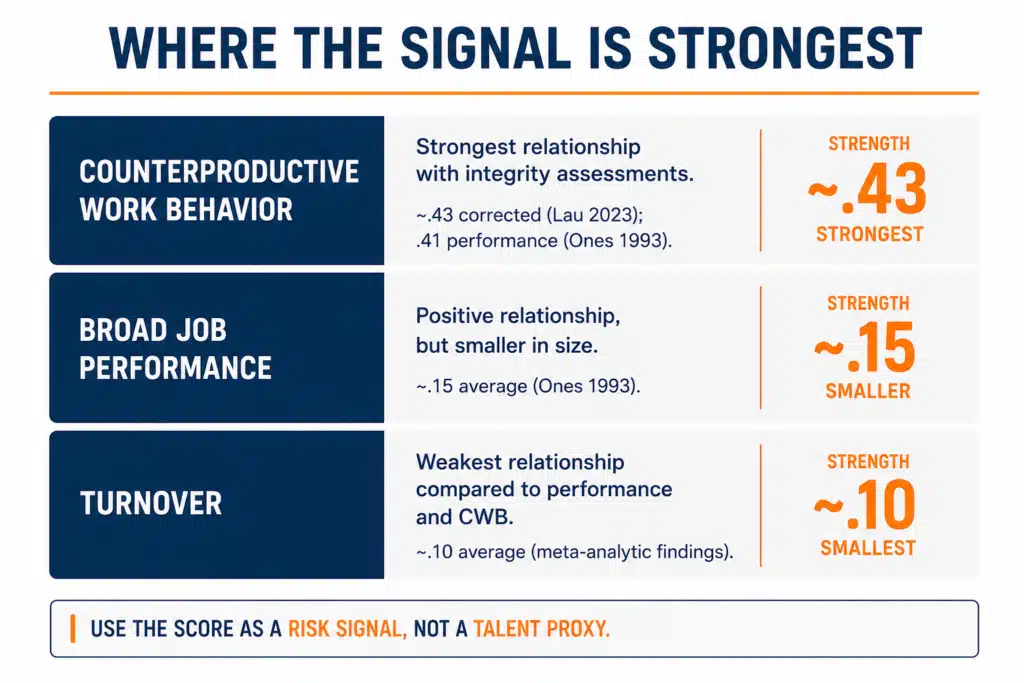
Here is the part vendors tend to blur. Integrity tests are genuinely useful, and they are useful in a narrower way than the brochure suggests. The foundational meta-analysis by Ones, Viswesvaran, and Schmidt in the Journal of Applied Psychology (1993) pooled 665 validity coefficients across roughly 576,460 data points and found a mean operational validity near .41 for job performance, with validity that generalized to theft, disciplinary problems, and absenteeism. Three decades later the picture holds up: the 2023 meta-analytic review in the Journal of Pacific Rim Psychology combined 150 studies (N = 67,016), reported a corrected mean validity near .43 for workplace deviance, saw value-oriented and cognitive-style formats climb into the .60s, and confirmed the effect held in US samples.
There is a second finding that should matter to anyone defending a hiring process: these tests tell you something your other tools miss. The review by Berry, Sackett, and Wiemann in Personnel Psychology (2007) found that overt and personality-based formats both predict counterproductive behavior, and do it better than broad Big Five composites; it also flags Schmidt and Hunter’s result that integrity tests add some of the largest incremental validity over a cognitive-ability measure. Translation: stacked on top of an aptitude score and a résumé, an integrity test still earns its slot.
But “integrity testing” is not one thing, and treating it as one is how good intentions turn into bad hires. The Association of Test Publishers’ Model Guidelines for Preemployment Integrity Testing describe these instruments as tools aimed at counterproductive behaviors such as theft, violence, substance use, and turnover, and insist on standardized development, consistent scoring, and confidentiality before anyone trusts a result. Validity drifts with the format you buy, the industry you run, and, crucially, who decides what counts as “deviance.”
A supervisor’s gripe about attendance and a confirmed timecard-edit investigation can both get filed under counterproductive behavior, yet they are not remotely the same evidence. So when a vendor waves a single impressive number, ask the only questions that matter: which format is this, which risk outcomes does it predict, and were those outcomes measured anywhere that looks like your shop floor? Generic averages do not survive UGESP scrutiny, and they should not survive yours.
Choosing the Right Honesty Integrity Test Format
Candidates can almost always feel when a test is fishing for dishonesty, and they will answer the test they think you are giving. That single fact decides whether you walk away with a real read on judgment and risk, or just a ranking of who performs sincerity best. The format is the fork in the road.
Overt integrity tests ask straight out about attitudes toward theft and rule-breaking. They feel intuitive, they are easy to explain to an operations leader who is sick of shrink, and they are the most coachable thing in your stack the moment applicants start trading tips.
Personality-based measures come at risk sideways, through traits like dependability and impulse control, which makes them harder to fake and harder to game, though less obviously “about honesty” to a skeptical manager. Neither is the right answer in the abstract; the right answer is the one matched to the job. For a hard deterrence screen in cash handling, controlled substances, or a high-shrink store, an overt measure can earn its place, as long as you treat it as one input and assume people will try to beat it.
For a durable signal at scale, in warehousing, food production, or dependability-driven support work, lean personality-based. And if a vendor dangles a “value-oriented” or integrity-cognitive hybrid, do not assume it is interchangeable with anything else; make them tell you which category you are actually buying. The deeper comparison of faking, coaching, role fit, and score interpretation lives in our guide to overt vs. personality-based honesty tests.
Using a Honesty Integrity Test for Effective Hiring Decisions in Your Selection System
Here is the moment that breaks most programs. A candidate aces the interview, checks out on references, and lands a borderline integrity score. If your only rule is “low score, no hire,” you have just promoted one data point to company policy, and you will defend that policy every time it costs you someone good. Using a honesty integrity test for effective hiring decisions is, at bottom, a decision about how much that score gets to say.
You have three honest options, and they are not equal. A hard screen-out is justifiable only when a job’s loss events are severe, immediate, and clearly tied to the cutoff you set. Weighting the score as one factor in a composite is usually the smarter play, because it keeps any single coachable signal from running the show. Banding scores into ranges does something quietly powerful: it stops managers from pretending a two-point gap is a meaningful difference between two human beings. Pick the one that fits the stakes, not the one that feels tidiest in your ATS.
The strongest setups use the test as a prompt, not a gate. On a distribution-center role where time theft and safety shortcuts drive the cost, a low band does not end the conversation; it shapes the next one, sending the interviewer to probe attendance history, reactions to supervision, and how the candidate talks about cutting corners. Background checks stay reserved for the roles and jurisdictions where they are lawful and relevant.
The score becomes a veto only when it lines up with the specific risk you actually track. Want a fast test of your own design? Answer three questions in one sentence each: what are you trying to reduce in the first 60 to 180 days, what changes when a candidate lands in a low band, and what you will do when a clearly strong candidate lands there too. If your honest answer to the last one is “reject and move on,” you do not have a selection system; you have outsourced your judgment to a number.
The mechanics of cut scores, weighting, and role thresholds are laid out in our strategic guide to honesty tests for HR hiring decisions, with the wider assessment context in our overview of integrity assessments for smarter hiring.
Compliance and Adverse-Impact Reality Check

“Is this legal?” is the question everyone asks and the wrong one to lead with. Integrity tests are legal. Whether your use of one survives a challenge is an entirely different matter, and it rests on a single idea: a selection tool has to be job-related and defensible the moment it screens out one group more than another. The EEOC’s guidance on employment tests and selection procedures is blunt that integrity and personality tests are selection procedures, to be managed with the same rigor as any other step. A vendor’s “validated” stamp does not transfer that responsibility to them. It stays with you.
The professional and legal standards point the same way. The Standards for Educational and Psychological Testing, issued jointly by AERA, APA, and NCME, put validity and fairness at the center of any credible testing program, and the 2014 edition hands fairness an entire foundational chapter. On the legal side, the firm Fisher Phillips, in its analysis of whether to use integrity tests, spells out the Title VII bar: a hiring test must be job-related, consistent with business necessity, and the least discriminatory alternative available.
None of that is exotic, but all of it has to be on paper. Be ready to show the loss outcomes you are targeting, why this format maps to those outcomes for this role family, and your adverse-impact checks at each stage, from invitation to completion. If you cannot produce that chain on a Tuesday afternoon when someone asks for it, you do not have a defensible program; you have a vendor claim and your fingers crossed. Our guide to honesty test legal compliance in hiring walks the full framework, including state-level limits.
Implementation Controls That Protect the Signal
You can buy a test with excellent validity and ruin it by Friday of week one. All it takes is a leaky rollout: applicants swapping answer keys in a group chat, a manager who has decided a low score is a permanent mark against a candidate. The instant candidates treat the test as a puzzle, you stop measuring reliability and start measuring test-taking strategy, which is worth nothing to you. High-volume hiring makes this worse, not better, because the gaming spreads fast and a breakroom kiosk is the perfect place to rush through coached answers under social pressure.
The controls that keep the signal clean are unglamorous and they work, and they echo the standardized-administration principles the test publishers and the testing Standards both push. Tell candidates the purpose and what to expect, never which answers pass. Standardize proctoring and device rules wherever you can. Make a low score a reason to ask better interview questions, not a reason to close the file. And apply the same retest and disclosure rules to every single applicant, because consistency is the difference between a defensible process and a discrimination claim waiting to be filed. The step-by-step on placement, timing, and documentation is in our guide to using honesty tests in the hiring process.
Frequently Asked Questions
Are honesty and integrity tests legal to use in hiring?
Yes, as long as you run them like the selection procedures they are: document job-relatedness and business necessity, and watch for adverse impact. If a protected group screens out at a higher rate, the burden is on you to show the test is job-related and to ask whether a less discriminatory alternative would work just as well.
Do integrity tests trigger EPPA restrictions?
Generally no. The Employee Polygraph Protection Act goes after polygraphs and similar lie-detector devices, not standardized written or online integrity and personality assessments. Just do not market your process as “lie detection,” and have counsel confirm your approach in regulated or high-theft settings where EPPA exceptions occasionally come into play.
When should you retest a candidate?
Only under a written policy applied to everyone the same way, such as a set cooling-off period before a re-application or once a prior result has aged out. Retesting because a manager did not like a score is how a tool becomes a liability.
What should you tell candidates about the test?
Explain the job-relevant purpose in plain language, that you are assessing reliability and rule adherence, and set expectations on time and confidentiality. Resist the urge to hint at “right” answers; the moment you coach, you are scoring performances instead of people.
How often should you revalidate or monitor the test?
Often enough to catch drift, and any time the job or the test version changes. If you cannot point to a current link between the assessment and the risks you actually track, you are leaning on a vendor’s word rather than your own evidence.
Build Hiring Decisions You Can Defend
A honesty integrity test for effective hiring decisions earns its keep when it is validated, aimed at named risks, used as one voice in the room rather than the only one, and backed by paperwork you can hand over without flinching. IntegrityFirst Tests helps US HR teams match the right format to each role, set decision rules that hold up under pressure, and monitor adverse impact so the program lowers risk instead of becoming one. Talk with IntegrityFirst Tests to scope a defensible program for your highest-risk roles.