Schedule a call!
The easiest way to make an assessment program fail is to treat it like a separate project from hiring.
Recruiters already have roles to fill, candidates to follow up with, managers asking for updates, and open requisitions that cannot sit still for weeks. If an honesty or integrity test creates extra admin work, forces recruiters into another system, or produces results that no one knows how to use, the program will not hold up.
That is why the real question is not whether employers should use screening tools. The better question is how to use honesty and integrity tests in hiring in a way that fits the workflow recruiters already manage.
When the process is designed well, the test gives HR an earlier read on honesty, reliability, accountability, and workplace risk. When the process is designed poorly, it becomes another disconnected step that candidates question and recruiters avoid.
This guide focuses on implementation: where to place the test, how to explain it to candidates, how recruiters should use results, and how HR can keep the process consistent.
For a broader definition of this category, read Honesty and Integrity Test Definition and Types for HR. For the assessment-focused methodology, see Honesty and Integrity Assessment for Smarter Hiring.
Step 1: Decide Which Roles Actually Need the Test
Do not begin by adding the same test to every requisition.
Start with the roles where honesty, reliability, conduct, attendance, safety, theft risk, or policy adherence have a direct business impact. These are usually roles where a poor hiring decision becomes visible quickly after the start date.
Common examples include:
| Role category | Why the test may be useful |
| Staffing and temporary placement | Fast hiring cycles leave less time for deeper review |
| Construction and field roles | Safety, attendance, and reliability matter immediately |
| Logistics and transportation | Dependability and risk control are central to operations |
| Retail and hospitality | Theft, customer trust, attendance, and conduct can affect margins |
| Manufacturing and warehouse | Safety, consistency, and policy adherence matter every shift |
| Healthcare support | Trust, reliability, and patient/client care standards are critical |
| High-volume hourly hiring | Recruiters need consistent signals before interviews |
For office, technical, executive, or professional roles, honesty and integrity tests may still be relevant, but placement and interpretation may be different. In those roles, the test may be one part of a broader evaluation that also includes structured interviews, references, work samples, or technical assessments.
The practical rule is simple: use the test where it answers a real hiring-risk question.
Step 2: Place the Test Before Recruiter Time Is Heavily Invested
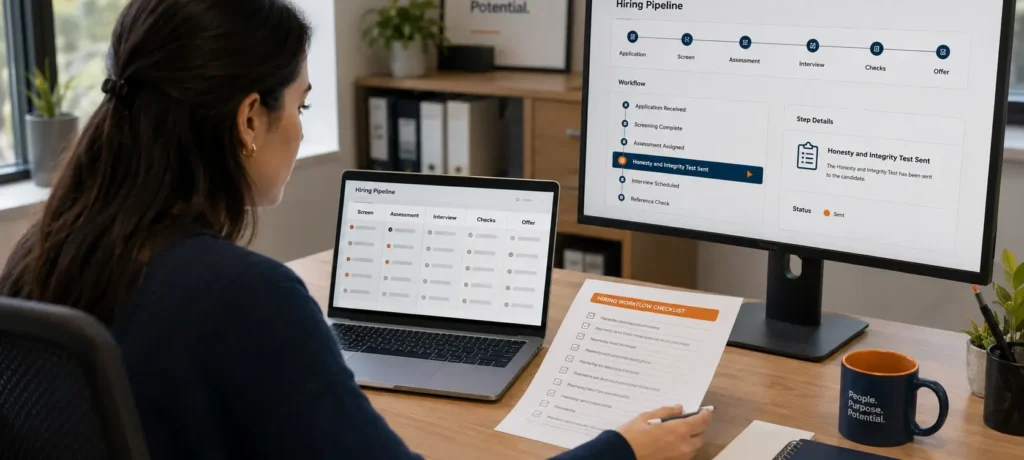
Timing is where many programs lose value.
If the test happens after two interviews, a hiring manager may already have a preferred candidate. If the test happens before basic qualifications are reviewed, HR may waste assessment volume on candidates who were never eligible.
For most high-volume and risk-sensitive roles, the best placement is after minimum qualifications and before the first major interview step.
A clean workflow looks like this:
- Application received
- Minimum qualifications reviewed
- Honesty and integrity test sent
- Candidate completes the test
- Result appears in the hiring workflow
- Recruiter reviews the result
- Qualified candidates move forward
- Review candidates receive a structured second look
- Not qualified candidates follow the approved disposition process
This keeps the test early enough to matter, but not so early that it creates unnecessary friction for every applicant.
For teams connecting assessments to ATS stages, the companion guide How to Implement Talent Assessment Tools in ATS Workflows explains how triggers, score writeback, and recruiter next steps should work inside a hiring system.
Step 3: Keep the Candidate Message Direct
Candidates should understand why they are being asked to complete the test.
The message does not need to be long. It should explain what the step is, why it exists, how long it takes, and what happens next.
A simple candidate message could be:
“Please complete this short pre-employment assessment as the next step in your application. It helps us evaluate candidates consistently for this role and can be completed from any device.”
That tone works because it is clear and neutral. It does not make the test sound like a background investigation, a personality judgment, or a trap.
Avoid language such as:
“This test will determine whether you are honest.”
“We use this test to catch risky candidates.”
“You must pass this test to prove your character.”
That kind of wording can damage candidate trust and create unnecessary support questions.
For candidate-facing context, connect this article with What Is an Honesty Integrity Test for HR.
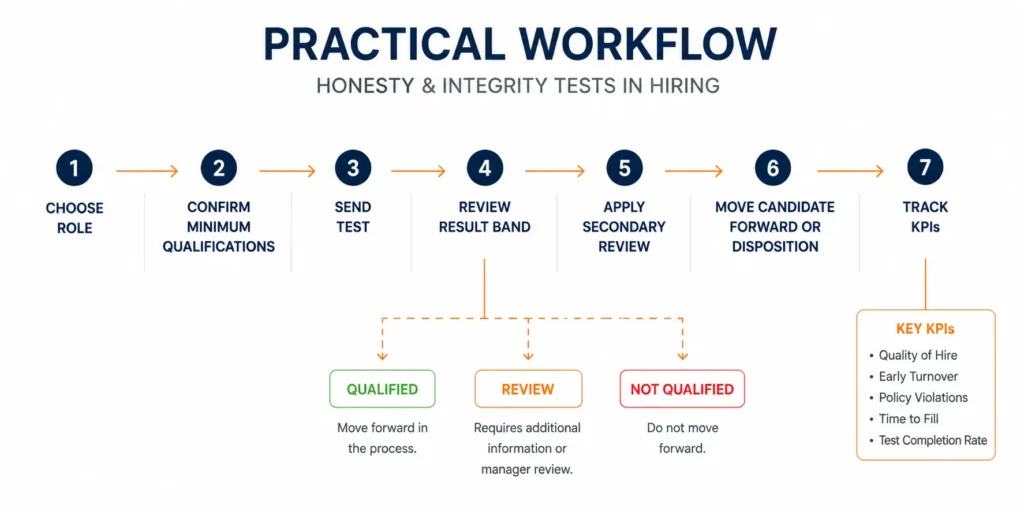
Step 4: Use Clear Result Bands

An honesty and integrity test should not leave recruiters with a vague score and no instructions.
The result should connect to a defined action.
| Result band | What it means | Recruiter action |
| Qualified | No major honesty or integrity concerns identified | Continue the hiring process |
| Review | Some responses or patterns need a second look | Apply approved review criteria |
| Not qualified | Result does not meet the role standard | Follow approved disposition process |
| Incomplete | Candidate did not finish | Send reminder or close after deadline |
The “Review” band matters. It gives HR room to handle nuance without letting every recruiter create their own standard.
For example, a review process might require the recruiter to check whether the concern is job-related, escalate to HR operations or compliance, document the decision, and apply the same process to similar candidates.
This is how the test becomes useful. It does not just produce information. It creates a consistent next step.
Step 5: Train Recruiters on What to Do, Not Just Where to Click
Recruiter training should focus less on product navigation and more on decision behavior.
Recruiters need to know:
- which roles receive the test,
- when it is sent,
- what candidates are told,
- where results appear,
- what each result band means,
- how review cases are handled,
- how to document exceptions,
- what not to say to candidates.
If a recruiter cannot explain the assessment in one sentence, the process needs work.
A practical explanation is:
“We use this short assessment to evaluate honesty, reliability, and workplace risk consistently for this role.”
That is enough for most candidate conversations. Recruiters should not be asked to interpret psychology, defend the science, or improvise policy language.
For a broader HR implementation view, use Honesty and Integrity Assessment for HR Teams.
Step 6: Keep Hiring Managers in Their Lane
Hiring managers should understand how the result affects the process, but they do not need unlimited access to every detail.
Too much detail can create inconsistency. One manager may overreact to a result. Another may ignore it completely. A third may ask interview questions that were never approved.
A better approach is to give managers an approved summary.
For example:
| Candidate status | Manager-facing guidance |
| Qualified | Candidate may proceed to interview |
| Review | HR is completing secondary review before next step |
| Not qualified | Candidate will not proceed under the approved process |
| Incomplete | Candidate has not completed the required step |
If the process allows follow-up questions, those questions should be structured and job-related.
Examples:
“Tell me about a time you made a mistake at work. What did you do next?”
“Describe a situation where you had to follow a policy you did not agree with.”
“Have you ever had to report a workplace issue or concern? How did you handle it?”
The goal is not to trap the candidate. The goal is to understand accountability and judgment in a consistent way.
Step 7: Document the Rules Before Launch
The legal and compliance risk usually does not come from using a test. It comes from using it inconsistently.
Before launch, HR should document:
| Area | What to define |
| Role coverage | Which roles receive the test and why |
| Timing | When candidates take the test |
| Candidate communication | How the test is explained |
| Result bands | What each outcome means |
| Review process | Who reviews borderline cases and how |
| Overrides | When exceptions are allowed |
| Data storage | Where results live and who can access them |
| Monitoring | How results and outcomes are reviewed over time |
The EEOC’s guidance on employment tests and selection procedures explains that tests can help employers evaluate candidates, but they must be used carefully to avoid discriminatory practices or unjustified exclusion.
The Uniform Guidelines on Employee Selection Procedures also apply to tests and other selection procedures used as the basis for employment decisions.
In practical terms, HR should make sure the test is job-related, applied consistently, documented, and monitored.
Step 8: Pilot With One Role Before Scaling
A pilot gives HR a chance to fix the process before it becomes company policy.
Start with one role family, one location group, or one high-volume hiring team. Choose an area where honesty, reliability, and conduct risk are clearly relevant.
During the pilot, watch how the process behaves in real hiring conditions.
Are candidates completing the test?
Are recruiters sending it at the right stage?
Are results appearing where recruiters need them?
Are review cases handled consistently?
Are managers aligned?
Are candidates asking the same questions repeatedly?
Is the workflow reducing wasted interview time?
Do not wait until the end of the pilot to adjust basic workflow issues. If candidates are confused, fix the message. If recruiters are bypassing the test, fix the trigger or training. If managers do not understand the result, simplify the summary.
A pilot is not only a test of the assessment. It is a test of the operating model around it.
Step 9: Measure Whether It Improves Hiring
Once the test is live, HR should measure more than test volume.
The question is not “How many candidates completed the assessment?” The question is “Did the process help us make better hiring decisions?”
Useful metrics include:
| Metric | Why it matters |
| Assessment invitation rate | Confirms the workflow is being applied |
| Completion rate | Shows whether candidates can complete the step easily |
| Time to completion | Reveals candidate friction |
| Qualified / Review / Not qualified distribution | Shows how results move through the funnel |
| Recruiter adoption | Shows whether the team trusts the process |
| Review-case resolution time | Measures whether borderline cases are handled efficiently |
| Override frequency | Reveals pressure, confusion, or misalignment |
| Time-to-interview | Measures recruiter efficiency |
| Early turnover | Tracks post-hire quality |
| Absenteeism trends | Useful for frontline hiring |
| Claims or incidents | Relevant for risk-sensitive environments |
| Adverse impact review | Supports fairness monitoring |
If completion rates are low, the problem may be candidate communication or assessment length. If overrides are high, the result bands may not match the role. If recruiters are not using results, the output may be too hard to find or understand.
Measurement should help HR improve the workflow, not just report activity.
Common Mistakes to Avoid
Sending the test to every applicant
This can create unnecessary friction and assessment spend. Use minimum qualifications first.
Waiting until the final stage
Late testing often creates conflict because hiring managers may already be committed to a candidate.
Giving recruiters unclear scores
A number without guidance does not help a busy recruiter. Use result bands and next steps.
Skipping the review process
If “Review” has no owner, it becomes a bottleneck.
Over-sharing details with hiring managers
Managers need approved summaries, not uncontrolled interpretation.
Treating the vendor as the compliance plan
Vendor documentation helps, but HR owns how the test is used.
Ignoring the candidate experience
A confusing invitation can lower completion and damage trust.
FAQ
How do you use honesty and integrity tests in hiring?
Use honesty and integrity tests after minimum qualifications and before major interview time is invested. Define which roles need the test, send it consistently, use clear result bands, train recruiters, document review rules, and measure post-launch outcomes.
Should every candidate take an honesty and integrity test?
Not necessarily. HR should use the test for roles where honesty, reliability, conduct, attendance, safety, or workplace risk are job-relevant. Minimum qualification review should usually come first.
Can recruiters reject candidates based only on the test?
HR should define decision rules before launch. Some results may lead to disposition, while others may require structured review. The process should be job-related, consistent, documented, and monitored.
Where should the test sit in the hiring process?
For high-volume or risk-sensitive roles, the test usually works best after minimum qualifications and before recruiter or hiring manager interviews.
How should candidates be told about the test?
Use clear, neutral language. Explain that the test is part of the hiring process, helps evaluate candidates consistently, can be completed from any device, and is required before the next step.
What metrics should HR track after implementation?
Track completion rate, time to completion, result distribution, recruiter adoption, review-case resolution, override frequency, time-to-interview, early turnover, absenteeism, claims or incidents, and adverse impact review.
Final Takeaway
Honesty and integrity tests work best when they are built into the hiring process with clear timing, clear ownership, and clear next steps.
They should not sit outside the ATS. They should not leave recruiters guessing. They should not be explained to candidates in vague or intimidating language. And they should not be used differently from one location to another.
For employers that need a focused pre-interview screen, IntegrityFirst Tests helps evaluate honesty, accountability, reliability, and workforce risk before recruiters and managers invest more time. IntegrityFirst is designed for practical use in high-volume and risk-sensitive hiring workflows, including staffing, construction, logistics, manufacturing, healthcare support, retail, hospitality, and transportation.
For companies that want that assessment connected to the rest of the hiring workflow, Discovered brings applicant tracking, workflows, assessments, candidate communication, scorecards, interviews, and automation into one platform.
IntegrityFirst gives HR the focused honesty and integrity signal.
Discovered gives HR the connected hiring system around it.
To reduce hiring risk with a focused integrity screen, schedule an IntegrityFirst demo.
To connect assessments with ATS workflows, scorecards, communication, interviews, and automation, book a Discovered demo.