Schedule a call!
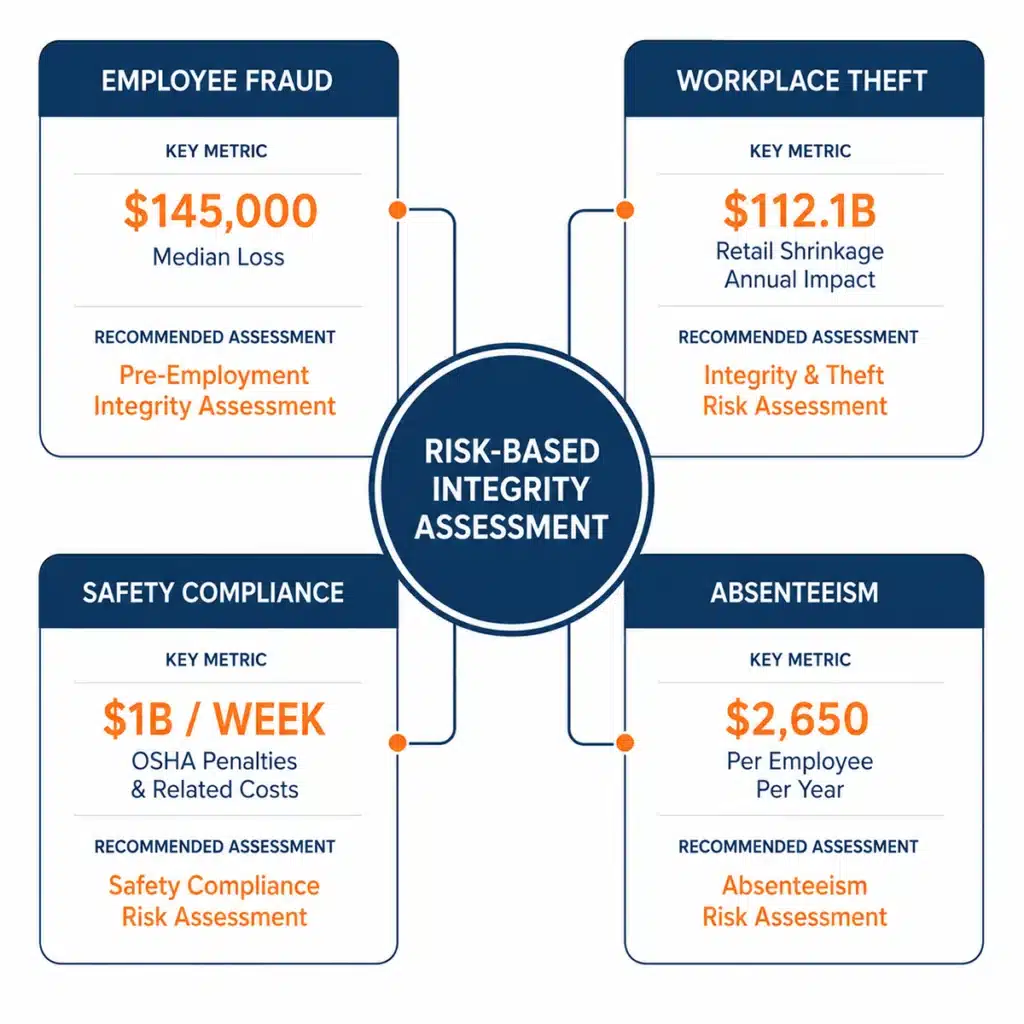
Integrity assessment for fraud prevention and risk reduction addresses a critical gap in most hiring processes: the inability to predict which candidates pose specific workplace risks. Organizations face four primary integrity-related threats—employee fraud, workplace theft, safety violations, and absenteeism—yet most screening practices treat these risks as interchangeable. They are not. A candidate who demonstrates low fraud risk may still pose significant safety risk; conversely, someone reliable in compliance may be chronically absent.
This distinction matters because different risk types require different assessment approaches, different cutoff scores, and different validation evidence. By understanding the specific risk landscape your organization faces, and by matching integrity assessment methods to those particular risks, HR leaders can build targeted screening processes that measurably reduce exposure without over-screening or creating false positives.
This guide maps the four primary risk domains, explains how each manifests in hiring, and shows how to select and configure integrity assessments to address them.
The Workforce Risk Landscape: Four Domains of Integrity Risk
Not all integrity risk is created equal. Organizations that implement pre-employment integrity testing for high-risk roles must first understand what they are actually measuring and screening for. The four primary domains are:
1. Employee Fraud and Financial Misconduct Direct financial theft, embezzlement, falsification of expense reports, or misappropriation of confidential information. Fraud risk is highest in roles with financial access or information control.
2. Workplace Theft and Shrinkage Taking company property, merchandise, materials, or supplies without authorization. This includes both high-value theft and chronic small-item removal. Retail, logistics, and manufacturing sectors face this risk acutely.
3. Safety Compliance and Regulatory Risk Failure to follow safety procedures, take required precautions, or report hazards. Safety compliance failures result in OSHA violations, workers’ compensation claims, and workplace injuries.
4. Absenteeism and Time Fraud Chronic unexcused absence, time-clock fraud (clocking in/out for others), or falsifying timesheets. This creates operational disruption and inflates labor costs.
Each domain has distinct predictors, different validation evidence, and different assessment strategies. The meta-analysis finding that integrity test scores predict counterproductive work behavior overall at a corrected validity of .32 masks important variation: some assessment methods predict fraud risk more strongly than safety risk, and vice versa.
Employee Fraud and Financial Misconduct Risk
Why it matters: Occupational fraud imposes a substantial financial burden on organizations of all sizes. According to analysis of 1,921 real-world cases investigated by Certified Fraud Examiners, the median loss per fraud case reached $145,000 globally, while organizations in the United States and Canada reported a median loss of $120,000 per case. CFEs estimate that organizations lose 5% of their annual revenues to occupational fraud each year. Fraud is not random—it is concentrated among employees with specific behavioral and attitudinal patterns that can be measured before hire.
Risk indicators: Candidates demonstrating low accountability for past mistakes, willingness to rationalize rule-breaking, or comfort with deception are at elevated fraud risk. Financial roles, budget authority positions, and information security roles carry the highest fraud exposure.
Assessment approach: Overt integrity tests are most effective for fraud risk screening because they directly measure attitudes toward dishonesty and financial ethics. Situational judgment tests—asking candidates how they would handle scenarios involving financial pressure or opportunity for misconduct—also predict fraud-relevant behavior. Supplementing assessment with thorough background checks and reference verification is essential; assessment scores should never be the sole decision point. Notably, the ACFE 2024 Report to the Nations found that 87% of fraud perpetrators had no prior fraud-related criminal history, meaning traditional criminal background checks alone are insufficient—behavioral assessment of integrity-relevant attitudes adds a layer of screening that criminal records cannot provide.
Validation evidence: Integrity assessments predict counterproductive work behavior—the category encompassing fraud and financial misconduct—at a corrected validity of .32 across a meta-analysis of 104 studies. Fraud-specific assessment formats that include items on financial rationalization and misrepresentation have demonstrated validity at or above this baseline in published validation studies. Organizations should request vendor-provided validity data specific to their industry and role level before selecting an assessment tool.
Measurement and cutoff: Organizations screening for fraud risk should establish a higher (more stringent) cutoff score than for general integrity screening, as the stakes of a fraud-prone hire in a financial role are substantial. Document the rationale for your cutoff choice and monitor whether it produces adverse impact by demographic group.
Workplace Theft and Shrinkage Risk
Why it matters: Employee theft and internal fraud consistently rank among the primary contributors to retail and logistics shrinkage. According to the National Retail Federation’s National Retail Security Survey, inventory shrinkage cost the US retail industry an estimated $112.1 billion in 2022, with employee theft and internal fraud accounting for a significant share of those losses alongside external theft and process failures. High-theft-risk hires create cascading costs: direct inventory loss, increased auditing overhead, security investment, and team morale damage when trusted colleagues are caught stealing.
Risk indicators: Candidates with attitudes permissive toward taking company property, rationalization of small thefts, or dishonesty in past employment are at elevated theft risk. Retail, food service, warehouse, and transportation roles are most vulnerable.
Assessment approach: Overt integrity tests with explicit theft-related items (“Is it acceptable to take company merchandise at a discount without paying?” “Have you ever taken company property?”) are most effective and transparent. Covert assessments that measure conscientiousness and rule-following also predict theft-relevant behavior, though candidates may not understand why they are being assessed.
For roles with high theft exposure, pairing the integrity assessment with reference checks that explicitly ask about honesty and past theft-related behavior (where legal to do so) strengthens prediction. Avoid assessment formats that are overly complex or ambiguous in these roles—clarity about what is being measured reduces candidate confusion and improves assessment validity.
Validation evidence: The predictive validity of integrity assessments for theft-specific outcomes aligns with the broader meta-analytic evidence for counterproductive work behavior, at a corrected validity of .32 . Organizations with high-shrinkage exposure should seek vendor validation studies specific to their industry and role type before establishing cutoff scores.
Measurement and cutoff: Organizations in high-shrinkage environments (retail, hospitality, logistics) can often justify stricter integrity cutoff scores than general manufacturing or professional services. This choice should be documented and monitored for adverse impact. If you find that certain demographic groups score lower on your theft-risk assessment, investigate whether the assessment items are truly job-related or whether different groups interpret questions differently.
Safety Compliance and OSHA Risk
Why it matters: OSHA recordable incidents and workers’ compensation claims are concentrated among small numbers of high-risk employees. Employees who fail to follow safety procedures, ignore hazard warnings, or rationalize safety shortcuts create disproportionate organizational risk. OSHA estimates that employers pay approximately $1 billion per week in workers’ compensation costs alone, with a significant share attributable to preventable incidents. Pre-employment screening for safety-relevant integrity traits can reduce the likelihood of hiring candidates prone to safety shortcuts.
Risk indicators: Candidates demonstrating low accountability, disregard for rules, or willingness to cut corners to save time or effort are at elevated safety risk. Safety-sensitive roles—construction, manufacturing, transportation, healthcare, chemical handling—require explicit safety risk assessment.
Assessment approach: Situational judgment tests are more effective for safety risk screening than overt fraud-specific tests. Present candidates with realistic safety dilemmas: “You notice a colleague is not using required PPE. What do you do?” Behavioral interviews exploring past instances of risk-taking, corner-cutting, or rule-breaking also predict safety compliance. Safety-specific integrity assessments should include items measuring comfort with uncertainty and willingness to report hazards, not just general honesty.
Complement assessment with safety training evaluation during onboarding. Candidates who score high on safety-relevant integrity traits but lack safety knowledge still pose risk; comprehensive onboarding that tests safety understanding is essential.
Validation evidence: Pre-employment integrity assessment predicts counterproductive work behavior—including safety violations—at a corrected validity of .32 . Organizations should conduct their own outcome analysis linking pre-hire assessment scores to post-hire safety incident rates to validate that their specific cutoff score is working as intended in their work environment.
Measurement and cutoff: Safety-sensitive organizations should establish clearly job-related cutoff scores for safety-relevant integrity items, separate from general fraud or theft risk items. Document the job analysis basis for your cutoff. Monitor whether implementation reduces actual incident frequency and claim costs—this outcome data is your strongest validation evidence that screening is working.
Absenteeism and Time Fraud Risk
Why it matters: Chronic absenteeism costs employers $2,650 per employee annually in lost productivity. Unexcused absences, tardiness, and time-clock fraud are concentrated among specific employee profiles that are identifiable in pre-employment screening. For operations-heavy organizations, pre-employment integrity testing for high-risk roles targeting absenteeism is a measurable cost lever.
Risk indicators: Candidates demonstrating low commitment to prior employment, frequent job-hopping without clear progression, or willingness to bend time-tracking rules are at elevated absenteeism risk. Frontline and shift-based roles are most vulnerable; the cost of sudden absences is highest in roles where immediate staffing replacement is difficult.
Assessment approach: Conscientiousness-focused personality assessments and situational judgment tests asking “What would you do if you were sick but the team was short-staffed?” predict absenteeism-relevant behavior. Direct questions about attitude toward shift work, reliability in prior employment, and willingness to work required hours are appropriate for frontline hiring. Behavioral interviews exploring work history gaps and reasons for prior job changes add context.
Combine assessment with clear communication of attendance expectations, documented attendance policies, and progressive discipline. Screening alone will not eliminate absenteeism; clear expectations and consistent enforcement are essential.
Validation evidence: Meta-analytic evidence linking conscientiousness to work attendance shows a corrected validity of approximately .22, indicating a meaningful but moderate predictive relationship. This is lower than fraud or theft prediction but still operationally significant for high-volume frontline hiring where marginal improvements in attendance reduce cumulative scheduling and productivity costs.
Measurement and cutoff: Organizations using integrity assessment to screen for absenteeism risk should include specific items on reliability and consistency, not just general honesty. Pilot your assessment with a subset of roles first. Compare screening results to actual first-year attendance outcomes to validate that your cutoff score is predictive in your specific organization and role.
How to Match Integrity Assessment Format to Risk Type
Not all integrity assessments are equally effective for all risk types. Here is how to select the right format for your specific organizational risk landscape:
| Risk Domain | Most Effective Format | Why | Validation Strength | Complementary Tools |
|---|---|---|---|---|
| Fraud & Financial Misconduct | Overt integrity test with fraud-specific items | Direct measurement of attitudes toward dishonesty and rationalization | Corrected validity .32 (PubMed 21319880) | Background check, reference verification, financial audit trail review |
| Workplace Theft | Overt integrity test with theft items | Clear, transparent, difficult to fake | Corrected validity .32 (PubMed 21319880) | Reference checks, inventory auditing, security protocols |
| Safety Compliance | Situational judgment + behavioral interview | Reveals actual safety decision-making, not just attitudes | Corrected validity .32 (PubMed 21319880) | Safety training evaluation, near-miss reporting, hazard assessments |
| Absenteeism | Conscientiousness assessment + reliability questions | Predicts follow-through and work consistency | Corrected validity .22 (Barrick & Mount, 1991) | Attendance policy clarity, progressive discipline, role fit assessment |
Key principle: Do not use a single assessment across all roles. Instead, configure your assessment—whether you use overt, covert, or situational formats—to emphasize the risk types most relevant to each role. A customer-facing retail role prioritizing theft risk should emphasize different items than a safety-critical manufacturing role prioritizing safety compliance.
Measuring Risk Reduction Outcomes
Integrity assessment for fraud prevention and risk reduction is only defensible if you measure actual risk reduction. Here is how to establish outcome metrics for each risk domain:
Fraud and Financial Misconduct:
- Metric: Number of financial irregularities or fraud cases detected post-hire (target: fewer than pre-screening baseline)
- Baseline: Prior years’ audit findings or financial control violations
- Analysis: Compare post-hire fraud rates between screened and unscreened cohorts where possible
Workplace Theft and Shrinkage:
- Metric: Shrinkage rate or documented theft incidents
- Baseline: Shrinkage as percentage of inventory; prior incident frequency by location
- Analysis: Track shrinkage and incident frequency before and after integrity assessment implementation; isolate the impact from other security or inventory changes
Safety Compliance:
- Metric: OSHA recordable incident frequency; workers’ compensation claim frequency; near-miss reports
- Baseline: Prior 3-year average by role or location
- Analysis: Calculate incident rate reduction; account for confounding factors including safety training, equipment changes, and workload
Absenteeism:
- Metric: Absence frequency; unexcused absences per employee per year
- Baseline: Prior cohort data; compare screened vs. unscreened hires where possible
- Analysis: Track first-year absence rates; segment by role type and role-specific assessment cutoff
Data collection approach: Maintain integrity assessment scores and hiring decisions in a secure database linked to HR outcomes (safety incidents, fraud cases, absence data). Conduct quarterly outcome reviews comparing screened vs. unscreened cohorts, or pre-screening vs. post-screening periods. Document all findings to build evidence that your screening process is working—or to identify where adjustments are needed. For guidance on legal standards governing the use and documentation of pre-employment selection tools, consult the EEOC Uniform Guidelines on Employee Selection Procedures.

Frequently Asked Questions
Q: How do we avoid false positives—flagging low-risk candidates as high-risk? False positives are a real concern and a source of candidate frustration. To minimize them: use validated assessment formats specific to the risk domain you care about (fraud-specific items for fraud risk, not generic integrity questions); set cutoff scores based on job analysis and prior outcome data, not arbitrary thresholds; combine assessment results with other information including background check, reference check, and behavioral interview; allow candidates to provide context if they score in the borderline range; review your false positive rate quarterly—if you are screening out many candidates who go on to succeed, adjust your cutoff or assessment wording.
Q: Can we use the same integrity assessment across all roles, or do we need role-specific versions? Role-specific versions are more effective, but not always practical. A middle-ground approach: use a common core assessment measuring general conscientiousness and honesty, plus role-specific items (fraud items for finance roles, safety items for operational roles). This ensures consistency while targeting the most relevant risks.
Q: What should we do if a candidate discloses a past mistake or ethical lapse? Past mistakes do not automatically disqualify candidates. The key is context and evidence of change. For example, a candidate who shoplifted in college but has no theft-related incidents in a 10-year work history is likely lower risk than their assessment score might suggest. Use the assessment as a trigger for deeper conversation, not an automatic screen-out.
Q: How often should we update our integrity assessment or cutoff scores? At minimum, annually. Compare assessment results to actual outcomes (fraud, theft, safety incidents, absences) for cohorts you screened. If you find that high-scorers are experiencing safety incidents, or low-scorers are succeeding, investigate and adjust. Also update assessments when job responsibilities change or when you enter a new industry or market.
Q: What if our assessment shows adverse impact on a protected group? This is a serious compliance issue. If your assessment disproportionately screens out members of a protected class: first, verify that the impact is real by conducting a formal adverse impact analysis; review whether the assessment is truly job-related for the risk type you are measuring; investigate whether different groups interpret questions differently; consider adjusting cutoff scores, item wording, or assessment format; and consult your legal counsel. The EEOC Uniform Guidelines on Employee Selection Procedures define the federal standard for adverse impact analysis in pre-employment screening. Document all remedial actions and continue monitoring.
Q: How do we explain assessment results to candidates who are screened out? Provide clear, respectful feedback tied to job requirements. For example: “Your assessment results, combined with our evaluation of the specific requirements of this role, indicate that this may not be the right fit at this time. We encourage you to reapply for other positions or to reach out if you have questions about the assessment.” Avoid vague language—be specific about what the assessment measures and why it matters for the role.
Next Steps: Implementing Risk-Focused Integrity Assessment
Start with these practical steps:
- Map your risk landscape. Which risks matter most to your organization? Conduct a loss analysis for fraud, theft, safety incidents, and absenteeism. Quantify the cost of each.
- Select role cohorts for pilot. Choose one or two role categories with the highest risk exposure—for example, warehouse roles for theft risk or safety-critical roles for safety compliance risk.
- Select or develop role-specific assessment. Choose an integrity assessment tool validated for your target risk type, or configure a validated tool to emphasize relevant risk items.
- Establish baseline metrics. Document pre-screening loss rates, incident frequency, or absence rates for your pilot roles.
- Implement screening and track outcomes. Administer assessment, record results, and link them to HR outcomes including theft incidents, safety records, and absence data for 6–12 months.
- Analyze results and refine. Compare post-screening outcomes to baseline. If risk reduction is meaningful, scale to other roles. If results are weak, investigate whether your cutoff, assessment wording, or complementary tools need adjustment.
- Monitor for adverse impact. Quarterly, analyze assessment results by demographic group in line with EEOC Uniform Guidelines. Ensure no protected class is disproportionately screened out.
For a complete overview of integrity assessments — including what they predict, how validity evidence works, compliance requirements, and how to build a defensible implementation — see our integrity assessments guide.
If you need expert guidance on designing risk-focused integrity assessment processes, configuring assessments for specific risk types, or analyzing outcome data, IntegrityFirst Tests can support your implementation. Our team works with organizations to build validated, role-specific assessment strategies that measurably reduce fraud, theft, safety, and absenteeism risk while maintaining legal defensibility and fair hiring practices.
Contact IntegrityFirst Tests to discuss how integrity assessment for fraud prevention and risk reduction can strengthen your organization’s risk profile.