Schedule a call!
Integrity risk assessment as strategic HR tool means treating workforce integrity like an enterprise control system, not a compliance checkbox. You target the roles and moments where misconduct drives the biggest losses, then govern selection and monitoring to measurably reduce claims and churn.
That shift matters because leaders do not judge HR on intentions or policies. They judge it on what the business can see and pay for: workers’ compensation severity, safety incidents tied to rule-bending, inventory and cash variance, early-tenure terminations, and attrition driven by low trust in escalation paths.
In high-volume environments, integrity failures rarely look like headline fraud. They surface at the seams, where rushed hiring meets inconsistent supervision and accountability shifts by level or location. This guide frames strategic integrity risk management for HR leaders in board-level terms, then lays out a role-tiered approach that holds up legally and produces outcomes your COO and general counsel will act on.
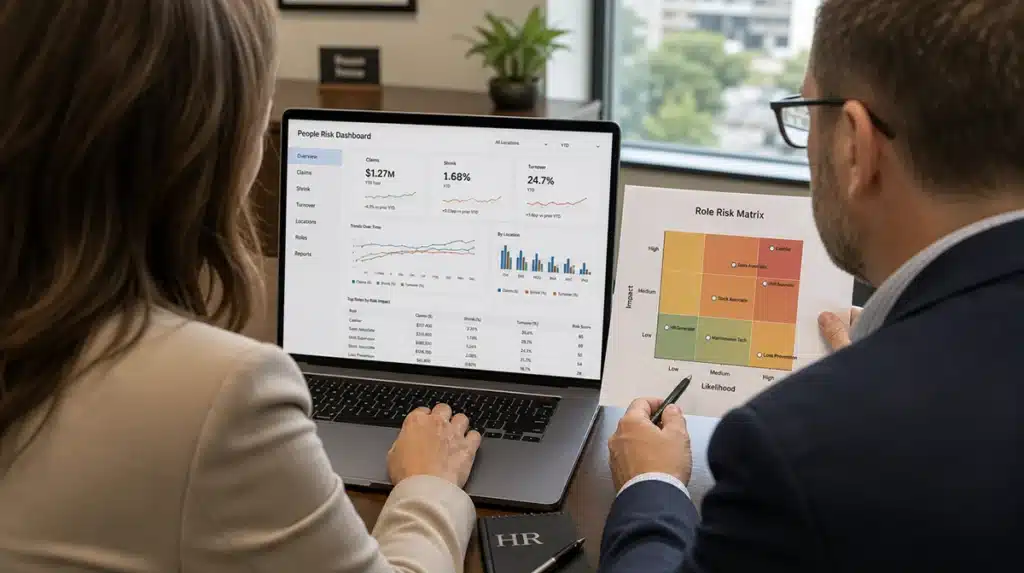
Why Integrity Risk Is a Strategic HR Priority, Not Just a Compliance Function
If you treat integrity risk as a compliance chore, you will manage it like one: a policy, a perfunctory screen, and a file that only gets opened when Legal calls.
In high-volume hiring, that framing keeps the focus on paperwork and misses where the damage shows up: preventable injuries, workers’ compensation frequency, and the churn of good employees who will not stay under inconsistent accountability.
What makes this strategic is that HR sits at the control points that shape exposure. You influence who enters the workforce, how quickly they are placed into risk-bearing work, and whether standards are applied consistently. Treating integrity as enterprise integrity risk control, a governed category with leading indicators leadership can see, is also how you build the high-trust culture covered in our guide to integrity and honesty in hiring for HR leaders.
One site can run higher incident and shrink rates under identical procedures when local supervision normalizes corner-cutting and suppresses reporting. That is not simply a bad-manager problem; it is a predictable risk pattern you can detect, design around, and reduce.
Define the Integrity Risks That Matter
You cannot govern what you cannot name, and “integrity” is too vague to survive a finance or legal review. You need a definition a CFO and general counsel can recognize: integrity risk is the probability that workforce behavior or process misuse creates a safety or financial impact.
In practice it clusters into a few board-relevant categories you can actually govern, each with leading and lagging indicators:
- Safety and rule-breach risk (shortcuts, bypassing PPE, falsified checklists). Leading: near-miss reporting rate, repeat coaching on the same violation. Lagging: recordables tied to procedure violations, workers’ compensation frequency and severity.
- Asset and shrink risk (theft, diversion, misuse of equipment or inventory). Leading: inventory adjustments by site or shift, access exceptions, override frequency. Lagging: shrink percentage, cash variance, high-cost loss events.
- Conduct and retaliation risk (harassment, intimidation, abuse of supervisory discretion). Leading: hotline mix and substantiation rates, retaliation flags, transfer requests out of specific teams. Lagging: claims, settlements, regrettable-turnover clusters.
If you cannot specify the category and the measurement plan, you are not managing integrity risk; you are screening and hoping the numbers follow.
Integrity Risk Assessment as Strategic HR Tool: The Control System
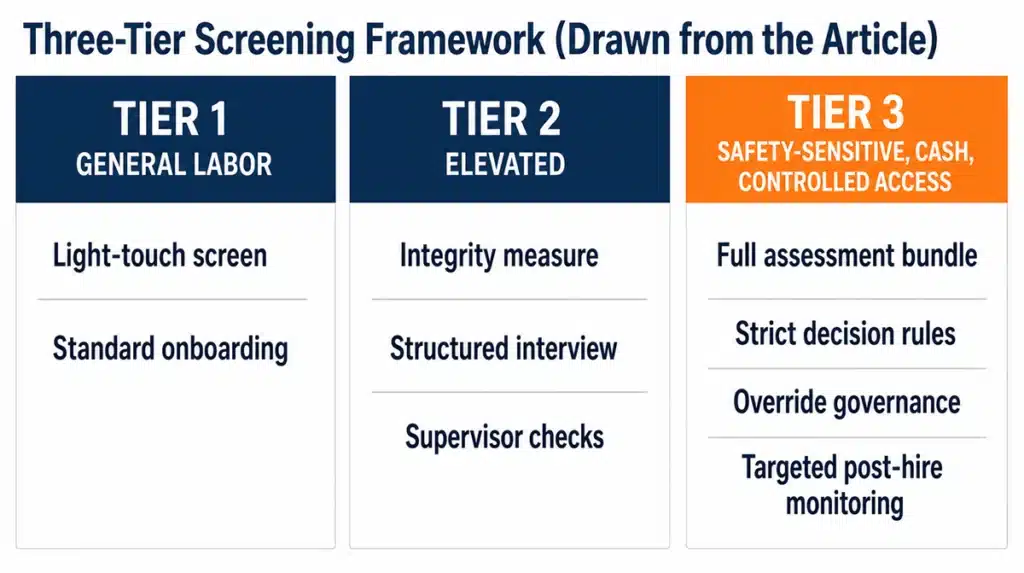
Treat the assessment as a control system by mapping where loss concentrates, placing proportional controls at those points, and showing that the controls change outcomes. Role-tier design, decision rules, and override rules are the core of workforce risk governance.
Start with role-risk segmentation, because not every job deserves the same approach. A forklift operator on a fast-moving dock and a cash-office lead carry different downside. A single generic screen across all roles either over-controls low-risk hiring and hurts fill rates, or under-controls high-risk roles and absorbs preventable claims and shrink.
The assessment layer should be intentionally layered, not treated as a verdict. Use a pre-employment integrity test as one input alongside structured interviews and reference checks, with decision rules managers cannot quietly override. At minimum, your system should specify role-risk tiers, an assessment bundle per tier, decision rules tied to documented job requirements, override governance, and post-hire controls for higher tiers.
The practical build inside the hiring funnel is covered in our guide to how to implement integrity assessments in hiring.
Monitoring keeps the system honest. You are verifying control performance, not surveilling employees. If one site spikes in cash variances and early-tenure terminations for timekeeping issues, the signal points to supervision and controls, not just “bad hires.” If you cannot connect selection signals to post-hire outcomes by role and location, you do not have a control system; you have a screening ritual.
Making It Legally Defensible at Scale
Picture your hiring screen becoming evidence in a termination dispute or class claim. If you cannot show why it fits the job and how it is monitored, the tool turns from protection into exposure. Defensibility is what keeps integrity risk assessment as strategic HR tool credible when results are challenged, and it rests on three non-negotiables.
First, validation logic: tie each assessment to the job requirements and risk-bearing behaviors for the role tier, and document your validation basis. Under the federal Uniform Guidelines on Employee Selection Procedures, a selection rate for any group below four-fifths (80 percent) of the highest group’s rate is treated as evidence of adverse impact that must be justified.
Second, adverse-impact monitoring: track selection rates and outcomes by protected class and by site, and investigate drift, including local cut-score changes made to hit time-to-fill targets. Third, vendor governance you can audit: require technical documentation, version control, and clarity on how scoring and cut strategies were set.
One point of reassurance: written integrity assessments are distinct from lie detector tests. The Employee Polygraph Protection Act restricts polygraphs and similar devices, not standard paper-and-pencil or online integrity questionnaires. The practical checkpoint is whether Legal and your COO can receive one packet that covers role rationale, cut-and-override governance, and the adverse-impact dashboards you review on a set cadence.
The Business Case and Board-Level HR Integrity Risk Reporting
You will not win resources by promising “better people.” You win when leaders see a direct line from tighter controls to fewer claims, fewer investigations, and fewer costly early exits. The business case for integrity risk assessment as strategic HR tool rests on loss reduction, not on assessment licensing fees. Framed for leadership, this is the integrity risk assessment business case for HR.
Turnover is the number boards already understand. Gallup estimates that replacing a single employee can cost from one-half to two times that employee’s annual salary, and that voluntary turnover costs U.S. businesses about $1 trillion a year. Against numbers like those, a control that moves first-year turnover and claims pays for itself quickly.
Build the board view from inputs finance trusts: loss reduction (workers’ compensation frequency and severity, safety incidents tied to rule violations, shrink and cash variance by location and role tier), churn reduction (30/60/90-day turnover and policy-violation terminations converted to replacement and training cost), and operating efficiency (fewer investigations, less manager time on remediation, lower rework from overrides).
Presented this way, board-level HR integrity risk reporting reframes the program as an enterprise control. It is also the integrity risk assessment ROI for senior HR leaders to defend in a budget review: spend that returns measurable reductions in costs the organization already tracks.
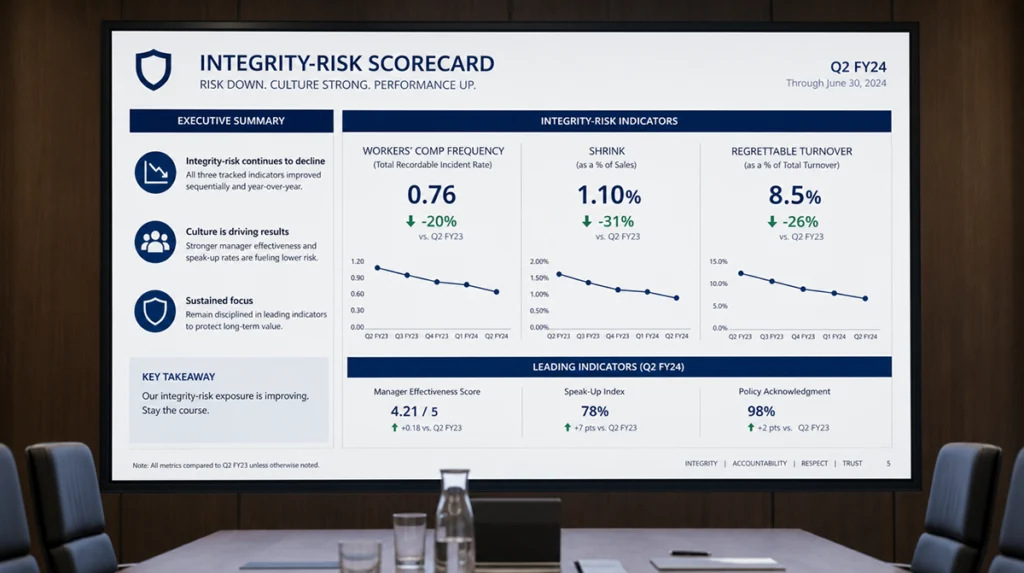
Case Study: Finance Firm (Turnover 32%→12%, Claims −50%)
A mid-market finance firm facing 32% turnover and elevated workers’ compensation exposure treated integrity risk assessment as strategic HR tool, not a one-off test. The CHRO rebuilt governance around role risk: higher-risk roles (cash handling, client-facing operations, and safety-adjacent facilities work) received a defined assessment bundle, structured decision rules, and a formal override path that required documented rationale and periodic audit.
HR operations and frontline leaders tracked early-tenure exits and claim drivers by role and manager, then used that data to tighten onboarding gates such as training verification before full access and probation check-ins. Within a year, turnover dropped from 32% to 12% and workers’ compensation claims fell by 50% (IntegrityFirst client data).
Against Gallup’s replacement-cost range, a 20-point turnover reduction at a firm that size is a board-visible saving on its own, before counting the claims reduction. The takeaway is not that a test fixed the workforce; it is that the firm started managing integrity as controllable operational risk.
Frequently Asked Questions
Do you need overt integrity tests, or are personality-based measures better?
You do not need an ideological answer. Both overt and personality-based integrity measures can predict counterproductive work behaviors, so choose based on role-risk fit and your governance requirements rather than a preference for one format.
Will this hurt candidate experience and your ability to hire at scale?
It will if you treat it as a moral exam instead of a job-relevant control. Keep it role-tiered, explain it as a standard safety-and-trust screen for specific jobs, and make decisions fast so candidates do not stall in review queues.
What about false positives and good people being screened out?
If you use any single signal as a verdict, you will create avoidable talent loss. Set decision rules that route borderline results into structured review for high-risk roles, and audit post-hire outcomes so you can recalibrate cut scores.
How do unions or regulated, brand-sensitive environments change the approach?
They raise the bar on consistency and documentation. You will want clear role-based rationale and tight override governance so you can show the process is job-related and uniformly applied.
What should you pilot first if you want proof without a big rollout?
Start where loss concentrates and measurement is clean: one or two high-risk role families in a handful of locations, tied to a small set of outcomes you already track, such as early-tenure turnover and policy-violation terminations.
Make Integrity Risk a Board-Level Advantage
Used well, integrity risk assessment as strategic HR tool gives the CHRO a CHRO integrity risk assessment framework that connects selection and monitoring to the loss metrics leadership already tracks: claims, shrink, investigations, and regrettable turnover. IntegrityFirst Tests provides validated integrity assessment tools built for United States HR teams that want to turn workforce integrity into measurable, board-ready outcomes.
For the full program behind the board-level case, see our complete guide to integrity risk assessment for HR.
Ready to build the business case for your organization? Contact IntegrityFirst Tests to schedule a demo, and we will show you projected savings on claims and turnover for your highest-risk roles.