Schedule a call!
You are not looking for a new buzzword. You are trying to choose an integrity screening approach you can defend when Legal asks for job-related evidence, and when an audit or a claim forces you to explain who accepted what risk and why.
This guide helps you do two things: select an integrity risk assessment framework and tools for HR that fit how your organization actually makes decisions, and evaluate vendors with the same discipline. You will leave with a clear way to compare NIST 800-30, ISO 31000, and CIS, a structured way to pressure-test platforms like IntegrityFirst, Workday, HireRight, and TrueScreen, and the documentation that keeps the program standing up over time: risk statements, thresholds and escalation paths, and a risk register you can actually maintain.
Frameworks and tools are one piece of the wider discipline; see how they fit in our overview of integrity risk assessment for HR.
What an Integrity Risk Assessment Framework and Tools for HR Must Deliver
In HR selection, “integrity risk” is not a judgment about values. It is the measurable risk that a hiring decision increases your exposure to counterproductive work behavior or policy violations you actually care about, such as theft, safety shortcuts, or data misuse. One cluster of avoidable cash variances or safety incidents can trigger investigations, lost productivity, and messy termination documentation, even when recruiting “followed the usual process.”
The trap is treating an integrity test rollout as the framework. A framework has to do the unglamorous work your stakeholders will ask for later: define what “integrity” means for your roles, show how you will make risk decisions, and create a paper trail that survives audit, litigation, or leadership turnover.
Whichever framework you choose, the assessment itself must sit inside a validated selection procedure under the federal Uniform Guidelines on Employee Selection Procedures, where a selection rate below four-fifths (80 percent) of the highest group’s rate is treated as evidence of adverse impact that must be justified.
When you evaluate NIST, ISO, or CIS for HR use, judge each on whether it helps you produce and maintain three things:
- Risk appetite and thresholds: what you will accept, mitigate, or escalate by role family, location, or regulated exposure, and who has authority to accept residual risk.
- Governance cadence: a repeatable rhythm to review validity evidence, adverse-impact signals, exception requests, and vendor changes, not a one-and-done assessment.
- Defensible artifacts: documented risk statements, a selection-decision log (why this tool, for which roles, under what constraints), and a risk register with clear owners and review dates.

NIST 800-30: When and How to Use It in HR
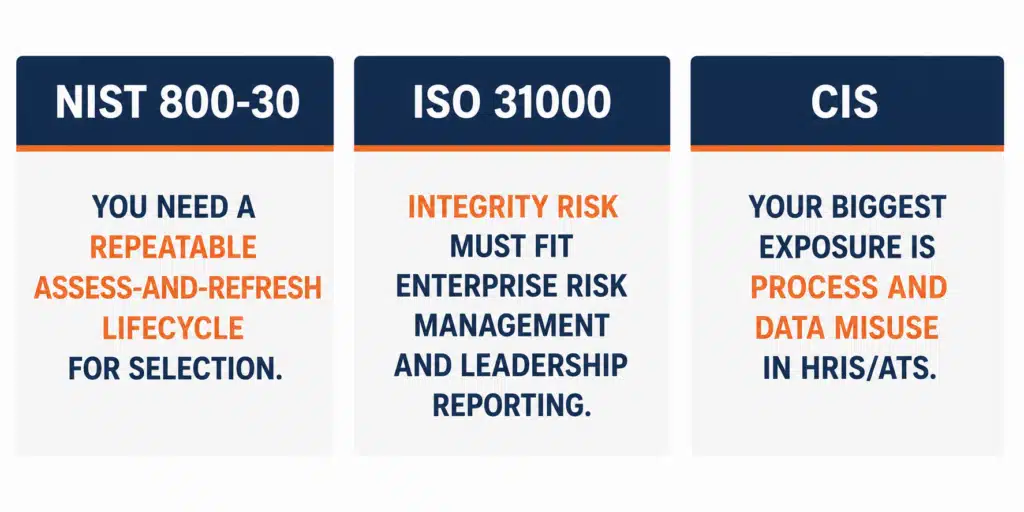
NIST works well when you treat integrity screening as a living risk assessment rather than a policy you write once and set aside, which makes it a practical NIST integrity risk assessment for HR. The federal Guide for Conducting Risk Assessments (NIST Special Publication 800-30) frames risk assessment as a prepare, conduct, and maintain cycle, which maps cleanly to how selection systems actually drift as roles change and vendors update scoring models.
In practice, prepare means you define the HR-specific risk being assessed: which role families, which counterproductive behaviors, and which thresholds trigger escalation, plus who can accept residual risk (often HR with Legal or Compliance). Conduct is where you document the risk statements, how integrity screening fits the selection procedure, and what could go wrong (invalid inference, adverse-impact signals, confusion with polygraphs). Maintain is the part most teams skip: a cadence and triggers to refresh the assessment when adverse-impact monitoring or a vendor change calls for it.
ISO 31000: The Broad Governance Approach
ISO 31000 fits when your integrity screening has to plug into enterprise risk management, not just your selection workflow. If Legal and Audit need to see the same risk language, decision rights, and evidence trail they use elsewhere, an ISO 31000 integrity risk assessment HR application treats integrity risk as a managed portfolio with defined context and explicit risk criteria. The central artifact becomes a risk-register entry (cause, event, consequence, owner, controls, review cadence), with integrity testing positioned as one technique among several rather than “the framework.”
The shift that surprises teams is ownership. You cannot keep acting as though HR alone accepts residual risk when the consequences land elsewhere. For multi-site operations where safety incidents and timecard fraud already trigger audits, ISO-style governance forces you to document who sets risk tolerance (often Operations leadership), how exceptions are approved, and what gets reported upward, so controls extend beyond the test itself. (ISO 31000 is a paid international standard; if you adopt it, budget for the licensed text.)
CIS: For Lean Teams and Tech-Adjacent HR Functions
CIS fits when your HR team sits close to IT and you need a control-oriented, implementable way to reduce integrity-related exposure quickly, especially where risk shows up in systems behavior: who can edit a record, who can override a disposition, what gets exported to spreadsheets. The CIS Critical Security Controls, a prioritized set of safeguards from the Center for Internet Security, translate well into HRIS and ATS guardrails.
If recruiters and HR business partners can change requisition requirements, update candidate statuses, or grant ad hoc report access without separation of duties or logging, your biggest integrity problem may not be who you hire. It may be how easily someone can misuse the process and the data around it. Use CIS-style thinking to set pragmatic guardrails such as role-based access and audit logs, and treat each control as evidence by mapping it to a specific HR integrity risk you are tracking.
Framework Comparison Table (NIST vs ISO vs CIS)
Make this an operating-model decision, not a philosophical one. When the framework matches how your organization already makes risk calls, your documentation gets simpler and your approvals get faster. This integrity risk assessment framework comparison summarizes the trade-offs:
| Dimension | NIST 800-30 | ISO 31000 | CIS |
| Best fit | A repeatable lifecycle for integrity risk in selection | Alignment with enterprise risk language and leadership reporting | Implementable controls for HRIS/ATS workflow and data misuse |
| Primary output | Documented assessment with refresh triggers | Risk-register-centered workflow (criteria, owners, treatments, cadence) | Control set (access, logging, approvals) tied to HR risks |
| Decision rights | Requires aligning HR, Legal, and the business on risk acceptance | Forces cross-functional ownership and explicit risk tolerance | Usually owned by HR/IT/HRIS with clear control owners |
| Main trade-off | You still must define governance and acceptance authority | Governance overhead can slow quick rollouts | Does not, by itself, prove selection validity |
Selecting the Right Integrity Assessment Tool
Tool selection is the second half of an integrity risk assessment framework and tools for HR program. Once the framework is set, anchor tool selection to its outputs so you evaluate vendors like an RFP filter instead of a sales demo. When you cannot name the target risks and role families in plain language, the most polished demo wins and you lose defensibility on cutoff, content, and workflow when Legal asks.
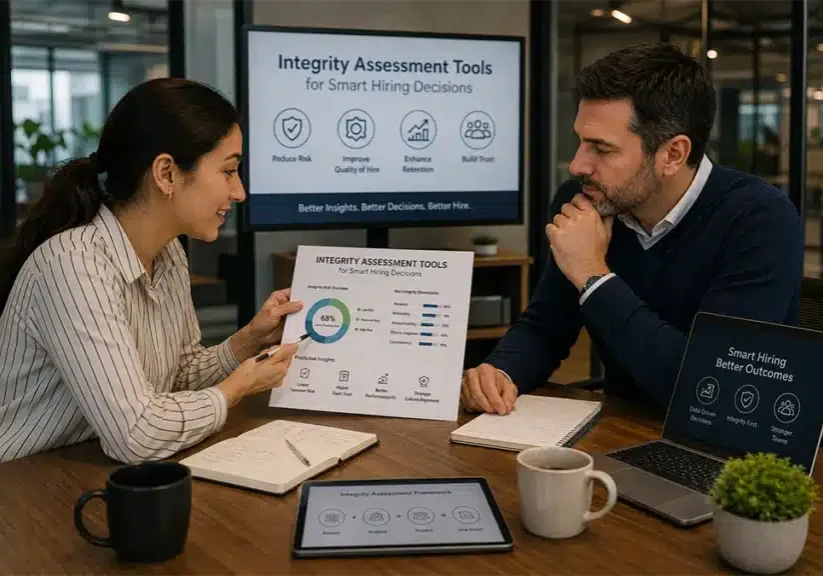
Our guide to integrity assessment tools for smart hiring decisions covers how to match a tool to specific risk targets.
For the validity evidence behind those tools, see our complete guide to integrity assessments.
Start your requirements with the minimum you would need to document and maintain a selection procedure, not just administer a test:
- Criterion breadth: whether the assessment targets a narrow outcome (for example, theft) or broader counterproductive behavior. If your risk register includes safety shortcuts or data misuse, a theft-only instrument will not map cleanly.
- Validation posture you can defend: what evidence supports the prediction and how results are meant to be used (screen-out, score banding, structured follow-up). Do not accept “validated” as a tagline; you need documentation for a selection file.
- Adverse-impact monitoring support: what reporting you get on selection rates by protected class, at what cadence, and what happens when signals emerge.
- Privacy and data handling: what candidate data the tool collects, how long it is retained, and who can access it.
- Workflow fit and controls: role-based access, audit logs, and documented overrides for hard-to-fill sites or internal transfers.
Tool Comparison: IntegrityFirst vs Workday vs HireRight vs TrueScreen
Brand familiarity and “it integrates with our ATS” are the quickest ways to choose wrong. You are buying a risk control that has to hold up under scrutiny, so when comparing integrity assessment tools for HR teams, judge each on what it predicts, what evidence supports its use, what you can monitor for adverse impact, and how cleanly you can govern exceptions and data. This integrity assessment platform comparison for HR frames what to verify rather than vendor claims:
| Option | Strongest fit when | Pressure-test in review |
| IntegrityFirst | Integrity screening is the product and you need clear criterion definition plus configurable decision rules | How cutoffs and score bands are governed and logged; adverse-impact reporting cadence; data retention and access controls |
| Workday | Governance, permissions, and auditability inside your HRIS matter most across recruiting workflows | How the assessment’s job-relatedness is supported; monitoring plan; override and exception logging by site and role |
| HireRight | Integrity screening sits inside a broader, compliance-heavy screening stack | Documentation quality for selection files; adverse-impact monitoring support; how exceptions are handled and recorded |
| TrueScreen | You need flexible screening operations and hands-on support for distributed hiring | At-scale adverse-impact monitoring and reporting; documentation deliverables; data handling and retention |
In demos, force specifics: ask for the override log with approvers, monthly adverse-impact reporting by location, and validation plus use guidance you can file for defensibility. If a vendor cannot answer those cleanly, the integration will not save you later.
Building an HR Integrity Risk Register — Template and Guidance
Keep your register usable, not policy-like, or it will not get maintained. It is your program’s logbook: what could go wrong, who owns the decision, and when you will revisit it. Use this HR integrity risk register template, the documentation backbone of any integrity risk assessment framework and tools for HR program, as a starting point:
| Field | What to record | Example entry |
| Role family / location | Roles and populations in scope | Warehouse associates — Site A |
| Risk statement (cause → event → consequence) | The specific integrity risk in plain language | Weak controls + high cash handling → theft → shrink and investigation costs |
| Inherent risk rating | Risk before controls | High |
| Current controls | Tool plus workflow controls | Integrity assessment + role-based access + audit logs + exception workflow |
| Control owner | Who owns the control | HR + Operations + Legal/Compliance |
| Thresholds / triggers | Events that force escalation or review | Adverse-impact signal; incident spike; vendor model change |
| Residual risk + acceptance authority | Remaining risk and who accepts it | Medium; Operations leader approves |
| Monitoring cadence / next review | How often and when next | Monthly; next review: YYYY-MM-DD |
Frequently Asked Questions
How strong is the evidence that integrity tests work?
Decades of meta-analytic research show integrity tests predict both job performance and counterproductive behaviors, not just theft. What matters for defensibility is whether the vendor can show job-related evidence that matches your roles and defined criteria, since effects vary by test type, industry, and how outcomes are measured.
Should you choose an overt or personality-based integrity test?
There is no reliable general rule that one format beats the other across contexts. Match the instrument to the behavior set you are trying to predict (narrow theft-only versus broader counterproductive behavior) and document how you will use results (screen-out versus structured follow-up).
Are integrity tests the same as lie detector tests under EPPA?
No. The Employee Polygraph Protection Act primarily restricts polygraph and other lie detector testing, not standard written or oral integrity assessments. If someone raises EPPA as a blocker, have them specify whether they mean polygraph use or a standard pre-employment assessment.
How do you make an integrity screening program defensible?
Treat the assessment as one component of a validated selection procedure: define job-related criteria, use the tool consistently for the roles in scope, and keep documentation that explains cutoff logic and decision rules. Add a monitoring plan for selection rates and adverse-impact signals, plus a documented process for what you do when signals appear.
How often should you refresh the assessment and monitoring?
Set a cadence that matches hiring volume and risk exposure, and add triggers for out-of-cycle review. Revisit when roles change, you add sites or populations, your vendor updates scoring, exception requests increase, or incident patterns shift enough that your current definition of integrity risk no longer fits.
Match the Framework and Tool to How You Decide
A defensible program starts by choosing an integrity risk assessment framework and tools for HR that fit how your organization makes risk calls, then documenting the decisions in a register you maintain. Choose the framework for your operating model (NIST for a repeatable lifecycle, ISO for enterprise governance, CIS for control hardening), evaluate tools against your defined risks, and keep the evidence current. IntegrityFirst Tests provides validated integrity assessment tools built for United States HR teams that need defensible, role-matched screening. Want help choosing and standing up the right setup? Contact IntegrityFirst Tests to schedule a demo, and we will walk you through framework fit, vendor evaluation, and the documentation your Legal and Operations partners will expect.