Schedule a call!
An honesty test for employment helps employers identify risky behaviors, improve workforce reliability, and hire with greater confidence. In the war for talent, HR leaders face a relentless challenge: how to avoid bad hires without slowing down the hiring process. Nearly half of applicants admit to dishonesty during pre-employment screening according to recent surveys. That means every new hire carries the risk of absenteeism or costly turnover.
One large employer cut new workers’ compensation claims by more than half within a year of implementing targeted integrity screening for high‑risk roles. Risky Hires Stop Hiring Your Next Work Comp Claim
Integrity tests show corrected validities of about .32 for counterproductive work behavior, and around .15-.18 for job performance. This means they meaningfully predict which hires are more likely to engage in theft or poor performance. See supporting research. However, while these tools filter out some qualified applicants, honest candidates can feel blindsided if they fail a test. It’s a red flag for morale and trust when the assessment solution isn’t clear or fair.
This guide will cut through the confusion with actionable data-driven insights. With best practices inspired by Adam Grant, it reveals how to use honesty tests ethically. You will raise the bar on confident decisions, reduce costs, and build a resilient workplace culture by accurately measuring dependability and trustworthiness.
What Are Honesty Test for Employment?

Honesty tests for employment are specialized assessments used in hiring to identify applicants who may pose workplace risks such as theft, absenteeism or counterproductive behaviors. Recent work on integrity testing and counterproductive work behavior shows these tests are especially useful for flagging risks like theft and absenteeism. These are key forms of counterproductive work behavior that harm culture and the bottom line. See the latest findings.
About 5,000 to 6,000 U.S. businesses use integrity or honesty tests each year. Their popularity comes from blunt realities: up to 44% of applicants admit to lying on pre-employment screening. Losses from bad hires sap organizational functioning and profitability.
The two main types of honesty tests are overt integrity tests. These are direct questions about ethics or past behavior. There are also clear-purpose personality tests, which examine traits like conscientiousness. Both methods aim to forecast who is likely to engage in rule-breaking, supporting better employee assessment and bad hires prevention.
However, misuse and over-reliance on these tools, especially without blocking and tackling on structured interviews or work samples, can lead to skepticism, false positives, and the loss of qualified applicants who feel unfairly flagged. Laszlo Bock often reminds us that data-driven insights only create ROI when integrated thoughtfully into a holistic selection process.
How to Use Honesty Tests Strategically for Hiring ROI

You’re instrumenting hiring with more than a personality test, a true screening solution. British Airways adopted a scientifically validated honesty test. After a year, turnover dropped 12% and frontline worker retention rose 15%. Scholars have noted that some critical reviews of integrity tests relied on partial or misclassified data sets, and that when integrity measures are properly defined and analyzed, they “predict counterproductive work behaviors and job performance well,” underscoring the importance of using scientifically validated tools. Explore the evidence.
1. Integrate Honesty Tests with Robust Screening
Honesty assessments should complement structured interviews and reference checking. For example, combine results with situational judgment exercises for a well-rounded profile. This fit for purpose approach strengthens workforce quality while filtering for actual risk factors rather than stereotypes.
2. Enforce Legal and Scientific Validity
Always choose scientifically validated tools that align with EEOC guidelines and minimize adverse impact.
Organizations that treat integrity testing as a core risk‑management tool often see workers’ compensation costs fall by double‑digit percentages over just a few reporting cycles. How Employee Disengagement Affects Workers Compensation Costs
For instance, thorough vendors transparently report incremental validity. Document compliance steps and routinely analyze for bias elimination, especially if tests act as a screen-out measure to reduce claim frequency.
3. Integrate Assessments with ATS and Analytics
Employ platforms that support ATS integration and instant results reporting. For example, you could use leading systems to flag applicant faking. This allows for faster shortlisting and accurate ROI tracking.
4. Educate Applicants and Build Fair Processes
Educate every candidate: clarify why honesty tests are used. Provide accessible information about test limitations and how best foot forward attitudinal approaches help. Respond to applicant reactions with empathy, supplement ambiguous outcomes with in-person review, and collect ongoing feedback to improve.
5. Track Metrics and Bust Myths
Regularly review metrics: turnover reduction and ROI. Beware: nearly 50% of flagged test failures may be honest individuals caught by false positives. Practical improvement means eliminating the band-aid solution mindset. A holistic process, as recommended by Patrick Lencioni, enhances team morale, productivity, and profitability. This makes honesty tests a strategic asset rather than a rubber stamp.
See Data-Driven Honesty Tests in Action—Book a Demo
IntegrityFirst will help you hire smarter. Instantly screen for job fit, reduce turnover and cut workplace risks like theft. Validated assessments boost employee retention and ROI across every stage of the hiring process.
As Dr. Robert Hogan often notes, when assessments include agreeableness, they quickly reveal culture carriers who align with company values. With mobile friendly assessment tools, language accessibility and compliance assured, every candidate enjoys a positive onboarding experience. You get accurate validity and peace of mind.
Ready to raise the bar? Book a demo now to see how IntegrityFirst can transform your next hiring cycle and deliver lasting return on investment for your organization.
Maximize Workforce Quality With Honesty Tests: Key Takeaways
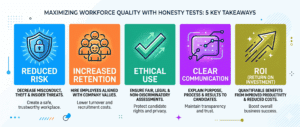
It’s energizing to know your hiring solutions will raise the bar and improve safety culture. When you combine honesty tests with interviews and cognitive ability test data, you get a sharper people pipeline and real return on investment.
Case studies show that pairing integrity assessments with focused safety initiatives can cut OSHA‑recordable incidents by more than 30% while stabilizing frontline turnover. Pre Employment Test Cuts Workers Comp Claims
Amy C. Edmondson’s research shows transparency and communication set the stage for positive applicant experiences. Explain each survey step and stress above board practices to gain trust. Candidates who understand can navigate background evaluation reviews with confidence. Download our checklist or book a demo to maximize your workforce quality and retention, ensuring your hiring process stands out in today’s war for talent.