Schedule a call!
Understanding how honesty tests reduce employee turnover is one of the most valuable insights an HR leader can have. Organizations that deploy structured pre-employment integrity assessments before hiring consistently report measurable reductions in turnover, workers’ compensation claims, absenteeism, and workplace safety incidents.
The research supports this directly. A meta-analysis of 104 studies on integrity test validity confirms corrected validity coefficients of .32 for counterproductive work behavior and .18 for job performance — robust predictive power that translates into measurably reduced hiring risk across US industries.
This guide covers what honesty tests are, how each format works, the specific workforce outcomes they improve, a 6-step implementation process aligned with US legal standards, and the most common pitfalls HR teams encounter when deploying them.
What Is a Pre-Employment Honesty Test?
A honesty test is a structured pre-employment assessment that identifies a candidate’s reliability, trustworthiness, and likelihood of engaging in counterproductive work behavior. The US Office of Personnel Management (OPM) formally recognizes these tools as valid instruments that predict theft, absenteeism, and overall job performance.
In practice, honesty tests are structured questionnaires — delivered digitally or on paper — that ask candidates to respond to scenarios and belief statements about workplace honesty, rule-following, and ethical decision-making.
They are not personality tests and they are not polygraph alternatives. They are validated, legally defensible screening instruments that help HR professionals identify high-risk candidates before a costly hiring decision is made.
Sample questions include: “Have you ever witnessed a coworker steal? What was your response?” and “Do you believe breaking workplace rules is ever justifiable?” HR reviewers analyze response patterns for inconsistencies and behavioral risk indicators.
How Honesty Tests Reduce Employee Turnover and Workplace Risk
The data on how honesty tests reduce employee turnover is consistent across industries and role types. These outcomes compound over time when screening is applied systematically across high-risk positions.

Lower Turnover Rates
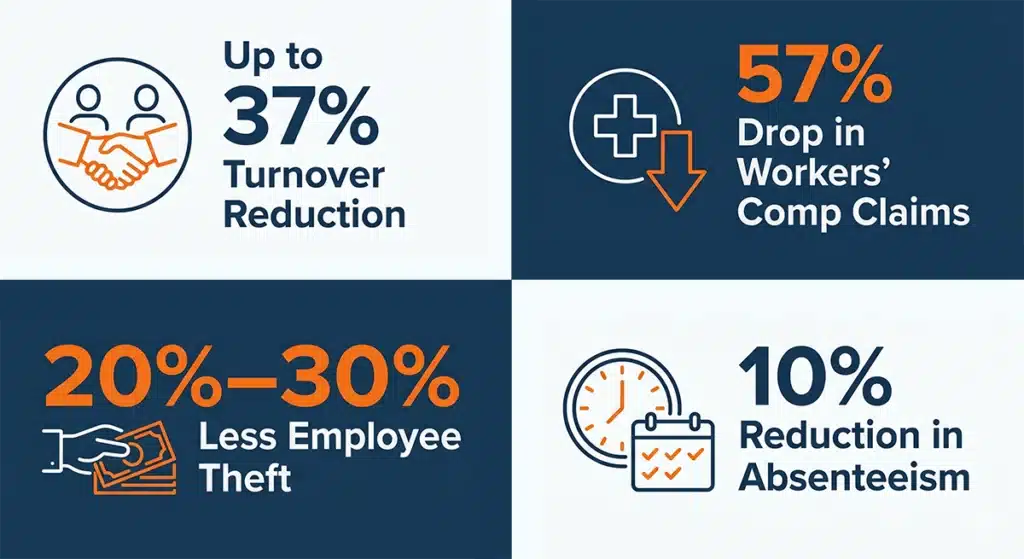
Organizations that implement structured integrity screening report turnover reductions of up to 37% in high-risk roles. The mechanism is direct: honesty tests identify candidates whose attitudes toward accountability and rule-following predict early departure behavior.
This catches the risk before onboarding investment is made. Companies deploying integrity assessments alongside structured interviews consistently see 15–25% declines in involuntary turnover within the first year.
For high-volume hiring environments in retail, logistics, and healthcare, this represents substantial annual savings in avoided replacement costs.
Fewer Workers’ Compensation Claims
One of the most underreported benefits of pre-employment honesty testing is its direct impact on workers’ compensation costs. Screening out the riskiest 8–10% of applicants reduces workers’ compensation claim frequency by double-digit percentages within the first year of implementation.
The connection is behavioral. Candidates who score poorly on integrity assessments are more likely to engage in unsafe workplace behaviors, file fraudulent claims, or fail to follow established safety protocols.
Removing these candidates from the hiring pipeline before they are hired directly reduces claim frequency and severity in safety-critical roles.

Reduced Absenteeism and Workplace Theft
Research confirms that integrity tests predict a broad range of counterproductive work behaviors — not just theft, but absenteeism, time fraud, and interpersonal misconduct.
Organizations that add honesty testing to their pre-employment screening process report a 10% reduction in productivity-related absenteeism and 20–30% declines in employee theft within the first year of consistent deployment.
For a national retailer with 500 frontline employees, a 20% reduction in theft and a 10% improvement in attendance translates to hundreds of thousands of dollars in annual savings — before factoring in avoided investigation and termination costs.
Improved Workplace Safety
Honesty testing and workplace safety are closely connected. Research on high-turnover environments shows that improving integrity screening alongside safety culture reduces OSHA-recordable incident rates by more than a third.
Candidates who score higher on pre-employment integrity assessments are more likely to follow established safety protocols, report hazards proactively, and hold peers accountable to workplace safety standards.
For safety-critical industries — construction, manufacturing, healthcare, and transportation — this outcome alone justifies the cost of implementing a structured honesty testing program.

Types of Honesty Tests and When to Use Each
According to SHRM pre-employment testing guidelines, selecting the right assessment format for the specific role and risk profile is essential for both predictive validity and legal defensibility. There is no single format that works for every position or organization.
| Test Type | How It Works | Best Use Cases | Strengths | Limitations |
| Overt Integrity Test | Direct questions about past theft, rule-breaking, and attitudes toward workplace misconduct | Retail, cash-handling, field service, entry-level roles | High face validity; easy to administer and score; clear red-flag identification | More susceptible to coached or socially desirable responses |
| Personality-Based Test | Indirect assessment of conscientiousness and ethical risk orientation through trait indicators | Leadership hiring, customer-facing and high-collaboration roles | Less susceptible to faking; broader behavioral coverage; stronger incremental validity | Lower transparency; scoring less intuitive for candidates |
| Situational Judgment Test (SJT) | Realistic workplace scenarios requiring candidates to describe or select their most likely response | Supervisory roles, high-responsibility positions, assessment centers | Reduces adverse impact; high realism; difficult to game | Higher development and scoring costs; requires expert rubric design |
Best practice for US organizations operating in high-risk industries is to combine overt and personality-based formats. Overt tests flag direct risk indicators early; personality-based tests surface subtler behavioral patterns that predict long-term reliability.
Digital delivery is now the standard for high-volume hiring environments. It improves scoring consistency, reduces administrative cost, and integrates directly with most applicant tracking systems without affecting predictive validity.
Legal Compliance: What HR Must Know Before Deploying Honesty Tests
Any pre-employment honesty test used in the United States must comply with EEOC employment testing guidance, which requires assessments to be job-related, consistent with business necessity, regularly reviewed for adverse impact, and fully documented for compliance audit readiness.
| Validity or Law | What It Means | HR Best Practice |
| Content Validity | The assessment covers traits and behaviors directly relevant to the role | Review question relevance against specific job requirements at least annually |
| Construct Validity | The test measures the integrity traits it claims to measure | Use only tools with published validation studies and third-party documentation |
| Criterion Validity | Test scores predict actual job performance and workplace conduct | Monitor post-hire performance data to validate predictive accuracy over time |
| EEOC Guidelines | Federal standard for nondiscriminatory pre-employment testing | Assess adverse impact by demographic group; document all screening rationale |
| Employee Polygraph Protection Act | Restricts polygraphs and physiological monitoring in US hiring | Use validated paper or digital honesty tests — never polygraph-based instruments |
| State Legislation | State laws govern data handling, disclosure, and candidate testing rights | Consult legal counsel for state-specific requirements before deployment |
Structured honesty tests that focus tightly on attitudes toward workplace misconduct consistently reduce adverse impact compared to broader personality assessments.
Regular validity reviews and complete documentation of scoring rationale protect the organization during regulatory audits and any candidate-initiated legal challenges.
How to Implement Honesty Tests in Your Hiring Process
Putting what you know about how honesty tests reduce employee turnover into practice requires a structured process aligned with US legal standards and integrated into your existing hiring workflow.
The following six steps reflect current best practice for US HR teams deploying integrity screening for the first time or updating an existing program.
- Select a validated assessment tool. Choose a honesty test with documented construct and criterion validity, a peer-reviewed validation study, and transparent scoring documentation. Confirm the vendor can provide adverse impact data and a technical manual on request.
- Define role-specific deployment criteria. Identify which positions genuinely benefit from honesty testing based on their risk profile — access to assets, cash handling, safety exposure, or supervisory responsibility over other employees.
- Integrate with your existing ATS workflow. Connect assessment delivery directly to your applicant tracking system. Consistent administration timing — pre-interview or post-conditional offer — is essential for legal defensibility.
- Communicate clearly with candidates. Inform applicants about the assessment before they begin: its purpose, the estimated completion time, and how results will be used in the hiring decision. Transparency reduces candidate anxiety and lowers the risk of legal challenges based on inadequate disclosure.
- Score, interpret, and document results. Apply research-based scoring rubrics and flag inconsistent response patterns. Document the basis for each hiring decision, including how assessment results were weighted relative to other evaluation inputs.
- Monitor outcomes and refine regularly. Track post-hire performance data, turnover rates, workers’ compensation claims, and absenteeism by cohort. Review for adverse impact by demographic group at least annually and update scoring thresholds accordingly.

Common Pitfalls to Avoid in Honesty Testing
Even well-designed honesty testing programs fail when implementation is inconsistent or tools are not properly maintained. These are the most common pitfalls in US organizations deploying integrity screening:
- Overly broad screening criteria. Questions that are too restrictive flag trustworthy candidates unnecessarily. Use role-specific, validated question sets rather than generic integrity surveys applied indiscriminately across all positions.
- Social desirability bias. Candidates who recognize the intent of direct honesty questions may adjust their responses to appear more ethical than their actual behavior suggests. Combining overt and personality-based formats reduces this risk significantly.
- Adverse impact from culturally insensitive question design. Items that reference culturally specific norms or situations can disproportionately screen out candidates from protected groups. Audit for subgroup differences at least quarterly.
- Using the assessment as a standalone decision. Honesty test scores are most predictive when combined with structured behavioral interviews, reference checks, and background verification. Relying on them as a sole disqualifier creates legal exposure and reduces hiring quality.
- Failing to communicate with candidates. Applicants who receive no explanation of the assessment’s purpose are more likely to disengage, respond defensively, or file complaints. Clear upfront communication is both legally prudent and operationally effective.
- Neglecting documentation. Failure to maintain a complete audit trail of assessment results, scoring rationale, and hiring decisions creates significant EEOC compliance exposure. Every screening decision must be recorded before moving a candidate forward or removing them from the process.
Frequently Asked Questions
How do honesty tests reduce employee turnover?
The evidence on how honesty tests reduce employee turnover points to one consistent mechanism: pre-hire screening identifies candidates with elevated risk profiles for early departure before onboarding investment is made. Meta-analytic research across more than 100 studies confirms that integrity tests predict counterproductive work behavior with a corrected validity of .32. Organizations report turnover reductions of 15–37% within the first year of implementation in high-risk roles.
How much does employee turnover cost US organizations?
SHRM estimates the total cost of replacing an employee ranges from 50% to 200% of annual salary, depending on the role, industry, and seniority level. For frontline and hourly positions, even a 15% reduction in turnover produces substantial annual savings when applied across a workforce of 100 or more employees.
Do honesty tests also reduce workers’ compensation claims?
Yes. Organizations that screen out the riskiest 8–10% of applicants using targeted honesty tests report workers’ compensation claim frequency dropping by double-digit percentages within the first year. Candidates who score poorly on integrity assessments are statistically more likely to engage in unsafe behaviors or file fraudulent claims.
Are pre-employment honesty tests legal in the United States?
Yes, when properly administered. Pre-employment honesty tests are recognized by both the OPM and the EEOC as legitimate screening tools when they are job-related, validated for the specific role, consistently administered, and regularly reviewed for adverse impact. Written and digital honesty assessments are not subject to the Employee Polygraph Protection Act restriction, which applies only to physiological monitoring instruments.
Which roles benefit most from honesty testing?
Roles with the highest return on investment from honesty testing include those involving cash handling, inventory management, access to sensitive data or client information, physical safety responsibility, and supervisory authority. Healthcare, retail, logistics, construction, and financial services organizations consistently report the strongest outcomes from systematic pre-employment integrity screening.
Start Reducing Turnover with IntegrityFirst Tests
IntegrityFirst Tests provides validated, US-compliant honesty assessment tools for HR teams that need measurable results and a legally defensible screening process. Our clients report consistent reductions in employee turnover, workers’ compensation claims, and absenteeism from the first year of implementation. Schedule a free demo with IntegrityFirst Tests and build a workforce you can rely on.