Schedule a call!
If you are considering honesty tests for HR hiring decisions, you are usually trying to reduce real operational risk without turning hiring into a black box. You want fewer theft and safety incidents and less time-and-attendance abuse, but you also need a selection system you can explain, apply consistently, and defend if results create adverse impact.
This strategic guide shows how integrity assessments work in practice as a pre-employment integrity test: one job-relevant input that improves hiring decisions, rather than a tool that “catches liars” or overrides structured interviews. You will learn how to separate integrity tests from prohibited lie-detector devices under EPPA, choose the right test type for your roles, evaluate the evidence behind vendor claims, set decision rules that do not backfire, and connect the investment to measurable ROI while protecting candidate experience.
The Decision Honesty Tests Actually Support
You are not using an honesty test to decide whether a person is “good” or “bad.” You are using it to make a hiring decision under uncertainty: whether this candidate is higher- or lower-risk for theft and timecard abuse. The test is a guardrail for risk and reliability, not a moral verdict.
That distinction changes how you judge the tool. If you expect it to catch lies the way a lie detector claims to, you will either over-trust a score or dismiss the whole category when a confident interviewer feels better about someone. The real question is whether the test adds incremental, job-relevant prediction beyond what you already collect. The U.S. Office of Personnel Management recognizes integrity and honesty tests as valid predictors of job performance and counterproductive behaviors such as theft and absenteeism, with a strong return on investment where those behaviors are disruptive. That is the lens to apply: incremental risk prediction, not a truth machine.
Use this as your decision standard:
- Does it predict job-relevant risk (theft, safety noncompliance, attendance) in a way that matters for your roles?
- Does it improve your selection system rather than override it, sitting as one input among the structured interview, checks, and job-fit data?
- Can you defend it under EEOC and UGESP expectations if results show adverse impact, remembering that the employer owns that responsibility even with vendor documentation?
Separate Honesty Tests From Lie Detectors
One careless label in a requisition or recruiter script can turn a legitimate assessment into an avoidable compliance problem. The Employee Polygraph Protection Act targets mechanical or electrical lie detection, such as polygraphs and similar devices, which most private employers generally cannot use for pre-employment screening. The U.S. Department of Labor’s Employee Polygraph Protection Act overview sets out those restrictions.
By contrast, most HR honesty tests are written or online integrity inventories, often grouped with personality-style measures, designed to predict the likelihood of counterproductive behaviors like theft and absenteeism. Treating these as lie detectors is how teams buy the wrong tool, message it poorly, and build a process they cannot defend. A practical step: ask your vendor and internal stakeholders to confirm in writing whether the assessment uses any physiological or device-based deception detection, then make sure candidate-facing materials describe it as an integrity or work-behavior assessment, not a test that detects lying.
Choose the Right Test Type
Not all honesty tests work the same way, and treating them as interchangeable is how integrity testing ends up with a tool your team cannot calibrate. The common families differ by what they ask candidates to reveal: direct admissions or indirect traits.
- Overt integrity tests ask explicit questions about attitudes toward theft and rule-bending. They are useful for a fast, face-valid risk screen in high-volume hiring, but they weaken when candidates learn the expected answers or when a team treats a low score as proof of dishonesty rather than a risk indicator.
- Personality-based tests infer risk from broader traits linked to reliability and rule-following. They weaken when you expect them to flag a specific behavior like time theft, or when you ignore that the same trait profile can play differently across jobs.
- Biodata approaches use structured history (attendance patterns, tenure, safety exposure). They weaken when you collect inconsistent data or let supervisors interpret it loosely. If two plants record an “attendance incident” differently, the results become hard to compare.
Picking the right family up front reduces misinterpretation and rework. For a side-by-side comparison, see our guide to overt vs. personality-based honesty tests.
What the Research Really Says
Integrity tests are more than soft signals, but they are not a lie detector either. Decades of research syntheses treat them as meaningful predictors of job performance and counterproductive work behavior across many jobs and settings, which is the basis for the OPM position cited above. That is enough signal to change hiring outcomes when you use it correctly, and enough to cause damage when you use it carelessly.
One caution matters for evaluation: “validated” is not universal. Observed relationships shift based on how validation was done, including whether studies use predictive versus concurrent designs and whether samples are applicants or current employees. If a vendor’s documentation leans heavily on incumbent (employee) data, you can see a different pattern once you deploy the test with applicants, who have stronger incentives to manage impressions. When you review evidence, ask what population and design the numbers come from, and plan to treat the score as incremental risk information rather than a stand-alone pass/fail verdict.
A Vendor Evaluation Framework
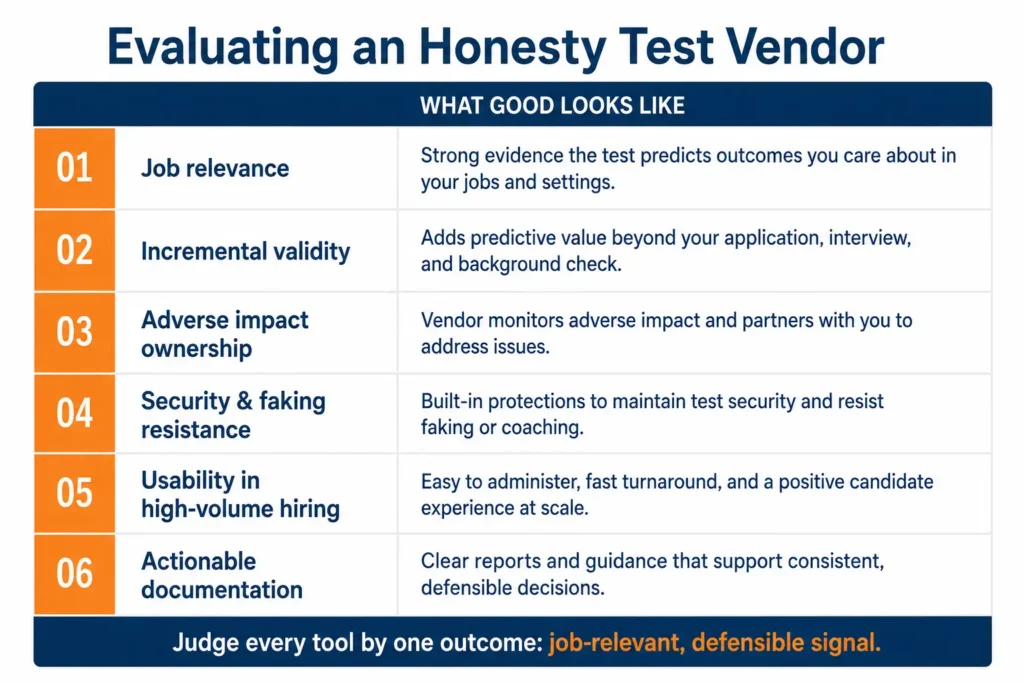
An honesty test is only as good as the decision it improves. If you evaluate vendors on whether their tool “detects liars,” you will buy something you cannot defend, cannot explain to hiring managers, and cannot reconcile when the score conflicts with a strong structured interview. Instead, judge every option by one outcome: does it add job-relevant, legally defensible signal for your roles? Use this rubric, for example when comparing tools for a high-volume warehouse associate role where safety, attendance, and shrink exposure all matter.
| Evaluation area | What to verify | What “good” looks like |
| Job relevance | Can the vendor map what the test measures to the specific risks in your roles (theft, safety, attendance)? | Clear linkage from constructs to your job analysis and role-specific risk exposure. |
| Incremental validity | Can they show the test adds value beyond what you already use (structured interview, experience screen, references)? | Evidence of added prediction, with outcomes tied to performance, incidents, or terminations in relevant populations. |
| Adverse impact (and your ownership) | What subgroup differences do they observe, and what monitoring do they support? | Transparent subgroup reporting and monitoring support; acknowledges employer responsibility under EEOC and UGESP. |
| Security and faking resistance | How do they handle coached applicants, retakes, item exposure, and inconsistency flags? | Controls that reduce coaching and item exposure; defined retake rules and interpretable response-quality flags. |
| Usability in high-volume hiring | How long is it, what is the completion rate, and how does it fit your ATS flow? | Low friction with minimal drop-off and straightforward ATS integration. |
| Documentation you can act on | Do you get scoring guidance, cut-score rationale, audit trails, and support for local validation? | Clear use guidance that supports consistent administration, defensible rules, and audit-ready records. |
Compliance and Defensibility in Practice
If you use an integrity test, treat it like any other selection procedure: you are accountable for job-relatedness, validity in use, and what happens to selection rates. The EEOC guidance on employment tests and selection procedures groups integrity tests with other employment tests, and UGESP expectations do not transfer to the vendor. If the test screens out a protected group at a higher rate, you need to show your use is justified for the job and administered consistently.
In practice, keep a tight paper trail tied to your job risks. For forklift operators or patient transporters, document the specific behaviors you are trying to reduce (safety violations, attendance failures, theft exposure) and how the assessment maps to them. Then track what you can audit: pass/fail criteria if any, completion rates, selection rates by demographic group, and downstream outcomes such as early terminations and safety incidents. Keep EPPA and broader selection-procedure rules as separate compliance tracks so you do not mislabel the tool. Our guide to honesty test legal compliance in hiring covers the full EEOC framework, adverse-impact monitoring, and documentation checklist.
Implementation That Will Not Backfire
When you set score rules before launch, the assessment becomes a consistent signal that speeds decisions instead of starting arguments. The fastest way to break the process is to run the assessment after two interviews, then let a single number overturn them, which increases legal exposure and creates a defensibility problem. Decide up front what the score is allowed to do, then lock the rules before you deploy:
- Where it sits: pre-interview (efficient and consistent) versus post-interview (higher drop-off cost and more conflict when scores disagree).
- How you use scores: a cutoff only with a clear job-related rationale, or bands (low/medium/high risk) that trigger different next steps.
- How it combines: never as an override; pair it with structured interview probes on policy adherence and accountability, and use background checks only for job-relevant, legally permitted verification.
- Retakes and accommodations: one retake under defined conditions (technical failure or documented disruption), plus a documented accommodation path so you do not improvise case by case.
An ROI Model You Can Defend
Model ROI by treating the honesty test as an incremental risk-reduction input, then pricing the outcomes you feel in operations. The stakes are real: in retail alone, the National Retail Federation reported that shrink accounted for $112.1 billion in losses in 2022, with internal and external theft making up roughly two-thirds of the total. If you cannot connect the score to fewer early quits, fewer incidents, or fewer claims, the purchase does not create operational value.

Use a simple equation: ROI = (value of avoided outcomes − total program cost) ÷ total program cost. Pull only what you can measure and defend:
- Program cost: (assessments completed × per-candidate fee) + admin time + integration or vendor support.
- Turnover value: 90- or 180-day turnover rate × replacement cost per hire (recruiting time, coverage, training hours).
- Safety value: recordable incidents and near-misses × average cost per event (medical, downtime, investigation time).
- Shrink and claims value: known loss or workers’ compensation claim frequency × average cost per case.
Baseline these metrics for one or two roles (forklift operators or cash-handling associates), then compare hires made with the test versus without it over the same window. Our guide to the ROI of honesty tests in hiring details the measurement model and documented outcomes.
Candidate Experience and Messaging
A strong applicant opens your invite link, reads language that sounds like a character interrogation, and closes the tab. Multiply that across a high-volume funnel and the cost shows up fast, even when the test itself is solid, and adverse-impact risk rises when good applicants drop out. If your email or recruiter script implies you are trying to catch liars, candidates either self-select out or switch into game-playing mode, which weakens the signal you are paying for.
Position it as a work-behavior and reliability assessment tied to real job demands, and keep the message consistent across the ATS invite, recruiter call, and on-screen instructions: what it is (a brief integrity or workstyle assessment), why you use it (consistent, job-relevant decisions in roles with safety, attendance, or loss exposure), and what candidates can expect (time to complete, whether it is timed, and basic privacy and record-retention language). Do not claim it detects lying, and do not share scoring rules or “how to pass” guidance.
Making the Hiring Decision
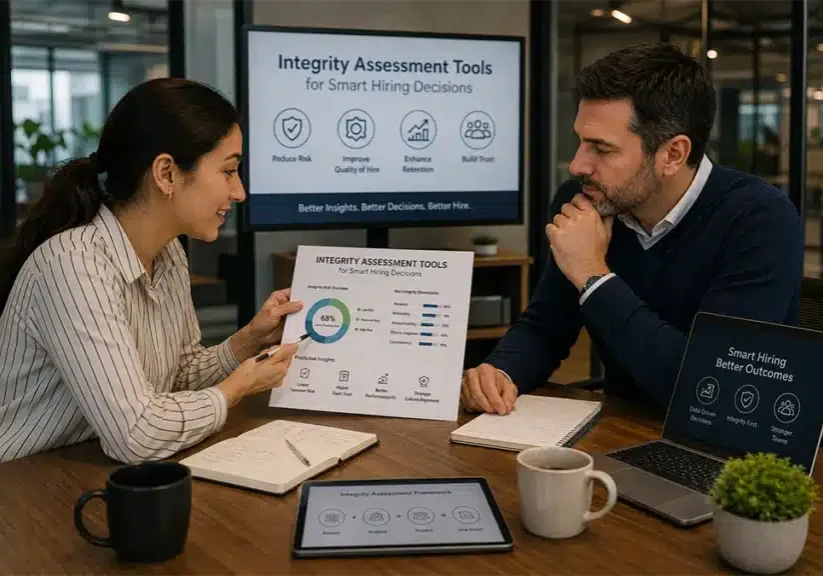
Use honesty tests for HR hiring decisions when you are hiring high-volume roles where a small shift in counterproductive behavior creates measurable operational improvement, such as cash-handling retail and warehouse roles with inventory access. Do not use them if you want a lie-catcher or a single-score veto. Proceed only if you can tie the assessment to job risks and lock decision rules before launch, and if you can monitor selection rates and outcomes in your ATS. Confirm the instrument is not device-based under EPPA, and message it as a work-behavior assessment. For the foundational program build, see our integrity assessments guide for smarter hiring.
Frequently Asked Questions
Does EPPA ban pre-employment honesty tests?
EPPA generally targets mechanical or electrical lie detection, such as polygraphs and similar devices, which most private employers cannot use for pre-employment screening. Standard written and online integrity inventories are a different category, but you still need to confirm exactly what the vendor administers and how it is described to candidates.
What if the test creates adverse impact?
If selection rates differ by protected group, you own the responsibility to show the assessment is job-related and valid in how you use it under UGESP, even with vendor documentation. In practice, you monitor selection rates and outcomes and stay ready to adjust cut scores, bands, or the assessment’s decision weight.
Are integrity tests legal in every state?
Rules can vary by state and by how the tool is positioned, what it measures, and what else you collect. Before rollout, have counsel review your specific vendor instrument, candidate communications, and data handling so you do not discover restrictions after embedding it in your ATS flow.
Should you allow retests?
Yes, but only under a written, narrow policy, such as a documented technical failure or verified disruption, so managers do not improvise retakes to get a better score. Unlimited retesting trains applicants to game the instrument and weakens your defensibility.
Can you use integrity-test results with background checks?
You can, but do not treat the score as a trigger for broad screening that is not job-relevant or legally permitted. Use it to focus structured interview follow-ups and role-specific verification, and keep the final decision anchored in documented job risks and consistent criteria.
Build Defensible Honesty Tests for HR Hiring Decisions
IntegrityFirst Tests helps US HR teams turn honesty tests for HR hiring decisions into a validated, defensible process: the right test type for each role, score bands tied to clear actions, compliance documentation, and outcome tracking leadership can act on. Schedule a demo with IntegrityFirst Tests to build the decision process behind better hires.