Schedule a call!
Insights about honesty and integrity assessments to identify workplace risk, strengthen hiring accuracy, and improve workforce trust.
Honesty and integrity assessments help employers identify risky behaviors, improve workforce reliability, and strengthen hiring decisions early. Most HR professionals know the sting of a great candidate walking away frustrated by an integrity assessment that just didn’t hit the mark. When vital roles go unfilled and workplace trust feels threadbare, it’s not just disappointing. It’s a jolt to your organization’s backbone. Employee dishonesty costs companies over $40 billion a year. Many recognize that poor pre-employment testing can fuel needless turnover or expose companies to legal headaches.
If you’ve ever felt that the system was put through the wringer with assessments that seemed better at turning away top talent than preventing workplace theft, you’re not alone. The wrong tools can be a red flag to the best candidates and do little to promote actual misconduct prevention.
This guide draws on proven findings from experts like Dr. Robert Hogan, turning back the curtain on what works. Expect actionable, compliance-ready advice for integrity assessment, with strategies to boost both candidate trust and predictive accuracy. Get ready to reimagine trustworthiness as a powerful lever in a holistic hiring process.
What Is Honesty and Integrity Assessments?
An honesty and integrity assessments is a pre-employment testing tool designed to evaluate a candidate’s ethical standards and potential for counterproductive behaviors. These assessments are widely used to ensure workplace safety and support risk reduction efforts throughout the hiring process.
There are two primary types: overt integrity tests and covert integrity tests. Overt assessments ask direct questions about attitudes toward integrity, workplace honesty and rule compliance attitude. Covert assessments take an indirect approach, evaluating related personality traits such as conscientiousness or hostility using Big Five personality theory as a foundation.
Honesty assessments may include:
- Direct theft inquiries: Questions about past workplace theft or views on stealing
- Behavioral questions: Scenarios to reveal how candidates might react to ethical dilemmas
- Rule compliance: Assessing overall attitude toward company policies and procedures
- Personality assessment: Using scales for aggression and broader workplace ethics
HR leaders familiar with the people ops mindset know these tests help distinguish true culture add candidates from those who simply fit the mold. When used properly, validated honesty tests improve candidate suitability and build a foundation for trustworthiness and objective hiring.
1. Why Use Honesty and Integrity Assessments?
Recent research shows that integrity tests provide a high return on investment in settings where counterproductive behaviors (such as theft of valuable property or sensitive information and absenteeism) are highly disruptive, and are frequently used as a screen‑out tool for large applicant pools in jobs requiring a high level of honesty and dependability. This is no trivial concern. Dishonest behavior bleeds $40 billion yearly from U.S. companies and can devastate teams in high-trust environments.
One national employer cut workers’ compensation claim costs by more than half within a year of tightening integrity screening at the pre‑hire stage. Read more in our article: The 4 Ingredient Recipe For Eliminating Worker Comp Claims
Adam Grant, whose work is respected across HR circles, often points to the predictive power of honesty assessments in alerting leaders to potential issues long before disciplinary problems arise. Organizations that deploy validated honesty tests see significant drops in shrink and fraud while their workforce quality and employee retention rates rise. Chronic absenteeism is also reduced with the use of validated honesty tests.
For instance, implementing repeated attitude checks in a mission-critical hire pipeline helps target trustworthiness, reducing legal risks related to negligent hiring or workplace culture erosion. If used precisely, these assessments are a risk management cornerstone. They are key for roles where candidate engagement helps move the needle on long-term performance and brand reputation.
2. Which Integrity Tests Exist? Overt vs. Covert Approaches
It surprises many HR leaders, but not all integrity assessments are created equal. Some aren’t designed to capture reliability or red flags directly. They infer it through deeper patterns. That’s why grasping the distinction between overt and covert tests is table stakes for better test accuracy and fair hiring.
Overt Integrity Tests: Direct, Transparent, and Targeted
Overt tests deal directly with questions about workplace conduct, rule compliance and attitudes toward theft. These assessments work well in environments with structured compliance needs, or where regulatory scrutiny demands clear data. For example, you might ask candidates about their feelings on taking longer breaks than allowed, revealing honest job motivation.
- Overt tests typically feature scenario-based questions about workplace absenteeism detection and ethical choices.
- Practical use: Regulated industries and large-scale employee honesty evaluations.
Covert Integrity Tests: Personality Traits and Inferred Risks
Covert assessments explore psychological drivers such as aggression scales and conscientiousness, using response patterns across unrelated items. These can hint at risks like harassment, even when no direct question is asked. For instance, responses to items about patience may flag a candidate reliability concern.
- Covert formats lower faking risk and require test validity.
- Use cases: Sensitive positions or when candidate privacy are priorities.
Hybrid and Emerging Formats: Combining Both Worlds
Hybrid approaches blend overt items and personality indicators for a fuller picture. This technique enables organizations to run the numbers on candidate engagement and capture nuanced candidate feedback.
- Hybrid tests also improve compliance with EEOC guidelines and support unbiased hiring.
- Practical tip: Use hybrid formats in innovative workplaces or culture-driven hiring.
3. Do Honesty Assessments Truly Predict Risk?
Recent science helps HR leaders move past gut instinct. An updated meta‑analysis of 104 studies found corrected validities of .32 for counterproductive work behavior, .18 for job performance (after illustrative range‑restriction corrections), .16 for training performance, and .09 for turnover, confirming that integrity tests meaningfully predict on‑the‑job risk and performance outcomes. These predictive numbers make integrity assessments table stakes for any company concerned about risk or workplace absenteeism.
Organizations that pair validated honesty tests with a structured integrity questionnaire report up to double‑digit reductions in avoidable turnover in frontline roles. Read more in our article: Integrity Screening Case Study
Oprah Winfrey is admired for her focus on workplace transparency and would recognize that test accuracy marks the difference between smart risk controls and a costly approach to hiring. However, which tests can you trust? Only validated and well-documented assessments make the grade for FCRA compliance and avoiding legal risk.
| Validation Study | What Was Tested | Predictive Accuracy | Key Risk Factors |
|---|---|---|---|
| Ones et al., 2012 | Counterproductive behaviors | 0.32 | Aggression scales, theft |
| Ones et al., 2012 | Job performance | 0.18 | Job fit, absenteeism |
| Ones et al., 2012 | Training performance | 0.16 | Candidate feedback |
| Ones et al., 2012 | Employee turnover | 0.09 | Workplace absenteeism |
Validation tables like this prove that background screening and aggression scales matter. Ignore false negatives at your peril, only robust validation gives you a defensible paper trail for regulatory scrutiny. Prioritize candidate communication and insist on test defensibility.
4. What Are Common Pain Points and Candidate Concerns?

It’s a gut punch to watch the best candidates lose faith after a poorly designed integrity test. Picture a top performer opting out of your process because they felt honest but got filtered by inconsistencies or repetitive confusing questions. When your talent pipeline hits a snag like this, your hiring brand can suffer. Turnover goes up, not down.
Many honest candidates fail assessments due to misunderstood or poorly framed questions, or because the tests put it through the wringer with excessive repetition. This builds frustration, feeding the perception that HR relies on “gaming” and box-ticking over meaningful dialogue. Test designers often overlook the impact on data privacy.
To fix these pitfalls, focus on updating assessments for clarity. Use only the minimum needed redundancy. Be transparent about the process, why you use integrity screens, and how EPPA regulations shape your approach.
You might build trust by sharing candidate feedback with leadership, benchmarking the assessment process, and opening candidate communication for flagging confusing questions. This proactive strategy turns pain points into growth opportunities. It helps HR promote a culture add approach.
5. Compliance Essentials: EEOC, FCRA, EPPA, GDPR

Compliance isn’t just a box-ticking exercise. It’s what keeps HR safe and your hiring process objective when legal questions arise. Responsible hiring leaders know that a defensible honesty or integrity assessment must put compliance front and center to build lasting trust and a real culture add. Not just culture fit.
- EEOC Guidelines: Uphold anti-discrimination rules and only use validated, non-biased assessments.
- FCRA Compliance: Inform candidates.
- EPPA Regulations: Never use polygraphs for most private sector roles.
- GDPR/Data Privacy: Limit and secure candidate data access.
- Candidate Consent: Obtain signed permission before any screening.
- Employment Discrimination Laws: All assessments should relate directly to job requirements.
- Documentation: Retain detailed records of tests and decisions.
Patrick Lencioni points out that strong compliance is foundational to organizational health. Touch base often with your legal counsel. Keep compliance standards evolving as part of every hiring decision.
6. How to Interpret Assessment Results Effectively
Imagine seeing clear actionable risk signals instead of red-tape confusion. Some integrity assessments flag inconsistent responses across multiple questions on the same issue and highlight specific risk‑factor items such as theft or workplace violence indicators. These assessments can also generate tailored interview questions so hiring managers can probe high‑risk areas and document candidates’ explanations before making final decisions. With the right approach, you gain a sharper lens for the next culture add, not just culture fit, streamlining decisions and building trust.
Red flags appear when answers contradict across repeated questions or when predictive scoring surfaces patterns linked to theft. Don’t rubber stamp risks. Instead, investigate flagged responses by asking evidence-based questions. This method ensures your process is thorough, not just a square peg, round hole fit.
For example, you could use dashboarding tools for reviewing assessment results and original interview notes side by side. This holistic hiring strategy keeps the focus on candidate transparency, encourages reasoned second looks, and enables managers to circle back confidently on both job skills and integrity issues. Aim to probe, record, and decide with clarity before offering the final seal of approval.
7. Prevent Bias, Faking, and Legal Risk
Imagine a strong candidate slipping away because your assessment flagged an error—maybe due to faking. Legal risk grows and you’re left circle back, trying to fix a flawed process in a rush. When a culture add, not just culture fit, is on the line, getting this right is table stakes for modern HR.
Step 1: Build and Validate Objective Assessment Tools
Rigorous development is essential. Partner with industrial-organizational (I/O) psychologists to validate each test item and regularly review for hidden bias. Use structured scoring rubrics. For instance, you could implement regular audits after seeing how a test flagged a disproportionate number of certain groups. Adjust the tool before broad rollout.
Step 2: Strengthen Candidate Instructions and Transparent Communication
Many incidents of faking or poor results result from confusing instructions. Use plain, direct language. Offer specific examples up front. Encourage candidates to ask questions if they feel uncertain about any assessment component. This reduces honest errors, giving everyone an even playing field.
Step 3: Monitor and Review Outcomes for Bias or Manipulation
Post-hire analysis by your people ops team is critical. Review results compared to job performance. For example, if candidates flagged for risk turn into strong contributors, promptly recalibrate your first-pass filter. Use your HRIS system to track and proactively minimize legal risk.
Streamline Hiring With Validated Honesty Assessments
Reduce turnover and claims. Discover how IntegrityFirst’s validated and easy-to-use assessments streamline hiring for high-trust and high-performance teams. Request your demo today.
8. Enhance Candidate Communication and Experience
It’s powerful to see candidate trust grow when HR focuses on transparent communication and genuinely values each interaction. Like comfortable flats at a long hiring event, the right tone and touch can improve the overall journey by keeping engagement high.
- Clearly communicate test purpose: Explain how honesty assessments fit into your selection process.
- Set expectations early: Share time estimates upfront. Candidates appreciate predictability.
- Offer immediate, supportive feedback: Whether advancing or rejected, provide actionable feedback tied to assessment results.
- Maintain an open line for questions: Promptly respond to candidate queries.
- Personalize rejection messages: Go beyond canned responses. Reference specific assessment experiences.
- Promote second-chance opportunities: Let rejected candidates know how they can become eligible for future roles or improve on certain dimensions.
- Encourage authentic engagement: Reiterate a culture add ethos and invite candidates to stay connected.
Every thoughtful touch base inspires ongoing goodwill, and strengthens the employer brand for high-volume and specialist roles alike.
9. When (and When Not) to Use Integrity Assessments
Integrity assessments shouldn’t be a one-size-fits-all solution.
Using a purpose‑built honesty test as an early filter has helped large employers shrink chronic absenteeism and related safety incidents while stabilizing headcount quality. Read more in our article: Honesty Test Guide Improve Hiring Cut Turnover Reduce Risk
Blindly requiring them for every role increases false negatives. This potentially excludes high performers. The smart use of assessments is table stakes for elevating risk management and supporting a genuine culture add, not just culture fit.
Simon Sinek often reminds HR leaders that clarity of intent is the key to trust. The decision to deploy these tools is best made with a matrix: mapping risk appetite and candidate volume. For example, using an assessment as a first-pass filter works for high-volume, entry roles. However, it could be off-putting or even counterproductive for innovative, hard-to-fill positions where out-of-the-box thinkers thrive.
| Scenario | When to Use | When NOT to Use | Best Next Step |
|---|---|---|---|
| Cash handling, sensitive data | Yes | Rarely | Use for compliance & trust roles |
| High-volume entry positions | Yes | Deploy as first-pass filter | |
| Creative or specialist positions | Yes | Prioritize interviews, behavioral tools | |
| Evidence of high false negatives | Yes | Calibrate or supplement with references | |
| Diversity/culture-building focus | Yes | Consider SJTs or culture add interviews |
The key: use the decision matrix as more than a checklist. Revisit it often as your team’s strategy evolves.
Elevate Workforce Quality With Honesty and Integrity Assessment (Conclusion/CTA)
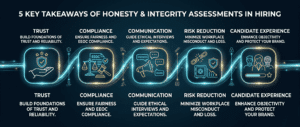
Superior hiring is never built on shortcuts or checkbox thinking. Consistent, science-driven honesty and integrity assessments serve as the real retention levers. They lower turnover and workplace risk by identifying dependable talent early. When combined with SHRM-compliant best practices, your organization gains a powerful standard for quality while safeguarding against legal pitfalls.
Avoid the temptation to simply lift another company’s process. Instead, prioritize clear testing and transparent candidate care at every stage. Even the best tool is only as effective as the people and strategies behind it.
Key Takeaways:
- Integrity assessments cut turnover and risk when validated and legally sound.
- Only transparent and well-documented processes boost workforce quality.
- Candidate-focused communication protects reputation and widens your culture add.
Tap into our expert team for detailed guides. These resources will give your organization the seal of approval on every hire. Ready to redefine quality and trust? Contact us today for a workforce that stays.