Schedule a call!
An integrity risk assessment for HR leaders treats workforce integrity as operational risk you can measure and manage, not as a vague values exercise. When you are asked to “assess integrity,” you are usually being asked to prevent losses you can name: workers’ compensation claims, injuries, shrink, and turnover. A generic test or a values campaign rarely moves those numbers. This guide shows how to define integrity-related risk scenarios by role and site, apply a simple five-part loop across pre-employment screening and ongoing monitoring, and record it all in a workforce integrity risk register you can govern and report on, with a logistics case study where claims dropped 32% and turnover fell 23%.
The stakes are concrete. According to OSHA, employers paid more than $1 billion per week in direct workers’ compensation costs for disabling workplace injuries. That is the category of loss an integrity risk program is built to reduce, which is why HR leaders increasingly treat integrity as an operational control rather than a culture slogan.
This guide is part of our broader hub on integrity risk assessment for HR, which connects risk identification, strategy, program building, and tooling.

What Integrity Risk Assessment Means in HR
An integrity risk assessment in HR identifies, quantifies, and controls workforce behaviors that create operational loss, then tracks whether the controls actually reduce incidents over time. In practice, you map integrity behaviors across the employee lifecycle and tie them to outcomes you already pay for, such as workers’ compensation claims and safety incidents. Those outcomes are large: the National Retail Federation reported that shrink reached $112.1 billion in 2022, with internal and external theft accounting for nearly two-thirds of it, and theft is only one of the behaviors a risk assessment targets.
If you find yourself drifting into broad “enterprise risk” language, pull it back to a single question: what employee actions create measurable loss or exposure, and what will you do differently in selection and management because of it? This is not about third-party questionnaires or abstract character labels. It is about keeping high-volume operations staffed with people who reliably follow rules and work safely. The specific behavior categories worth screening for, including fraud, theft, safety violations, and absenteeism, are mapped in our guide to integrity assessment for fraud prevention and risk reduction.
Why Ongoing Integrity Risk Assessment Matters Beyond Pre-Employment Screening
You hire solid people, and then a shift change, a new supervisor, or a high-pressure week rewires what gets tolerated. By the time the losses show up in claims, shrink, or terminations, the pattern is already entrenched.
Pre-employment screening gives you a point-in-time snapshot, but risk shows up in motion. Once shortcuts become “how we do it here,” you are reacting instead of controlling. The same person who looked fine on day one can change when the job, the team norms, or the level of accountability changes. A warehouse associate might start in pick-and-pack under tight supervision, then move to returns or cage access during peak season. The integrity exposure shifts from time-on-task and safety compliance to shrink. If you only assess at hire, you are effectively betting that integrity risk never emerges after onboarding, and operations rarely works that way.
The Five Components of an HR Integrity Risk Assessment Program
You do not need a new “integrity initiative.” You need a repeatable loop you can run the same way you run safety: define what risk looks like in your operation, put controls in the workflow, and measure whether the loss actually drops. A NIST-style risk cycle translates cleanly to workforce integrity when you treat integrity as operational exposure (injuries, claims, and shrink) rather than a character label. For the hands-on build inside the hiring funnel, see our guide on how to implement integrity assessments in hiring.
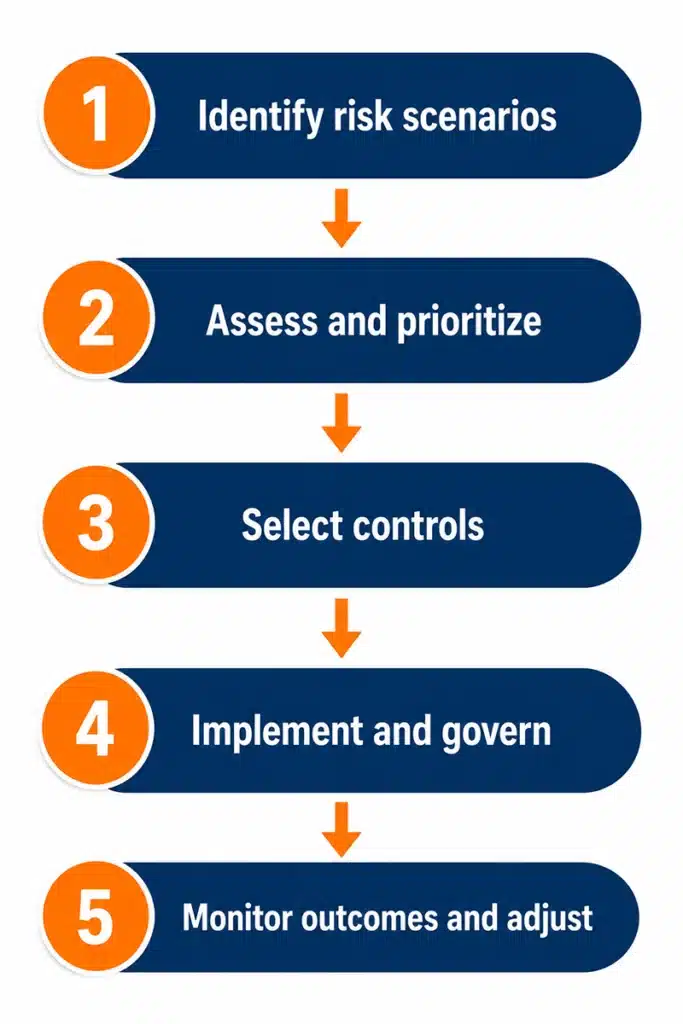
Here is the workforce integrity risk assessment process you can run end to end:
| Component | What you do | Example outputs / controls | What to track |
| 1. Identify risk scenarios | Define integrity-related behaviors that create measurable loss by role, site, and process | Role/site risk scenarios (buddy-punching, falsified scans, timecard edits, safety shortcuts, medication diversion) | Incident categories; where and when |
| 2. Assess and prioritize | Size impact and likelihood so you do not treat every role the same | Rough impact/likelihood scoring; prioritization by role and site | Estimated severity and frequency; top scenarios by exposure |
| 3. Select controls | Choose the minimum set of controls across hiring and employment that match the risk | Screening gates, onboarding emphasis, supervisor checks, access controls | Control coverage by scenario; control adherence |
| 4. Implement and govern | Assign owners, escalation paths, documentation, and a review cadence | Ownership model; documentation; review schedule | On-time reviews; exception handling; consistency across sites |
| 5. Monitor outcomes and adjust | Measure whether loss drops and change controls when the data disagrees | Leading-signal reviews; control tuning | Leading signals and lagging outcomes (claims, incidents, shrink, turnover) |
Pre-Employment Integrity Testing as the First Risk Gate
In high-volume hiring, pre-employment integrity testing functions as the first scalable gate, cutting predictable, high-frequency loss behaviors before you invest in interviews and onboarding. Treat it as a selection procedure that predicts job-relevant conduct, not as a character test. Federal guidance supports that framing: OPM describes integrity tests as valid predictors of job performance and of counterproductive behaviors such as absenteeism, illicit drug use, and theft, with the strongest return in settings where those behaviors are most disruptive. If your biggest costs come from preventable injuries or shrink in specific roles, you are screening for dependability and rule-following under pressure.
To keep it defensible, anchor the test to the same standard the EEOC applies to any employment test: it must be job-related and consistent with business necessity, validated for the role, and applied the same way for everyone in a job group. The risk is not that integrity tests are automatically safe; the risk is treating them as common sense and then being surprised by disparate impact or inconsistent use across sites. At minimum, pressure-test your design with three questions:
- What should it predict for this role? Name two or three behaviors tied to loss (for example, safety-rule compliance in manufacturing, or shrink and scan integrity in returns).
- How will you use the score? Make it one input into a structured process rather than an unexamined pass/fail label.
- What is your defensibility file? Document job relevance, administer it consistently, and monitor selection rates and outcomes so the process stays explainable when challenged.
Ongoing Monitoring: How to Identify Integrity Risk in Current Employees

Ongoing employee integrity risk monitoring works when you run it like safety: you watch for pattern breaks that predict loss, not for moments to catch individuals out. If you try to score everyone all the time, you create false alarms, slow supervisors down, and trigger the employee-relations pushback leaders rightly fear. The goal is narrower: spot emerging risk early enough to intervene before it becomes a claim, a termination, or a shrink event.
Start with a small set of operational signals you already generate, then review them on a cadence that matches the job’s risk. In a distribution center you might track repeated timecard edits and safety-rule violations; in healthcare, medication-handling discrepancies. You do not need perfect proof at this stage, only consistent triggers that tell you where to look. Make escalation explicit so monitoring does not become surveillance by rumor: a weekly supervisor review for frontline exceptions, a monthly HR and operations trend review by site or shift, and a clear handoff when thresholds are hit. If you cannot explain who owns the next step and what “actionable” means, you are collecting data you will not use.
Building and Maintaining a Workforce Integrity Risk Register
If risk lives in people’s heads, it disappears the moment a manager transfers or peak season hits, and you end up applying scattered, reactive policies while the same loss keeps moving around the building. A workforce integrity risk register is the operational home of your assessment and the map that keeps controls from drifting. If your register does not change a workflow, it is just documentation. A distribution center that logs “time theft” as a generic risk will not reduce it, but an entry that names buddy-punching on night-shift outbound can drive a concrete control (badge readers, supervisor review of edits) and an accountable cadence.
Keep it simple and tiered so you do not create a bottleneck where every role gets the same scrutiny. You might maintain separate lines for forklift operators (injury severity), returns associates (shrink exposure), and charge nurses (medication handling), because the controls and owners differ even when the label sounds similar. At minimum, make each entry answer:
- Risk scenario (behavior + where): What action creates loss, in which job family, site, or shift?
- Impact and likelihood (rough score): Enough to prioritize without false precision.
- Current controls: What gates already exist (screening, training, supervisor checks, access limits)?
- Control owner and review rhythm: Who updates it, and how often?
- Signals and outcomes: What you will watch and what should move (claims, incidents, shrink, turnover).
Measuring and Reporting Integrity Risk Outcomes
When your data connects a control change to fewer claims, fewer incidents, or lower shrink, integrity stops being a debate and becomes a lever. That is how you earn budget, alignment, and permission to standardize across sites. If you cannot show movement in the outcomes leadership pays for, you have activity without proof.
Pick two or three lagging outcomes per risk scenario (workers’ compensation claim frequency and cost, recordable injuries) and pair them with one or two leading signals you can influence weekly (timecard-edit rates, policy violations). Then report it as control, then signal, then outcome, and keep the format simple and consistent. For example, when you add an integrity test for forklift roles, you track selection rates and first-90-day safety violations, then tie those to claim rate by site and shift over time.
Case Study: Logistics Firm (Claims -32%, Turnover -23%)
The effect is documented beyond any single employer. A multi-industry study by researchers at the University of Florida and Pacific University found that integrity-screened employees filed workers’ compensation claims at a lower rate, and at a lower average cost per claim, than unscreened employees across four industries. That published finding is the mechanism a workforce integrity risk program is built to reproduce in your own operation.
A high-volume logistics employer treated integrity as operational exposure rather than a values campaign. The team focused its risk register on a few repeatable loss scenarios by role and shift, then used pre-employment integrity testing as an early gate for the highest-exposure roles (equipment operators and inventory-adjacent work), while setting ongoing triggers such as timecard-edit concentration and scan-exception spikes for targeted supervisor and HR review.
The results were measurable: workers’ compensation claims dropped 32% and turnover fell 23% (IntegrityFirst client data). The lesson is not that a test “fixed” the workforce. It is that the employer matched controls to where the loss actually occurred, owned the workflow, and tracked outcomes leadership already cared about.
Frequently Asked Questions
Are integrity tests legal, or do EPPA rules apply?
The Employee Polygraph Protection Act primarily restricts lie detector and polygraph examinations, not standard written pre-employment integrity questionnaires. The exposure appears when a vendor sells speech, video, or affect-based tools that function like modern lie detection, which can pull you into a very different legal and employee-relations profile.
Do integrity tests create disparate impact risk?
Yes, so treat them like any other selection procedure. You need a job-related rationale, and you should monitor selection rates by protected class and by location. Federal guidance groups integrity and personality tests together and points back to validation expectations, so do not rely on “common sense” defensibility.
Should you use integrity test results as pass/fail?
If you turn a score into an automatic rejection without a clear job-related link, consistent administration, and outcome monitoring, you are choosing simplicity over control. A more defensible program uses integrity as one structured data point, for example routing borderline results to a consistent review step, rather than a label that quietly varies by site.
What are the most common rollout pitfalls in high-volume operations?
Credibility erodes fast when supervisors can override results informally, or when different sites apply different cutoffs whenever they feel understaffed. You also create backlash when monitoring looks like blanket surveillance instead of a small set of clearly defined triggers tied to preventable loss.
What documentation makes the program defensible?
Keep a file that shows what behaviors you are trying to predict for each job group, how the tool is used consistently, and how you review adverse impact and real outcomes (claims, incidents, shrink, turnover). If you cannot explain the logic in plain language to an operations leader, you will not be able to defend it when it matters.
Turn Workforce Integrity Into a Measurable Control
An integrity risk assessment gives HR leaders a way to treat integrity as operational risk: identified by role, screened at hire, monitored over time, and reported in outcomes leadership already tracks. IntegrityFirst Tests provides validated integrity assessment tools built for United States HR teams that want to reduce workers’ compensation claims, lower turnover, and keep high-volume operations staffed with reliable people.
Want to see how it would work in your operation? Contact IntegrityFirst Tests to schedule a demo, and we will walk you through pre-employment screening, ongoing monitoring, and the outcome reporting your leadership already cares about.