Schedule a call!
Effective integrity assessment implementation starts with a decision about what you are actually trying to control. You do not implement an integrity assessment because you want another score in your ATS. You implement it because you need fewer workers’ compensation claims, less shrinkage, and a process you can defend when leadership or regulators ask: “Why this test, and why this decision?” Understanding how to implement integrity assessments in hiring means treating the assessment as an operational system—not a purchase.
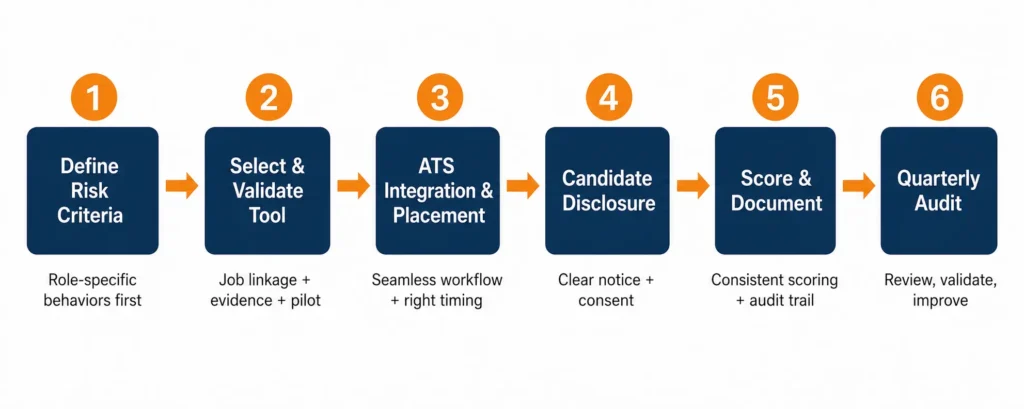
That kind of outcome does not come from selecting a validated pre-employment integrity test and assuming managers will apply it consistently across every site and shift. It comes from controlling the entire implementation: defining role-specific risk behaviors first, selecting and locally confirming an assessment that maps to those risks, and placing it intentionally in your hiring funnel. This guide walks HR professionals through an end-to-end framework for how to implement integrity assessments in hiring so your program improves measurable outcomes without becoming an inconsistent, high-liability gate.
Why Implementation Process Matters as Much as Tool Selection
Selecting a validated integrity assessment does not automatically make your hiring process more reliable or more defensible. If you deploy the same test at different funnel stages, allow supervisors to interpret scores inconsistently, or skip documentation, you have introduced inconsistency rather than objectivity.
Consider a scenario where two distribution centers operate on the same ATS: one site uses the assessment after the structured interview and treats it as a discussion prompt, while the other uses it as an automatic rejection screen during a high-volume night shift. The result is different pass rates, different quality-of-hire outcomes, and a difficult story to tell when safety incidents or employee grievances trigger regulatory scrutiny. The assessment did not change—the process did.
If you want integrity assessments to reduce shrinkage and workers’ compensation claims, treat implementation as a controlled system with defined role risk criteria and a consistent, intentional funnel placement. High-volume hourly hiring programs tend to generate the strongest measurable lift when the assessment is tied to a clear outcome story—shrinkage, workers’ compensation, and turnover—rather than being treated as a generic honesty score. For more on outcome-linked deployment, see our article on integrity testing for high-volume hiring.
Defining Role-Specific Risk Criteria Before Selecting a Tool

Starting with a generic goal such as “screen for honesty” produces a generic instrument and an undefined scoring standard. Integrity must mean risk-relevant behavior in a specific job, in a specific environment. A single definition of integrity does not apply equally to a forklift operator, a cashier, and a patient transporter.
Begin with your loss drivers and convert them into job-relevant risk criteria by role family. For example, if workers’ compensation claims are rising in a distribution center, the integrity risk is typically not dishonesty in the abstract—it is corner-cutting on PPE compliance or bypassing lockout-tagout procedures under time pressure.
|
Risk Behavior Criteria (by role family) |
Example Success Metrics |
|
Safety compliance and rule-following under pressure |
Recordable incident rate, near-miss reporting rate, safety write-ups per 100 FTE |
|
Time and attendance reliability |
30/60/90-day attendance points, no-call-no-show rate, schedule adherence |
|
Theft, shrinkage, and asset handling (cash, inventory, controlled items) |
Shrinkage %, internal loss incidents, exception reports tied to employee IDs |
|
Policy adherence and documentation quality (healthcare, food production) |
Audit defects, missing logs, rework rates, customer or QA complaints |
Before advancing to tool selection, verify the list with operations and safety leadership. The operational test is this: if you hired 20% more candidates who score well on these criteria, which specific metric should move within 90 days? If that question cannot be answered in plain language, the criteria are not yet specific enough to support a defensible selection process.
The strongest integrity programs start by mapping risk to measurable business outcomes—OSHA recordables, attendance points, and shrinkage rates—so ROI can be demonstrated within 60–90 days of implementation. For a detailed framework on connecting pre-hire screening to measurable risk outcomes, see how to measure employee risk before hiring.
Selecting and Validating Your Integrity Assessment Tool
A validated integrity assessment can still fail in your specific roles and environment if job linkage and consistent usage are not established locally. The tool becomes defensible only when you can demonstrate a clear chain of logic: the behaviors identified in the previous section map to what the assessment measures, and you use it consistently enough that scores carry the same meaning across sites and shifts.
Use a three-part framework to evaluate vendors: job linkage, published evidence, and local confirmation.
Job linkage: Ask the vendor to explain, in plain terms, what the instrument measures—for example, rule-following and dependability—and which of your 3–5 risk behaviors it is intended to predict. If the vendor cannot map their instrument to your specific risk criteria, the tool is not matched to your risk profile.
Published evidence: Require documentation that stands up in leadership and audit conversations. Ones, Viswesvaran, and Schmidt’s meta-analysis of 665 validity coefficients found a mean operational predictive validity of .41 for supervisory ratings of job performance, confirming that integrity test validities generalize across jobs, settings, and organizations. The OPM Assessment and Selection guidance corroborates this finding and describes integrity tests as valid predictors of both overall job performance and counterproductive behaviors including absenteeism and theft. If the vendor cannot produce comparable documentation for their specific tool—not just a generic norm table—the evidence standard is not met.
Local confirmation: Run a 60–90 day pilot in one or two representative locations before scaling. A staged rollout—starting with defining counterproductive behaviors, then piloting and training, then monitoring on-the-job outcomes rather than only pass rates—provides the local validation evidence your organization needs . Track whether assessment results correlate with your chosen outcomes—early turnover and safety write-ups, for example—before committing to full-scale deployment.
Integrating With Your ATS and Setting Pipeline Placement

Funnel placement determines both what the assessment captures and what you can credibly defend, so it must be a deliberate and documented choice. Placing the assessment too early amplifies candidate drop-off and increases score noise from rushed mobile completions. Placing it too late wastes interviewer time on candidates whose integrity risk profile should have been identified earlier.
Research on integrity testing shows that scores can be affected when candidates attempt to present themselves in an unrealistically positive light. This means placement and administration controls matter as much as instrument selection.
A defensible default for high-volume hourly roles is to trigger the assessment after confirming basic eligibility—availability, required certifications, work authorization—and before scheduling supervisor interview time. In a warehouse hiring process, for example, candidates might move from “Applied” to “Meets Minimums,” then receive the assessment link with a 24–48 hour completion window before the onsite interview is scheduled. This maintains throughput while reducing the opportunity for candidates to treat the assessment as a test they can prepare for over multiple sessions.
Configure the ATS to Enforce Consistency
Recruiter memory is not a reliable process control at high volume. Configure your ATS so that assessment invitations, reminders, and status updates trigger automatically, and so that exceptions follow a defined and documented path. At minimum, establish: a single consistent trigger stage, an expiration rule for incomplete assessments, and a clearly defined retest policy specifying when retesting is permitted and when it is not.
Automated ATS configuration reduces missed steps, inconsistent invitations, and manual overrides that create compliance and adverse impact risk in high-volume hiring. For guidance on ATS integration for assessment tools, see our article on talent assessment tools and ATS integration.
Building a Candidate Communication and Disclosure Process
Candidate communication is a compliance requirement, not a candidate experience preference. A vague introduction such as “it’s a personality test” increases assessment drop-off and creates grounds for candidate complaints. Overstating the assessment as a deterministic truth measure creates legal exposure. Candidates must receive a clear, standardized disclosure before completing the assessment.
A complete disclosure covers the following elements: what the assessment measures (for example, rule-following and dependability for safety-sensitive roles), how long it takes to complete, how results are used (one input alongside interviews and eligibility verification, not the sole decision factor), a plain-language privacy statement specifying who can view results and how long data is retained, and a clear accommodations path—how to request help, by when, and who responds.
Standardizing this disclosure across all recruiters and locations eliminates variation in how the assessment is introduced, which protects both candidates and the organization. In high-volume warehouse hiring, a one-paragraph disclosure paired with a named accommodations contact reduces candidate non-completion because candidates understand what they are agreeing to and what follows.
Scoring, Interpreting, and Documenting Every Hiring Decision
Consistency in scoring and documentation is where most high-volume integrity assessment programs fail. When individual supervisors determine what a “good” integrity score means at the point of a hiring decision without a defined policy, outcomes vary across sites and shifts in ways that are both operationally unreliable and legally indefensible.
Choose a decision model. Select either cut scores for pass/fail decisions or bands for tiered actions, and apply the same model across all locations. Cut scores simplify throughput but raise the stakes of where the threshold is set. Score bands often work better when you want the assessment to inform a structured interview rather than replace it. For example, a candidate who scores in a mid-band for a safety-sensitive warehouse role might trigger a standardized follow-up interview focused on rule-following under pressure, rather than an automatic rejection.
Lock down manager guidance and documentation. Define who can access results, what action each score band requires, and what constitutes an approved exception. In your ATS, require a structured decision rationale entry every time a candidate advances or is rejected—and make this field mandatory, not optional. If you cannot reconstruct why a specific hiring decision was made following a safety incident or a regulatory inquiry, the assessment was not implemented as a controlled selection process: it was used as an additional opinion without a documented basis.
Auditing for Adverse Impact on a Quarterly Cadence

A quarterly adverse impact audit converts your integrity assessment from a static screening step into a managed, defensible selection control. Without a scheduled audit, process drift goes undetected until a manager complaint, EEOC charge, or union grievance forces a reactive investigation.
Run the audit on the exact decision point where the assessment affects candidate movement—for example, automatic rejection at a cut score, or mandatory follow-up interview for a mid-band result. Pull applicant flow data by protected group for that stage, calculate selection rates, and apply the EEOC Uniform Guidelines on Employee Selection Procedures four-fifths (80%) rule as a practical flag: if one group’s selection rate is less than 80% of the highest-selecting group’s rate, treat it as a signal requiring investigation before continuing at the same threshold.
When a flag appears, investigate process factors before drawing conclusions about the instrument:
- Confirm process consistency: same pipeline placement, same retest rules, same accommodations path, and same recruiter actions across all locations and shifts
- Review how scores are applied: a cut score set too aggressively, score bands drifting into informal auto-rejections, or overrides applied unevenly across sites
- Re-verify job linkage: confirm that your risk criteria still reflect the actual job requirements and that your pilot or ongoing outcome data still shows job-relevant signal
A quarterly log of selection rates, four-fifths flags, and resulting process adjustments constitutes the documented evidence that your selection system is managed and defensible.
Implementation Case Study: Workers’ Compensation and Turnover Reduction
One mid-sized warehouse operator began with loss drivers rather than tool selection: a workers’ compensation rate of 12%, high 90-day voluntary quits, and preventable safety incidents linked to rule-bending during peak periods. HR and Safety translated those drivers into role-specific criteria—PPE compliance and time-and-attendance reliability—then selected an integrity assessment that mapped to those behaviors and ran a short pilot to confirm a relationship between assessment scores and early-tenure outcomes before scaling.
The assessment was integrated into the ATS after minimum-qualification screening and before supervisor interviews. Automated invitations and a fixed completion window were configured. Candidates received a standard disclosure explaining that the assessment measured job-relevant dependability and rule-following and served as one input in the hiring decision, not a deterministic outcome. Hiring managers used score bands to trigger consistent follow-up probes, and recruiters logged score band and job-linked rationale in the ATS for every decision.
With quarterly adverse impact checks using the four-fifths rule at the exact decision point, the organization maintained process control while tracking outcomes against baseline. Over 12 months, the company reported a reduction in workers’ compensation claim frequency from 12% to 8.5%, a reduction in turnover of 18 percentage points, and a 30% improvement in warehouse productivity (IntegrityFirst client data). What produced those results was not the assessment instrument alone—it was consistent placement, consistent interpretation, and consistent measurement against defined pre-hire risk criteria. For a detailed breakdown of the four primary integrity risk domains and how to measure reduction outcomes, see our integrity assessment for fraud prevention and risk reduction guide.
Frequently Asked Questions
Q: Where should the integrity assessment be placed in a high-volume hiring funnel?
Place the assessment after minimum-qualification verification and before supervisor interview time, so you protect throughput without using it as a default automatic rejection gate. If placement is moved earlier or later for operational reasons, document the rationale and maintain consistent placement across all sites and shifts.
Q: Should retesting be permitted?
Permit retesting only under conditions that can be applied consistently—for example, a documented technical failure during the original administration or an approved accommodation request. Allowing retesting on candidate request without defined criteria creates a process inconsistency that undermines scoring reliability and introduces adverse impact risk.
Q: How do you handle accommodation requests without disrupting hiring timelines?
Establish a single, documented path for accommodation requests with an internal SLA for response, assigned to a named contact. A repeatable, documented workflow protects the organization and ensures that accommodations are handled consistently rather than improvised case by case.
Q: When is it appropriate to change cut scores or band thresholds?
Change thresholds only on a scheduled review cadence tied to outcome data and adverse impact monitoring, then apply the change prospectively to new applicants only. Adjusting thresholds mid-cycle to meet a hiring volume target invalidates ongoing ROI measurement and creates a defensibility gap if the change is later scrutinized.
Q: How long should integrity assessment results and decision notes be retained?
Retain results and the hiring decision rationale in the same system—ideally your ATS—for a period aligned with your organization’s broader assessment data retention policy and applicable employment recordkeeping requirements. The operational standard is that you can reconstruct, at any point within the retention window, who reviewed the score, what action it triggered, and the job-relevant rationale for the hiring decision.
Next Steps: Implementing Integrity Assessments in Your Organization
Implementing integrity assessments effectively requires the same operational discipline as any other risk control: defined criteria, consistent execution, documented decisions, and scheduled outcome review. The framework above provides a complete implementation path—from risk criteria definition through quarterly adverse impact auditing—that produces both measurable results and a defensible process.
IntegrityFirst Tests works with HR leaders to implement validated, role-specific integrity assessment programs tailored to your organization’s risk profile and hiring environment. Our team provides assessment selection support, ATS integration guidance, adverse impact monitoring, and outcome tracking so your program delivers measurable risk reduction from implementation through ongoing operation.
Contact IntegrityFirst Tests to discuss how to implement integrity assessments in your hiring process.