Schedule a call!
Candidate selection is where hiring pressure becomes real.
The recruiter has a shortlist. The hiring manager wants interviews. The role has been open too long. A candidate looks good on paper, answers interview questions confidently, and seems ready to move forward.
That is also the point where weak selection criteria can create problems later.
Attendance issues, policy violations, reliability concerns, workplace conduct problems, theft risk, safety shortcuts, or early turnover often appear after the candidate has already been selected. By then, the organization has already spent recruiter time, manager time, onboarding resources, and sometimes client or team trust.
That is why honesty and integrity tests for candidate selection should not be treated as a side step in the process. Used correctly, they help HR bring a more consistent risk signal into the selection decision before the company commits more time to a candidate.
This article is not about adding more complexity. It is about giving HR a practical way to use honesty and integrity test results inside candidate selection without turning recruiters into assessment experts.
For a broader implementation guide, read How to Use Honesty and Integrity Tests in Hiring. This guide focuses specifically on how test results should support candidate selection decisions.
What Candidate Selection Requires From an Integrity Test
A candidate selection process needs more than a score.
Recruiters need to know what the result means. Hiring managers need to understand whether a candidate should move forward. HR needs documentation. Compliance needs consistency. Candidates need a process that is clear and reasonable.
A useful honesty and integrity test should help answer questions such as:
- Is this candidate aligned with the reliability expectations of the role?
- Are there risk signals that should be reviewed before interview scheduling?
- Does the result support moving the candidate forward?
- Should HR apply a secondary review process?
- Is the same standard being applied to candidates in similar roles?
- Can the decision be explained later if needed?
The U.S. Office of Personnel Management describes integrity and honesty tests as assessments designed to evaluate whether an applicant is likely to be honest, trustworthy, and dependable. OPM also connects low integrity with counterproductive workplace behaviors such as theft, absenteeism, disciplinary problems, sabotage, and violence. OPM integrity/honesty tests.
For candidate selection, that means the test should not sit outside the decision process. It should be connected to role criteria, result bands, review rules, and documented next steps.
Start With Role Risk, Not a Universal Cutoff
The biggest mistake HR teams make is applying the same selection standard to every role.
A single company-wide cutoff may be easy to manage, but it rarely reflects how risk works across jobs.
A warehouse associate, delivery driver, healthcare aide, cashier, hospitality worker, manufacturing operator, and field technician may all require reliability and integrity. But the type of risk, the level of exposure, and the business consequences are different.
A better selection model starts with role risk.
| Role factor | Why it matters for selection |
| Access to money, inventory, tools, or client property | Raises theft, misuse, or trust exposure |
| Safety-sensitive work | Increases importance of rule-following and judgment |
| Independent or unsupervised work | Requires stronger dependability and accountability |
| High turnover environment | Makes early reliability signals more valuable |
| Client-facing work | Adds reputational and service risk |
| Regulated or sensitive settings | Requires stronger documentation and consistency |
This does not mean HR should create a different standard for every job title. It means role families should be grouped thoughtfully.
For example, an employer may define different selection rules for frontline warehouse roles, customer-facing retail roles, healthcare support roles, transportation roles, and office-based professional roles.
For a broader definition of this category, connect this article with Honesty and Integrity Test Definition and Types for HR.
Build Selection Criteria Before Candidates Take the Test
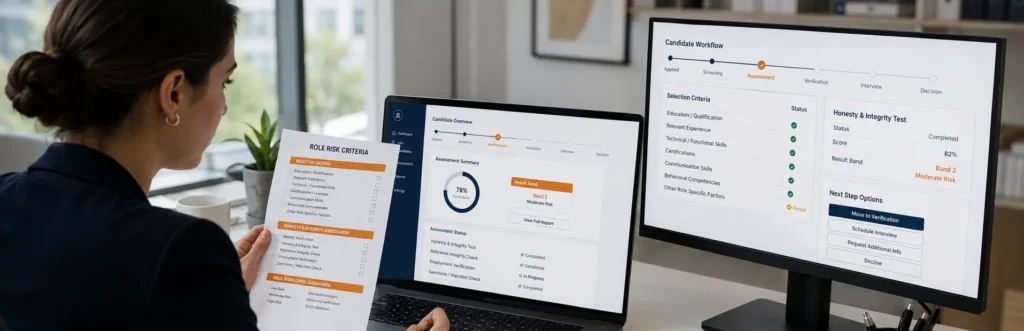
Honesty and integrity tests are most useful when HR defines the selection logic before results arrive.
If the recruiter waits to see the score and then decides what it means, the process becomes inconsistent. One recruiter may move a candidate forward. Another may stop the process. A manager may override the result because the candidate interviewed well.
Before launch, define:
| Selection element | What HR should decide |
| Role coverage | Which roles require the test |
| Test timing | When candidates take the test |
| Result bands | What Qualified, Review, and Not Qualified mean |
| Review ownership | Who handles borderline results |
| Override rules | When exceptions are allowed |
| Documentation | Where decisions and reasons are stored |
| Candidate communication | How the test is explained |
| Monitoring | How outcomes are reviewed over time |
This makes selection easier for recruiters because they are not being asked to invent judgment rules under pressure.
For a direct how-to workflow, use How to Use Honesty and Integrity Tests in Hiring.
Use Result Bands That Match Selection Decisions

A candidate selection process needs decision-ready outputs.
A dense report may be useful for a specialist, but it is often too much for a busy recruiter or hiring manager. A vague score is not enough either.
A practical model uses result bands tied to selection actions.
| Result band | Selection meaning | Next step |
| Qualified | Candidate meets the defined integrity standard for the role | Continue to recruiter or manager review |
| Review | Candidate has risk signals that require a structured second look | Apply secondary review criteria |
| Not qualified | Candidate does not meet the defined standard for the role | Follow approved disposition process |
| Incomplete | Candidate did not complete the test | Send reminder or close after deadline |
The “Review” category is where discipline matters most.
Without a review process, borderline results become inconsistent. Some recruiters move candidates forward because the role is urgent. Others stop candidates too quickly. Hiring managers may ask for exceptions without understanding the selection criteria.
A structured review path should define who reviews the result, what information is considered, how the decision is documented, and when the candidate may continue.
Keep the Test in the Right Part of the Funnel
For most roles, honesty and integrity testing should happen after minimum qualifications and before major interview time.
That timing protects both efficiency and fairness.
If the test happens too early, HR may assess candidates who do not meet basic requirements. If it happens too late, managers may already be invested in candidates they like.
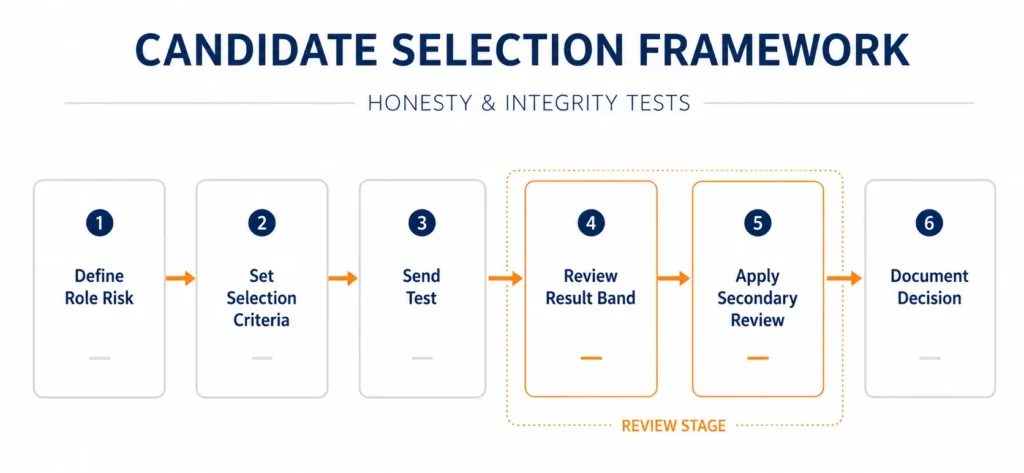
A clean selection workflow looks like this:
Application received
Minimum qualifications reviewed
Honesty and integrity test sent
Candidate completes the test
Result band appears in the hiring workflow
Qualified candidates continue
Review candidates receive structured review
Not qualified candidates are dispositioned under the approved process
Hiring managers interview a more consistent shortlist
For teams connecting selection tools to ATS stages, read How to Implement Talent Assessment Tools in ATS Workflows.
Use the Test With Interviews, Not Instead of Them
An honesty and integrity test should not be the only selection input.
It should sit alongside minimum qualifications, structured interviews, work history, references, role-specific screening, and manager evaluation.
The test helps HR decide what needs more attention before a candidate moves forward. For example, a review result may lead to a structured follow-up question during the recruiter screen or hiring manager interview.
Approved follow-up questions might include:
“Tell me about a time you had to follow a workplace rule you disagreed with.”
“Describe a situation where you made a mistake at work. What did you do next?”
“Have you ever seen a coworker ignore a policy or take a shortcut? How did you respond?”
These questions should be used consistently and only where appropriate. The goal is not to trap the candidate. The goal is to understand accountability, judgment, and alignment with the role.
For related trust-focused content, read Integrity and Honesty in Hiring to Assess Trust.
Keep Hiring Managers Focused on Approved Selection Signals
Hiring managers should not be left to interpret honesty and integrity test reports on their own.
That creates inconsistency. One manager may overreact to a single result. Another may ignore the assessment completely. A third may ask questions that were never approved by HR.
A better approach is to provide a short selection summary.
For example:
| Candidate status | Hiring manager guidance |
| Qualified | Candidate may proceed to interview |
| Review | HR is completing secondary review before next step |
| Not qualified | Candidate will not proceed under the approved process |
| Incomplete | Candidate has not completed the required selection step |
If managers need context, provide approved language tied to the role, not speculative interpretation.
The result should help the manager focus the interview. It should not become an informal character judgment.
Design the Process for Consistency and Fairness
Honesty and integrity tests can support better selection decisions, but only when HR uses them consistently.
The EEOC explains that employment tests and selection procedures can help employers evaluate applicants, but they can create legal issues if used in a discriminatory way or if they disproportionately exclude protected groups without proper justification. EEOC employment tests and selection procedures.
The Uniform Guidelines on Employee Selection Procedures apply to tests and other selection procedures used as the basis for employment decisions, including hiring, promotion, referral, retention, and other employment actions. Uniform Guidelines on Employee Selection Procedures.
For HR, the practical requirements are straightforward:
- Use job-related selection criteria.
- Apply the same process to similarly situated candidates.
- Define result bands before launch.
- Document review and override decisions.
- Train recruiters and managers.
- Monitor outcomes over time.
- Review adverse impact where appropriate.
This is not about making the process slow. It is about making the process explainable.
Candidate Communication Should Match the Selection Stage
Candidates should understand that the test is part of the selection process.
The message should be clear, direct, and professional.
Example:
“Please complete this short pre-employment assessment as the next step in your application. It helps us evaluate candidates consistently for this role and can be completed from any device.”
Avoid language that suggests the test is judging character in isolation.
Do not say:
“This test determines if you are honest.”
“We use this to catch risky candidates.”
“You must prove your integrity before moving forward.”
Candidate communication should reduce confusion, not create concern.
For candidate-facing explanation and test categories, use What Is an Honesty Integrity Test for HR.
What HR Should Measure After Using Tests in Selection
A candidate selection program should be measured by decision quality, not test volume.
Useful metrics include:
| Metric | Why it matters |
| Test completion rate | Shows whether candidates can complete the step easily |
| Result distribution | Shows how candidates are moving through selection bands |
| Review case rate | Reveals how often secondary review is needed |
| Review resolution time | Measures selection efficiency |
| Override frequency | Signals pressure, confusion, or role mismatch |
| Recruiter adoption | Shows whether the process is being used correctly |
| Hiring manager acceptance | Shows whether managers trust the shortlist |
| Time-to-interview | Measures whether selection is becoming more efficient |
| Early turnover | Helps evaluate post-hire quality |
| Absenteeism or incident trends | Useful for frontline and risk-sensitive roles |
| Adverse impact review | Supports fairness monitoring |
If the test creates too many review cases, the criteria may need adjustment. If completion rates are low, the candidate message or timing may be wrong. If hiring managers frequently override results, HR may need better training or clearer selection rules.
Measurement should help HR improve the process, not simply prove that the tool was used.
Common Selection Mistakes to Avoid
Using the Test as a Standalone Decision
Honesty and integrity tests should support candidate selection. They should not replace structured judgment.
Applying the Same Standard to Every Role
Different role families carry different risk levels. Selection standards should reflect the role.
Letting Managers Interpret Reports Freely
Managers need approved summaries and next steps, not uncontrolled interpretation.
Skipping the Review Path
A “Review” band without an owner becomes a bottleneck.
Testing Too Late
Late testing creates conflict when managers already want the candidate.
Failing to Document Overrides
Overrides may be reasonable, but undocumented exceptions weaken consistency.
Measuring Activity Instead of Outcomes
The number of tests sent is not the business result. Better selection outcomes are.
FAQ
What are honesty and integrity tests for candidate selection?
Honesty and integrity tests for candidate selection are structured pre-employment tools used to evaluate honesty, reliability, accountability, dependability, and workplace risk before a candidate moves deeper into the hiring process.
Should honesty and integrity tests be used before interviews?
For high-volume and risk-sensitive roles, they often work best after minimum qualification review and before major interview time is invested. This helps recruiters and hiring managers focus on candidates who meet the role’s integrity and reliability standards.
Can HR reject a candidate based on an integrity test?
HR should define decision rules before launch. Some results may support disposition, while others should trigger structured review. The process should be job-related, consistent, documented, and monitored for fairness.
How should hiring managers use honesty and integrity test results?
Hiring managers should use approved summaries and structured follow-up guidance. They should not independently interpret detailed reports or use results as informal character judgments.
What is the difference between hiring and candidate selection?
Hiring refers to the broader process of filling a role. Candidate selection is the decision process used to decide which qualified candidates move forward, receive interviews, or receive offers.
What metrics should HR track?
HR should track completion rate, result distribution, review rate, override frequency, recruiter adoption, time-to-interview, early turnover, absenteeism, incidents, and adverse impact review.
Final Takeaway
Candidate selection becomes stronger when HR defines the decision process before pressure enters the room.
Honesty and integrity tests can help, but only when they are tied to role risk, clear result bands, structured review rules, recruiter training, candidate communication, and post-launch measurement.
For employers that need a focused pre-interview screen, IntegrityFirst Tests helps evaluate honesty, accountability, reliability, and workforce risk before recruiters and managers invest more time. IntegrityFirst is designed for practical use in high-volume and risk-sensitive hiring workflows, including staffing, construction, logistics, manufacturing, healthcare support, retail, hospitality, and transportation.
For companies that want candidate selection connected to the broader hiring workflow, Discovered brings applicant tracking, workflows, assessments, candidate communication, scorecards, interviews, and automation into one platform.
IntegrityFirst gives HR the focused honesty and integrity signal.
Discovered gives HR the connected hiring system around it.
To reduce hiring risk with a focused integrity screen, schedule an IntegrityFirst demo.
To connect assessments with ATS workflows, scorecards, communication, interviews, and automation, book a Discovered demo.